
从汉服到旗袍,我在中国各朝代的衣柜里翻了个遍 | I Raided the Wardrobe of Every Chinese Dynasty and Here's What I Found
从汉服到旗袍,我在中国各朝代的衣柜里翻了个遍 | I Raided the Wardrobe of Every Chinese Dynasty and Here's What I Found
去年秋天我在西安大唐不夜城逛街,路上每三个女生就有一个穿着汉服——发髻、齐胸襦裙、披帛,妆容精致到可以直接走进壁画里。一个穿着唐制大袖衫的姑娘在喷泉前跳了一段古典舞,围观的人举着手机拍个不停。我旁边一个大叔小声嘀咕:"这要搁古代,她这身行头至少是个三品诰命。"
Last autumn I was strolling through Xi'an's Great Tang All Day Mall, and every third girl on the street was wearing Hanfu — hair swept into buns, chest-high ruqun skirts, draped silk shawls, makeup refined enough to step straight into a mural. One girl in a Tang-style broad-sleeved robe danced a classical piece by the fountain while a crowd filmed endlessly on their phones. An uncle next to me muttered: "Back in the day, an outfit like that would put her at least at third-rank court lady."
这让我开始好奇:中国几千年的朝代更替,衣服到底变了多少?答案是——变得你根本认不出是同一个文明。
That made me curious: across thousands of years of dynastic change, how much did Chinese clothing actually evolve? The answer is — so much that you wouldn't recognize it as the same civilization.
汉朝:一块布的哲学
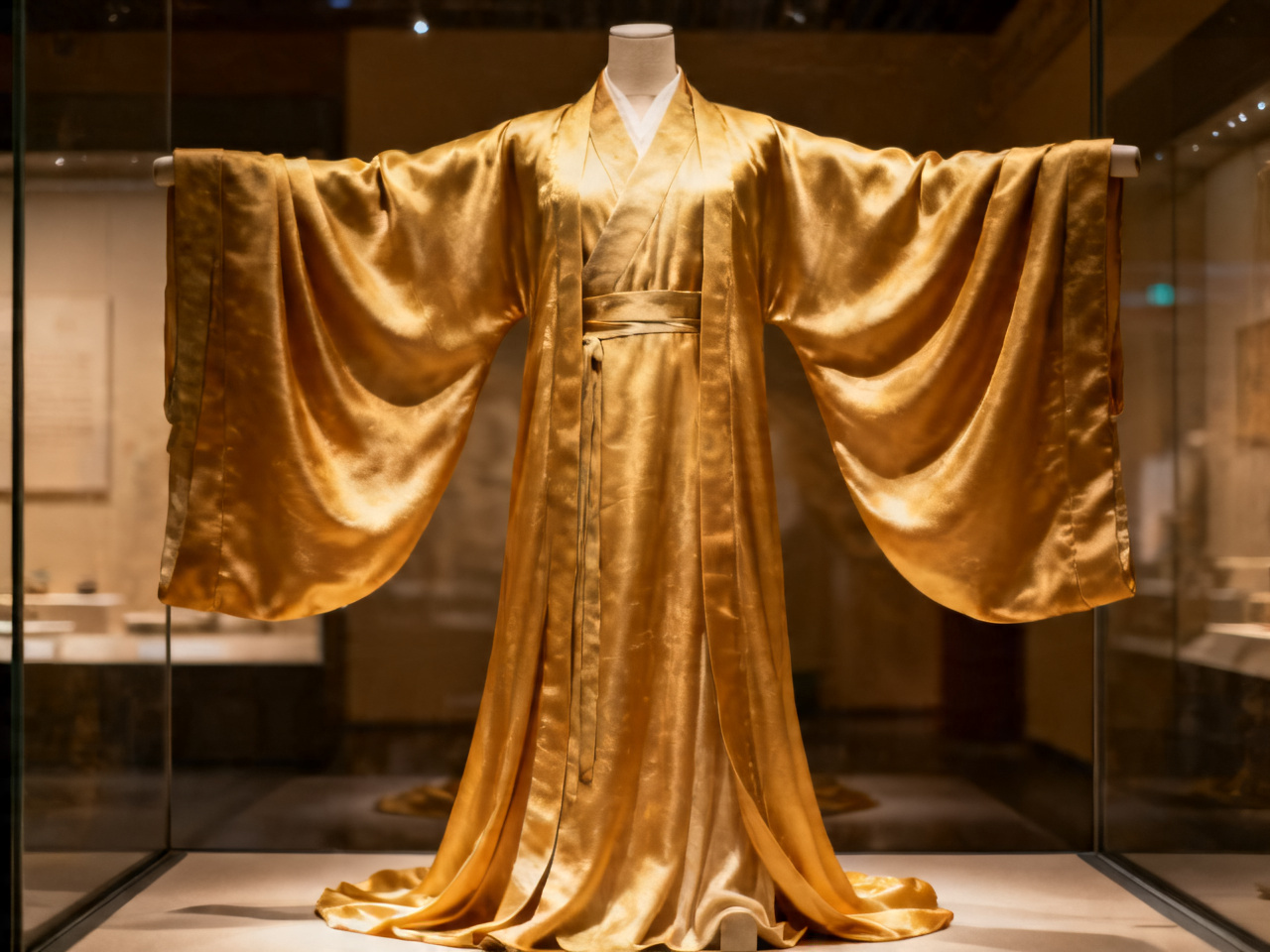
最纯正的"汉服"其实是汉代的衣服——曲裾深衣。这种衣服的核心理念让人震惊:用一块完整的布,不裁剪、不浪费,通过折叠和缠绕包裹全身。深衣的下摆绕体一圈半到两圈,行走时裙角自然摆动,既庄重又有韵律感。《礼记·深衣》里甚至规定了深衣的数学比例——十二幅布对应十二个月,不是随便裁的。
The most "authentic" Hanfu is actually Han dynasty clothing — the quju shenyi (curved-hem deep garment). The core concept is astonishing: using a single complete piece of cloth, uncut and waste-free, the body is wrapped entirely through folding and winding. The hem wraps around the body one-and-a-half to two times, and when walking, the skirt edge sways naturally — dignified yet rhythmic. The Book of Rites even specifies the mathematical proportions: twelve panels of cloth corresponding to twelve months. Nothing is arbitrary.
我在湖南省博物馆看过马王堆出土的那件素纱禅衣——西汉的,重量只有49克,不到一两。一件能罩住全身的袍子,比一颗鸡蛋还轻。两千年前的纺织技术能做到这种程度,现代工厂试过复制,第一次做出来的重量是80克,花了十三年才把重量降到49.5克。差那0.5克,至今没过关。
At the Hunan Provincial Museum, I saw the famous plain gauze robe unearthed from Mawangdui — Western Han dynasty, weighing only 49 grams, less than an ounce. A full-body garment lighter than an egg. The weaving technology of two thousand years ago achieved what modern factories initially couldn't replicate — their first attempt came out at 80 grams. It took thirteen years to bring it down to 49.5 grams. That last 0.5 gram? Still not matched.
唐朝:史上最大胆的穿衣自由
如果汉代服装是"克制的美",唐代就是"放飞的美"。唐朝女性的穿衣自由度可能是整个中国封建史上最高的——低胸齐胸裙、半透明纱衣、甚至女扮男装骑马都不稀奇。周昉画的《簪花仕女图》里,贵族女性穿着薄如蝉翼的纱衣,里面的手臂和肤色若隐若现。这种审美放在宋明两代简直不可想象。
If Han dynasty clothing was "restrained beauty," the Tang dynasty was "beauty unleashed." The sartorial freedom of Tang women was possibly the highest in all of Chinese feudal history — low-cut chest-high skirts, semi-transparent gauze garments, even women cross-dressing in men's clothing to ride horses were unremarkable. In Zhou Fang's painting "Court Ladies Adorning Their Hair with Flowers," noblewomen wear cicada-wing-thin gauze, arms and skin tone visible underneath. This aesthetic would be unthinkable in the Song or Ming dynasties.
唐朝的开放不只是审美上的。那个时代的长安有大量外国商人、僧侣、使节,胡服(中亚风格的翻领窄袖上衣)在长安非常流行。女性穿胡服、戴胡帽,骑马打马球——这种画面在敦煌壁画和唐三彩陶俑上随处可见。我有时候觉得,唐朝的长安可能比今天的某些城市还时尚。
The Tang dynasty's openness wasn't just aesthetic. Chang'an teemed with foreign merchants, monks, and envoys, and "hufu" (Central Asian-style lapel tunics with narrow sleeves) were wildly popular. Women wore hufu, donned Central Asian hats, rode horses, and played polo — scenes ubiquitous in Dunhuang murals and Tang tricolor pottery figurines. Sometimes I think Tang dynasty Chang'an might have been more fashionable than some cities today.
明朝:最后的汉族审美巅峰
明朝的服装是汉族传统服饰的最后高峰——因为接下来就是清朝了。明代最有辨识度的是飞鱼服和曳撒,前者是锦衣卫的标志性服装,后者是从蒙古服饰演变来的骑射便服。飞鱼服不是谁都能穿的,它是皇帝赐给有功之臣的赐服,等级仅次于蟒袍。
Ming dynasty clothing marked the final peak of Han Chinese traditional dress — because next came the Qing. The most recognizable Ming garments were the feiyu robe and yisan: the former was the iconic uniform of the Jinyiwei (Embroidered Uniform Guard), the latter a riding-convenient garment evolved from Mongol clothing. The feiyu robe couldn't be worn by just anyone — it was an imperial gift to meritorious officials, ranked just below the python robe.
明朝普通人的穿着也很讲究。朱元璋对服装等级有非常严格的规定:什么身份穿什么颜色、什么面料、什么纹样,全部明文规定。违反者最严重可以被治罪。不过民间还是有办法钻空子——比如规定平民不能穿绸缎,但没说不能穿"丝绵",于是商人们就用丝绵做了看起来跟绸缎差不多的衣服。上有政策,下有对策,从古到今都一样。
Even commoners dressed carefully in the Ming. Zhu Yuanzhang imposed extremely strict clothing regulations: what identity wore what color, what fabric, what pattern — all codified by law. Violations could be punished as crimes. But the common people always found loopholes — regulations said commoners couldn't wear silk, but didn't mention "silk-padded cotton," so merchants created silk-cotton garments that looked almost identical to silk. Where there's policy, there's a workaround — true then as now.
清朝旗袍:它不是你以为的那个旗袍
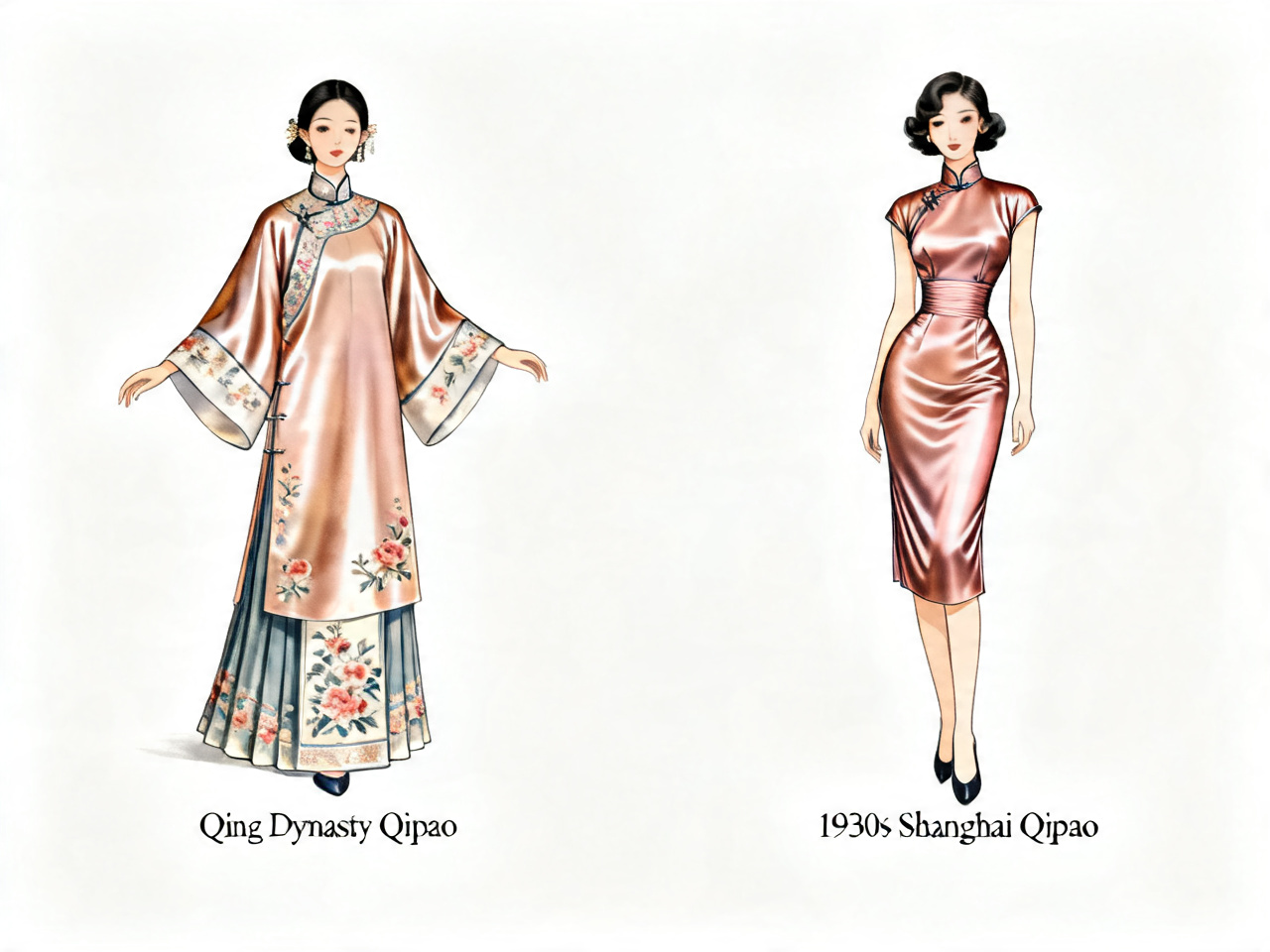
先澄清一个巨大的误会:今天我们说的"旗袍"(那种修身、高开叉、凸显身材的连衣裙)跟清朝的旗袍几乎没有关系。清朝旗袍是满族女性的日常服装——宽松、直筒、长及脚面、完全不显身材。今天那种性感的旗袍,其实是1920-30年代上海裁缝在西方立体剪裁影响下改良出来的。也就是说,"旗袍"这个名字来自满族,形态来自西方,在民国上海被重新发明。
Let me clear up a massive misconception first: today's "qipao" — that form-fitting, high-slit dress that accentuates the figure — has almost nothing to do with the Qing dynasty qipao. The Qing version was everyday Manchu women's clothing — loose, straight-cut, floor-length, revealing nothing of the body's shape. Today's glamorous qipao was actually reinvented by Shanghai tailors in the 1920s-30s under the influence of Western three-dimensional tailoring. In other words, the name "qipao" comes from Manchu culture, its form from Western fashion, and it was reborn in Republican-era Shanghai.
2025年的中国:汉服复兴不是cosplay
回到西安的那个秋天。我跟一个穿汉服的女生聊了几句,问她是不是在参加什么活动。她说不是,就是日常穿——上班穿现代装,下班换汉服逛街、喝咖啡、见朋友。她的原话是:"这又不是古装,这是我的民族服装。日本人穿和服不会有人问'你是不是在cosplay',为什么我穿汉服就要被问?"
Back to that autumn in Xi'an. I chatted with a girl in Hanfu and asked if she was attending some event. She said no — she just wears it as daily clothing. Modern clothes for work, Hanfu for evening strolls, coffee, meeting friends. Her exact words: "This isn't a costume. It's my ethnic clothing. Nobody asks a Japanese person wearing a kimono if they're cosplaying, so why should I get that question for wearing Hanfu?"
这个观点让我沉默了一会儿。中国是唯一一个主体民族没有明确"民族服装"的大国——因为清朝的剃发易服政策强制中断了汉族服饰传统。汉服复兴运动从2003年左右开始,到今天已经是一个年产值过百亿的产业。淘宝上搜"汉服"有超过200万个结果,从99块的入门款到几万块的手工织锦应有尽有。
That point silenced me for a moment. China is the only major country whose dominant ethnic group has no clearly defined "national costume" — because the Qing dynasty's hair-cutting and clothing-change edicts forcibly severed the Han clothing tradition. The Hanfu revival movement began around 2003 and has grown into an industry worth over 10 billion yuan annually. Searching "Hanfu" on Taobao yields over 2 million results, from 99-yuan starter pieces to hand-woven brocade costing tens of thousands.
从49克的素纱禅衣到淘宝上99块的汉服入门款,中国人穿衣服这件事的故事线,比大多数电视剧都精彩。每一次朝代更替都是一次审美革命,每一次外来文化冲击都催生新的融合。而现在,2025年的中国年轻人正在做一件有意思的事:他们不是在复古,而是在用古老的布料讲一个关于身份认同的新故事。
From a 49-gram gauze robe to a 99-yuan Hanfu starter kit on Taobao, the story of how Chinese people dress is more dramatic than most TV series. Every dynastic change was an aesthetic revolution; every wave of foreign cultural influence birthed new fusions. And now, in 2025, young Chinese are doing something fascinating: they're not going retro — they're using ancient fabrics to tell a new story about identity.
- 支付失败怎么办:来华游客应急指南 | Payment Failed? A Visitor's Emergency Guide
- 中国旅游网络与上网指南 | Internet & Connectivity Guide for China Travel
- 中国武术文化体验:太极拳少林功夫 | Chinese Martial Arts: Tai Chi & Shaolin Kung Fu
- 五月在宁波老外滩遇到雨,我一个人看着江面发亮,忽然觉得赶路也值得被原谅 | Rain at Ningbo's Old Bund in May Made Me Feel Even a Hurried Life Deserved Forgiveness
- 菜市场早餐和街边小吃的点单经验 | What I Learned Ordering Breakfast and Street Snacks Beside a Chinese Wet Market
- 中国高铁怎么买票?外国人全流程指南 | How to Buy China's High-Speed Rail Tickets: A Complete Guide for Foreigners
- 桂林那晚,老板娘一句“别搜了”比榜单更会点菜 | In Guilin, the Owner’s “Stop Searching” Guided Dinner Better Than Any List
- 零下二十多度的哈尔滨,先考验的不是勇气,是手机电量 | In Harbin Below Minus Twenty, the First Test Was Not Courage but Phone Battery
- 福州鱼丸店门口那张小桌,让我记住了慢慢吃 | A Small Table Outside a Fuzhou Fish Ball Shop Taught Me to Eat Slowly
- 青岛海岸三站法:栈桥、八大关和崂山怎么排更顺 | Qingdao in Three Stops: Pier, Badaguan, and Laoshan in Better Order
Comments (0)