
我在和田河边捡了一块石头,然后掉进了八千年的坑 | I Picked Up a Stone by the Hetian River and Fell Into an 8,000-Year Rabbit Hole
我在和田河边捡了一块石头,然后掉进了八千年的坑 | I Picked Up a Stone by the Hetian River and Fell Into an 8,000-Year Rabbit Hole
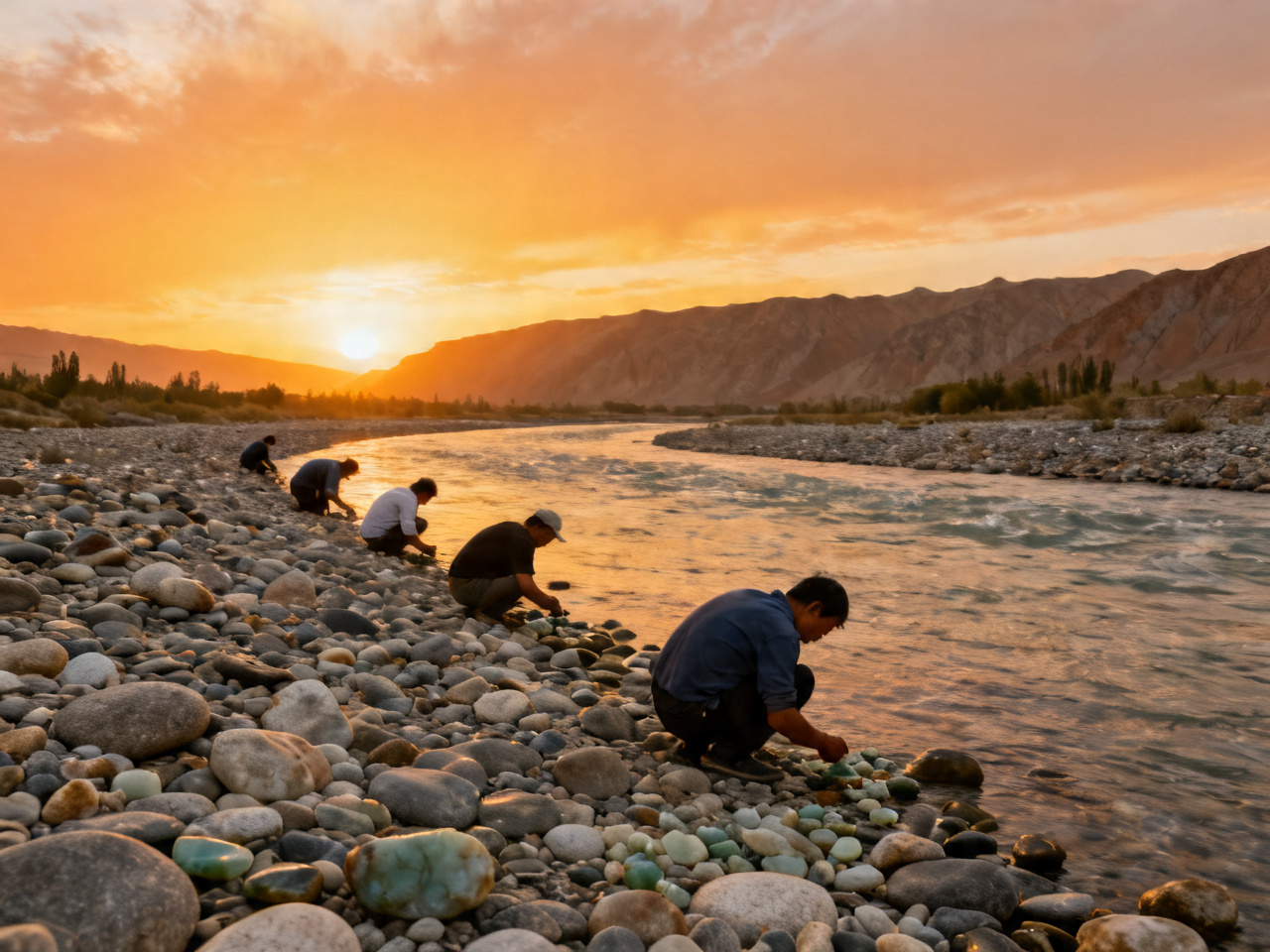
三年前我第一次去新疆和田,当地朋友带我去玉龙喀什河边"捡玉"。说是捡玉,其实就是在河滩上翻石头——几百号人弯着腰,像在找丢了的硬币。我翻了两个小时,捡起一块温润的白色小石头,朋友看了一眼说:"这就是籽料,虽然小,但是真的。"那一刻我才明白,为什么中国人跟玉的关系这么深——因为这东西就在你脚下,但你得用心才找得到。
Three years ago I visited Hetian in Xinjiang for the first time. A local friend took me to the Yurungkash River to "pick jade." In reality, it meant flipping rocks on a riverbank — hundreds of people hunched over like they were searching for dropped coins. After two hours, I picked up a small, warm white stone. My friend glanced at it and said, "That's seed jade. Small, but real." That's when it hit me why the Chinese have such a deep bond with jade — it's right under your feet, but you need patience and intention to find it.
八千年,比文字还老
中国人玩玉的历史,比甲骨文还早五千年。内蒙古兴隆洼遗址出土过距今八千年的玉玦——一种环形耳饰,死者耳边各放一只,是目前已知最早的玉器。到了五千年前的良渚文化,玉器已经不是装饰品了,而是权力和信仰的象征。良渚的玉琮——外方内圆的柱形器——至今没人能完全说清它的用途,但考古学家普遍认为它是沟通天地的礼器。一座良渚大墓里能出土几百件玉器,而普通墓葬一件都没有。玉,从一开始就不是人人能拥有的东西。
The Chinese love affair with jade predates oracle bone script by five thousand years. At the Xinglongwa site in Inner Mongolia, archaeologists unearthed jade jue — ring-shaped ear ornaments — dating back 8,000 years, placed beside the ears of the deceased. By the time of the Liangzhu culture 5,000 years ago, jade had graduated from ornament to symbol of power and faith. The Liangzhu jade cong — a cylindrical tube with a square exterior and round interior — still defies full explanation, though most archaeologists consider it a ritual vessel for communicating between heaven and earth. A single elite Liangzhu tomb could yield hundreds of jade pieces, while commoner graves contained none. From the very beginning, jade was never meant for everyone.
君子比德于玉——这句话到底什么意思?
孔子说过:"君子比德于玉焉。"很多人把这句翻译成"君子的品德像玉一样",但实际意思更具体。《礼记》里把玉的物理特性一一对应到品德上:温润是仁,缜密是智,不挠而折是义,垂之如坠是礼。也就是说,古人不是随便找了个比喻,而是认真地从玉的质地、光泽、声音、断口里提取出了一整套道德标准。我在北京故宫看过一块清代白玉如意,通体没有一丝杂色,灯光下透出淡淡的油脂光——那种温润感确实会让你联想到"温良恭俭让"这几个字。
Confucius said: "A gentleman compares his virtue to jade." Many translate this loosely as "a gentleman's character resembles jade," but the original meaning is far more specific. The Book of Rites maps jade's physical properties onto moral qualities one by one: warmth is benevolence, density is wisdom, breaking cleanly without bending is righteousness, hanging straight downward is propriety. The ancients weren't reaching for a casual metaphor — they seriously extracted an entire ethical framework from jade's texture, luster, sound, and fracture. I once saw a Qing dynasty white jade ruyi scepter at the Palace Museum in Beijing, perfectly uniform in color, glowing with a subtle oily sheen under the lights — that warmth genuinely evokes the five Confucian virtues.
和田玉和翡翠:两个完全不同的故事
很多外国朋友分不清和田玉和翡翠,觉得都是"Chinese jade"。其实它们连矿物成分都不一样——和田玉是透闪石(nephrite),翡翠是辉石类矿物(jadeite)。和田玉的历史至少六千年,是中国玉文化的正统主角;翡翠进入中国主流审美其实很晚,大约是清代中期以后的事,主产地还不在中国境内,而是缅甸。
Many foreign friends can't tell Hetian jade from jadeite, lumping both under "Chinese jade." They're not even the same mineral — Hetian jade is nephrite (tremolite), while jadeite is a pyroxene mineral. Hetian jade boasts at least 6,000 years of history as the orthodox protagonist of Chinese jade culture; jadeite entered mainstream Chinese aesthetics much later, roughly from the mid-Qing dynasty onward, and its primary source isn't even in China but in Myanmar.
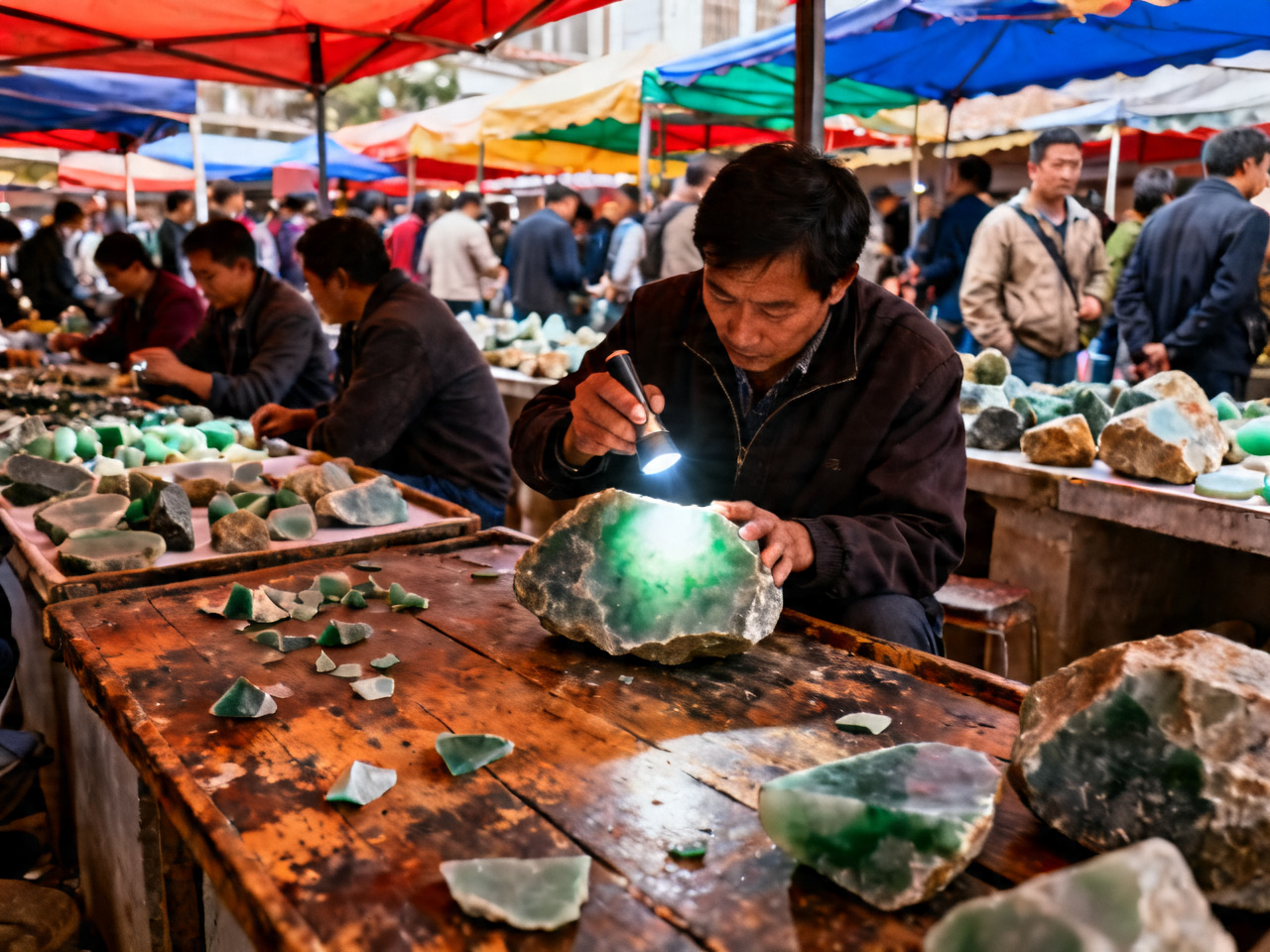
我在云南瑞丽的翡翠市场待过三天。那里的交易方式很有意思:买家用手电筒照石头的"窗口"(切开的小面),通过光线穿透的深度和颜色来判断内部品质,这叫"赌石"。一块不起眼的原石可能切出满绿的帝王绿,也可能里面全是棉絮。我亲眼看到一个买家花了十二万买了一块原石,当场切开——里面是灰白色的,基本报废。他脸色很平静,点了根烟说"赌嘛"。这大概就是翡翠市场最真实的样子。
I spent three days at the jadeite market in Ruili, Yunnan. The trading method is fascinating: buyers shine flashlights on a stone's "window" — a small cut face — judging internal quality by how deep and what color the light penetrates. This is called "gambling on stones." An unremarkable rough stone might reveal imperial green inside, or it might be full of cotton-like inclusions and essentially worthless. I watched a buyer spend 120,000 yuan on a rough stone that was cut open on the spot — grey-white inside, basically a total loss. His expression stayed calm. He lit a cigarette and said, "That's the gamble." That's probably the most honest snapshot of the jadeite market.
年轻人的玉,跟爷爷辈的完全不一样了
十年前,戴玉的基本是中年以上的男性,手里盘个把件,脖子上挂个观音或者貔貅。现在完全变了。我在北京三里屯看到过二十出头的女生戴着极简风格的和田玉项链,设计感很强,完全不像传统玉器。淘宝和小红书上,"新中式珠宝"是个大热搜词,和田玉被做成耳钉、戒指、手链,跟银和金搭配,价格从几百到几万不等。
A decade ago, jade was mostly worn by men over forty — spinning a hand piece, wearing a Guanyin or pixiu pendant around the neck. That's completely changed. I've seen girls barely in their twenties wearing minimalist Hetian jade necklaces in Beijing's Sanlitun — strong design sense, nothing like traditional jade pieces. On Taobao and Xiaohongshu, "new Chinese-style jewelry" is a trending search term, with Hetian jade fashioned into earrings, rings, and bracelets, paired with silver and gold, priced anywhere from a few hundred to tens of thousands of yuan.
更有意思的是玉器直播。我有次半夜刷抖音,看到一个主播在和田的加工作坊里,举着一块原石对着镜头喊:"家人们看这个油性!这个脂白!"弹幕里全是"拿下""多少钱""能刻貔貅吗"。据说和田当地有上千个这样的直播间,年销售额过百亿。一块八千年前的石头,现在是靠5G和算法在传播——我奶奶知道了大概会觉得世界很荒诞。
Even more interesting is jade live-streaming. One night I was scrolling Douyin and stumbled into a broadcast from a Hetian workshop — a host holding up a rough stone, shouting at the camera: "Family, look at this oiliness! This mutton-fat white!" The comments were flying: "I'll take it," "How much?" "Can you carve a pixiu?" Reportedly there are over a thousand such live-stream rooms in Hetian, with annual sales exceeding 10 billion yuan. A stone from 8,000 years ago, now propagated by 5G and algorithms — my grandmother would probably find the world absurd if she knew.
玉不琢,不成器。但更准确地说——玉不懂,不值钱。这东西的价值从来不只在石头本身,而在你看它的眼睛里。
"A jade uncut cannot be useful." But more accurately — jade misunderstood is jade undervalued. Its worth was never just in the stone itself, but in the eyes that behold it.
- 我在青岛学会把海边步行和补水当成一件事 | In Qingdao I Learned to Treat Waterfront Walking and Hydration as One Task
- 十一月最适合旅游的城市 | Best Chinese Cities to Visit in November
- 丝绸之路探险之旅 | The Silk Road Adventure
- 丽江古城深度游:纳西文化与雪山美景 | Lijiang Old Town: Naxi Culture & Snow Mountain Views
- 中国民间艺术:剪纸、皮影与年画 | Chinese Folk Art: Paper-Cutting, Shadow Puppets & New Year Prints
- 剪纸日记|在红纸与窗光之间学习耐心 | Paper-Cutting Diary | Learning Patience Between Red Paper and Window Light
- 在中国用手机支付:支付宝和微信支付外国人能用吗? | Mobile Payments in China: Can Foreigners Use Alipay and WeChat Pay?
- 我怎么把自己练成一个“半个中国人”:从排队、问路到饭桌节奏的融入笔记 | How I Trained Myself into a Half-Local in China: Notes on Queues, Directions, and Table Rhythm
- 广东广西10日海陆游 | 10-Day Guangdong-Guangxi Sea & Land Tour
- 北京故宫与胡同深度游 | Beijing: Forbidden City & Hutong Deep Dive
Comments (0)