
那些把中国拍得像特效片的博主,真正厉害的是懂得怎么给震撼留空拍 | The Creators Who Film China Like Special Effects Know How to Leave Space Between the Shocks
他们把中国拍成了“像假的地方”,但真正被记住的是路线顺序 | They Filmed China Like It Was Too Unreal to Be True, but What Stayed Memorable Was the Order of the Route
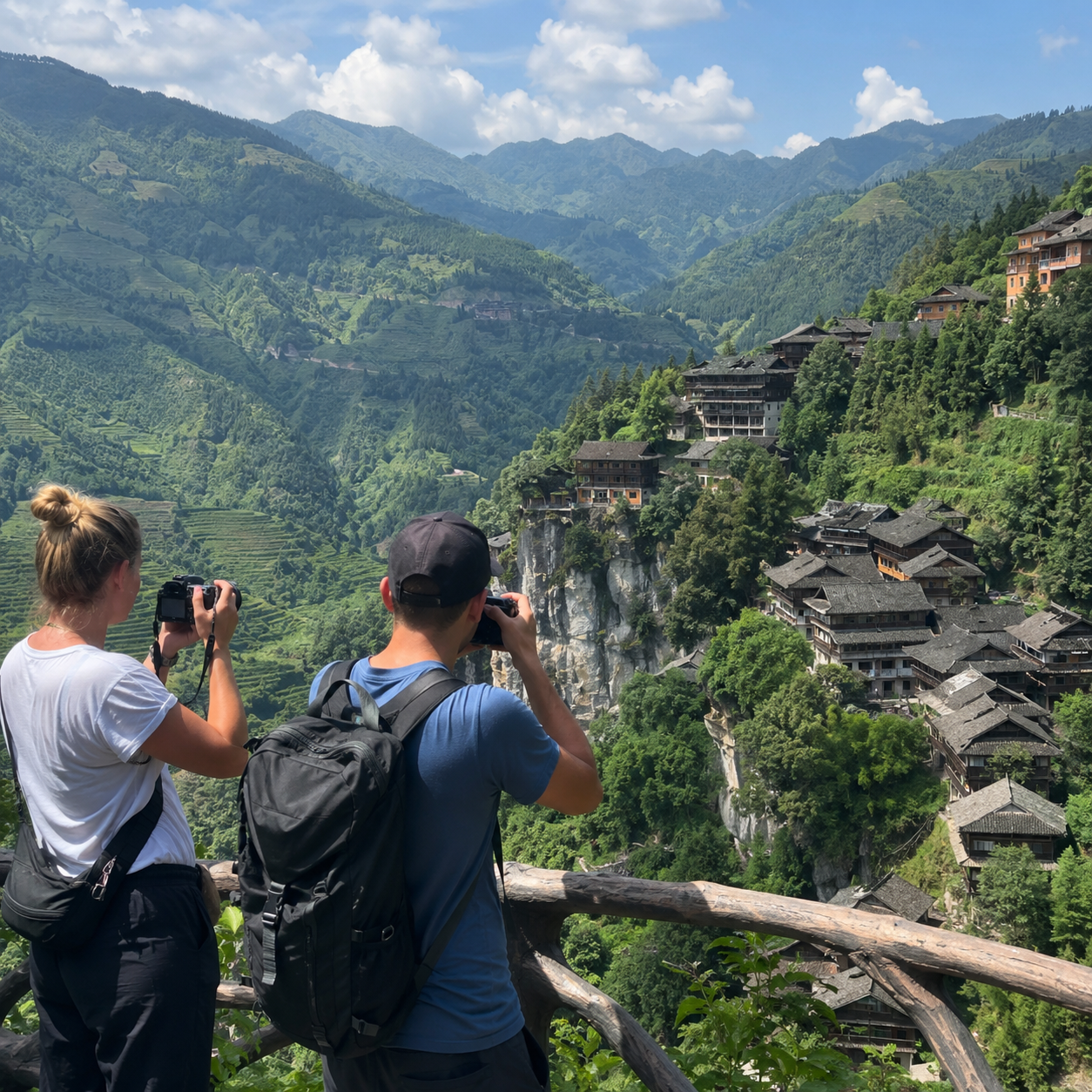
这几年,国外头部旅行频道里,Kara and Nate 这类以“世界奇景实测”著称的创作者,一旦把镜头转向中国,最容易被外界截取传播的,往往都是那些看起来像特效背景的画面:像童话一样的村落、悬空的山体、带强烈视觉刺激的观景点、以及一眼看上去“不像真的”的空间。但如果把他们公开发布的中国视频完整看成一条路线,而不是几段高能剪辑,真正值得研究的反而不是这些奇景本身,而是他们怎样把这些奇景串成一趟能不断升级、又不断换气的旅行。
In recent years, when major foreign travel channels like Kara and Nate—known for testing dramatic places around the world—turn their cameras toward China, the clips most often extracted and reshared are the scenes that look almost artificial: fairy-tale villages, suspended mountain landscapes, adrenaline-heavy viewpoints, and spaces that seem unreal at first glance. But if their public China video is read as a full route rather than a string of high-energy edits, what becomes worth studying is not the wonders alone. It is the way those wonders are arranged into a trip that keeps escalating while still knowing when to breathe.
TravelCN 如果只重复“他们说中国太震撼了”,价值其实不大。真正有价值的是把这种公开视频里的路线逻辑拆出来:为什么他们不是把所有最炸裂的场景挤在同一时段里;为什么某些地方更适合当成整条行程里的“爆点”,而另一些地方则更像给身体和情绪做缓冲的过渡带。对准备来中国的读者来说,这种拆解,远比单纯的惊叹更实用。
If TravelCN merely repeats that “they found China unbelievable,” the value remains limited. The real value lies in extracting route logic from that public material: why they did not compress every explosive scene into the same block of time, why some places work better as the route’s dramatic peaks, and why others function more like emotional and physical buffers. For readers preparing to come to China, that kind of breakdown is far more useful than simple amazement.

Kara and Nate 这类视频为什么适合拿来做中国路线分析 / Why a Kara and Nate Style Video Works So Well for China Route Analysis
Kara and Nate 的公开视频标题本身就已经说明了他们处理中国的方式:不是选一个城市深挖,而是把多个“看起来不真实”的地点,压进同一趟叙事旅程里。这样的剪法容易火,是因为观众会被“下一站还能更夸张吗”这件事勾着走;但它之所以对中国旅游分析有参考意义,是因为中国确实很适合这种层层推进的路线结构——从山、水、村落、空间体验到休息方式,每一站都可以把前一站的感受往上再抬一点。
The public title alone already shows how Kara and Nate tend to handle China: not by digging deeply into one city, but by compressing several places that look almost unreal into the same narrative journey. This structure goes viral because viewers keep asking whether the next stop can become even more surprising. Yet it becomes useful for China travel analysis precisely because China works extremely well with this layered escalation—from mountains and water to villages, spatial experiences, and even modes of rest, each stop can lift the emotional register slightly above the previous one.
这种路线设计的好处,是它不会把中国拍成一块平整的大拼盘。它让观众意识到,中国不是只有“名胜数量很多”,而是不同类型的景观之间确实存在叙事差异。有些地方负责给人第一下视觉冲击,有些地方负责把“这真存在吗”的疑问继续延长,还有些地方负责在情绪快绷满时给出一个意外的放松段。越是会剪旅程的博主,越容易把这一点拍出来。
The benefit of this route design is that it avoids flattening China into a broad tourist platter. It helps viewers realize that China is not merely a country with many attractions, but one where different categories of landscape carry different narrative functions. Some places deliver the first visual jolt. Some stretch the viewer’s disbelief even further. Others arrive precisely when the emotional line is close to overfilling and provide an unexpected release. The better a creator is at cutting journeys, the more clearly this pattern appears.

真正被他们拍活的,不只是奇景,而是“升级感” / What They Truly Bring to Life Is Not Just Wonder, but Escalation
对这类视频来说,最重要的不是单个地点够不够出名,而是顺序对不对。观众先看到一个已经足够夸张的地点,如果下一站只是同类型重复,注意力就会掉;但若下一站在材质、尺度、身体感受或空间方式上明显不同,观众就会继续跟着走下去。中国很适合这种结构,因为它能在一条线上迅速切换“山的垂直感”“水的流动感”“古村的静感”“观景设施的刺激感”。
For this kind of video, the crucial element is not fame but sequence. Once viewers have seen one place dramatic enough on its own, attention fades quickly if the next stop is merely the same spectacle in another outfit. But when the next stop changes the texture, scale, bodily sensation, or spatial logic, the audience keeps moving with the route. China suits this structure unusually well because a single line can switch rapidly between mountain verticality, moving water, village stillness, and the engineered thrill of scenic infrastructure.
站在第三方报道者的角度看,这一点比“他们夸了中国”更重要。因为它提示 TravelCN:真正适合写成攻略的,不是把这些地点一股脑列成清单,而是要告诉读者,什么应该放在第一个、什么应该放在第二个、什么地方适合当作一段路中的回气点。中国的强项,并不总是单点无敌,很多时候它强在“连起来之后更强”。
From a third-person reporting angle, this matters more than the fact that “they praised China.” It tells TravelCN something operational: the best way to convert these places into a guide is not to list them all in one breath, but to explain what belongs first, what belongs second, and what should serve as a recovery point in the line. China’s strength is not always absolute dominance at the single-site level. Very often, its strength becomes larger after the route is connected.
观众最容易忽略的一层,是“身体会不会被这条线拖垮” / The Layer Viewers Most Easily Miss Is Whether the Body Can Survive the Line

国外大博主的视频有一个天然优势,也有一个天然风险。优势是他们善于把旅程推成一连串高峰;风险是观众很容易误以为自己也该按同样强度去走。可中国这种“奇景密度”高的国家,一旦把所有爆点压得太紧,人的身体会先撑不住,判断力也会掉。站在站里内容运营的角度,笔者更愿意补的,正是这部分:哪些点适合一天只留一个;哪些点要给出半天缓冲;哪些体验型项目不能和长距离换乘排在同一个下午。
Major foreign creator videos come with one natural advantage and one natural risk. Their advantage is the ability to turn travel into a chain of peaks. Their risk is that viewers may assume they should reproduce that intensity exactly. But in a country like China, where wonder density can be unusually high, compressing every peak too tightly causes the body to fail first and judgment to weaken soon after. From a site-operations perspective, this is the layer the writer most wants to add back in: which sites deserve one full day by themselves, which require a half-day buffer, and which experience-heavy activities should never share an afternoon with long transfers.
所以,如果要把这类国外视频转写成 TravelCN 真正能用的文章,关键不是把“他们去了哪几个地方”重复一遍,而是把“他们这条线为什么成立”讲清楚。成立的原因往往包括:景观类型在变化、移动方式在变化、情绪节奏也在变化。这样的路线读起来才像报道,落地以后才像攻略。
So if a foreign creator video is to be turned into something genuinely useful for TravelCN, the key is not to repeat the list of places they visited. The key is to explain why the line itself works. That usually includes changing landscape types, changing movement styles, and changing emotional tempo. Only then does the article read like reporting and become a guide once it touches the ground.
这类中国奇景路线,最值得期待的下一步 / The Most Interesting Next Step for This Kind of China Wonder Route
笔者最期待的变化,并不是下一位国外大博主再找到一个“更像 AI 生成”的地方,而是他们开始把中国的奇景路线拍得更成熟——不仅有惊讶,也有停顿;不仅有远景,也有步行、休息、换乘和晚饭。因为真正能让观众从“看热闹”走到“想预订机票”,靠的不是一秒钟的震撼,而是整条路线看起来真的能走、也真的值得走。
What the writer most hopes to see next is not simply another foreign creator finding an even more unreal-looking place in China. It is a more mature handling of China wonder routes—one that includes pauses as well as surprise, walking as well as wide views, transfers and dinner as well as spectacle. What actually moves a viewer from passive fascination to wanting to book a trip is not one second of visual shock. It is the sense that the whole line looks walkable and worth walking.
如果这种公开内容继续朝这个方向发展,那么对 TravelCN 来说,价值会越来越大。因为站内就能顺势做两层内容:上层写“为什么这条国外博主路线会火”,下层写“如果普通旅行者来中国,怎样把这条线走得更稳”。前者负责把注意力接住,后者负责把注意力变成真正的旅行判断。
If public creator content continues to move in this direction, its value for TravelCN will only grow. The site can naturally build two levels of content on top of it: one that explains why a foreign creator’s China route went viral, and another that shows ordinary travelers how to walk the same logic more steadily. The first level catches attention. The second level converts that attention into real travel judgment.
公开素材来源 / Public Source Notes
- Kara and Nate, “We Visited Unbelievable Places in China (that actually exist)”
- 仅少量使用公开视频封面作报道说明,不做整段搬运。
Public source used:
- Kara and Nate, “We Visited Unbelievable Places in China (that actually exist)”
- Only a very limited amount of public cover imagery is used for explanatory reporting, not for wholesale reproduction.
- 中国街头小吃十选:从北到南,一路吃过去 | Ten Chinese Street Snacks: Eating Your Way from North to South
- 数字人民币来了,外国游客到底怎么用?| E-CNY Is Here — How Does It Actually Work for Foreign Visitors?
- 中国货币与支付指南 | China Currency and Payment Guide
- 在吐鲁番的热度里寻找阴影和葡萄 | Seeking Shade and Grapes in Turpan's Heat
- 云南雨季反向玩法:人少、景美、预算可控 | Yunnan in Rainy Season: Fewer Crowds, Better Value
- 热海蒸汽打湿车票后,我把腾冲行程缩短了 | Steam at Rehai Wet My Ticket and Made Me Shorten the Tengchong Plan
- 中国的户籍制度到底是怎么回事? | What Exactly Is China's Hukou System?
- 糖画摊前的几分钟,让我第一次觉得“甜”也可以被画出来 | At a Sugar Painting Stall, I Realized for the First Time That Sweetness Can Be Drawn
- 杭州西湖边那阵风,提醒我热门景区也要会躲人流 | A Breeze by West Lake Reminded Me How to Dodge Crowds at Famous Attractions
- 支付宝绑定国际银行卡实操 | Alipay Foreign Card Binding Walkthrough
Comments (0)