
站在深圳北站外第一个红灯前,我开始读懂这座城的速度 | At My First Red Light Outside Shenzhen North, I Began to Read the City’s Speed
第一次到深圳,我先学会观察路口和人流 | On My First Day in Shenzhen, I Learned to Read Crossroads and Crowds
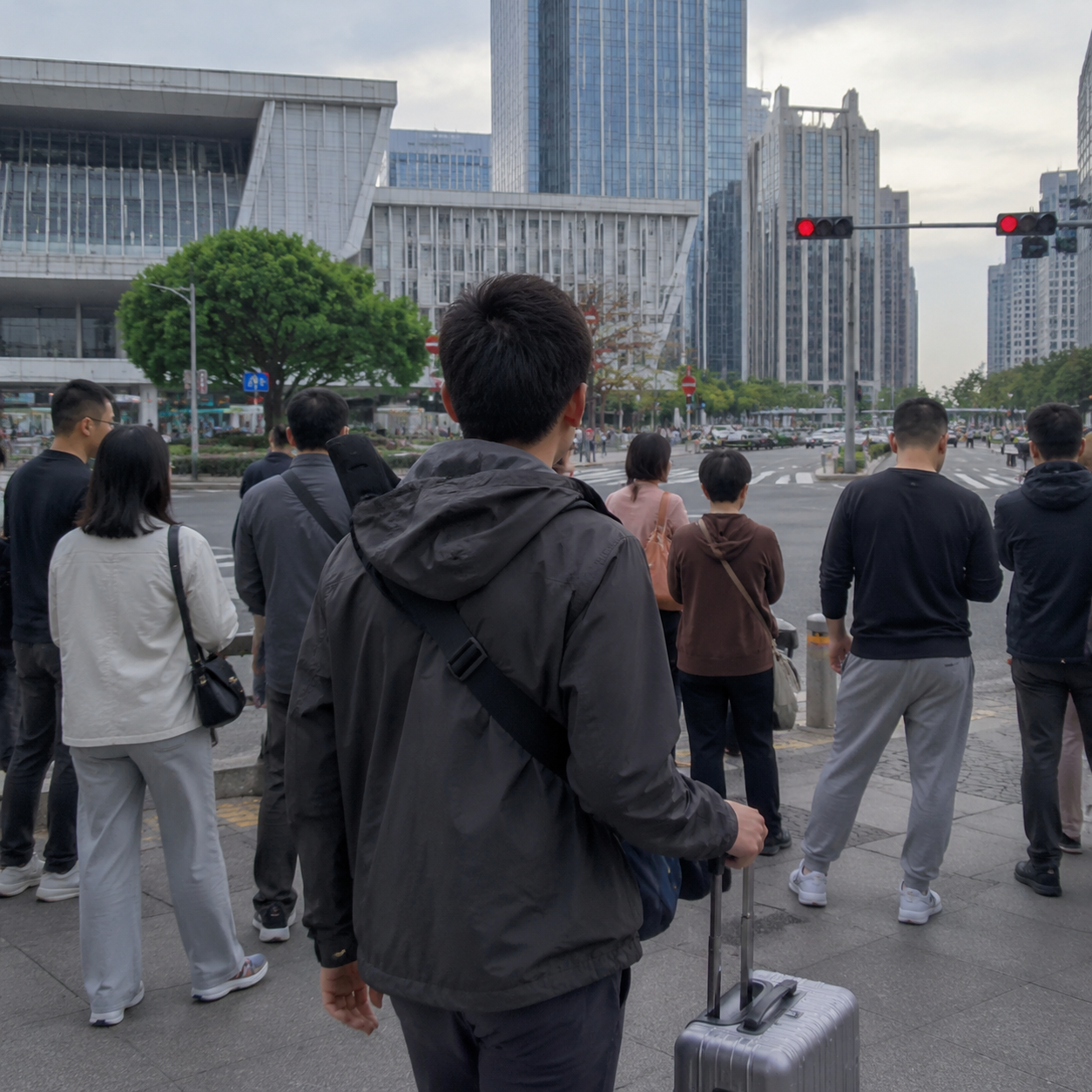
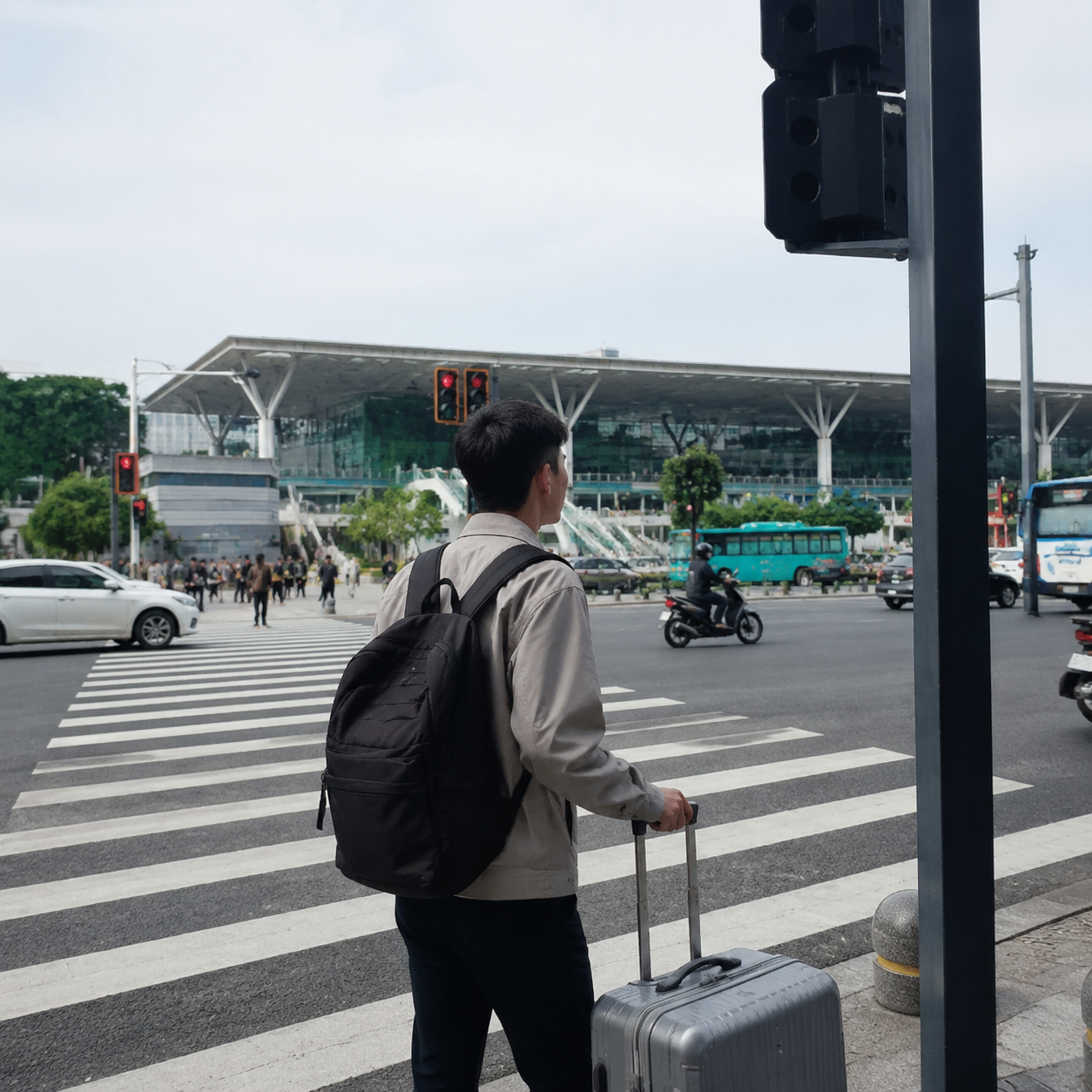
2024年10月18日早上八点二十,我拖着一只灰色行李箱站在深圳北站东广场外,肩带勒着我的外套,手机导航在手心里发热。身边的人没有停下来研究城市,他们像被一条看不见的线牵着,从出站口、扶梯、公交站牌和地铁入口之间流动。我是从加拿大来的,这是我第一次到深圳,原本以为第一眼会是高楼、玻璃幕墙和科技公司的标志,可真正让我站住的是一个路口:红灯还有二十六秒,几排人已经自然地停在斑马线后,外卖骑手在最边缘慢慢挪车,穿校服的学生盯着信号灯,白衬衫上班族把咖啡杯换到另一只手里。城市没有向我介绍自己,它先让我看它怎样呼吸。
At 8:20 on the morning of October 18, 2024, I stood outside the east square of Shenzhen North Railway Station with a gray suitcase, my shoulder strap cutting into my jacket and my phone navigation warming my palm. People around me did not stop to study the city; they moved as if pulled by an invisible thread, flowing among the exits, escalators, bus signs, and metro entrances. I had come from Canada, and it was my first time in Shenzhen. I thought my first impression would be towers, glass walls, and the logos of technology companies, but what actually made me pause was a crossroad: the red light still had twenty-six seconds left, and several rows of people had already stopped naturally behind the zebra crossing. Delivery riders edged forward at the side, students in uniforms watched the signal, and office workers in white shirts shifted coffee cups from one hand to another. The city did not introduce itself to me; it first showed me how it breathed.
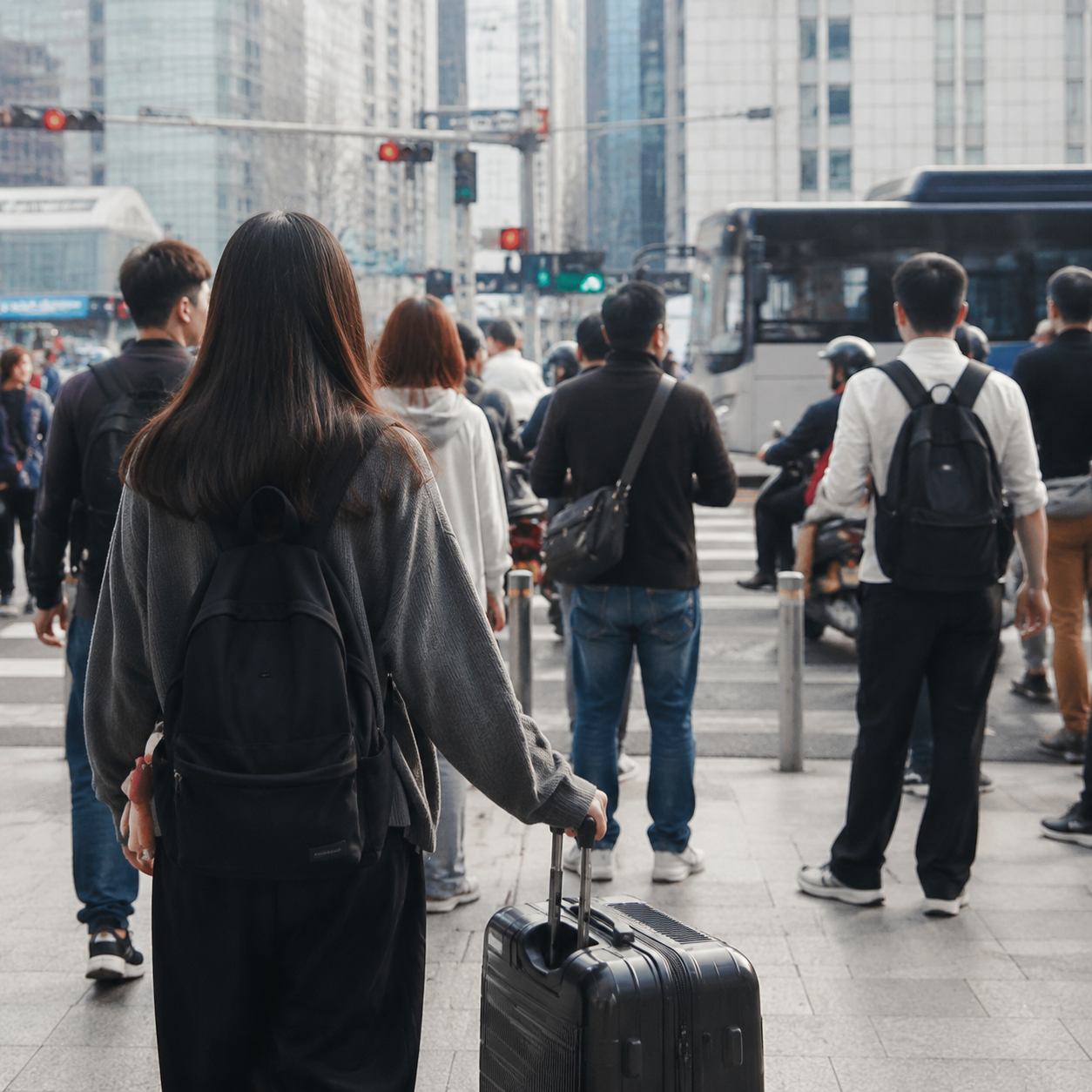
我把行李箱的拉杆压低一点,避免挡住身后人的路。路口的声音非常密:公交车进站时的气刹声,电动车刹车片轻轻摩擦的声音,行李箱轮子在地砖缝里跳动的声音,还有地铁站广播从地下入口涌出来的提示音。可是这些声音并没有混乱到让我害怕,因为每一种声音都对应着一种动作。绿灯亮起时,前排的人不是突然奔跑,而是像一张纸被风推开,边缘先动,中间跟上,最后整块人群平稳地过街。我跟着走,脚步一开始太慢,差点被后面拉着小车的阿姨轻轻碰到。她没有抱怨,只说了一句“往前走一点”,语气像是在提醒我加入节奏。
I lowered the handle of my suitcase a little so I would not block the people behind me. The soundscape of the crossroad was dense: the air brakes of buses entering the stop, the soft scrape of electric-bike brakes, suitcase wheels bouncing over tile gaps, and metro announcements spilling out of the underground entrance. Yet the sounds did not frighten me, because each one seemed attached to a specific movement. When the green light came on, the front row did not suddenly run; it moved like a sheet of paper pushed by wind, with the edges shifting first, the middle following, and then the whole crowd crossing steadily. I walked with them. At first my steps were too slow, and an auntie pulling a small cart almost bumped into me. She did not complain; she only said, “Move forward a little,” in a tone that sounded like she was inviting me into the rhythm.
在我住的酒店附近,深南大道像一条宽阔而自信的河。早高峰时,它并不只是车道和人行道的组合,而是一套不断切换的秩序。出租车在临停点只停几秒,乘客开门、弯腰、关门、并入人流,动作像排练过。过街的人会提前选择位置:赶时间的人站在斑马线最前沿,推婴儿车的人靠近坡道,骑共享单车的人在非机动车道边等。最让我惊讶的是,很多人并不是只看红绿灯,他们还看对面人群的密度、转弯车辆的速度、交警手势和天桥入口的拥堵程度。我以前习惯把交通灯当成唯一答案,在深圳我才明白,灯号是句子里的标点,人流才是完整的语法。
Near my hotel, Shennan Avenue looked like a wide and confident river. During the morning rush, it was not simply a combination of lanes and sidewalks; it was an order that kept switching. Taxis stopped at temporary drop-off points for only a few seconds, passengers opened doors, bent down, closed doors, and merged into the crowd with movements that seemed rehearsed. Pedestrians chose their positions in advance: people in a hurry stood at the very edge of the crossing, people pushing strollers stayed near the ramp, and those on shared bikes waited beside the non-motorized lane. What surprised me most was that many people did not look only at the traffic lights. They also watched the density of the crowd across the road, the speed of turning cars, the gestures of traffic police, and the congestion near the footbridge entrance. I used to treat a traffic light as the whole answer. In Shenzhen I learned that the signal was only punctuation in a sentence, while the crowd was the full grammar.
上午十点,我去了科技园。地图上看,几个地铁站之间距离不远,可真正走在地面上,我才知道“近”在深圳有不同层次。一个园区入口到另一栋楼可能只隔着两条车道、一条绿化带和一座天桥,但如果你没有提前看人流方向,就会被带到完全不同的出口。我在科苑站出来后,跟着一群背电脑包的人走上人行天桥。天桥上没有人停着拍照,大家像在一条室内走廊里通勤。扶手一侧贴着共享办公和咖啡品牌的广告,另一侧能看见园区楼宇的玻璃反光。我的行李已经放在酒店,手里只剩手机和一瓶水,但我依然觉得自己像带着太多东西,因为周围的人走得轻、快、准。
At ten in the morning, I went to the Science and Technology Park. On the map, several metro stations looked close to one another, but once I walked above ground, I understood that “close” had several meanings in Shenzhen. The entrance of one campus and another building might be separated only by two lanes, a green strip, and a footbridge, yet if you did not read the direction of the crowd in advance, you could be carried toward a completely different exit. After leaving Keyuan Station, I followed a group of people with laptop bags onto a pedestrian bridge. No one stopped there to take photos; everyone commuted as if moving through an indoor corridor. Advertisements for coworking spaces and coffee brands lined one side of the handrail, while the other side reflected the glass of campus buildings. I had already left my suitcase at the hotel and held only my phone and a bottle of water, but I still felt as if I was carrying too much, because the people around me walked light, fast, and precisely.
天桥中段有一个分叉,左边通向写字楼,右边通向商场。我原本想去左边看看科技公司的楼下是什么样子,可人流在分叉处突然变得复杂。外卖员从右侧上来,几个穿工牌的人从左侧下来,两位清洁工推着工具车沿边缘慢慢移动。我停了一下,立刻意识到自己成了障碍。一位年轻人从我身边绕过,脚步没有变慢,只把身体稍微侧了一点。我学他的动作,把手机收起来,先走到不挡路的护栏旁,再重新看地图。那一刻我明白,在这座城市里,观察不是游客的装饰动作,而是最基本的礼貌。
In the middle of the footbridge there was a fork: left toward office towers, right toward a shopping mall. I had intended to go left to see what the ground level of technology companies looked like, but the flow became complicated at the fork. Delivery workers came up from the right, several people wearing employee badges came down from the left, and two cleaners pushed a tool cart slowly along the edge. I stopped for a second and immediately realized I had become an obstacle. A young man moved around me without slowing down, only turning his body slightly. I copied him, put away my phone, stepped to the railing where I would not block anyone, and checked the map again. In that moment I understood that in this city, observation was not a decorative act for tourists; it was basic courtesy.
中午我进了商场,想找一顿简单的饭。商场内部和街面一样有节奏,只是声音换成了电梯提示、餐厅叫号和咖啡机蒸汽声。扶梯口旁边贴着楼层导览,许多人走近时并不完全停下,而是扫一眼就继续前进。餐厅门口的队伍也很有意思:有人先占位,有人先扫码点单,有人站在玻璃窗前看厨师装盘。队伍不是一条直线,而是由几种目的组成的临时结构。我排在一家牛肉饭店外,前面的男孩一边看手机会议消息,一边在屏幕上改备注;后面的女孩和同事讨论下午的产品演示,声音不高,但关键词像电梯一样不断上升:版本、上线、客户、接口。
At noon I entered a mall to find a simple meal. The inside of the mall had a rhythm just like the street, except the sounds had changed into elevator chimes, restaurant order calls, and the hiss of coffee machines. Floor guides were posted beside the escalators, and many people did not fully stop when they approached them; they glanced once and kept moving. The queues outside restaurants were interesting too: some people saved seats first, some scanned codes to order first, and some stood by the glass window watching cooks plate food. A queue was not a straight line; it was a temporary structure made of several purposes. I waited outside a beef rice restaurant. The boy in front of me checked meeting messages on his phone while changing order notes on the screen; the girl behind me discussed an afternoon product demo with her colleague. Their voices were not loud, but the keywords rose like an elevator: version, launch, client, interface.
我坐下后,旁边桌两个工程师模样的人在吃饭。他们没有谈论宏大的创新,只讨论一个地铁口到公司前台要走几分钟,下午下雨时哪条通道不积水,哪个电梯高峰期更容易上去。我听着这些琐碎的细节,忽然觉得比任何宣传片都更能解释深圳。科技园不是一个抽象名词,它首先是一群人每天如何从地铁口走到工位,如何在十五分钟里吃完饭,如何把雨伞塞进电脑包侧袋,如何在电梯里看完一封邮件。高楼的光泽很容易被看见,支撑高楼运转的步幅却需要你站在人群边缘慢慢读。
After I sat down, two people who looked like engineers ate at the next table. They did not talk about grand innovation; they discussed how many minutes it took to walk from a metro exit to the company reception desk, which passage stayed dry when it rained in the afternoon, and which elevator was easier to catch during peak hours. Listening to these small details, I suddenly felt they explained Shenzhen better than any promotional video. The Science and Technology Park was not an abstract term. It was first a group of people walking from metro exits to desks every day, finishing lunch in fifteen minutes, tucking umbrellas into the side pockets of laptop bags, and reading an email in an elevator. The shine of tall buildings was easy to see; the stride that kept them operating had to be read slowly from the edge of the crowd.
下午两点多,我从商场出来,太阳照在玻璃幕墙上,反光像一层薄薄的水。我想去另一侧的街区,却发现地面过街不方便,最近的选择是人行天桥。天桥台阶旁有电梯,但排队的人不少:一位推轮椅的老人、一位抱孩子的父亲、两个拉货的小哥。其他人自动选择楼梯,没有人站在电梯口犹豫。我也走楼梯,汗从背后冒出来。上到桥面时,我看见桥下的车辆一层层滑过去,公交、网约车、蓝色货车、电动车各自占着自己的线。行人走在桥上,车辆流在桥下,两种速度交叉却不碰撞,像城市把不同的急迫分层放好。
A little after two in the afternoon, I came out of the mall. Sunlight hit the glass curtain walls, and the reflections looked like a thin layer of water. I wanted to go to the block on the other side, but crossing at street level was inconvenient, and the nearest option was a footbridge. There was an elevator beside the stairs, but several people were waiting: an elderly person in a wheelchair, a father holding a child, and two young men pulling cargo carts. Everyone else automatically chose the stairs; no one stood at the elevator entrance hesitating. I took the stairs too, sweat forming on my back. When I reached the bridge deck, I saw vehicles sliding below in layers: buses, ride-hailing cars, blue delivery vans, and electric bikes each held their own line. Pedestrians moved above, traffic flowed below, and the two speeds crossed without touching, as if the city had sorted different kinds of urgency into levels.
我在桥上停了很短的时间,只够喝一口水。旁边一个穿蓝色工服的师傅把安全帽夹在胳膊下,也在看桥下。他问我是不是找路,我说是,想去对面那栋楼。他指了指远处一个出口,说从那里下去少绕一点,又提醒我下桥后不要立刻横穿,因为转弯车多。他的中文很快,我只听懂大半,但手势足够清楚。说完他就走了,脚步沉稳,像对这片区域的每个缝隙都很熟。陌生城市里的帮助有时不是热情地陪你走一段,而是给你一个准确的方向,然后把你放回城市的秩序里。
I stopped on the bridge only long enough to drink a sip of water. Beside me, a worker in a blue uniform held a hard hat under his arm and also looked down at the road. He asked whether I was looking for directions. I said yes, I wanted to reach the building across the road. He pointed to an exit in the distance and said going down there would save me a detour, then reminded me not to cross immediately after descending because many cars turned there. His Chinese was fast, and I understood only most of it, but his gesture was clear enough. Then he left, walking with steady steps, as if he knew every seam of the area. Help in a strange city is sometimes not someone warmly walking with you for a while, but someone giving you an accurate direction and placing you back into the city’s order.
傍晚六点,我去车公庙换乘。地铁站里的人流比早上更像潮水,因为目的地开始分散:有人回家,有人去吃饭,有人去健身,有人去见客户。站厅里每一个转角都有箭头,每一个通道都有电子屏,但最有效的指引仍然是人群的选择。我站在换乘通道入口,看见左侧的人步伐更快,右侧的人更放松,中间有人停下看手机,立刻会退到墙边。深圳地铁的队伍让我印象很深,候车区的线画得清楚,乘客在两侧排开,中间留给下车的人。车门打开时,最先发生的不是上车,而是等待。
At six in the evening, I transferred at Chegongmiao. The flow inside the metro station was more like a tide than in the morning, because destinations had begun to scatter: some people were going home, some to dinner, some to the gym, and some to meet clients. Every corner in the concourse had arrows, and every passage had electronic screens, but the most effective guide remained the crowd’s choices. I stood at the entrance of a transfer passage and saw that people on the left walked faster, people on the right were more relaxed, and those who stopped to check phones immediately moved to the wall. The queues in the Shenzhen Metro impressed me deeply. The waiting area lines were clearly marked, passengers lined up on both sides, and the middle was left for people getting off. When the doors opened, the first thing that happened was not boarding; it was waiting.
我以前在一些城市坐地铁时,总觉得上车是一次小小的竞争。可在这里,竞争被规矩包住了。下车的人先出来,上车的人再挤进可用的空间,背包会被转到胸前,雨伞会竖着拿,手机屏幕会降低一点以免碰到别人。车厢里没有完全安静,短视频的声音偶尔漏出来,孩子问问题,朋友低声聊天,但整体仍然保持一种共同的克制。我抓着扶手,看见玻璃窗里反射出一排疲惫的脸。那不是冷漠,而是一天工作之后把体力精确分配给回家路程的表情。
In some cities where I had taken metros before, boarding felt like a small competition. Here, the competition was wrapped inside rules. People getting off came out first, then those boarding squeezed into available space. Backpacks were turned to the front, umbrellas were held vertically, and phone screens were lowered slightly to avoid touching others. The carriage was not completely quiet. Short-video audio occasionally leaked out, children asked questions, and friends spoke softly, but overall there was a shared restraint. Holding the handrail, I saw a row of tired faces reflected in the window. It was not indifference; it was the expression of people allocating their remaining energy precisely for the trip home.
晚饭前我去了一个商场外的小广场。几栋楼之间的空地被灯光切成几块:一边是外卖员等单的区域,一边是下班的人抽烟聊天的台阶,另一边是小孩踩滑板车的地方。一个咖啡店门口排着短队,队伍移动得很快,因为很多人已经在手机上点好,只来取走。两个年轻女孩站在垃圾桶旁分一杯奶茶,一个男生蹲在地上给电动车充电器绕线,还有一位保安不断提醒停放的单车不要堵住入口。这个小广场没有景点的名字,却像一本打开的城市笔记,把工作、消费、等待和休息写在同一页上。
Before dinner I went to a small plaza outside a mall. The open space between several buildings was divided by light into several areas: one side for delivery riders waiting for orders, one set of steps for people chatting and smoking after work, and another corner where children rode scooters. A short line stood outside a coffee shop, moving quickly because many people had already ordered on their phones and came only to pick up. Two young women shared a cup of milk tea beside a trash bin, a young man squatted on the ground winding the charger of an electric bike, and a security guard kept reminding people not to park shared bikes in front of the entrance. The little plaza had no scenic name, yet it was like an open city notebook, writing work, consumption, waiting, and rest on the same page.
那天我没有去很多著名地方,甚至没有拍到一张可以让朋友立刻认出深圳的照片。我的相册里多是路口、扶梯、站台、排队的人和天桥边的标识。晚上回到酒店,我把照片一张张看过去,才发现每张图里都有方向:箭头指向出口,队伍指向车门,斑马线指向对岸,人的身体指向下一件要做的事。对第一次到来的我来说,深圳的速度并不是简单的快,而是一种把选择提前放进动作里的能力。人们在到达路口前就知道站哪里,在进入商场前就知道去哪层,在下地铁前就把包挪到不挡人的位置。
That day I did not visit many famous places, and I did not even take a photo that would let my friends recognize Shenzhen immediately. My album was full of crossroads, escalators, platforms, people in lines, and signs beside footbridges. When I returned to the hotel at night and looked through the photos one by one, I realized that every image contained direction: arrows pointed to exits, queues pointed to train doors, zebra crossings pointed to the other side, and people’s bodies pointed toward the next thing they needed to do. For me as a first-time visitor, Shenzhen’s speed was not simply fast. It was the ability to place decisions inside movements ahead of time. People knew where to stand before reaching the crossing, which floor to go to before entering the mall, and how to shift their bags before getting off the metro.
第二天早上七点半,我又来到同一个路口。这一次我没有站在最中间看导航,而是先退到一棵行道树旁,观察两轮信号灯。第一轮,我看车从哪个方向转弯,看行人怎样绕开施工围挡;第二轮,我看哪条斑马线更适合去地铁入口。绿灯亮起时,我拉着背包带加入人群,速度不算快,却不再突兀。一个穿黑色运动鞋的男人从我左边超过去,一个拿豆浆的女孩从我右边经过,我们之间没有语言,却共享了同一条过街的节拍。我第一次觉得自己不是被深圳推着走,而是在它允许的空隙里学会了走。
At 7:30 the next morning, I returned to the same crossroad. This time I did not stand in the middle looking at navigation. Instead, I first stepped back beside a street tree and watched two rounds of signals. During the first round, I observed which direction cars turned from and how pedestrians moved around construction barriers. During the second, I checked which zebra crossing best led to the metro entrance. When the green light came on, I held my backpack strap and joined the crowd. My speed was not especially fast, but I no longer felt abrupt. A man in black sneakers passed on my left, and a girl holding soy milk passed on my right. We exchanged no words, yet shared the same crossing beat. For the first time, I felt I was not being pushed along by Shenzhen, but learning to walk within the spaces it allowed.
我在地铁入口前买了一份热包子,塑料袋被蒸汽撑得鼓起来。卖包子的阿姨一边找零钱,一边提醒后面的人往旁边排,不要挡住进站的人。她的摊位很小,却把路口的逻辑延伸到了早餐里:等待的人站成一边,付钱的人靠近窗口,拿到食物的人立刻离开流线。我咬了一口包子,烫得说不出话,只能点头表示好吃。阿姨笑了一下,又转向下一个顾客。那一秒我很清楚地感觉到,深圳的日常不是靠某个宏大的口号维持,而是靠无数人把一点点空间让出来、把一点点时间算清楚。
In front of the metro entrance I bought a hot steamed bun, its plastic bag puffed up by steam. The auntie selling buns counted change while reminding the people behind me to line up to the side and not block those entering the station. Her stall was small, yet it extended the logic of the crossroad into breakfast: people waiting stood to one side, people paying moved close to the window, and people who received food immediately left the flow line. I bit into the bun and it was too hot for me to speak, so I could only nod to show it was good. The auntie smiled briefly and turned to the next customer. In that second I felt clearly that Shenzhen’s daily life was not maintained by a grand slogan, but by countless people giving up small bits of space and calculating small bits of time.
午后我去了南山另一处办公区。路边的树很高,树荫把人行道切成明暗相间的格子。几个穿着工牌的人站在路牌下等车,他们没有焦躁地张望,只是偶尔看一眼手机上的车辆位置。一辆网约车停下时,乘客没有立刻上车,而是先确认车牌,往前挪半步避开后面骑车的人,再打开车门。这样的动作如果单独看并不特别,可一天之内重复无数次,就变成了城市的性格。深圳给我的印象不是每个人都很赶,而是每个人都知道别人也在赶,所以尽量不把自己的停顿变成别人的障碍。
In the afternoon I went to another office area in Nanshan. The roadside trees were tall, and their shade cut the sidewalk into alternating squares of light and dark. Several people wearing employee badges waited under a road sign. They did not look around anxiously, only occasionally checking the car location on their phones. When a ride-hailing car stopped, the passenger did not get in immediately. She first confirmed the license plate, moved half a step forward to avoid a cyclist behind her, and then opened the door. Such actions were not special when seen alone, but repeated countless times in a single day, they became the city’s character. My impression of Shenzhen was not that everyone was rushing, but that everyone knew others were rushing too, and therefore tried not to turn their own pauses into someone else’s obstacle.
傍晚下起了小雨。地铁站口的伞一下子打开,像一群深色的花。雨并不大,却让路口的规则更加明显。骑车的人放慢速度,行人把手机收进包里,商场门口的保安把防滑垫往外推了半米。有人在门檐下等车,有人沿着建筑边缘快走,还有人从地下通道绕行。我站在屋檐下看了一会儿,发现雨没有让城市停住,只是让它切换到另一套动作。红绿灯仍然计时,人群仍然分层,天桥仍然承担它的工作。深圳在雨里不像电影里的未来城市,它更像一台被很多双手共同保养的机器,每个螺丝都知道自己的位置。
In the evening a light rain began. Umbrellas opened at the metro entrance like a group of dark flowers. The rain was not heavy, but it made the rules of the crossroad even clearer. Cyclists slowed down, pedestrians put phones into bags, and the security guard at the mall entrance pushed an anti-slip mat half a meter farther out. Some people waited for cars under the eaves, some walked quickly along the edge of buildings, and others detoured through underground passages. I stood under the roof and watched for a while, realizing that the rain had not stopped the city; it had only switched the city to another set of movements. Traffic lights still counted down, crowds still layered themselves, and footbridges still did their work. In the rain, Shenzhen did not look like a future city from a film. It looked more like a machine maintained by many hands, with every screw knowing its position.
离开深圳那天,我在机场线的车厢里回想第一天早上的路口。窗外的站名一个个滑过去,车厢里有人闭眼休息,有人回复消息,有人把行李箱转到座椅下方留出通道。我忽然发现自己也在做同样的事:背包放在膝盖上,鞋尖收回座位线内,手机音量调到很低。短短几天不可能让我理解一座城市的全部,可它已经改变了我的身体习惯。第一次到深圳,我没有先学会辨认哪栋楼属于哪家公司,而是学会看路口、看队伍、看人们怎样在拥挤中给彼此留出前进的缝隙。
On the day I left Shenzhen, I sat in the airport-line carriage and thought back to the crossroad from my first morning. Station names slid past the window one by one. Inside the carriage, some people rested with their eyes closed, some replied to messages, and some turned suitcases under seats to keep the aisle clear. Suddenly I noticed that I was doing the same thing: my backpack was on my knees, my toes were pulled back within the seat line, and my phone volume was very low. A few days could not allow me to understand a whole city, but it had already changed my body habits. On my first visit to Shenzhen, I did not first learn which tower belonged to which company; I learned to read crossroads, queues, and the ways people left one another narrow spaces to keep moving.
- 冬至温泉之旅:全国最佳泡汤地 | Winter Solstice Hot Spring Tour
- 现金还是手机支付?来华前必读 | Cash or Mobile Pay? What You Need to Know Before Visiting China
- 深夜便利店里那几分钟,让我第一次觉得自己也进入了中国城市的夜班节奏 | A Few Minutes in a Late-Night Convenience Store Made Me Feel I Had Entered the Night Rhythm of a Chinese City
- 北京三日线:第一次来中国,怎么走才不赶路 | Beijing in 3 Days: A First-Time Route Without Rush
- 云南古城最怕被一句“适合慢下来”说完,真正值钱的是慢下来以后怎么走 | Yunnan’s Old Towns Deserve More Than “Good for Slowing Down”; What Matters Is How You Move Once You Slow
- 早上七点,广州人已经喝了两轮茶 | Morning Tea in Guangzhou: A Ritual Before the Rest of China Wakes Up
- 广西山水5日行程:桂林阳朔龙脊梯田 | 5-Day Guangxi: Guilin, Yangshuo & Longji Terraces
- 落地后的第一笔钱:在中国旅行建立支付备用方案 | Your First Payment After Landing: Building a Backup Plan for Travel in China
- 孩子在北京地铁里第一次自己问路 | When My Child Asked for Directions Alone on the Beijing Subway
- 第一次在中国夜市买烤串,我学会先控制手,而不是先追最热闹的摊子 | The First Lesson I Learned Buying Skewers at a Chinese Night Market Was to Control My Hand Before Chasing the Busiest Stall
Comments (0)