
我在苏州骑共享单车绕错了两次,才学会怎么在中国城市里骑得省力 | I Took Two Wrong Turns on a Shared Bike in Suzhou Before Learning How to Ride Chinese Cities with Less Effort
我在苏州骑共享单车绕错了两次,才学会怎么在中国城市里骑得省力 | I Took Two Wrong Turns on a Shared Bike in Suzhou Before Learning How to Ride Chinese Cities with Less Effort
六月的苏州,早上八点二十,我们站在平江路北口,刚从地铁口涌出来的人流像被轻轻推着往前走。朋友一手捏着手机导航,一手扶着一辆橙色共享单车,我则在路边急着调整座椅,鞋底还沾着刚踩过的雨水。我们原本只想骑到一座小园林,结果在第一段路就拐错了方向,沿着一条太安静的小巷越骑越远。
In Suzhou in June, at 8:20 in the morning, we stood at the north entrance of Pingjiang Road as the crowd spilling out of the metro moved forward like it was being gently pushed. My friend held phone navigation in one hand and an orange shared bike in the other, while I hurried to adjust my seat by the curb, the soles of my shoes still damp from rain. We only meant to ride to a small classical garden, but on the very first stretch we turned the wrong way and drifted farther and farther down an alley that was much too quiet.
很多人第一次在中国城市里骑共享单车,都会以为难点在扫码、付押金,或者分不清哪种车更便宜。真正的难点其实是节奏:什么时候该骑,什么时候该推;什么时候该相信导航,什么时候该抬头看路;什么时候该图最近,什么时候该选更顺的那一条。苏州不是最拥挤的城市,却特别适合把这些细微的判断全部放大给你看。
Many first-time riders in Chinese cities assume the difficult part is scanning the code, paying a deposit, or figuring out which bike is cheaper. The real challenge is rhythm: when to ride and when to walk; when to trust navigation and when to look up at the street; when to choose the shortest path and when to choose the smoother one. Suzhou is not the most crowded city, but it is especially good at magnifying all those tiny decisions until you can clearly see them.
我们前一天晚上还在酒店里研究过路线,自以为准备充分。朋友阿遥去过杭州和南京,骑车经验比我多,语气也很自信:“苏州地势平,今天肯定轻松。”我信了这句话,甚至没认真看地图上的水系和步行段提示。第二天出门时,空气里有潮湿的栀子花味,远处早餐店蒸笼一掀,甜豆浆的热气和肉包子的香味一阵阵飘过来,我们就更容易产生错觉:这么温柔的城市,骑车应该不会出什么问题。
The night before, we had studied the route in the hotel and thought we were well prepared. My friend Ayao had ridden in Hangzhou and Nanjing and sounded confident: “Suzhou is flat. Today will be easy.” I believed that sentence and did not seriously examine the waterways and walking segments marked on the map. When we headed out the next morning, the air carried the damp fragrance of gardenias, and each time a breakfast shop lifted a steamer lid, clouds of sweet soy milk heat and the smell of meat buns drifted over. It became even easier to fall for the illusion that in a city this gentle, cycling could not possibly go wrong.
第一处错误发生得很典型:我们看见地图上的蓝线笔直,就下意识以为那是一条可以直接骑过去的路。实际到了拐角,前面是一座只供行人通过的小桥,桥面被晨练的大爷大妈和举着相机的游客占得满满当当。车铃声根本没有意义,反而显得我们很冒失。我们只好下车推行,轮胎压过桥头青石板的缝隙,发出有点发闷的咯噔声,旁边河道里乌篷船慢慢擦过去,船桨搅开一圈圈灰绿的水纹。
Our first mistake was typical: we saw a straight blue line on the map and instinctively assumed it was a route we could simply ride through. At the corner, however, a small bridge ahead was for pedestrians in practice, packed with retirees doing morning exercise and visitors holding cameras. Ringing the bell was pointless and only made us seem clumsy. We had to get off and push, the tires thudding dully over the seams in the old bluestone bridgehead while a black-canopied boat slid along the canal beside us, its oar stirring rings through gray-green water.
过了桥,我们发现自己偏到了居民区内部。这里没有大景点的热闹,却有更真实的生活细节:晾衣杆上挂着还没干透的床单,电动车从窄巷里悄悄钻出来,修鞋摊旁边放着一把折叠小凳,豆腐店门口的地上还留着刚冲过水的湿痕。问题是,这种路看起来很有味道,骑起来却不省力,因为你必须不断减速、避让、再起步。骑了不到十分钟,我小腿已经开始发酸,跟想象中的“江南平路漫骑”完全不是一回事。
Once across, we realized we had drifted into the interior of a residential quarter. It lacked the bustle of a famous sight, but it offered more truthful details of daily life: bedsheets still damp on clothes poles, electric scooters slipping quietly out of narrow lanes, a folded stool beside a shoe-repair stand, and fresh washwater still shining on the pavement outside a tofu shop. The problem was that roads like this looked atmospheric but were not efficient. You had to slow down, yield, and restart constantly. In less than ten minutes my calves were already sour, and this was nothing like the effortless Jiangnan ride I had imagined.
阿遥比我先反应过来。她把车停在一棵香樟树下,说:“我们不是在跟地图比赛,是在跟体力做交易。”这句话后来成了我那天最有用的提醒。我们重新打开导航,把“最短路线”的执念放掉,改选更宽、更连续的道路;遇到明显游客密集的历史街区,就默认提前下车推一段;如果前面两百米内要穿桥、过巷、绕摊位,那还不如一开始就别逞强。
Ayao realized it before I did. She stopped under a camphor tree and said, “We’re not competing with the map. We’re bargaining with our energy.” That became the most useful sentence of the day. We reopened navigation, let go of our obsession with the shortest route, and switched to roads that were wider and more continuous. When we approached an obvious historic quarter crowded with visitors, we simply assumed we would walk for a stretch. If the next two hundred meters meant a bridge, a lane, and market stalls, there was no point pretending we should stay on the bike.
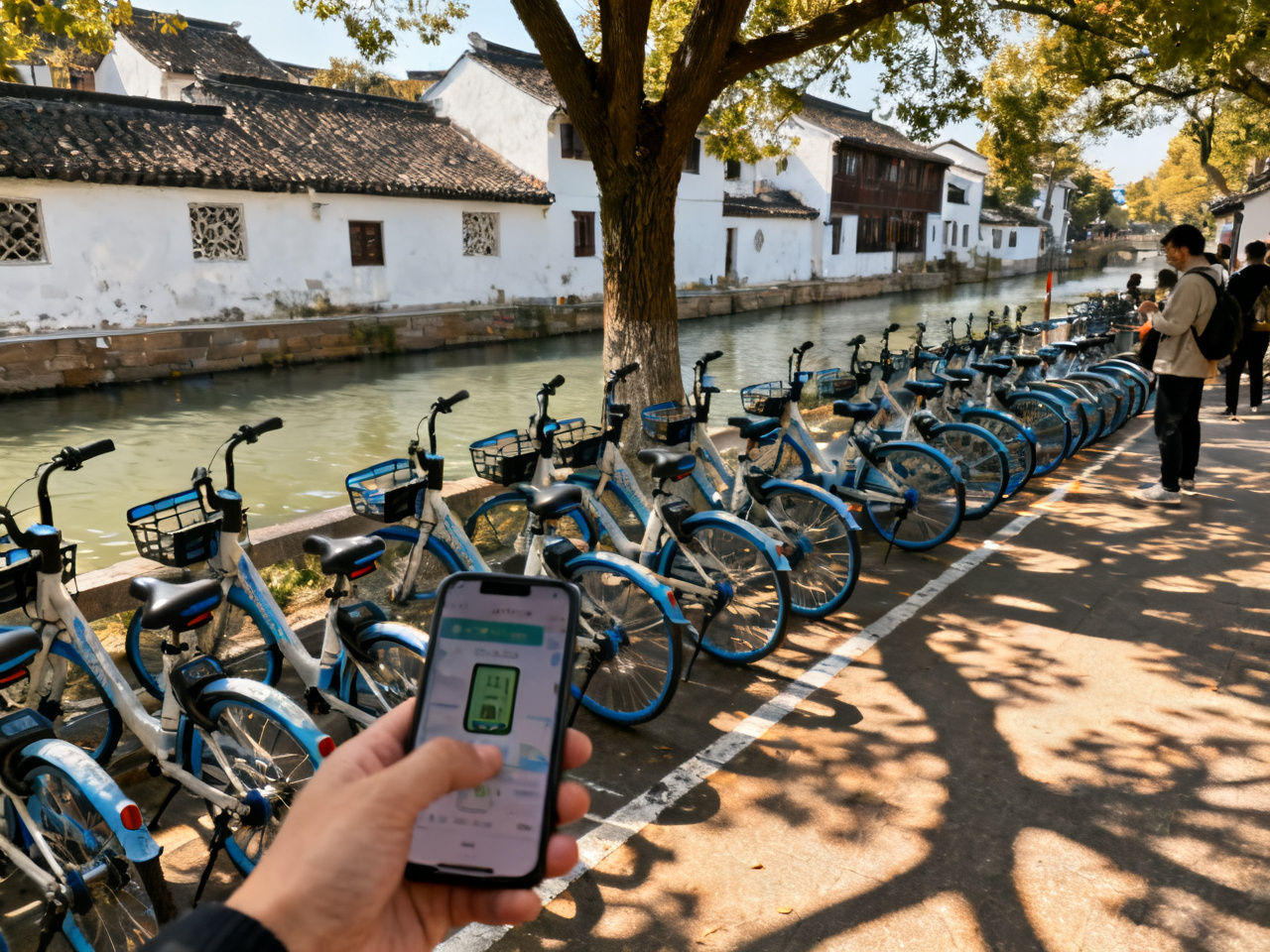
第二次绕错路比第一次更狼狈。我们想从一条看起来很顺的河边道切出去,结果骑到一半,前面突然被临时施工围挡拦住,只留下一条只够行人挤过去的缝。太阳这时已经升高,照在白墙上有一点晃眼,额头的汗顺着鬓角往下滑,手心也被车把磨得发黏。我们只好原路折返,迎面还碰上一个送外卖的小哥,他看我们掉头掉得手忙脚乱,笑着提醒:“大路更快,别老钻小路。”那一刻我有点不好意思,但也终于承认,本地人对“省力”两个字的理解,比游客浪漫得多,也实用得多。
The second wrong turn was more awkward than the first. We tried to cut out through a riverside path that looked smooth enough, only to discover halfway along that temporary construction barriers blocked the way, leaving a slit barely wide enough for pedestrians. By then the sun had climbed higher and flashed off the white walls. Sweat ran down from my temples, and my palms had turned sticky against the handlebars. We had to backtrack, and on the way a delivery rider coming toward us laughed and called out, “The main road is faster. Stop squeezing into little lanes.” I felt slightly embarrassed, but that was the moment I finally accepted that locals understood the phrase “save effort” in a way that was less romantic and far more useful than tourists usually do.
从那之后,我们开始学会用中国城市自己的逻辑骑车。第一条经验是:把地铁和单车当组合工具,而不是二选一。如果一段路跨河太多、红绿灯太密、或者景区周边明显拥堵,就先坐一两站地铁,把最折磨人的部分跳过去,再从出口附近找车。这种方法在很多城市都适用,尤其适合第一次来的人。如果你还不熟悉不同出行方式之间怎么衔接,可以先读一下这篇中国城市通勤方式怎么选,会比单纯盯着地图更有帮助。
After that, we began to ride using the city’s own logic instead of ours. The first lesson was to treat the metro and the bike as a combined tool rather than an either-or choice. If a section crossed too many canals, had too many lights, or was obviously clogged around a scenic area, it was better to take the metro for one or two stops, skip the most draining portion, and pick up another bike near the exit. This works in many Chinese cities and is especially useful for first-time visitors. If you are still figuring out how different modes connect, a practical guide to choosing urban commuting options in China is more helpful than staring at a map alone.
第二条经验是:别只看公里数,要看“停车—解锁—通过”这条链条顺不顺。共享单车省力的时候,往往不是因为它跑得快,而是因为它减少了等待和转身。如果你需要频繁跨栏杆找停车点,或者景区周边电子围栏特别严格,那一公里都会显得很长。相反,沿主干道边缘、大学周边、商业街外围这些地方,找车和还车通常都更顺。我后来才意识到,我们早上之所以骑得累,不是因为苏州难骑,而是因为把所有最不适合连贯骑行的路段全挑中了。
The second lesson was not to judge by distance alone, but by how smooth the chain of “park, unlock, pass through” would be. Shared bikes save effort not because they are fast, but because they reduce waiting and backtracking. If you keep having to cross barriers to find parking zones, or the geofencing near scenic areas is unusually strict, even one kilometer can feel long. By contrast, roads along main arteries, around universities, and on the outer edges of shopping streets usually make both pickup and return easier. I realized later that Suzhou itself was not difficult to ride. We had simply selected every segment least suitable for uninterrupted cycling.
第三条经验和体力直接相关:把座椅调高一点,把背包背轻一点,把水提前买好一点。听起来很普通,但真的很有用。我们中午在一家便利店门口停下时,我一口气喝掉半瓶冰乌龙茶,冷气从喉咙一路压到胃里,才觉得自己重新活过来。门口风扇吹出混着关东煮和咖啡机蒸汽的热风,便利店店员看见我们满头汗,还主动指了指旁边可以暂时停放单车的空位。中国城市里这种非常日常的小帮助,常常会让整个出行体验突然顺畅起来。
The third lesson was directly about stamina: raise the seat a little, lighten the backpack a little, and buy water before you need it. It sounds ordinary, but it matters. When we stopped at a convenience store around noon, I drank half a bottle of iced oolong tea in one go, and only when the cold slid from my throat into my stomach did I feel revived. The fan at the entrance pushed out warm air mixed with the smell of oden and coffee steam. Seeing us sweaty and flustered, the clerk even pointed to an open area beside the store where we could leave the bikes for a while. In Chinese cities, that kind of utterly ordinary assistance often makes the whole trip suddenly run better.
阿遥后来还提醒我,别把共享单车看成“景点之间的交通”,而要把它看成“观察城市尺度的工具”。坐车的时候,苏州是一幅白墙黛瓦的横向长卷;骑车的时候,你会注意到巷口菜店的吆喝、桥洞里返上来的凉气、树荫下老人聊天时扇子扑出来的风,甚至还有游客消失之后街区真正回到生活本身的速度。正因为骑得没有那么快,你才会意识到一座中国城市并不是只靠名胜串起来的,它也靠早餐摊、便利店、公交站和无数微小的停顿组成。
Ayao later reminded me not to think of shared bikes as mere transportation between sights, but as a tool for sensing a city’s scale. In a car, Suzhou looks like a horizontal scroll of white walls and dark tiles. On a bike, you begin to notice the vegetable seller calling from a lane entrance, the coolness rising from under a bridge, the flutter of a hand fan beneath tree shade, and even the speed at which a district returns to ordinary life once the tourists move on. Because you are not moving too fast, you realize that a Chinese city is not stitched together by landmarks alone. It is also built from breakfast stalls, convenience stores, bus stops, and countless tiny pauses.
如果你准备把骑行和更长距离的移动结合起来,比如先高铁到苏州,再在市内用地铁加单车穿行,那么提前理解衔接逻辑会非常省事。相关的基础思路可以参考这篇中国高铁出行全流程指南,它和城市内的节奏感其实是一脉相承的:不是每一步都快,而是每一步都少折返。
If you plan to combine cycling with longer-distance travel—arriving in Suzhou by high-speed rail and then moving through the city by metro and bike—it helps enormously to understand how the connections work in advance. An end-to-end guide to China’s high-speed rail follows the same underlying logic: not that every step must be fast, but that every step should minimize backtracking.
下午三点多,我们终于骑到一段真正舒服的路。河道退到一侧,车道平直,梧桐叶把光筛成一块一块的,偶尔有公交车从旁边低声滑过。我们不再争论哪条线更短,也不再急着证明自己会“玩得像本地人”,只是顺着风往前骑。经过一家糕团铺时,门口飘出来桂花糖藕的甜味,我和阿遥同时放慢速度,对看一眼,然后默契地下车买了两份。
A little after three in the afternoon, we finally reached a stretch of road that felt genuinely easy. The canal fell away to one side, the lane ran straight, and the plane trees sifted the sunlight into shifting patches. Now and then a bus whispered past. We stopped arguing over which line was shorter, and we stopped trying to prove we could “do it like locals.” We simply rode with the breeze. Passing a pastry shop, we caught the sweet fragrance of osmanthus lotus root drifting out, and Ayao and I slowed at the exact same moment, exchanged a glance, and got off to buy two portions.
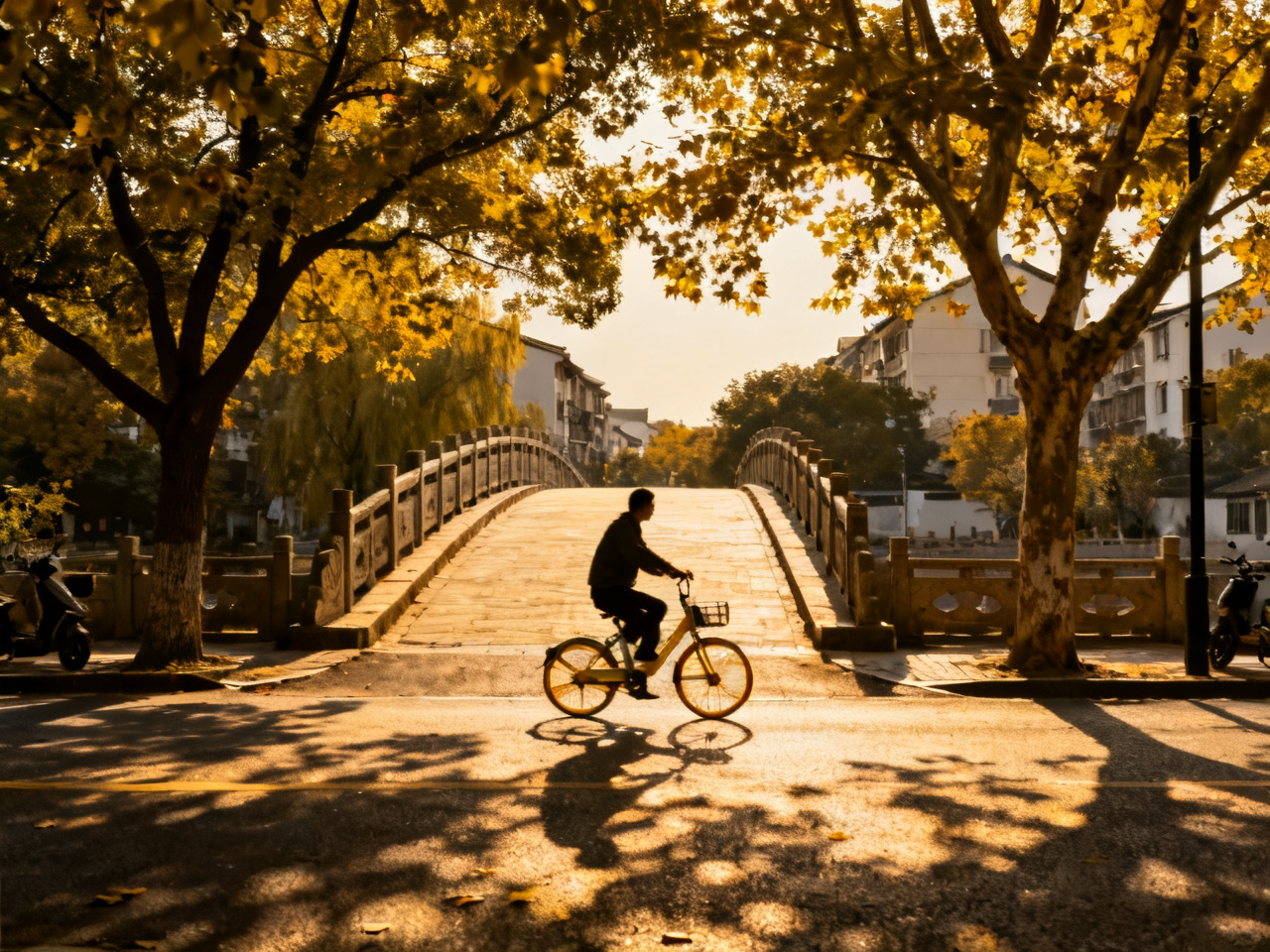
傍晚回到平江路附近还车时,我再看那条早上让我们绕错的支路,已经没有最初那种“非要征服它”的心情了。学会在中国城市里骑得省力,并不是学会找一条完美路线,而是学会接受路线会不断被人流、桥梁、天气和自己当天的状态修改。我们把车停进白线里,锁车声“咔哒”一下落定,河边的灯刚亮,水面浮着一点橘色反光,旁边卖梅子饮的小摊开始排起短队。我们站着喝完最后几口冰饮,听见桥上传来车铃、笑声和晚风吹过树叶的轻响,忽然觉得这一天真正学会的,不是怎么少走弯路,而是怎么让弯路也不那么累。
When we returned the bikes near Pingjiang Road at dusk, I looked again at the side street that had sent us astray in the morning and no longer felt the need to conquer it. Learning to ride Chinese cities with less effort does not mean discovering one perfect route. It means accepting that your route will keep being revised by crowds, bridges, weather, and your own condition that day. We parked within the white lines, and the lock clicked shut. Lights had just come on along the canal, a touch of orange shimmered on the water, and a small queue was forming at a stall selling plum drinks. We stood there finishing the last cold mouthfuls, hearing bike bells on the bridge, bursts of laughter, and the soft sound of evening wind moving through leaves. What we had really learned that day was not how to avoid every wrong turn, but how to make the wrong turns less tiring.
- 我在重庆磁器口边走边吃陈麻花:现金和扫码怎么备份 | Walking and Snacking in Ciqikou, Chongqing: Payment Backup Plan
- 青岛真正舒服的地方,不是海风和啤酒本身,而是白天夜里总会自己换挡 | What Makes Qingdao Truly Comfortable Is Not Sea Breeze and Beer Themselves but the Way the City Shifts Gears Between Day and Night
- 第一次在中国社区医院挂普通门诊,我先学会的不是看病,而是先找分诊台 | The First Thing I Learned at a Chinese Community Hospital Was Not the Consultation, but Finding Triage First
- 八月海滨全攻略:中国最值得去的海滩 | August Beach Guide: China's Best Coastal Destinations
- 中国民间艺术:剪纸、皮影与年画 | Chinese Folk Art: Paper-Cutting, Shadow Puppets & New Year Prints
- 我坐绿皮火车从昆明晃到北京 | I Took a Slow Train from Kunming All the Way to Beijing
- 苏州夜里最珍贵的经验,常常不是多走一座桥,而是在最好看的地方及时收住 | The Most Valuable Lesson in Suzhou at Night Is Often Not One More Bridge but Knowing When to Stop at the Beautiful Moment
- 西藏拉萨朝圣之旅:布达拉宫与大昭寺 | Lhasa Pilgrimage: Potala Palace & Jokhang Temple
- 窑火没有替我把碗烧好:景德镇一只歪口杯的诞生 | The Kiln Could Not Fix My Crooked Cup in Jingdezhen
- 在中国点外卖全流程:美团饿了么实操 | Ordering Food Delivery in China: Meituan & Ele.me Guide
Comments (0)