
风沙把莫高窟的时间吹慢了 | The Sandstorm Slowed Time at the Mogao Caves
风沙把莫高窟的时间吹慢了 | The Sandstorm Slowed Time at the Mogao Caves
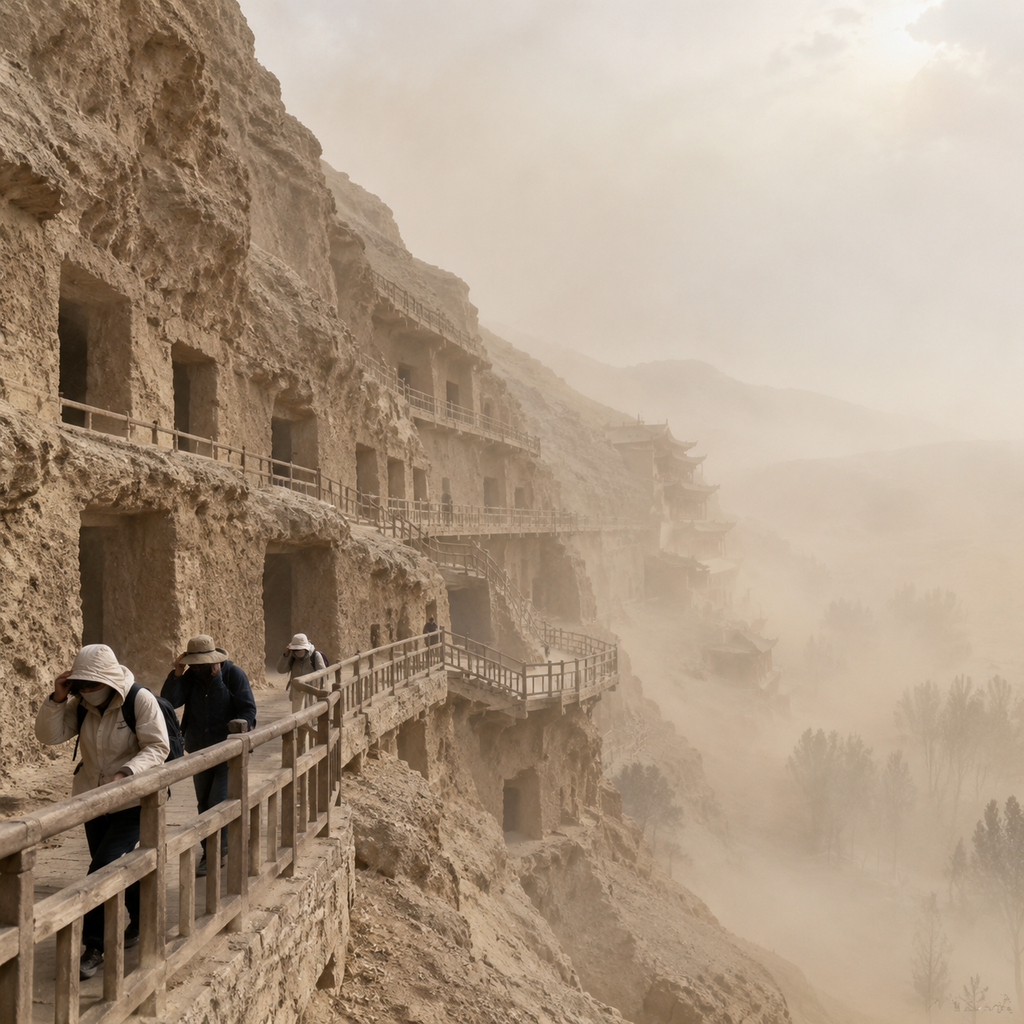
清晨的敦煌还没有完全亮起来,我站在住处门口整理背包,先摸到的是一层细细的沙。它不像雨水那样明显,也不像灰尘那样容易被看见,只在手机边缘、拉链齿和鞋面上留下粗糙的触感。风从空旷处推过来,带着干燥的冷意,路旁的树叶被吹得翻面。我原本把今天想得很简单:去莫高窟,参观,回来。可当我把相机收进包里,给镜头套上保护袋,又看见同行游客在门口反复拍打衣袖时,我意识到敦煌的风沙不是景色之外的背景,它会直接进入人的动作,也会改变人接近遗产的方式。
Dunhuang had not fully brightened when I stood outside my lodging and arranged my bag. The first thing I felt was a fine layer of sand. It was less obvious than rain and harder to notice than dust, leaving only a rough texture along my phone, zipper teeth, and shoes. Wind pushed in from the open land, carrying a dry chill, while roadside leaves turned inside out. I had imagined the day simply: visit the Mogao Caves and return. But as I put my camera into a protective bag and watched other visitors brush their sleeves again and again, I understood that Dunhuang’s wind and sand were not scenery in the background. They entered our movements and changed how we approached heritage.
我没有急着上车,而是站在风里观察入口附近的人。有人把帽檐压低,有人用手掌护住眼睛,也有人在风变大时把原本敞开的外套拉到下巴。司机提醒大家把容易被风吹走的纸张和塑料袋收好,这个提醒很普通,却让我第一次把“出发”理解成一种准备:不是为了拍出更戏剧性的沙漠照片,而是先让自己的物品、身体和注意力适应这里。车窗外的能见度一阵清楚、一阵发白,远处的轮廓像被擦掉又重新出现。我的行程因此从赶在某个时间点抵达,改成先接受路况和天气带来的不确定。
I did not hurry into the vehicle. Instead, I watched people near the entrance. Some pressed down their hat brims, some shielded their eyes with their palms, and others pulled their open jackets up to their chins when the wind strengthened. The driver reminded us to secure loose paper and plastic bags. It was an ordinary reminder, yet it made me understand departure as preparation: not an attempt to produce a more dramatic desert photograph, but a way to let my belongings, body, and attention adjust to the place. Visibility beyond the window shifted between clear and pale, with distant outlines erased and redrawn. My itinerary changed from racing toward a fixed arrival to accepting uncertainty created by weather and road conditions.
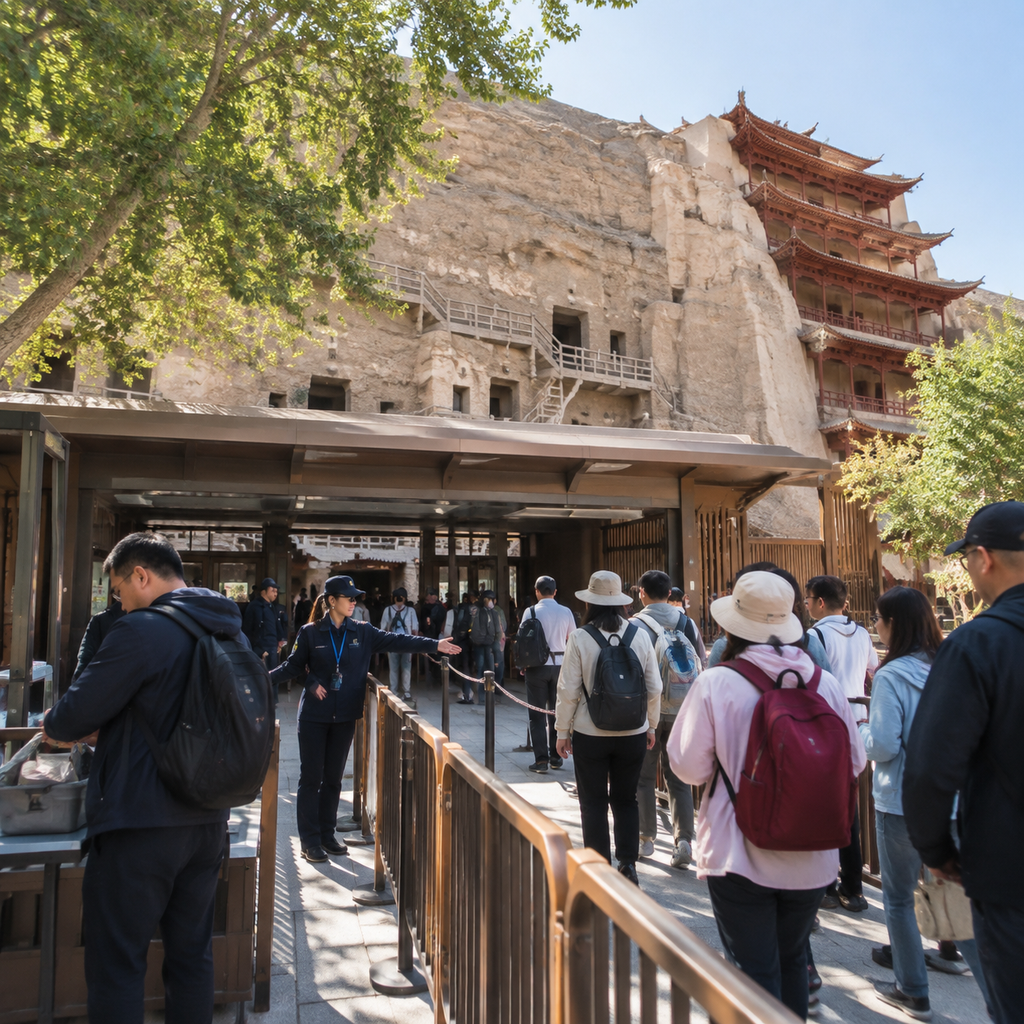
抵达参观区域后,我发现这里的第一课并不在洞窟里。入口处的人流被分成几个自然的层次:刚下车的人先检查随身物品,已经准备好的人靠边等待,工作人员则不断用手势让队伍向前、向内、向指定位置移动。大家的动作并不整齐,却有一种逐渐形成的秩序。有人想停下来拍门口的风景,后面的人没有催喊,只是稍微放慢脚步;工作人员抬手示意保持通道畅通,那位游客便把手机收回去。这个小小的让步让我感到,参观不是从看见洞窟才开始,而是从学会不让自己的兴趣堵住别人的路开始。
Once we reached the visitor area, I realized the first lesson was not inside a cave. The flow of people formed several natural layers: those who had just arrived checked their belongings, those already prepared waited to one side, and staff repeatedly used gestures to move the line forward, inward, and toward designated positions. The movements were not perfectly uniform, yet a workable order emerged. Someone wanted to stop for a photograph of the entrance; people behind did not shout, but slowed slightly. A staff member raised a hand to keep the passage open, and the visitor put the phone away. That small concession made me feel that a visit begins before seeing any cave: it begins when I learn not to block someone else’s path with my own curiosity.
我过去把景区秩序想成一种方便游客的服务,到了这里才发现它同时也是保护工作的一部分。人流如果在狭窄处散开,停留时间、身体距离和声音都会变得难以控制;一旦每个人都凭自己的节奏前进,后面的人就会不断靠近,前面的人也更容易为了拍照停住。讲解人员没有用夸张的语气强调后果,而是在队伍移动时把注意事项拆成一个个可以执行的动作:跟紧队伍、听清提示、不要触碰、不要使用闪光灯、在该停的位置停下。它们听起来像参观规则,实际却把抽象的“爱护文物”变成了脚步和手的位置。
I used to think of visitor order as a convenience service. Here I saw that it was also part of conservation. If a crowd spreads out in a narrow place, dwell time, physical distance, and sound become difficult to control. When everyone follows a private rhythm, those behind press forward and those ahead are more likely to stop for photographs. The guides did not dramatize the consequences. Instead, as the line moved, they broke care into actions: stay with the group, listen for instructions, do not touch, do not use flash, and stop only where stopping is allowed. These may sound like visitor rules, but they turned the abstract idea of protecting heritage into the positions of feet and hands.
我跟着队伍向前时,注意到许多游客其实在主动调整自己。有人把手机从举在眼前改成垂在胸前,只在允许停留的地方打开相机;有人发现背包容易碰到身边人,便把它转到身体前方;还有人本来想把帽子摘下来,却在听到提示后重新戴好,避免头发和衣物在风里乱飘。这样的动作很细小,甚至不会出现在旅行照片里,但它们让我看见游客并非只是接受管理的一群人。秩序需要工作人员推动,也需要每个人在一秒钟内做出克制。那种克制不是扫兴,反而让我的眼睛从“我要拍到什么”转向“我能否安静地看完”。
As I moved with the group, I noticed that many visitors were actively adjusting themselves. Some lowered their phones from eye level to their chests, opening the camera only where stopping was permitted. Someone shifted a backpack to the front after realizing it brushed against nearby people. Another visitor put a hat back on after hearing a reminder, keeping hair and clothing from blowing around. These gestures were tiny and unlikely to appear in travel photographs, but they showed me that visitors were not merely a crowd being managed. Order depended on staff guidance, yet also on each person making a momentary choice to restrain themselves. That restraint did not diminish the visit. It moved my attention from “What can I capture?” to “Can I look quietly enough to finish seeing?”
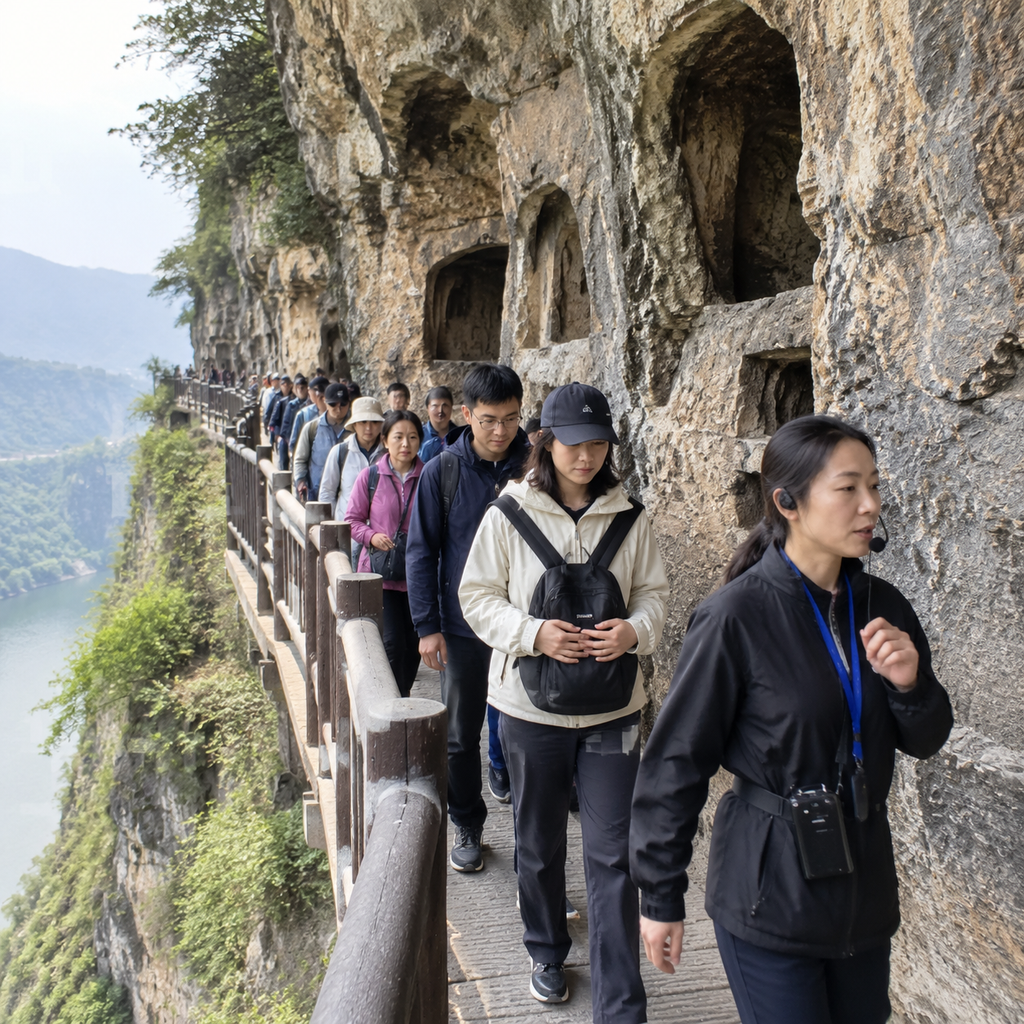
真正进入洞窟相关空间时,风沙的存在反而变得不那么直接,可我的身体仍然记得刚才的风。鞋底带进来的沙粒让我每一步都更加小心,衣领里残留的干涩感提醒我不要频繁触摸脸部,外面的强光则让眼睛需要一点时间适应较暗的环境。讲解人员在前面控制节奏,进入和离开之间有清楚的间隔。有人走得快,刚想越过前面的人,工作人员便侧身挡住路线,用手势让他回到队列。没有争执,也没有长篇训斥,队伍很快恢复移动。我在那一刻感到,文化遗产的观看有时必须接受“不自由”:不能任意折返,不能想停多久就停多久,也不能把个人方便放在空间承受能力之上。
Inside the cave-related spaces, the sand was less visible, but my body still remembered the wind. Grains carried in by my shoes made each step more deliberate. The dryness left around my collar discouraged me from touching my face repeatedly, and the bright outdoors meant my eyes needed time to adjust to the darker interior. The guide regulated the pace, with clear intervals for entering and leaving. A visitor moved quickly and tried to pass; a staff member stepped sideways to block the route and gestured for him to return to the line. There was no argument and no lengthy reprimand, and the group soon moved again. I felt that viewing heritage sometimes requires accepting limits: I cannot turn back whenever I want, stop for as long as I want, or place personal convenience above what the space can bear.
我没有把那些限制当成参观体验的缺失。相反,限制使我开始注意到洞窟不是一个可以随意消费的室内展厅。这里的空间、空气、光线、温湿度以及人的数量彼此牵连,我能做的不是凭肉眼判断一切是否安全,而是相信专业人员建立的边界。关于保护,我不敢写自己看见了什么具体壁画细节,因为我知道短暂观看��专业监测不是一回事。我能确认的只有自己的行为:我没有伸手靠近墙面,没有把手机闪光打开,没有为了寻找更好的角度挤到别人前面,也没有把讲解员尚未说完的内容抢先解释给同行人听。保护意识首先要求我承认自己的无知。
I did not treat those limits as a missing part of the visit. They made me realize that the caves are not an indoor display room available for unrestricted consumption. Space, air, light, temperature, humidity, and visitor numbers are connected, and I could not judge safety with my eyes alone; I had to trust boundaries established by professionals. I will not claim to have noticed specific mural details, because a brief visit is not the same as professional monitoring. What I can confirm is my own conduct: I did not reach toward a wall, turn on a flash, push ahead for a better angle, or interrupt the guide by explaining unfinished information to my companion. Conservation awareness begins with admitting what I do not know.
讲解员的作用也不只是把知识从一个人的嘴里传到另一群人的耳朵里。她会在队伍过于靠近时停一下,等后面的人重新拉开距离;会观察有人因为光线变化而迟疑,便用更慢的手势引导;会在离开一个空间前确认没有人落在后面。她的语气并不总是抑扬顿挫,有些提示甚至重复了几次,可正是这种重复把参观从一次性的兴奋拉回到持续的注意。同行人问了一个关于保护的问题,我没有听到完整答案,只看到讲解员先让大家站稳,再把回答放在队伍不拥堵的位置。知识在这里必须服从现场,现场也因此变得更有意义。
The guide’s role was not simply to transfer information from one mouth to many ears. She paused when the group became too close, waiting for the people behind to create space again. When someone hesitated as the light changed, she used slower gestures to guide them. Her voice was not always dramatic, and some reminders were repeated several times. That repetition brought the visit back from one-time excitement to sustained attention. My companion asked a conservation-related question. I did not hear the full answer, but I saw the guide first make sure everyone was standing safely, then respond where the line would not become congested. Here, knowledge had to follow the needs of the site, and the site became more meaningful because of that discipline.
我开始留意自己在“看”这件事上的贪心。刚开始,我总想把眼睛停在最显眼的地方,想迅速建立一张完整印象,好像只要看得足够多,就能证明这趟路没有白���。后来我发现,真正难的是接受片段。讲解员让我们移动时,我需要离开尚未看够的位置;光线和角度不允许我把所有东西看清时,我需要停止追逐细节;同行人脚步变慢时,我还要把自己的速度放回群体。遗产观看不是把空间占为己有,而是在有限时间里与其他人共享一份不能复制的现场。共享意味着我必须放弃一部分“完整拥有”的幻想。
I began to notice my own greed in looking. At first I wanted to keep my eyes on the most prominent places, building a complete impression as quickly as possible, as if seeing enough would prove the journey worthwhile. Then I realized that the harder task was accepting fragments. When the guide moved us on, I had to leave a place I had not finished looking at. When light and angle did not allow me to see everything clearly, I had to stop chasing detail. When my companion slowed down, I had to return my pace to the group. Heritage viewing is not taking possession of a space. It is sharing an unrepeatable encounter within limited time. Sharing means giving up the fantasy of completely owning what I see.
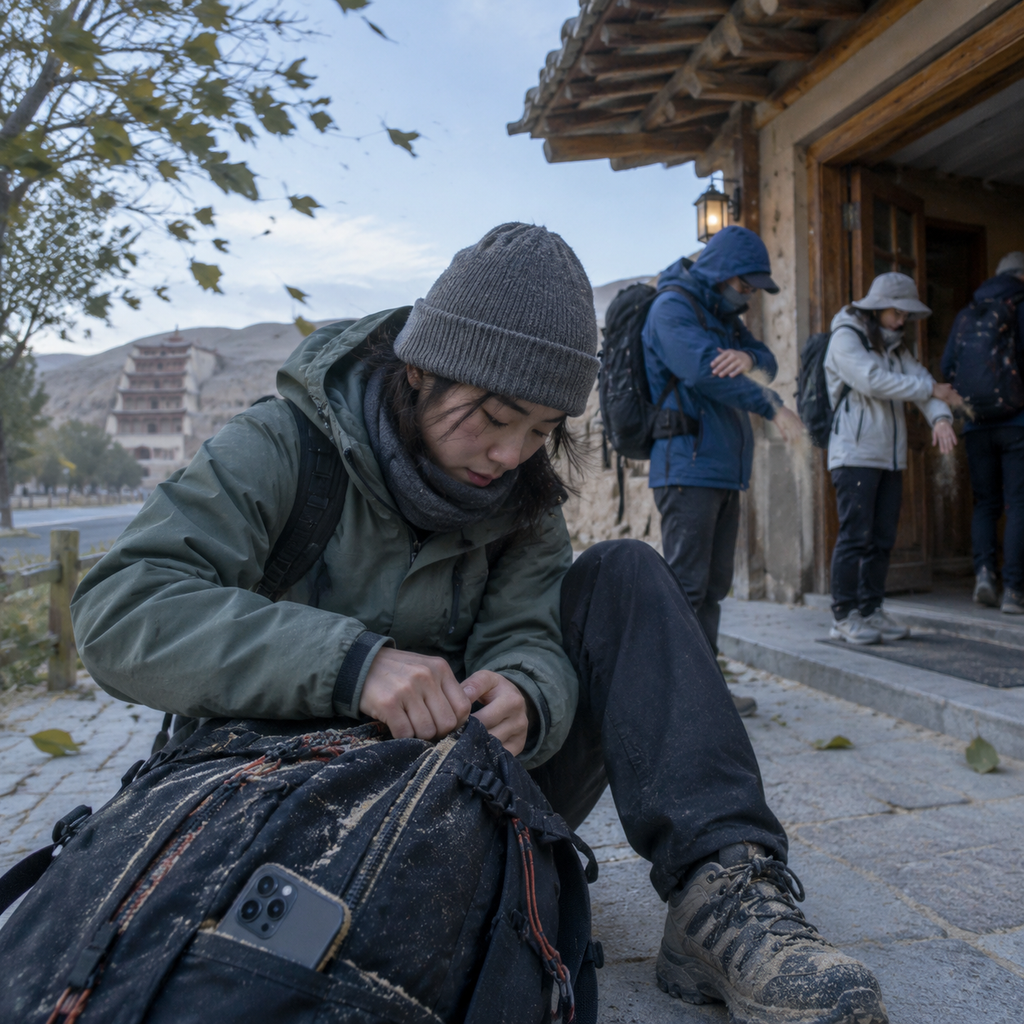
外面的风沙还在影响参观后的每个小动作。离开洞窟区域时,游客们没有立刻散开,有人先检查眼镜边缘,有人拍掉鞋面上的沙,有人把相机从保护袋里取出又马上放回去。工作人员提醒大家不要堵在出口附近,队伍于是沿着通道继续向前。我原本想在出口停下来拍一张人群和荒地的照片,可看见一位老人需要慢慢走过,我便把手机放下,让出靠边的位置。照片并没有因此消失,反而变成了一种不必保存的记忆:我记得自己曾经把取景框让给一个人的脚步。
The wind and sand continued to shape every small action after we left the caves. Visitors did not scatter immediately. Some checked the edges of their glasses, some brushed sand from their shoes, and others took cameras out of protective bags only to put them away again. Staff reminded everyone not to block the exit, so the group continued along the passage. I had wanted to stop there for a photograph of the people and the open land, but an elderly visitor needed to walk through slowly. I put my phone down and moved aside. The photograph did not vanish. It became a memory that needed no file: I remembered giving the frame to someone else’s careful steps.
我的行程在午后出现了一个很实际的调整。原先安排的户外停留被我取消了一部分,不是因为敦煌不值得继续看,而是因为风让眼睛和皮肤都在消耗注意力。我把时间留给较安静的室内休息,也重新检查了水、纸巾、眼镜布和设备保护。这个决定没有什么戏剧性,却使我更清楚地理解旅行计划的边界:行程表只能告诉我顺序,不能替我判断身体是否还能稳定地观看。若为了完成清单而让自己疲惫到只剩下拍照反射,景点再多也不会增加理解。我宁愿少去一个地方,也不想把莫高窟变成被风沙和疲劳共同压缩的打卡节点。
My itinerary changed in a very practical way that afternoon. I cancelled part of the outdoor stop, not because Dunhuang was unworthy of further attention, but because the wind was consuming the attention of my eyes and skin. I kept time for a quieter indoor rest and checked my water, tissues, glasses cloth, and equipment protection again. The decision was not dramatic, yet it clarified the limits of travel planning: an itinerary can tell me an order, but it cannot decide whether my body can still look steadily. If I follow a checklist until fatigue leaves me with only a reflex to take photographs, more attractions will not create more understanding. I would rather visit one fewer place than compress the Mogao Caves into a stopover shaped jointly by sand and exhaustion.
休息时,我听见同行游客讨论刚才的参观。有人说自己没有看清某些内容,有人说队伍移动得比想象中快,也有���觉得不能拍照很可惜。我没有急着判断谁对谁错,因为这些反应都很真实。遗产参观和普通景点浏览不同,它经常要求游客把“我付出了时间,所以应该得到完整自由”这套消费逻辑放在一边。工作人员不是在减少我们的收获,而是在为整个群体保留一个可持续的观看条件。一个人多停留几分钟,可能就意味着后面的人更拥挤;一个人随手触碰,可能把不可逆的风险转嫁给别人。我逐渐明白,遗产现场的公平不是每个人都随心所欲,而是每个人都承担一点限制。
During the rest, I heard visitors discussing the visit. One said certain things had not been clear; another found the group faster than expected; someone else regretted not being able to take photographs. I did not rush to decide who was right, because each reaction was genuine. Heritage visits differ from ordinary sightseeing: they often ask visitors to set aside the consumer logic that time and payment should guarantee complete freedom. Staff were not reducing our experience; they were preserving conditions for a sustainable shared view. One person stopping for several extra minutes could make the people behind more crowded. One casual touch could pass irreversible risk to others. I began to understand that fairness at a heritage site does not mean everyone follows every impulse. It means everyone accepts a small share of limitation.
我也观察到游客之间的互相提醒。一个年轻人把手机举得很高,旁边的同伴轻轻碰了碰他的手臂,他马上收低;一位孩子在通道边蹲下系鞋带,家长先看向工作人员,得到允许后才把孩子带到不妨碍人流的位置;有人听漏了提示,前面的游客回头用手指了指队伍方向,却没有替工作人员训斥。这样的互动没有被写进任何导览词,却构成了参观秩序的肌理。工作人员负责建立规则和及时纠偏,游客则用自己的动作把规则变成现场习惯。保护并不只存在于专业术语中,也存在于一个人是否愿意轻声提醒另一个人。
I also watched visitors remind one another. A young person raised a phone high; a companion lightly touched his arm, and he lowered it at once. A child crouched beside the passage to tie a shoe. The parent first looked toward staff and, after receiving permission, moved the child somewhere that did not obstruct the flow. Someone missed an instruction, and a visitor ahead pointed back toward the line without scolding in the staff member’s place. None of this appeared in a tour script, yet it formed the texture of order. Staff established rules and corrected problems; visitors turned those rules into habits through their movements. Conservation does not exist only in professional terms. It also exists in whether one person is willing to offer another a quiet reminder.
敦煌的风沙让我重新思考“古老”这个词。古老并不等于静止,也不等于可以让今天的人随意进入、随意观看。风每天都可能改变地表的触感,游客每天都在带来新的重量、热量和声音,工作人员则不断在这些变化中维持一个脆弱的平衡。我不具备判断遗产状况的专业能力,所以不把个人感动冒充知识,也不把一次参观当成对漫长历史的概括。能做的事情反而很具体:遵守安排,减少不必要的动作,听完提示,保持距离,不把未经核实的细节讲成事实。面对古老之物,谦逊不是姿态,而是一种减少干扰的方法。
Dunhuang’s wind and sand made me rethink the word “ancient.” Ancient does not mean motionless, nor does it mean that people today may enter, look, and behave without limits. Wind can alter the surface of the land every day. Visitors bring new weight, warmth, and sound each day. Staff continually maintain a fragile balance among these changes. I do not have the expertise to assess the condition of heritage, so I will not disguise personal emotion as knowledge or treat one visit as a summary of a long history. What I can do is concrete: follow arrangements, reduce unnecessary movement, listen to instructions, keep distance, and avoid presenting unverified details as fact. In front of something old, humility is not a pose. It is a way to reduce disturbance.
下午风势稍微变化时,我没有立刻把取消的户外路线补回来。站在窗边,我看着远处颜色单调的地面和被风吹斜的细线,忽然觉得“多看一点”未必等于“看得更深”。我把当天已经发生的片段重新排列:入口处收紧的帽带,队伍里收低的手机,讲解员停下来等待的几秒,出口处给老人让开的空隙,还有鞋底沙粒带来的谨慎。它们没有组成一幅壮观的照片,却共同说明了一个事实:观看文化遗产需要借助制度,也需要借助身体的自我约束。旅行不是把所有可能的地点填满,而是让自己在某个地方留下更准确的感受。
When the wind shifted slightly in the afternoon, I did not immediately restore the outdoor route I had cancelled. From the window I watched the plain-colored ground and fine lines slanting in the wind, and realized that seeing more does not necessarily mean seeing more deeply. I rearranged the day’s fragments: a tightened hat strap at the entrance, lowered phones in the queue, the few seconds when the guide waited, the space given to an elderly visitor at the exit, and the caution created by sand under my shoes. They did not form a spectacular photograph, but together they made one point clear: viewing cultural heritage relies on institutions and on bodily restraint. Travel is not filling every possible location. It is allowing one place to leave a more accurate impression.
我后来把“保护意识”理解成一种观看技术,而不只是道德要求。它要求我先看清自己所在的位置,再看景物;先听清工作人员的提示,再追问自己的好奇;先估计身体会不会挡住别人,再举起设备。它还要求我承认有些信息应该交给专业讲解和公开资料,而不是凭印象补全。面对没有被我看清的部分,我可以保留疑问;面对没有被允许拍摄的部分,我可以让记忆以语言和感受留下,而不是寻找规避规则的方法。这样的观看速度更慢,却并不贫乏。它把“我想得到什么”改成“这个地方允许我怎样接近”。
I later understood conservation awareness as a technique of looking, not only a moral demand. It asks me to identify my position before studying an object, listen to staff before pursuing curiosity, and consider whether I will block someone before raising a device. It also asks me to leave certain information to professional guides and public sources rather than filling gaps from impressions. When something remains unclear, I can keep the question. When photography is not allowed, memory can remain through language and feeling instead of through attempts to evade a rule. This pace is slower, but not poorer. It changes “What do I want to obtain?” into “How does this place allow me to approach?”
回程时,车里安静了很多。大家都被风吹得有些疲惫,手机屏幕一块块暗下去,偶尔有人递纸巾给旁边的人擦眼镜。窗外的风仍然把地面吹出模糊的层次,我却不再把它当成需要等待的坏天气。它提醒我,莫高窟所在的环境本身就参与了这次观看:我在风里收紧衣物,在沙里改变脚步,在保护边界前降低声音,也在工作人员的推动下承认自己的路线不能完全由愿望决定。那种被环境和秩序共同塑形的感觉,比“我看到了多少”更长久。
The vehicle was much quieter on the way back. The wind had tired everyone. Phone screens went dark one by one, and occasionally someone passed tissues to a neighbor cleaning their glasses. Outside, the wind still blurred the layers of the ground, but I no longer treated it as bad weather that merely needed to pass. It reminded me that the environment around the Mogao Caves participates in the act of viewing: I tightened my clothing in the wind, changed my steps in the sand, lowered my voice near conservation boundaries, and accepted, through staff guidance, that my route could not be governed entirely by desire. Being shaped jointly by environment and order stayed with me longer than the number of things I had seen.
我在敦煌的最后一个晚上没有急着整理照片。相机里有一些模糊的风景,有几张因为沙粒落在镜片附近而不够清楚,我没有把它们全部删除。它们让我想起这趟参观的真正难处并不是抵达,而是抵达之后怎样不把自己变成空间的负担。我也想起那些没有被镜头保存的动作:让路、收低手机、拉紧袋口、听完提示再提问、在风大时放弃一段路线。它们比一张完整的纪念照更能说明我如何接近莫高窟。古老的时间没有因为我到来而停下,只是风沙把我的脚步吹慢,让我终于有机会听见观看本身的重量。
On my final evening in Dunhuang, I did not rush to sort the photographs. Some landscapes were blurred, and several images were unclear because sand had gathered near the lens. I did not delete them all. They reminded me that the real difficulty was not arriving, but learning how not to become a burden to the space after arriving. I also remembered movements the camera had not saved: making room, lowering a phone, tightening a bag, listening before asking, and giving up part of a route when the wind rose. These gestures explain how I approached the Mogao Caves better than a complete souvenir photograph. Ancient time did not pause because I came. The sand simply slowed my steps enough for me to hear the weight of viewing itself.
我在第二天重新想起入口处那段路,发现自己此前把“抵达”想得太轻了。对很多旅行者来说,交通工具停下的那一刻似乎就意味着景点已经开始;可在敦煌,风向、扬尘、衣物、设备和人流都还没有进入稳定状态。有人一下车就寻找拍摄位置,有人先低头确认鞋带和包扣,也有人站在原地等眼睛适应被风吹来的沙。几种动作放在一起,像一场没有口令的准备操。它提醒我,参观莫高窟不能只按地图上的距离判断难度,还要把环境变化造成的迟疑、整理和等待算进去。一个人如果提前留出整理物品的时间,就不必在队伍中途停下来;如果先把会被风吹动的物件收好,也不会因为追逐一张照片而让同伴或陌生人替自己承担风险。行程节奏不是越快越好,而是让每个动作都有余地。
When I thought again about the approach from the entrance, I realized that I had previously treated “arrival” too lightly. For many travelers, the moment a vehicle stops seems to mark the beginning of a sight. In Dunhuang, however, wind direction, airborne sand, clothing, equipment, and crowd movement may not yet be settled. Some people step out and immediately search for a photographic position. Others first check their shoelaces and bag clasps, while some stand still until their eyes adjust to the sand carried by the wind. Together, these gestures resemble a warm-up without a spoken command. They reminded me that visiting the Mogao Caves cannot be judged only by distance on a map. Hesitation, tidying, and waiting caused by the environment also belong in the calculation. If a traveler leaves time to arrange belongings, there is less need to stop in the middle of a line. If loose items are secured first, companions and strangers will not have to bear the risk created by a chase for one photograph. A good pace is not the fastest pace; it is a pace that gives every action room.
我还开始留意“队伍”这个词在现场的实际含义。它不是一条永远笔直的线,也不是把所有人变成同一种速度的工具。前后距离会因为视线、地面状况和身体差异不断微调,工作人员的手势像是在给这条线安装柔软的关节。走得快的人需要克制,走得慢的人也不必因为自己的速度感到抱歉。对年长者、孩子、戴眼镜的人,或被风吹得睁不开眼的人来说,几步路的缓慢可能是保持稳定的必要条件。旁边的人若只想着“别拖慢我”,队伍就会变得紧张;若大家愿意把距离放宽一点,移动反而更顺。秩序的价值不在于让所有人看起来整齐,而在于让不同身体都能在同一空间里安全地前进。参观者不需要彼此认识,也可以用不抢行、不贴身、不横穿的方式给陌生人留出尊严。
I also began to notice what the word “queue” means in practice. It is not a permanently straight line, nor a device for forcing everyone into the same speed. The distance between people adjusts with sightlines, ground conditions, and bodily differences. Staff gestures give this moving line soft joints. Those who walk quickly need restraint; those who walk slowly do not need to apologize for their pace. For older visitors, children, people wearing glasses, or anyone struggling to keep their eyes open in the wind, a few slower steps may be necessary for stability. If those nearby think only, “Do not slow me down,” the queue becomes tense. If everyone allows a little more space, movement becomes smoother. Order does not matter because it makes people look identical. It matters because different bodies can move safely through one shared place. Visitors do not need to know one another to offer dignity through not cutting in, crowding, or crossing sideways through the flow.
风沙也改变了我对“装备”的理解。我原来把设备保护看成摄影爱好者才需要操心的事情,后来才发现,手机、眼镜、口罩、帽子和普通背包都可能影响参观动作。手机屏幕沾上细沙时,人会本能地反复擦拭;眼镜模糊时,人会停下来寻找光线;帽子松动时,人会突然伸手去抓。每一次临时处理都可能让身体偏离队伍,或者让手臂扫到身边的人。因此,真正有用的准备并不在于带上最多的东西,而在于把常用物品放在不必翻找的位置,把不急着使用的设备收紧,把擦拭镜片的动作安排在不阻挡通道的地方。这样的准备看似琐碎,却会减少现场的慌乱。保护意识有时从一个很小的决定开始:不让自己的物品在风中成为别人的障碍,也不让自己的急躁变成空间的额外负担。
Wind and sand also changed my understanding of “equipment.” I had thought protecting devices was mainly a concern for photography enthusiasts. Later I saw that a phone, glasses, mask, hat, or ordinary backpack could all affect the way someone moved. When fine sand touched a screen, the instinct was to wipe it repeatedly. When glasses blurred, a visitor might stop to find better light. When a hat loosened, a hand might suddenly reach up to catch it. Each improvised action could pull the body out of the group or brush an arm against someone nearby. Useful preparation therefore does not mean carrying the most things. It means placing frequently used items where they do not require searching, securing equipment that can wait, and wiping lenses only where the passage remains clear. These details look minor, but they reduce confusion on site. Conservation awareness sometimes begins with a small decision: do not let belongings become another person’s obstacle in the wind, and do not let impatience add another burden to the space.
参观秩序还有一个容易被忽略的层面:声音。风大的时候,人们会下意识提高音量,可在相对安静的空间里,过大的声音又会覆盖讲解和提示。有人为了让同伴听见而重复一句话,后面的人便不得不再靠近;有人边走边讨论刚才看到的内容,讨论本身没有问题,但若停在狭窄处,声音和身体就同时占据了通道。我后来尽量把问题记在心里,等到队伍允许停留或离开后再问。没有问出口的问题并没有消失,它们反而提醒我:知识获取也有时机。听讲时保持安静,不代表放弃交流;它意味着先让现场的基本信息完整抵达每个人,再把个人的疑问放进合适的间隙。对于公共文化空间而言,降低音量不是礼貌装饰,而是让信息能够被更多人听见的实际方法。
Visitor order also has a frequently overlooked dimension: sound. In strong wind, people naturally raise their voices, yet in a quieter space an unnecessarily loud voice can cover explanations and instructions. Someone may repeat a sentence so a companion can hear, causing people behind to move closer. Another person may discuss what was just seen while walking. Discussion is not the problem, but if it happens in a narrow section, both sound and bodies occupy the passage. I began to keep questions in mind and ask them only when the group could stop or had moved away. An unasked question had not vanished. It reminded me that learning also has timing. Staying quiet during an explanation does not mean giving up conversation; it means allowing essential information to reach everyone before placing a personal question into a suitable pause. In a public cultural space, lowering one’s voice is not decorative politeness. It is a practical way to help more people hear.
我对孩子在这里的表现印象很深。小朋友往往最先被风吸引,也最容易因为等待而不耐烦。他们想追着被吹动的纸片跑,想把帽子举起来看风从哪边来,或者在队伍暂停时蹲下研究地上的沙纹。成年人若只说“别动”,孩子未必理解原因;如果把提醒变成具体任务,情况会好很多。比如让孩子负责检查自己的帽带是否压好,观察前面的人什么时候移动,或者在不影响别人时数一数自己听见了几次提示。这样一来,秩序不再只是禁止,孩子也能参与判断。一个孩子愿意先看队伍再迈步,愿意在通道边缘等家人,而不是突然横穿,说明他正在学习公共空间的语言。保护教育并不一定要从复杂概念开始,先让孩子知道“我的动作会影响别人”,已经是很重要的起点。
I was especially struck by the children’s behavior there. Children are often the first to notice the wind and the first to become impatient while waiting. They may want to chase a scrap of paper, lift a hat to discover where the wind comes from, or crouch down to study patterns in the sand when the line pauses. If adults only say “Do not move,” children may not understand why. Turning the reminder into a concrete task works better. A child can check whether a hat strap is secure, watch for the people ahead to move, or count how many instructions are heard without disturbing anyone. Order then becomes more than prohibition; the child participates in judgment. When a child looks at the flow before stepping forward and waits at the edge for family instead of crossing suddenly, the child is learning the language of public space. Conservation education need not begin with complex concepts. Understanding that “my movement affects other people” is already an important beginning.
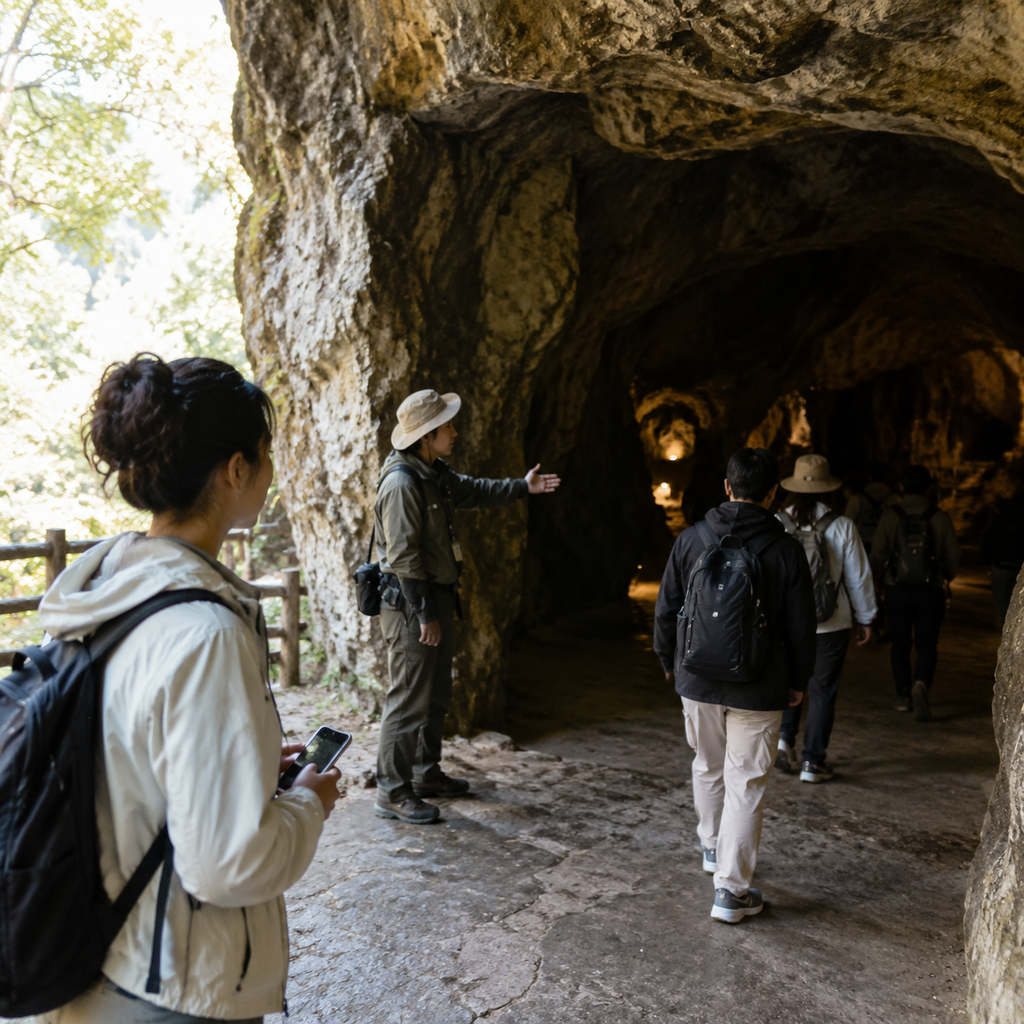
我也想到了那些因为信息不完整而焦虑的游客。第一次来到陌生遗产地,人很容易把不确定解释成管理混乱:不知道下一步往哪里走,不知道能不能停,不知道某个动作是否合适,于是便急着从别人身上寻找答案。有人跟着前面的人盲目加速,有人看到别人举手机就以为自己也可以举,有人因为担心错过内容而贴近讲解人员。其实,越是不确定,越应该先观察整体提示,而不是只复制邻近游客的动作。工作人员的手势、通道的宽窄、队伍的停顿和人群的方向,往往比某一个人的做法更可靠。若没有听清,可以在不打断移动的情况下礼貌询问;若答案暂时无法得到,也可以先跟随安排。行动判断不是要求旅行者永远自信,而是要求人在不确定中不把猜测变成冒险。
I also thought about visitors who became anxious because their information was incomplete. At an unfamiliar heritage site, it is easy to interpret uncertainty as disorder: not knowing where to go next, whether stopping is allowed, or whether a gesture is appropriate can make someone search hurriedly for answers in other people. A visitor may speed up because the person ahead did, assume photography is allowed because someone else raised a phone, or move close to a guide out of fear of missing information. Yet the less certain one feels, the more useful it is to observe the overall guidance rather than copy the nearest visitor. Staff gestures, passage width, pauses in the line, and the direction of the crowd are often more reliable than one person’s behavior. If something was not heard, it could be asked politely without interrupting movement. If an answer was not immediately available, following the arrangement was still possible. Good judgment does not require permanent confidence. It requires refusing to turn a guess into a risk when conditions are unclear.
当天我还看到一位游客因为天气变化而反复修改自己的计划。他起初背着较大的摄影包,走几步便停下来检查镜头,后来把其中一部分物品交给同行人保管,自己只留下水和必要的随身用品。这个过程没有被谁称赞,也没有形成什么戏剧性的高潮,却很有说服力:旅行者不是只能在“完全照计划完成”和“彻底放弃”之间二选一。可以缩短停留,可以降低设备负担,可以把拍摄愿望改成观察,也可以把一个户外节点留到条件更合适的时候。很多行程焦虑来自把计划当成承诺,仿佛少看一个地方就是失败。实际上,计划应该是帮助人作决定的草图,而不是逼迫身体服从的合同。面对风沙,能及时调整的人不是少完成了旅行,而是保住了继续旅行的能力。
That day I also saw a visitor revise his plan repeatedly as the weather changed. He had initially carried a large photography bag and stopped every few steps to check a lens. Later he handed some items to a companion and kept only water and what was necessary. No one praised the process, and it did not create a dramatic climax, but it was persuasive: a traveler does not have to choose only between completing a plan exactly and abandoning everything. A stop can be shortened, equipment reduced, a wish to photograph turned into observation, and an outdoor point postponed until conditions are more suitable. Much itinerary anxiety comes from treating a plan as a promise, as if seeing one fewer place meant failure. A plan is better understood as a sketch that supports decisions, not a contract forcing the body to obey. In wind and sand, a person who adjusts in time has not completed less of a journey; that person has protected the ability to continue traveling.
莫高窟给我的另一个提醒,是“慢”并不等于拖延。拖延是明明知道该做什么,却因为分心而迟迟不行动;慢则是把必要动作做完整,把注意力放在真正重要的地方。进出参观区域时,慢一点检查包带,慢一点确认前后距离,慢一点等同伴站稳,通常比匆忙后再回头补救更省时间。观看时慢一点,也不意味着占着一个位置不走,而是让目光在允许的时间内保持集中,不用不停切换手机、同伴和周围的动静。风沙把人的注意力切成许多小块,越想同时完成所有事情,越容易什么都做得粗糙。把动作拆开,先走稳、再听清、再观看、最后离开,节奏会显得朴素,却更接近一个负责任的参观者应有的状态。
The Mogao Caves gave me another reminder: being slow is not the same as delaying. Delay means knowing what should be done but postponing it through distraction. Slowness means completing necessary actions and placing attention where it matters. At entrances and exits, checking a strap carefully, confirming the distance ahead and behind, and waiting until a companion is steady can save more time than rushing and correcting mistakes later. Looking slowly does not mean occupying a position indefinitely. It means keeping the eyes focused during the permitted time instead of constantly switching between a phone, a companion, and surrounding movement. Wind and sand divide attention into small pieces. The more we try to do everything at once, the more roughly everything is done. Separating actions—walk steadily, listen carefully, look attentively, then leave—may seem plain, but it is closer to the condition of a responsible visitor.
如果把参观过程拆成几个判断节点,我会先问自己三个问题:现在的环境是否允许我停下来?我的身体和物品是否已经稳定?我的动作会不会改变别人的路线?这三个问题不需要专业术语,却能避免许多冲动。想拍照时,先看是否处于可以停留的位置;想提问时,先听完当前提示;想折返时,先确认是否会与进入的人流交叉;想整理衣物时,先移到不挡路的边缘。它们并不是一套僵硬的规章,而是把现场感受转换成行动的办法。旅行者当然会有遗憾,也会错过某个角度或某段内容,但遗憾并不比干扰更糟。一个没有得到的画面可以留在想象里,一次造成的触碰或拥堵却可能给别人留下真实的不便。
If I break the visit into decision points, I would ask three questions first: Is this environment suitable for me to stop? Are my body and belongings stable? Will my movement alter another person’s route? These questions require no specialized vocabulary, yet they prevent many impulses. Before taking a photograph, check whether stopping is allowed. Before asking a question, listen to the current instruction. Before turning back, make sure the movement will not cross the incoming flow. Before adjusting clothing, move to an edge that does not block the passage. These are not rigid regulations but ways to convert awareness of the site into action. A traveler will inevitably have regrets and miss a particular angle or piece of information, but regret is not worse than disturbance. An image not obtained can remain in imagination; a touch or obstruction can create real inconvenience for others.
在休息和回程之间,我对同行人说起一个很朴素的感受:参观遗产时,最值得带走的未必是“我见过什么”,还包括“我怎样没有去做某些事”。没有打开闪光灯,没有越过边界,没有把声音提高到压过讲解,没有为了让照片更完整而挤到前面,这些“不做”很难成为社交平台上的亮点,却是现场伦理最清楚的部分。它们让旅行从个人消费变成共同使用。一个空间能够接待许多人,不是因为它无限宽阔,而是因为人们愿意给它保留恢复和呼吸的余地。风沙让我更容易感到环境的脆弱,也让我意识到,若天气温和、视线清楚,人反而可能忘记自己的影响。看不见的承受能力同样需要被尊重。
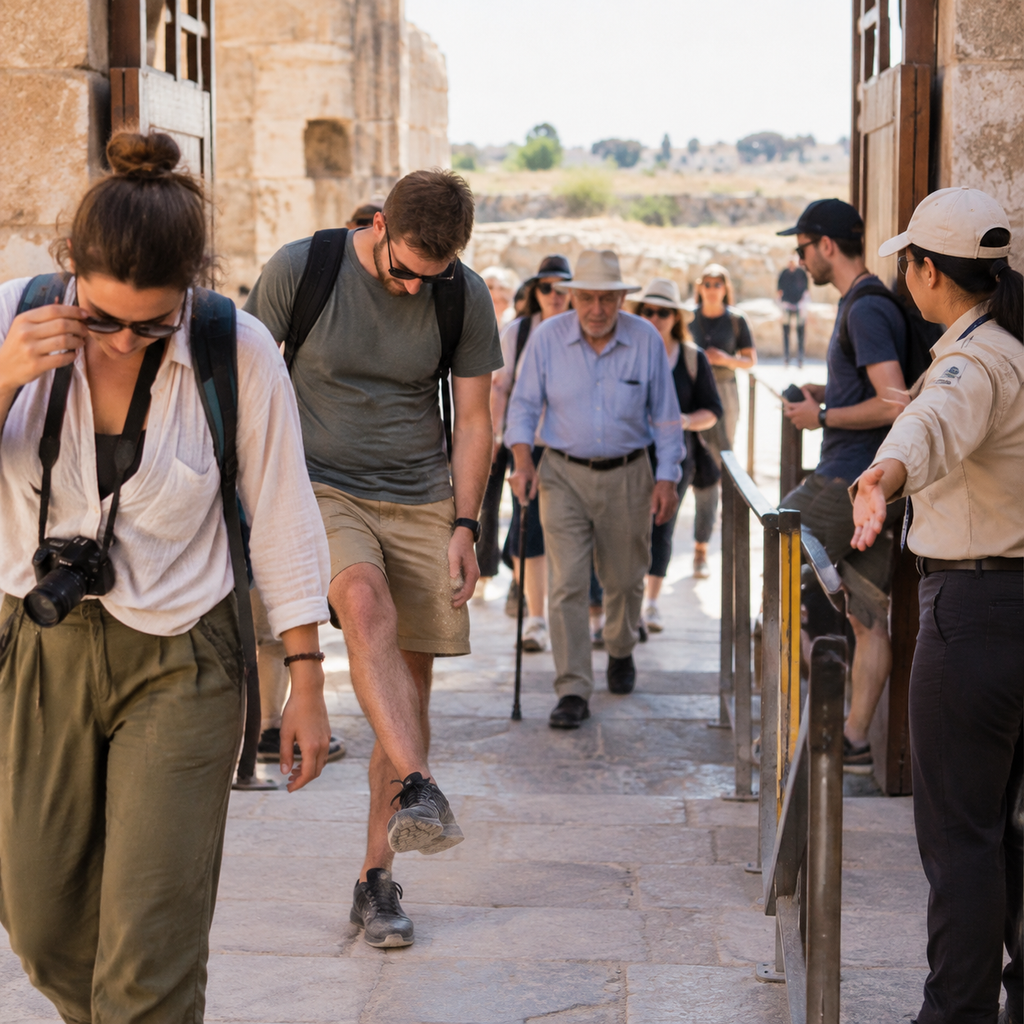
Between resting and returning, I shared a simple thought with my companion: in a heritage visit, what matters taking away is not only “what I saw,” but also “what I chose not to do.” I did not use a flash, cross a boundary, raise my voice over an explanation, or push forward for a more complete photograph. These refusals are unlikely to become highlights on social media, yet they reveal the clearest part of on-site ethics. They turn travel from individual consumption into shared use. A space can receive many people not because it is infinitely wide, but because visitors leave it room to recover and breathe. Wind and sand made the environment’s vulnerability easier to sense. They also made me realize that in mild weather and clear visibility, people may forget their own impact. Capacity that cannot be seen still deserves respect.
我不想把当天的风沙写成一种必须忍受的浪漫背景。它确实带来粗粝的美感,也确实让远景、路面和光线出现变化,但如果只把这些变化包装成“越艰苦越值得”,就会忽略身体的不适和保护工作的复杂性。有人眼睛不舒服,有人设备需要防护,有人走路变得谨慎,有人不得不放弃原本期待的停留,这些都是真实成本。承认成本并不会削弱敦煌的吸引力,反而使旅行判断更诚实。一个地方不需要靠让所有人吃苦来证明价值;旅行者也不需要把疲惫装成勋章。真正成熟的安排,是在想看、能看、该不该继续看之间不断校准。只有这样,风沙才不是被消费的异域符号,而是必须被认真对待的现场条件。
I do not want to turn that day’s wind and sand into a romantic background that visitors are expected to endure. It did create a rough beauty and changed distant views, surfaces, and light, but presenting every hardship as proof that a trip is worthwhile would ignore bodily discomfort and the complexity of conservation. Some people had irritated eyes, some needed to protect equipment, some walked more cautiously, and some had to give up a stop they had expected. These were real costs. Acknowledging them does not weaken Dunhuang’s appeal; it makes travel judgment more honest. A place does not need to make everyone suffer in order to prove its value, and travelers do not need to wear exhaustion like a medal. A mature plan keeps recalibrating among what one wants to see, what one can see, and whether one should continue. Only then does wind and sand remain a real condition of the site rather than an exotic symbol for consumption.
离开敦煌之前,我把参观时形成的判断延伸到其他遗产地。不同地方的空间承受能力不一样,管理方式也不一样,不能把在一个景区学到的动作机械地套到另一个地方。可有些原则可以带走:先看提示再行动,先确认边界再拍摄,先照顾队伍再满足个人好奇,遇到不确定时询问而不是猜测,发现自己疲惫时及时减量。更重要的是,不要把“我已经来到这里”当成一张可以换取无限自由的通行证。到达只是获得接近的机会,如何接近仍要由现场、规则和他人共同决定。这样的理解也改变了我的行程安排:我不再只统计去了几个点,而会考虑每段移动是否留出了观察、休息和调整的空间。
Before leaving Dunhuang, I extended the judgments formed during the visit to other heritage sites. Different places have different capacities and management methods, so an action learned in one destination cannot be mechanically imposed on another. Some principles can travel with us: read guidance before acting, confirm boundaries before photographing, consider the group before satisfying private curiosity, ask rather than guess when uncertain, and reduce the plan when fatigue appears. Most importantly, arriving somewhere is not a pass granting unlimited freedom. Arrival offers a chance to approach; how one approaches is still shaped by the site, its rules, and other people. This understanding also changed how I design itineraries. I no longer count only how many points I visited. I consider whether each movement leaves room for observation, rest, and adjustment.
最后一次经过风比较大的路段时,我没有再把手机拿出来。不是因为已经没有东西可看,而是因为我终于能把注意力放在风如何推动衣角、沙粒如何在路面上短暂聚集、身边人如何默契地收紧步伐。那几分钟没有新的信息进入相机,却有一种更完整的现场感留在身体里。莫高窟并没有要求我用一套漂亮的话证明自己懂得保护,我能做的只是把每一次提醒落实到行动,把每一次犹豫变成更谨慎的判断,把原本塞得过满的行程留出空白。空白不是浪费,它让人有机会在风停之前听见环境,在队伍移动时顾及他人,也让一次参观不止于“到过”。当脚下的沙不再被我急着甩掉,我知道这段路真正改变的,是我接近一个古老地方时的速度和分寸。
During the last stretch where the wind was strong, I did not take out my phone again. It was not because there was nothing left to see. I could finally attend to the way the wind moved the edges of clothing, the brief gathering of sand on the road, and the quiet way people around me tightened their steps. No new information entered the camera during those minutes, yet a fuller sense of the place remained in my body. The Mogao Caves did not ask me to prove conservation awareness with elegant words. I could only turn each reminder into conduct, turn each hesitation into a more careful judgment, and leave space in a schedule that had once been too full. Empty space is not wasted. It allows a person to hear the environment before the wind settles, consider others while the group moves, and make a visit more than a statement of having been there. When I no longer hurried to shake the sand from my shoes, I knew that the road had changed the speed and sense of proportion with which I approached an ancient place.
Public Source Notes
- 官方景区公开信息
- 文物保护机构公开资料
- 世界文化遗产公开资料
- 旅游公共服务公开信息
- 皮蛋:一颗被误解的中国蛋 | Century Egg: China's Most Misunderstood Delicacy
- 中国旅游医疗与保险指南 | Medical & Insurance Guide for China Travel
- 北京最怕第一次来的人一上来就把所有重量景点挤在同一天 | Beijing Is Hardest on First-Time Visitors When They Pack All the Heaviest Sights into One Day
- 我在中国早餐摊第一次学会豆浆要先问甜不甜 | The First Time I Learned at a Chinese Breakfast Stall to Ask Whether the Soy Milk Was Sweet
- 中医传统疗法 | Traditional Chinese Medicine
- 七月暑假全家游路线规划 | July Summer Family Trip Route Planning
- 我在重庆第一次学会先确认自己在哪一层,再决定往哪边走 | In Chongqing, I Learned to Confirm My Floor First Before Deciding Which Way to Go
- 中国跨城旅行怎么管钱:预算分桶法实战 | Budget Buckets for China Trips: A Practical Money System
- 青岛真正舒服的地方,不是海风和啤酒本身,而是白天夜里总会自己换挡 | What Makes Qingdao Truly Comfortable Is Not Sea Breeze and Beer Themselves but the Way the City Shifts Gears Between Day and Night
- 苏州不是靠滤镜取胜的城市,先后顺序一错,再美也会被看空 | Suzhou Is Not a City Won by Filters; Get the Sequence Wrong and Even Beauty Goes Flat
Comments (0)