
把重庆说成超大城市很容易,难的是教人第一晚从哪层开始不慌 | Calling Chongqing Massive Is Easy; Showing a Visitor Where to Begin on the First Night Without Panic Is Harder
他把重庆拍成“世界最大城市”以后,真正留住观众的是进入方法 | After He Framed Chongqing as One of the World's Largest Cities, What Really Held Viewers Was the Method of Entering It
Drew Binsky 这类国外头部旅行博主,最擅长的事情之一,就是把一座城市的第一印象直接推到极限。到了中国以后,重庆显然很适合这种镜头人格:人口规模巨大、坡地立体、轻轨穿楼、夜景密集,任何一个切口单独拿出来都足够抓人。但如果只把他的公开内容理解成“又一个外国人来重庆被震撼到了”,其实会低估这类视频真正有效的地方。它真正有效的,不只是夸张,而是它替观众完成了第一次进入一座超大中国城市的心理预演。
One of the things Drew Binsky does especially well is pushing the first impression of a city to its limit. After arriving in China, Chongqing clearly fit that camera personality: immense population scale, hillside layering, rail lines through towers, and dense night views, each of which is already gripping on its own. Yet if his public material is reduced to “another foreign traveler got stunned by Chongqing,” the most effective part of the video is missed. Its real effectiveness lies not in exaggeration alone, but in the way it performs a psychological rehearsal for entering a truly enormous Chinese city.
TravelCN 如果只摘取“世界最大城市之一”“36 million”这类标签,文章很容易变成一句会吓人的口号;可如果把他的公开视频当成一个进入动作来读,情况就不一样了。观众真正被带进去的,是从陌生、密集、判断失灵,到逐步找到交通逻辑、坡地逻辑和停下来喘气的位置。对于中国城市内容来说,这种“进入方法”远比惊呼本身更有长期价值。
If TravelCN extracts only labels such as “one of the world’s largest cities” or “36 million,” the article risks shrinking into a slogan whose main function is to intimidate. But once the public video is read as an entry process rather than a list of superlatives, the meaning shifts. What the viewer is led into is a sequence: unfamiliarity, density, temporary disorientation, and then the gradual discovery of transport logic, slope logic, and places where the body can pause. For writing about Chinese cities, that method of entry has far greater long-term value than surprise alone.
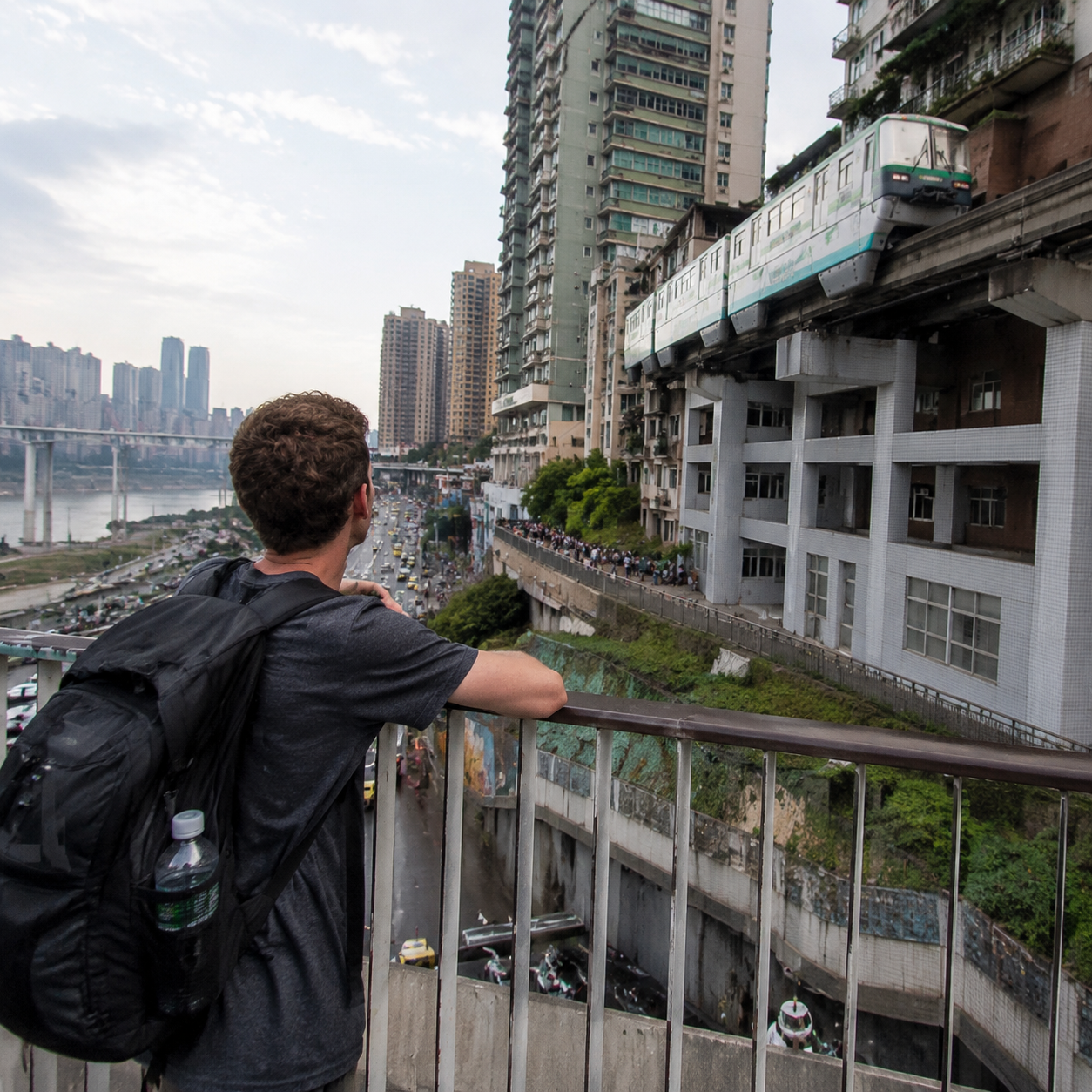

Drew Binsky 的重庆切口,为什么天然容易传播 / Why Drew Binsky’s Chongqing Angle Naturally Travels So Well
他公开标题里的重点其实很明确:不是“我去了重庆的一些景点”,而是“我正在进入一个极大的城市”。这句话的厉害之处,在于它立刻把观众从普通旅游观看模式里拽出来。因为人看景点,常常是在比较美不美;可一旦开始看“进入一座超大城市”,观众的注意力就会自然改成另一种问题:这里怎么动、怎么认路、怎么判断自己到底身处哪一层。
The emphasis in his public title is actually very clear. It is not “I visited some attractions in Chongqing,” but “I am entering an extremely large city.” The power of that frame is that it pulls the audience out of ordinary destination-viewing mode at once. People tend to judge attractions by whether they are beautiful. But the moment the subject becomes entering a mega-city, attention shifts almost automatically toward different questions: how does one move here, how does one orient, and how does one even determine which level of the city one is occupying?
重庆特别适合这种切口,因为它本身不是一种一眼就能读懂的城市。它不像很多平面城市那样,主干道、景点和方向关系在第一天就比较好理解。重庆的魅力恰好建立在“先误判,再修正”上:你以为自己已经到路面了,结果又要转一个平台;你以为这一段楼梯只是连接上下,结果它直接把你送进一条吃饭的街;你以为夜景只是远看,结果走近以后才发现它其实是由很多局部坡道、桥洞和转角共同撑起来的。
Chongqing is perfectly suited to this frame because it is not a city that yields itself in one glance. Unlike many flatter cities where the relation between main roads, landmarks, and directions becomes readable on day one, Chongqing builds part of its charm on a repeated cycle of misjudgment and correction. A traveler thinks they have reached street level and suddenly finds another platform. A staircase that seemed merely vertical becomes the entrance to a food street. A night view that looked like a distant spectacle turns out, up close, to be held together by slopes, bridge openings, and corners.

这类视频最值得读者学的,不是夸张,而是“先承认自己会乱” / What Readers Should Learn from This Kind of Video Is Not the Drama, but the Willingness to Admit They Will Get Confused
笔者一直觉得,国外大博主拍重庆最有参考价值的一点,不是他们能说出多大的数字,而是他们很愿意把“我刚刚有点搞不清楚这里怎么走”留在镜头里。这对观众是非常重要的示范。因为很多第一次来中国大城市的人,最怕的并不是路线复杂本身,而是自己一乱就开始怀疑:是不是我准备得不够、是不是我不适合来这种地方。
The writer has long felt that the most useful thing major foreign creators bring to Chongqing is not the scale number they can quote, but the willingness to leave moments of confusion inside the frame. That is an important model for viewers. Many people coming to a major Chinese city for the first time are not most frightened by complexity itself. What frightens them is the second step: the moment confusion makes them suspect they are underprepared or simply not suited to this kind of place.
可公开视频一旦把这种短暂失序拍出来,观众就会慢慢明白:原来在重庆这样的地方,方向感短时间失灵并不说明你不行,它只是进入过程的一部分。这样一来,观众就更容易把一时的迷路感,当成一种可恢复的旅行状态,而不是一次彻底的失败。对 TravelCN 来说,这种认知非常值钱,因为它能直接降低很多读者对中国超大城市的心理门槛。
Once public video leaves that temporary loss of orientation visible, viewers begin to understand something crucial: in a place like Chongqing, short-term disorientation does not prove personal inadequacy. It is simply part of the entry process. That insight helps people treat confusion as a recoverable travel condition rather than a total failure. For TravelCN, that is extremely valuable because it directly lowers the psychological threshold many readers feel toward China’s largest cities.
真正让视频成立的,是城市密度和生活切面同时出现 / What Makes the Video Work Is That Density and Everyday Life Appear Together

如果重庆只有高处夜景,它当然还是会被喜欢,但传播力不会这么耐久。真正让这类视频站得住的,是它把高密度城市奇观和日常生活切面放在了同一趟行程里:上一段可能是宏大的城市规模,下一段就切到地铁、老街、熊猫园、普通食物和走路时的体力反应。观众因此看到的不是一张海报,而是一种“这个地方真的有人每天这么过”的现实感。
If Chongqing offered only high night views, it would still attract people, but the durability of its spread would be weaker. What really stabilizes this kind of video is the way it places density and daily life inside the same journey. One segment may focus on giant urban scale, and the next cuts to the metro, older streets, a panda park, ordinary food, and the body’s reaction to walking. What viewers end up receiving is not a poster, but the reality that people genuinely live like this every day.
第三方报道体在这里最该补的,也正是这一层:一座让人震惊的中国大城,如果只写“震惊”,很快会变空;可如果能写出它怎么通过交通、食物、街巷和坡地把这种震惊固定下来,文章就会从热闹话题变成路线理解。Drew Binsky 的公开内容最适合被这样转化——不是复述他的每一步,而是把他那种“先大后细”的观看方式,变成普通读者也能拿去用的进入逻辑。
This is precisely the layer third-person reported writing should restore. A Chinese mega-city that shocks people quickly becomes hollow if the writing stops at shock alone. But once the text explains how transport, food, lanes, and slopes make that shock durable, the article turns from a loud topic into route understanding. Drew Binsky’s public content is especially suited to this kind of transformation—not by reproducing each step, but by turning his “macro first, detail next” viewing method into an entry logic ordinary readers can actually use.
对 TravelCN 来说,下一步不是继续喊“大”,而是继续拆“怎么进” / For TravelCN, the Next Step Is Not to Keep Shouting “Big,” but to Keep Breaking Down “How to Enter”
笔者更期待的,并不是再写一篇“重庆真的很大”,而是把“怎么进入重庆”这件事写得越来越具体:第一次到站以后,先判断哪一类出口;什么样的观景点适合白天,什么样的适合留到夜里;火锅应该放在哪个时段,坡地应该跟什么样的休息段搭配;一条看似很炸裂的重庆线路,怎样才能不把普通游客走成体力透支。
What the writer looks forward to is not another article repeating that Chongqing is enormous, but a growing specificity about how one actually enters it: which kind of exit to judge first after arrival, which viewpoints belong in daylight and which should be saved for night, where hotpot belongs in the day, what kind of rest segment should accompany steep walking, and how a route that looks visually explosive can avoid physically exhausting the ordinary traveler.
如果国外大博主负责把注意力带进来,那么 TravelCN 最该做的,就是把这种注意力接稳。Drew Binsky 已经替很多海外观众完成了“原来中国超大城市可以这样看”的第一步;站内文章若能继续把第二步、第三步补上——怎么进、怎么停、怎么走顺——这类报道体内容就会越来越有运营价值。
If major foreign creators are responsible for bringing attention in, then TravelCN’s task is to stabilize that attention. Drew Binsky has already completed the first move for many overseas viewers: showing that a Chinese mega-city can be looked at this way. If site articles continue by supplying the second and third moves—how to enter, where to pause, and how to make the route smoother—this kind of reported-format content will keep gaining operational value.
公开素材来源 / Public Source Notes
- Drew Binsky, “Entering the World's Largest City (Chongqing, China)”
- 仅少量使用公开视频封面作报道说明,不做整段搬运。
Public source used:
- Drew Binsky, “Entering the World's Largest City (Chongqing, China)”
- Only a very limited amount of public cover imagery is used for explanatory reporting, not for wholesale reproduction.
- 那张被擦亮的桌子,让我看见沙县小吃如何成为日常 | The Polished Table Showed Me How Shaxian Snacks Became Everyday Food
- 我第一次在中国用公共洗衣房,才发现洗衣这件小事也有一套共享秩序 | The First Time I Used a Public Laundry Room in China, I Realized Even Washing Clothes Has a Shared Order
- 中国住宿选择指南:酒店民宿客栈 | China Accommodation Guide: Hotels, B&Bs & Inns
- 阿坝雨后的路面只给我半个答案 | Aba’s Wet Road Gave Me Only Half an Answer
- 跨境支付的隐藏成本:汇率、限额与手续费,外国游客怎么少花冤枉钱 | The Hidden Costs of Cross-Border Payment in China: Exchange Rates, Limits & Fees That Catch Tourists Off Guard
- 中国寺庙参观礼仪完全指南 | The Complete Guide to Temple Etiquette in China
- 深圳夜里的便利店,让我看见中国城市的另一种安全感 | A Convenience Store at Night in Shenzhen Showed Me Another Kind of Urban Safety
- 在喀什,先让我停下来的不是景点,而是路口边那只刚出炉的馕 | In Kashgar, It Was Not a Landmark but a Fresh Naan Beside the Crossing That Made Me Stop
- 水果摊前站了十五分钟,我才学会在中国买水果不是只看价格 | Fifteen Minutes at a Fruit Stall Taught Me That Buying Fruit in China Is About More Than Price
- 中国西部丝绸之路探险 | Silk Road Adventures in Western China
Comments (0)