
苏州这种地方,最怕人还没看够,词已经先把它写完了 | A Place Like Suzhou Suffers Most When Words Finish It Before the Eyes Do
苏州真正难写的不是它有多温柔,而是你一旦写快了就会把它写空 | The Hardest Thing About Writing Suzhou Is Not Its Gentleness, but That the City Empties Out the Moment You Write It Too Fast
很多城市怕写慢,苏州却怕写快。因为你一旦着急,总会先抓那些最像苏州的东西:白墙、小桥、窄河、园林、乌篷船式的想象、清晨和雨后。它们当然都是真的,可如果文章只把这些标签快速排出来,苏州反而会立刻失掉神气。它最难得的地方,不在于“元素齐全”,而在于这些元素到底先后怎么出现。顺序一错,苏州就会变成一张明信片;顺序一对,它才会变成一座能走进去的小城系统。
Many cities are harmed by being written too slowly. Suzhou is harmed by being written too quickly. The moment the writer becomes impatient, the hand grabs the most visibly Suzhou-like elements first: white walls, little bridges, narrow water, gardens, boat imagery, early morning, and after-rain softness. All of those things are real. Yet the faster they are stacked, the quicker the city loses its inner life. Its value does not come merely from possessing the right elements. It comes from the order in which they appear. When that order goes wrong, Suzhou turns into a postcard. When it goes right, it becomes a small urban system one can actually enter.
对第一次来中国的人来说,苏州最大的误解通常不是“不够有名”,而是“看起来很好懂,所以应该很好走”。可真正走进去以后,决定体验质量的,往往不是你看了多少园林,而是你在什么时候进入园林;不是你拍了多少水巷,而是你在什么光线里去走那段水巷。TravelCN 如果只接住“很美很中国”的表层印象,会浪费掉这座城最珍贵的部分。
For first-time visitors to China, the largest misunderstanding about Suzhou is usually not that it lacks fame. It is that the city looks so readable that it must therefore be easy to walk. Once inside, however, what determines quality is not how many gardens one saw, but when one entered them; not how many canal lanes one photographed, but under what light one actually walked them. If TravelCN catches only the surface impression that Suzhou is beautiful and classically Chinese, it wastes the most precious thing the city has to offer.
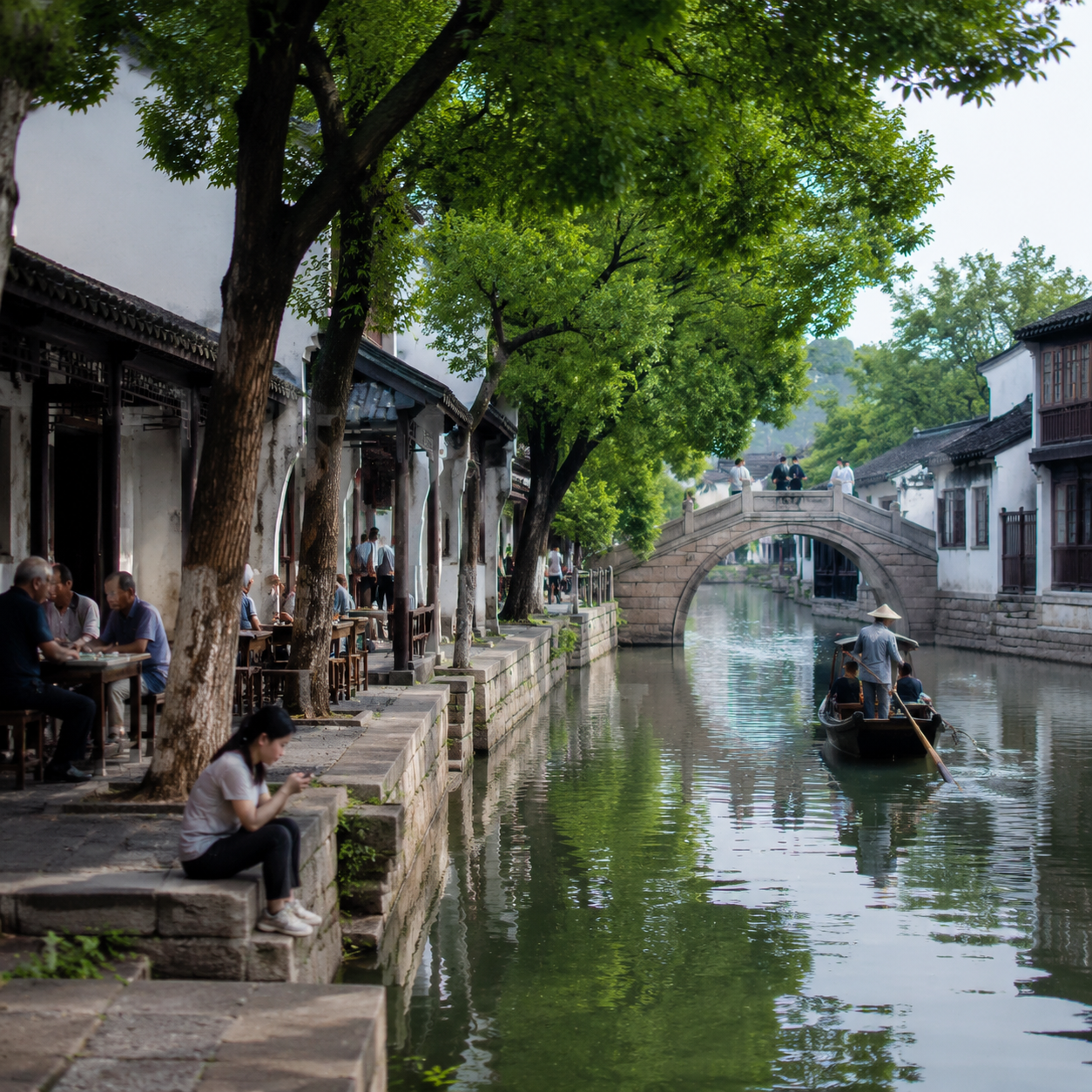
苏州最该讲明白的,是“眼睛什么时候开始变慢” / What Most Needs Explaining in Suzhou Is the Moment the Eye Begins to Slow Down
我一直觉得,苏州并不是那种一开始就会把人压住的城市。它更像先轻轻摆在你面前,看你会不会停下来。如果你的节奏还和大城市里一样,苏州会显得有点淡;可一旦眼睛开始变慢,它会突然变得很密。墙边的影子、回廊尽头那点亮处、水面细小的纹路、窗框背后留出的一点空白,都会比想象里更有内容。真正好的苏州文章,应该把这种“从淡到密”的过程写出来。
I have always felt that Suzhou is not the kind of city that overwhelms immediately. It first places itself lightly before the traveler and waits to see whether that traveler will stop. If one keeps moving with the rhythm of a larger city, Suzhou may seem almost thin. But once the eye slows down, the city suddenly becomes dense. The shadow beside a wall, the brightness at the end of a corridor, the fine lines on the surface of the water, and the small blank left behind a window frame all begin to carry more weight than expected. A good article about Suzhou should write this movement from lightness into density.
真正好的进入法,常常从“先少看一点”开始 / The Best Method of Entry Often Begins by Choosing to See Less at First
苏州最怕一种贪心:第一天就想把所有“最像苏州”的元素一次收完。园林想多看,河巷想多拍,桥要走完,夜色也不想错过。这样走不是不行,只是最后带走的往往只剩表面印象。更好的方法反而是先少看一点:先用一处园林把眼睛稳下来,再用一段水巷让步速降下来,最后才把更多细节慢慢放进视野里。对第一次来中国的读者来说,这种“先少一点”的判断,反而更容易让苏州真正成立。
Suzhou fears one particular form of greed: trying to collect every element that looks most like Suzhou on the first day. Too many gardens, too many canal photographs, every bridge walked, and evening atmosphere added on top. It is not impossible to move that way, but what remains afterward is often only the surface. A better method begins by seeing less. First let one garden stabilize the eye, then let one stretch of canal slow the pace, and only after that allow further details to enter the route. For readers coming to China for the first time, this judgment of less first often makes Suzhou feel more real rather than less.

这座城最后留住人的,往往不是“典型”,而是“回味” / What Often Makes Suzhou Stay in Memory Is Not Its Typicality, but Its Aftertaste
苏州当然很典型,可它真正留住人的地方,往往不是因为你确认了它很典型,而是因为离开以后你还在回想某一堵墙边的风、某一处园林转角的亮处、或者一条河边路上脚步自然放慢的那一刻。国外博主如果把这种回味留在公开内容里,TravelCN 最应该把它继续写深,因为这说明苏州不是一座只能靠标签成立的城市,它更像一座会在离开以后慢慢长大的城市。
Suzhou is certainly classic, but what often keeps it in memory is not the confirmation that it matches the expected image. It is the aftertaste: the wind beside one wall, the brightness at one turn in a garden, or the moment one’s steps naturally slowed on a canal-side lane. If foreign creators preserve that aftertaste in public material, TravelCN should deepen it further, because it proves that Suzhou is not a city sustained only by labels. It is a city that continues to grow after departure.
早晨在苏州最重要的,不是先拍,而是先让声音进来 / The Most Important Thing in Suzhou in the Morning Is Not to Photograph First, but to Let Sound Enter First
很多人到了苏州,第一反应是举起相机去找最像画面的角度。可真正好的早晨,并不总从画面开始,而往往从声音开始。水边有人提着东西走过,远一点有门被推开,桥下偶尔有轻轻的回音。你先听进去,再看进去,苏州就会变得更立体。因为这说明它不是一层静止布景,而是一座在很轻的声响里慢慢展开的城。
Many people arrive in Suzhou and instinctively raise the camera first, searching immediately for the angle that looks most like a painting. But a truly good morning does not always begin with the image. It often begins with sound. Someone passes the water carrying something in hand, a door opens farther away, and beneath the bridge there is sometimes a small returning echo. Once one listens first and looks second, Suzhou becomes more dimensional. It proves that the city is not a frozen set piece, but a place unfolding through very light sounds.

园林最适合的,不一定是“最多看几处”,而是“看完以后还留得住一点空白” / The Best Way to Use a Garden Is Not Always to See as Many as Possible, but to Leave with Some Blank Space Intact
苏州的园林如果排得太密,反而会互相冲淡。因为它们不是靠轰一下的壮观成立,而是靠转折、留白、借景和收束。你看完一处以后,最好让那一点空白先留在身上,再去下一处。国外博主如果把园林拍成连续机位,观众会觉得美;但如果 TravelCN 能补上“园林之间也需要留白”这层判断,读者得到的就不只是审美,而是更会走的能力。
If Suzhou’s gardens are packed too densely into one route, they begin to cancel one another out. They do not rely on one burst of spectacular force, but on turns, borrowed scenery, blankness, and closure. After leaving one garden, the traveler should ideally let some of that blankness remain before entering the next. Foreign creators may still make continuous garden shots feel beautiful, but if TravelCN adds the judgment that blank space is also needed between gardens, readers receive something more useful than beauty. They receive a better way of moving.
公开素材来源 / Public Source Notes
- 基于国外博主公开可见的苏州园林/水城路线内容切口重写,偏“如何进入苏州”的报道体分析。
- 不做整段搬运,重点转写路线与进入逻辑。
Public source note:
- Rewritten from publicly visible foreign-creator angles on Suzhou gardens and canal-city routes, focusing on method of entry rather than image alone.
- No wholesale reproduction is used; the emphasis is on route sequencing and perceptual rhythm.
- 中国行政区划与城市等级一览 | China's Administrative Divisions & City Tiers Explained
- 黄山山脚那家白灯小馆,让我在上山前先把胃和心都放平了 | A White-Lit Eatery at the Foot of Huangshan Settled Both My Stomach and My Mind Before the Climb
- 我站到皮影戏幕布后面的一晚 | The Night I Stepped Behind the Shadow Puppetry Screen
- 中国早餐图鉴:从豆浆油条到肠粉米粉 | A Field Guide to Chinese Breakfast: From Soy Milk & Fried Dough to Rice Rolls & Noodles
- 手机支付失败后,我给自己准备了三套备用方案 | After Mobile Payment Failed, I Prepared Three Backup Plans
- 一场突来的雨,让我在中国学会把屋檐下当成一种临时公共空间 | A Sudden Rain in China Taught Me to See the Eaves as Temporary Public Space
- 那本被果汁弄湿的拼音本,让本人第一次学会声调不是唱歌,而是方向 | A Pinyin Notebook Spilled with Juice Taught Me That Tones Are Not Singing but Direction
- 街头那碗热气,才是中国城市的真实体温 | Street Steam: The Real Pulse of Chinese Cities
- 皮影戏:光与影之间的千年叙事 | Shadow Puppetry: A Thousand Years of Storytelling Between Light and Shadow
- 贵阳的酸汤不是一道菜:从菜市场到晚饭桌 | Sour Soup in Guiyang Is More Than a Dish: From Market to Dinner Table
Comments (0)