
中国景区门口的安检队伍,其实有自己的节奏 | Security Lines at Chinese Scenic Spots Have Their Own Rhythm
中国景区门口的安检队伍,其实有自己的节奏 | Security Lines at Chinese Scenic Spots Have Their Own Rhythm
我第一次认真注意到中国景区门口的安检队伍,是在一个有雾的早晨。入口广场刚被洒水车洗过,石板还泛着湿光,卖烤肠的小车停在栏杆外,喇叭里反复提醒游客准备身份证件和门票。我背着一个鼓鼓的双肩包,里面有相机、薄外套、一本折角的地图,还有半瓶矿泉水。远远看去,队伍像一条被护栏折成几段的河,慢慢向前,却并不混乱。
The first time I really noticed the security line at the entrance of a Chinese scenic spot was on a misty morning. The plaza had just been washed by a street-cleaning truck, and the stone tiles still shone with damp light. A grilled-sausage cart waited outside the railings, while a loudspeaker repeated reminders about identity documents and tickets. I had a stuffed backpack with a camera, a light jacket, a folded map, and half a bottle of water. From a distance, the line looked like a river bent into several sections by metal barriers, moving slowly but not chaotically.
我当时以为自己只需要排队,像在机场一样等到轮到我,再把包放上机器。可是景区入口的节奏更接近一个早市:有人找同伴,有人把手机亮度调高,有老人问孩子票在哪里,还有穿红马甲的志愿者沿着护栏走动,提醒大家把雨伞、充电宝和水瓶提前拿出来。每个人都在移动,却又不断停顿,像一段需要跟着旁边人呼吸的慢拍子。
At first I thought I only needed to stand in line, as at an airport, wait my turn, and place my bag on the scanner. But the rhythm at a scenic spot felt closer to a morning market. People were looking for companions, increasing phone brightness, asking children where the tickets were, or listening to volunteers in red vests who walked along the railings and reminded everyone to take out umbrellas, power banks, and water bottles early. Everyone was moving, but everyone was also pausing, as if the whole line had a slow beat that depended on the breathing of the people beside you.
入口广场的空间很宽,却被分成了几种不同的路。左边是团队通道,导游举着小旗,身后跟着戴同色帽子的游客;中间是散客通道,排得最长,也最会突然停住;右边有一个较窄的快捷口,给本地年卡、老人优待证和工作人员使用。我站在中间队伍里,看见前面一家三口把背包从爸爸肩上换到妈妈手里,只为了让孩子腾出手拿证件。
The entrance plaza was wide, but it had been divided into several kinds of routes. On the left was the group channel, where guides held small flags and visitors in matching caps followed behind them. In the middle was the individual visitor channel, the longest and the most likely to stop without warning. On the right was a narrower fast lane for local annual passes, senior discount cards, and staff. I stood in the middle line and watched a family of three move a backpack from the father’s shoulder to the mother’s hand, simply so the child could free both hands for documents.
排队十分钟后,我才明白队伍的分流不是一开始就固定的。安检口前有两名工作人员,一名看机器屏幕,一名站在护栏转角处。他不大声喊,只用手势安排人群:手掌向左一压,十几个人就被引到旁边新开的通道;两根手指向前点,带小孩的家庭先靠近桌面;手背轻轻一挡,背包还没打开的人就会停在黄线外。那种手势很短,却很有效。
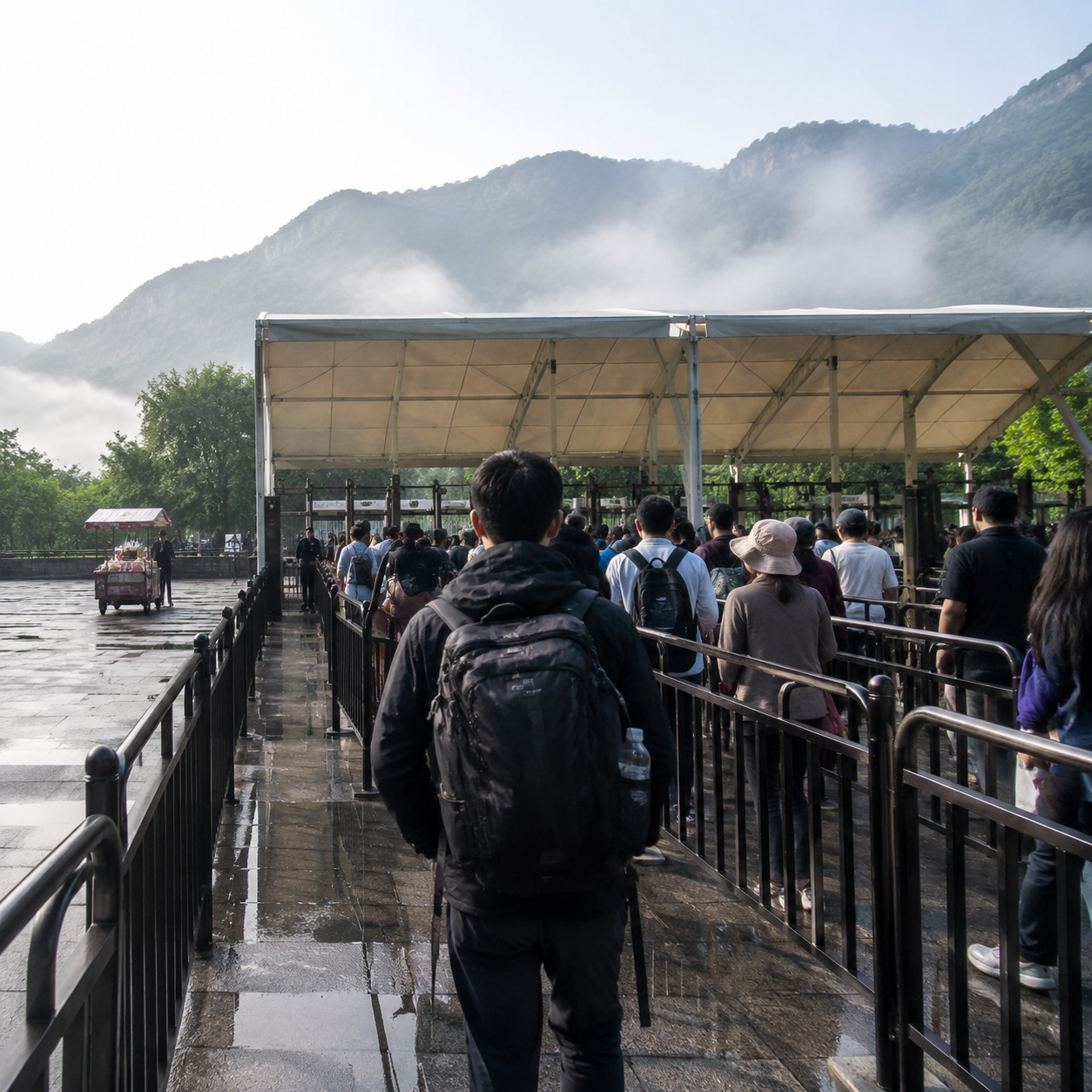
After ten minutes in line, I understood that the split in the queue was not fixed from the beginning. Two staff members stood near the security entrance: one watched the scanner screen, and another stood at the corner of the railing. He did not shout much. He arranged the crowd with gestures. A palm pressed to the left sent a dozen people toward a newly opened lane. Two fingers pointing forward brought families with small children closer to the table. The back of his hand raised slightly stopped anyone whose backpack was not yet open at the yellow line. The gestures were brief, but they worked.
我的前面是一位从广州来的阿姨,她带了一个布包和一只保温杯。她看我一直盯着队伍,笑着说:“你别看人多,快得很,先把水拿手上。”她把自己的杯盖拧松,又把布包的拉链拉开一半,动作熟练得像每天都要进一次景区。我照着她的样子,把矿泉水从包侧袋取出来,瓶身还带着早晨的凉气,手心一下子湿了。
In front of me stood an auntie from Guangzhou with a cloth bag and a thermos. Seeing me watching the line too carefully, she smiled and said, “Don’t be fooled by the crowd. It moves fast. Hold your water first.” She loosened the lid of her cup and opened the zipper of her cloth bag halfway, with the ease of someone who entered scenic spots every day. I copied her, pulling my mineral water from the side pocket of my backpack. The bottle was still cool from the morning air, and my palm became wet at once.
水瓶是我最早学会的细节。很多景区不禁止普通饮用水,但安检员需要确认它不是别的液体。前面一位年轻人把一瓶没开封的水放在篮子里,工作人员只是看了一眼;另一位游客带着深色保温杯,被请到旁边打开闻一闻。没有人表现得紧张,大家像接受一项临时的小检查,嘴上还在聊天,眼睛却已经看向下一道闸机。
The water bottle was one of the first details I learned. Many scenic spots do not ban ordinary drinking water, but the security staff need to confirm that it is not another liquid. A young man ahead of me placed an unopened bottle into the tray, and the staff member only glanced at it. Another visitor carried a dark thermos and was asked to step aside, open it, and let it be checked. Nobody seemed tense. People treated it as a small temporary inspection, still chatting while their eyes were already moving toward the next ticket gate.
真正让队伍变慢的不是安检机,而是包。一个背包能藏下太多小麻烦:折叠伞卡在侧袋,充电线缠住钥匙,饼干盒压在相机上,孩子的玩具枪被塞在最底层。每当有人在机器前才开始翻找,后面的队伍就会像被石头挡住的水,先静一下,再从旁边寻找新的缝隙。工作人员通常不会催得很凶,只会把空篮子推近一点,让人知道该快些。
What truly slowed the line was not the scanner, but the bags. A backpack can hide many small complications: a folding umbrella stuck in a side pocket, charging cables tangled with keys, a biscuit box pressing on a camera, a child’s toy gun buried at the bottom. Whenever someone began searching only after reaching the machine, the line behind them behaved like water blocked by a stone. It paused, then looked for another gap beside it. The staff usually did not rush people harshly. They simply pushed an empty tray closer, making the message clear.
我身后的配角是一对法国夫妇,第一次来中国旅行。他们带着登山杖和两只大相机包,明显把今天当作轻徒步。男士问我能不能把相机留在身上,我也不确定,只好指给他看前方的篮子。广州阿姨听见了,用很简单的英语说:“Bag, machine. Camera, maybe hand.”安检员听到后点点头,做了一个把包放下、把相机拿在手里的动作。
Behind me stood a French couple on their first trip to China. They carried trekking poles and two large camera bags, clearly treating the day as a light hike. The man asked whether he could keep the camera on his body. I was not sure, so I pointed at the trays ahead. The auntie from Guangzhou heard him and said in simple English, “Bag, machine. Camera, maybe hand.” A security worker nearby nodded and made a gesture: put the bag down, keep the camera in your hand.
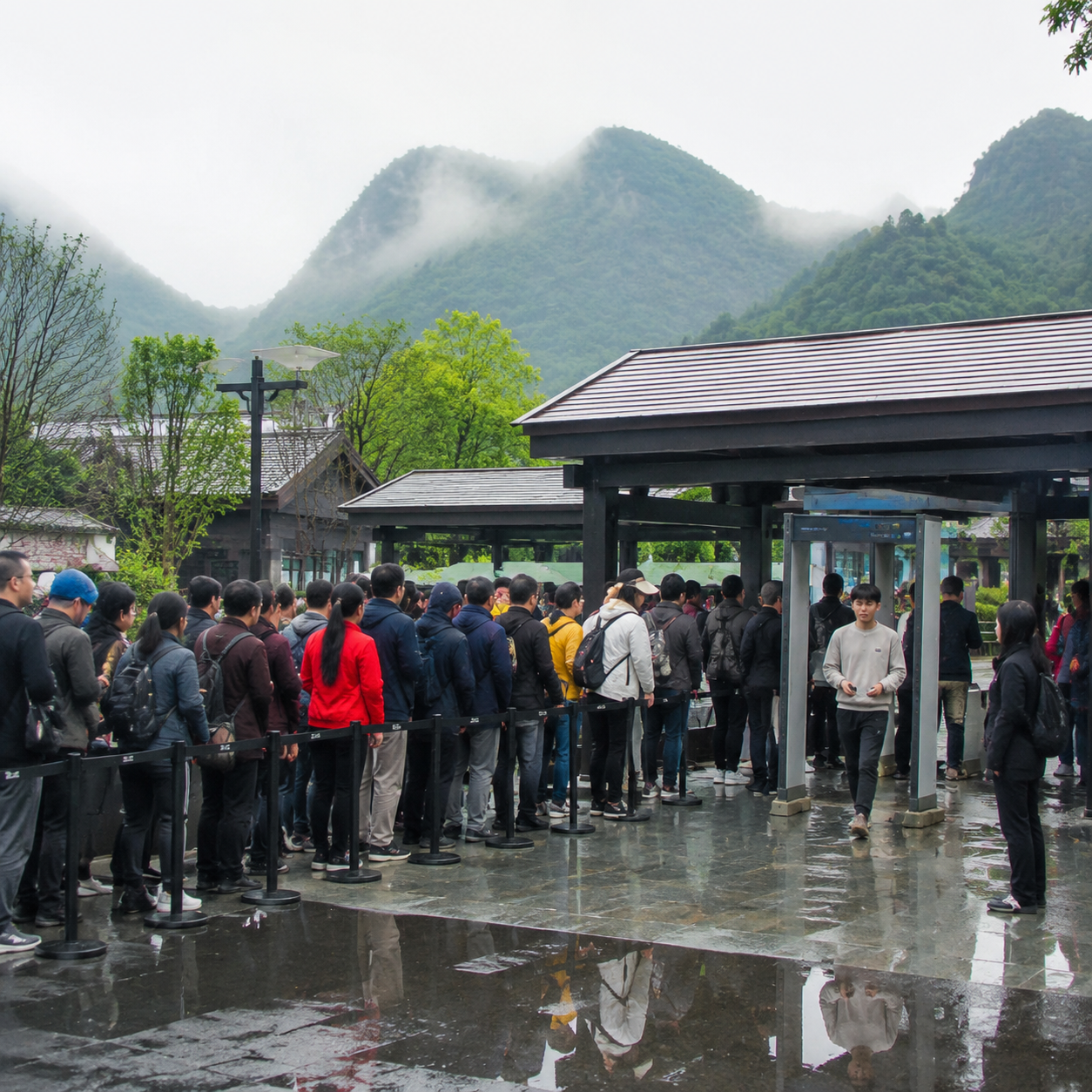
那一刻我发现,景区门口的沟通常常不靠完整句子。工作人员的手势、游客的眼神、护栏的开口、地上的黄线,都在告诉你下一步做什么。不会中文的人也能跟上,只要别急着把自己想象成例外。队伍里最顺利的人,不一定最懂规则,而是最会观察前面三个人怎么做,然后提前二十秒模仿。
At that moment I realized that communication at scenic spot entrances often does not depend on complete sentences. The staff’s gestures, the visitors’ eyes, the opening in the railing, and the yellow line on the ground all tell you what to do next. Even people who do not speak Chinese can follow, as long as they do not rush to imagine themselves as exceptions. The smoothest people in the line are not always those who know every rule, but those who watch the three people in front of them and copy the useful parts twenty seconds early.
队伍突然向前挪了一大段,因为团队通道旁边临时开了一个口。导游们先有点不满,担心自己的团被散客冲散,安检员便把手臂横在护栏边,像给两股水流搭了一个闸门。他先放过一个团队的尾巴,再放五六个散客,接着又让团队往前。没有喇叭,没有复杂解释,只有一个反复的节拍,大家很快就接受了。
The line suddenly advanced by a large step because a temporary opening had been made beside the group channel. The guides looked unhappy at first, worried that their groups would be broken apart by individual visitors. The security worker placed his arm across the railing like a gate between two streams of water. He let the end of one tour group pass, then five or six individual visitors, then another group. There was no loudspeaker and no complicated explanation, only a repeated beat that everyone quickly accepted.
轮到我靠近安检桌时,广场的声音变得更清楚。机器皮带轻轻响,塑料篮碰到桌角,闸机刷票后发出短促的提示音。一个小孩舍不得把玩具剑放进篮子,爸爸蹲下来说:“它也要坐小火车。”孩子这才松手。旁边的安检员没有笑出声,只把篮子往前推了一点,等玩具剑躺稳了再让皮带启动。
When my turn brought me close to the security table, the sounds of the plaza became sharper. The scanner belt hummed softly, plastic trays tapped the table corner, and ticket gates made short beeps after each scan. A child did not want to place his toy sword in the tray. His father crouched and said, “It has to ride the little train too.” Only then did the child let go. The security worker beside them did not laugh aloud; he merely pushed the tray forward a little and waited until the toy sword lay flat before starting the belt.
我把背包放进篮子,矿泉水拿在右手,相机挂在脖子上。安检员看了看我的包,又看了看水,伸手示意我把瓶盖打开。我拧开后,他没有接过去,只是让我轻轻晃一下。水面在瓶口下方动了动,他点头,让我往前走。整个过程不到二十秒,却让我觉得自己通过的不是一道机器,而是一种本地秩序的小考试。
I placed my backpack in a tray, held the mineral water in my right hand, and kept the camera around my neck. The security worker looked at my bag, then at the water, and signaled for me to open the cap. After I twisted it open, he did not take the bottle from me. He only asked me to shake it lightly. The surface moved under the cap, and he nodded for me to continue. The entire process took less than twenty seconds, yet it felt less like passing a machine than passing a small exam in local order.
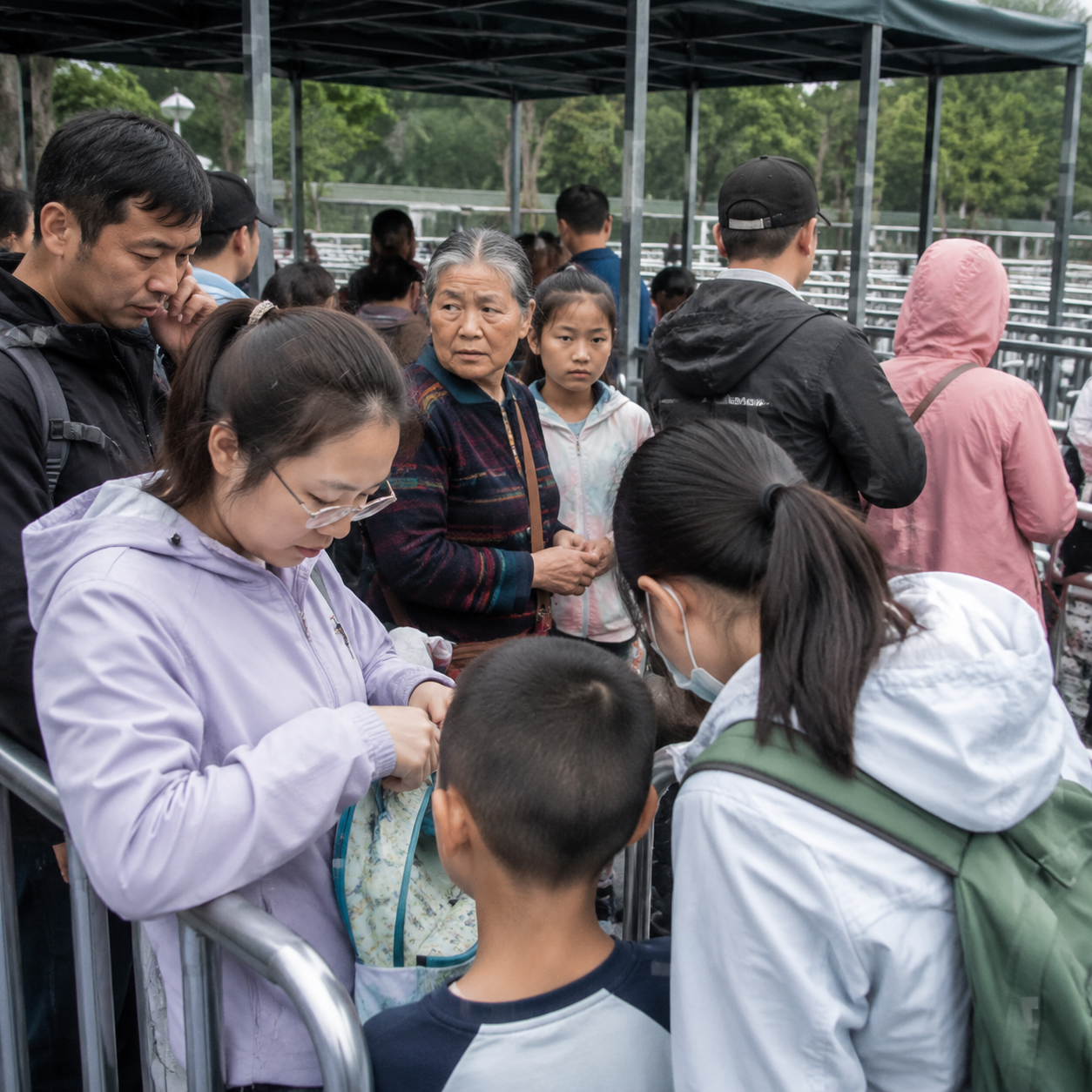
过了安检还没有真正结束。很多游客会在机器出口处停住,急着把所有东西恢复原状,于是出口又形成一个小堵点。广州阿姨早就把布包挂在手腕上,等包一出来,只把拉链一拉就走。法国夫妇慢了些,两根登山杖滚到篮子边缘,我帮他们按住,男士连说谢谢。后面的人没有抱怨,只是自然地从另一侧绕开。
Passing the scanner was not the true end. Many visitors stopped at the machine exit, eager to restore every item to its original place, and this created a small blockage after the inspection. The auntie from Guangzhou had already looped her cloth bag over her wrist; when it came out, she zipped it once and left. The French couple were slower. Their trekking poles rolled toward the edge of the tray, and I held them in place. The man thanked me several times. The people behind us did not complain; they simply moved around from the other side.
我后来在不同景区又见过类似的节奏。山门前的队伍通常更早开始,因为游客要赶第一班缆车;古镇入口的队伍更松散,因为旁边总有小吃摊分散注意力;博物馆式景区则更像正式场馆,工作人员会更明确地要求大家把金属物品放进篮子。地点不同,节奏不同,但核心很像:先观察,再准备,最后顺着人流走。
I later saw similar rhythms at different scenic spots. Lines at mountain gates usually began earlier because visitors wanted the first cable car. Lines at ancient town entrances were looser because snack stalls nearby kept distracting people. Museum-style attractions felt more formal, with staff more clearly asking visitors to place metal items in trays. The places differed, and so did the tempo, but the center of the experience was similar: observe first, prepare next, then move with the current.
有一次在湖边景区,雨刚停,大家都带着湿伞。安检口前的地面被伞尖点出一片水印,工作人员临时摆出两个塑料桶,一个收长伞,一个收折叠伞检查。队伍因此分成两股,拿长伞的人慢,拿折叠伞的人快。一个大叔不明白为什么自己被请到左边,旁边的女孩指了指他的伞,他恍然大悟,把伞竖起来笑着说:“原来是它排队。”
Once, at a lakeside scenic area just after rain, everyone carried a wet umbrella. The ground before the security entrance was marked by small wet dots from umbrella tips. Staff quickly placed two plastic buckets there, one for long umbrellas and one for folding umbrellas to be checked. The line split into two streams: long umbrellas moved slowly, folding umbrellas faster. An uncle did not understand why he had been sent left. A girl beside him pointed at his umbrella, and he suddenly understood, raising it with a grin and saying, “So it is the one standing in line.”
还有一次在冬天的城墙入口,游客穿得厚,包也显得更鼓。保温杯、暖宝宝、手套、围巾,全都让检查多了几秒。安检员的手势也变得更耐心,因为大家从外套口袋里找东西很慢。一个年轻妈妈把孩子的手套摘下后忘在桌上,已经走到闸机前,工作人员追了两步递还给她。队伍短暂地停了一下,随后又像没发生过一样继续向前。
Another time, at a city wall entrance in winter, visitors wore thick coats, and their bags looked bulkier than usual. Thermoses, heat packs, gloves, and scarves all added a few seconds to the inspection. The security workers’ gestures became more patient because people moved slowly while searching coat pockets. A young mother removed her child’s gloves and forgot them on the table. She had already reached the ticket gate when a worker took two quick steps and returned them. The line paused briefly, then continued as if nothing had happened.
这些场景让我改变了进景区前的准备方式。我会在到达广场前就把包里的东西分层:证件和手机放在最外侧,水瓶拿出来,充电宝放到容易看见的位置,相机带子理顺,口袋里的硬币和钥匙提前集中。这样做不是为了表现得多专业,而是为了不给身后的人增加一个无谓的停顿,也让自己少一点慌张。
These scenes changed the way I prepared before entering a scenic spot. Before reaching the plaza, I started arranging my bag by layers: documents and phone on the outside, water bottle in hand, power bank placed where it could be seen easily, camera strap untangled, coins and keys gathered from my pockets. I did not do this to look especially experienced. I did it to avoid adding an unnecessary pause for the people behind me, and to make myself less flustered.
我也学会了不要把入口广场当成单纯的等待区。它其实是景区体验的开场。你能在这里看到一天的游客结构:带团的、亲子的、拍照的、健走的、临时起意的本地人。你能看到城市管理的细节:护栏怎样摆,标识放在多高,工作人员如何在不制造紧张感的情况下维持速度。门票还没真正使用,景区已经开始教你它自己的步伐。
I also learned not to treat the entrance plaza as a mere waiting area. It is actually the opening scene of the scenic experience. There you can see the structure of the day’s visitors: tour groups, families, photographers, walkers, and local residents who decided to come on a whim. You can see details of urban management: how railings are arranged, where signs are placed, and how staff maintain speed without creating anxiety. Before the ticket is truly used, the scenic spot has already begun teaching you its pace.
当然,这种节奏也有让人不耐烦的时候。太阳晒起来,队伍停在没有阴影的地方,孩子哭,老人累,手机页面突然刷新失败,所有小问题都会被放大。可我发现,抱怨通常不能让队伍更快,反而会让自己错过真正有用的信息。前方哪条通道刚打开,哪个工作人员在示意分流,哪里有空篮子,谁已经准备好先走,这些都藏在看似普通的几秒钟里。
Of course, this rhythm can still make people impatient. When the sun becomes strong and the line stops in a place without shade, children cry, older visitors become tired, phone pages fail to refresh, and every small issue grows larger. But I found that complaining rarely makes the line faster. It often makes you miss the information that actually helps. Which lane has just opened, which worker is signaling a split, where empty trays are available, and who is already ready to move—these clues hide inside ordinary seconds.
那天早晨,我最终在闸机后等了一会儿。广州阿姨去买热豆浆,法国夫妇在整理镜头,我站在一棵还滴水的香樟树下,把矿泉水重新塞回包侧袋。回头看入口,队伍仍然很长,却已经不是我刚来时看到的那种陌生长龙。它更像一段不断调整的乐曲,有人快半拍,有人慢半拍,安检员的手势把它们重新合在一起。
That morning, after passing the ticket gate, I waited for a while. The auntie from Guangzhou went to buy hot soy milk, the French couple adjusted their lenses, and I stood under a camphor tree still dripping from the mist, sliding my mineral water back into the side pocket of my backpack. Looking back at the entrance, the line was still long, but it no longer looked like the strange dragon I had seen on arrival. It felt more like a piece of music constantly correcting itself, with some people half a beat fast and others half a beat slow, while the security workers’ gestures brought them back together.
走进景区后,雾从湖面上散开,第一座亭子的屋檐露了出来。身后还能听见机器的轻响和闸机的提示音,像入口广场留在空气里的回声。我忽然觉得,旅行里最容易被忽略的并不是风景,而是抵达风景之前那几分钟的共同练习。背包、水瓶、护栏、手势和陌生人的提醒,把一群互不认识的人临时编成了同一支队伍,然后又在山路和湖边把他们轻轻放开。
After I entered the scenic area, the mist lifted from the lake, and the roofline of the first pavilion appeared. Behind me I could still hear the soft sound of the scanner and the beeps from the ticket gates, like echoes left in the air by the entrance plaza. I suddenly felt that the most easily overlooked part of travel is not always the scenery, but the few minutes of shared practice before reaching it. Backpacks, water bottles, railings, gestures, and reminders from strangers temporarily weave unrelated people into one line, then gently release them again along the mountain path and beside the lake.
- 龙舟不只是比赛:一个外国人看懂端午的三年 | Dragon Boats Aren't Just Racing: 3 Years of an Outsider Learning Duanwu
- 夜市不是景点,是一座城市的另一副面孔 | Night Markets Aren't Tourist Attractions — They're a City's Other Face
- 我在镇江西津渡的五月雨声里,忽然不再害怕一个人吃饭 | In Zhenjiang's May Rain at Xijin Ferry, I Suddenly Stopped Fearing Eating Alone
- 中国高铁乘车全攻略(境外游客版) | Complete HSR Guide for Foreign Tourists
- 陪父母去乌镇的那个雨天,我第一次不再把“安排周全”当成孝顺 | A Rainy Day in Wuzhen with My Parents Taught Me That Love Is Not the Same as Overplanning
- 在成都公园里,孩子跟下棋爷爷聊了二十分钟 | My Child Spent Twenty Minutes Talking with Elder Chess Players in a Chengdu Park
- 广州早茶怎么点:两个人也能吃得体面不浪费 | Cantonese Dim Sum for Two: How to Order Smart
- 清明踏青好去处:近郊自然游 | Qingming Outing: Nature Trips Near the City
- 菜市场早餐摊前,我靠一个“这个”吃到了热豆浆 | At a Wet Market Breakfast Stall, One “This One” Got Me Hot Soy Milk
- 在地铁口停好共享单车那一刻,我才明白锁车并不等于结束 | The Moment I Properly Parked a Shared Bike Outside the Metro, I Understood That Locking It Is Not the End
Comments (0)