
一根提线停在掌心时,我在泉州听见了海风 | When a Puppet String Rested in a Palm, I Heard the Sea Wind in Quanzhou
一根提线停在掌心时,我在泉州听见了海风 | When a Puppet String Rested in a Palm, I Heard the Sea Wind in Quanzhou
下午的光还没有完全软下来,我沿着泉州一条不急着把游客送往景点的街巷慢慢走。鞋底踩过旧石板,墙根有潮气,电动车从身边掠过时带起一阵很短的风。街角传来的不是完整唱腔,而是几下断续的锣鼓声,像有人在屋里试着敲醒一件沉睡的东西。我顺着声音找到一处与提线木偶有关的演出和体验空间,站在门口没有立刻拍照。那一刻更像是先把自己从“观看者”这个位置上挪开,等着看看一台戏究竟如何从后台、手指、木架和观众的呼吸里长出来。
The afternoon light had not yet softened when I wandered through a Quanzhou lane that did not seem eager to deliver visitors to a landmark. My soles met old stone, dampness gathered near the walls, and a passing electric scooter lifted a brief ribbon of air. From a corner came a few broken sounds of percussion—not a complete melody, just the knocks of someone waking an old object indoors. I followed them to a space connected with Quanzhou string puppetry. I did not raise my camera at once. I first tried to move myself out of the role of “spectator” and wait for the performance to reveal how it grows from backstage work, fingers, wooden frames, and the breathing of an audience.
泉州提线木偶最容易让人先注意到的是“线”,可真正难以忘记的并不是线本身,而是线怎样把一个没有生命的木偶变成有方向、有重量、甚至有脾气的身体。走进体验区后,我拿到的是一组需要双手配合的提线装置。它并不轻巧得像玩具,也没有一上手就能随心所欲。手掌要托住提线板,手指要分辨不同线头,手腕不能僵住,肩膀也不能跟着紧张地抬起来。木偶垂在前方,安静得近乎没有表情;真正忙碌的是我的掌心。
The string is usually the first thing people notice in Quanzhou string puppetry, but what stays with you is not the string itself. It is the way a line gives an inanimate figure direction, weight, and even a kind of temperament. In the practice area, I held a control board that required both hands to work together. It was not as light and effortless as a toy, and it did not obey immediately. The palm had to support the board, the fingers had to tell one thread from another, the wrist had to remain flexible, and the shoulders could not rise with nervousness. The puppet hung ahead of me, almost expressionless. The real activity was happening inside my hand.
第一次尝试抬臂时,我把几根线一起带动了,木偶的动作于是变得混乱:头偏向一边,手臂慢半拍地摆开,脚下像踩不到地。旁边的指导者没有替我完成,只示意我先减少动作,把注意力放在一根线的起落上。这个提醒看起来简单,实际很难执行。人的本能总想“做出一个完整动作”,而提线木偶要求你承认动作可以被拆开,甚至要接受一个停顿。提线板不是方向盘,更像一张写着身体关系的地图。
On my first attempt to lift an arm, I pulled several threads at once. The puppet became confused: its head tilted, one arm opened a beat late, and its feet seemed unable to find the ground. The instructor did not take over. Instead, the gesture suggested that I reduce the movement and attend to the rise and fall of a single thread. The advice sounded easy but was difficult to follow. We instinctively want to produce a complete gesture. String puppetry asks us to admit that movement can be separated into small parts, and that a pause may be necessary. The control board is not a steering wheel; it is closer to a map of relationships between parts of a body.
我后来学会了一个很笨、却有用的顺序:先让木偶站稳,再让头部找到方向,接着尝试抬手,最后才考虑转身或行走。每一步都不漂亮,木偶也不总是按照预想移动。有时我以为自己只是轻轻一提,手臂却突然抬得过高;有时我想让它回到原处,线条却互相缠在一起。那种失败没有观众想象中尴尬,因为木偶替我承担了笨拙。它用自己的摇晃告诉我,控制不是用力越大越好,而是要持续听见线的反馈。
I eventually learned a clumsy but useful sequence: steady the puppet first, let the head find a direction, try the arm next, and only then consider turning or walking. None of it looked elegant, and the puppet did not always move as expected. A movement I thought was gentle could lift an arm too high; an attempt to return it could tangle the threads. The failure was less embarrassing than it might sound because the puppet carried the awkwardness for me. Its wobble made clear that control does not improve simply by adding force. It depends on continuing to listen to the feedback of the threads.
如果把一台提线木偶戏只理解成台前几分钟的热闹,就会错过大量真正决定观感的工作。后台通常比观众席安静得更紧张。木偶按照用途和角色被放在不同位置,提线板、线、服饰和道具需要在很短的切换间隔里找到彼此。操作者的手不能只记住一个动作,还要记住木偶此刻面对哪里、和谁发生关系、是否需要留出下一次转身的空间。台前看见的是流畅,后台守住的是秩序。
If a string puppet show is understood only as a few lively minutes in front of the curtain, much of the work that shapes the experience disappears. Backstage can be quieter yet more tense than the audience area. Puppets are placed according to use and role, while control boards, threads, costumes, and props must find one another within short transitions. A puppeteer must remember more than an isolated movement: where the figure is facing, whom it is relating to, and how much room the next turn will require. The audience sees fluency; backstage protects the order that makes fluency possible.
我在后台边缘站了一会儿,没有去打听无法确认的细节,也没有把工作人员当成可以随时提供“幕后故事”的拍摄对象。能看见的,是一只手在整理线,一双眼睛在确认台面,一件木偶服饰被轻轻掸去褶皱。有人低声提醒同伴注意位置,声音很短,像排练时留下的标记。那种克制让我意识到,传统表演并不靠神秘感维持尊严;它靠一次又一次准确的准备,把复杂劳动藏在观众看不见的地方。
I stood at the edge of the backstage area for a while. I did not ask for details I could not verify, nor did I treat the staff as people obliged to provide a “behind-the-scenes story” for my camera. What I could see was a hand arranging threads, eyes checking the stage, and a costume being gently smoothed. Someone gave a brief reminder about position. It sounded like a rehearsal mark. That restraint made me realize that a traditional performance does not preserve its dignity through mystery. It does so through repeated, precise preparation that allows complex labor to remain mostly unseen.
戏台本身也值得慢慢看。观众常常把目光集中在木偶的脸、衣袖和夸张姿态上,但台口、灯光、帷幕和声音的边界同样重要。一个动作必须在合适的高度被看见,太低会失去轮廓,太急又会让线的关系暴露出来。声音不只是给剧情服务,它还替身体补足了重量和距离。木偶明明只有一小段高度,唱腔、锣鼓和停顿却能把它推到比木架更大的空间里。
The stage deserves patient attention as well. Audiences often focus on a puppet’s face, sleeves, and enlarged gestures, yet the stage opening, lighting, curtain, and sound boundaries matter just as much. A movement has to appear at the right height: too low and its outline disappears; too fast and the relationship among the threads becomes obvious. Sound does more than serve a plot. It supplies weight and distance to a body made of wood. The puppet may be small, but singing, percussion, and pauses can expand it far beyond the frame of the stage.
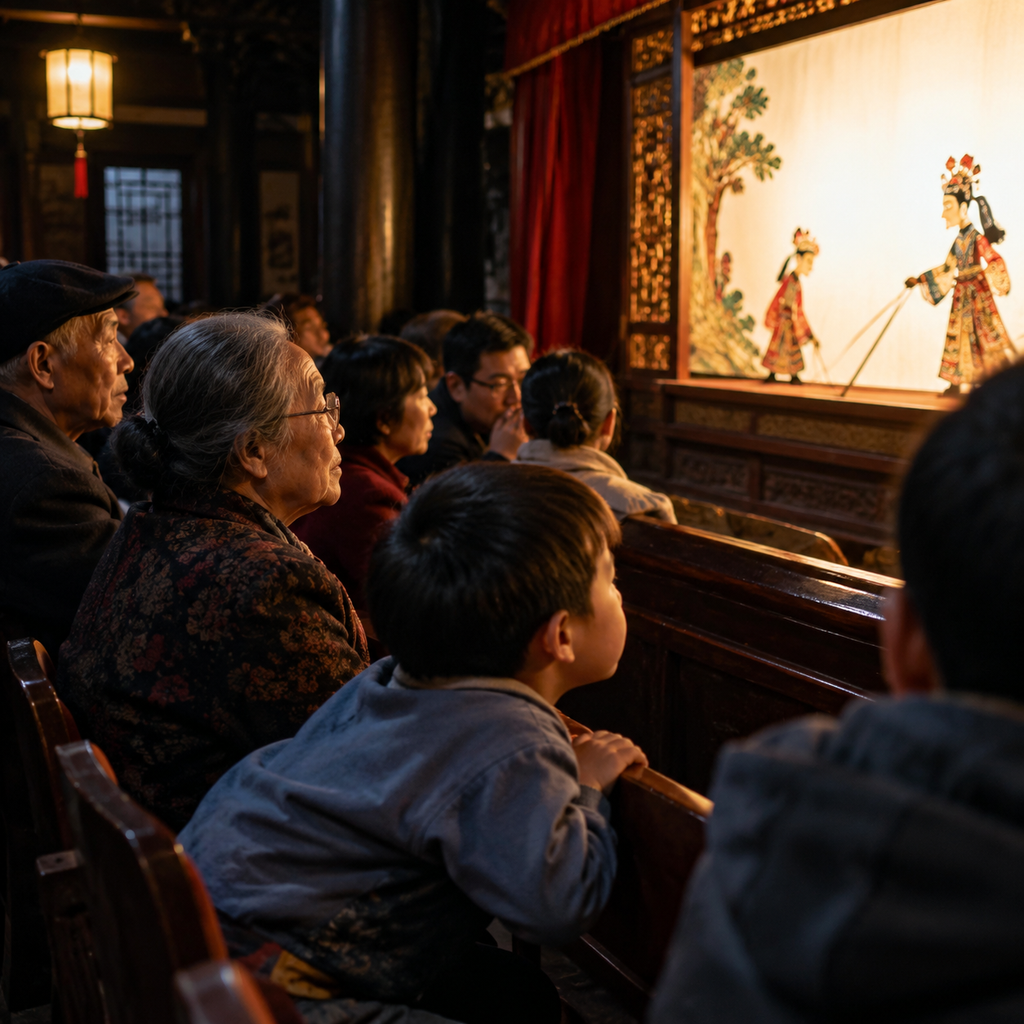
正式观看时,我特意坐得稍微靠后一些。近处能看见木偶的细节,后方却更容易看见观众整体如何被戏台牵引。孩子会在某个动作出现时向前探身,年长观众的注意力则更稳定,旁边的人偶尔压低声音交流,灯光变化后又迅速安静下来。没有人需要被提醒“请投入”,因为投入是从动作里自然发生的。观众的身体向前、屏息、发笑,都是戏台与他们之间正在形成的回应。
During the full viewing, I deliberately sat a little farther back. From close up, one sees the puppet’s details; from behind, it is easier to see how the audience as a whole is drawn toward the stage. Children lean forward when a particular gesture appears. Older viewers often keep a steadier gaze. Neighbors exchange a few quiet words and fall silent again when the lighting changes. No one needs to be told to “engage.” Engagement arises through the body: leaning forward, holding one’s breath, laughing. These are replies forming between stage and audience.
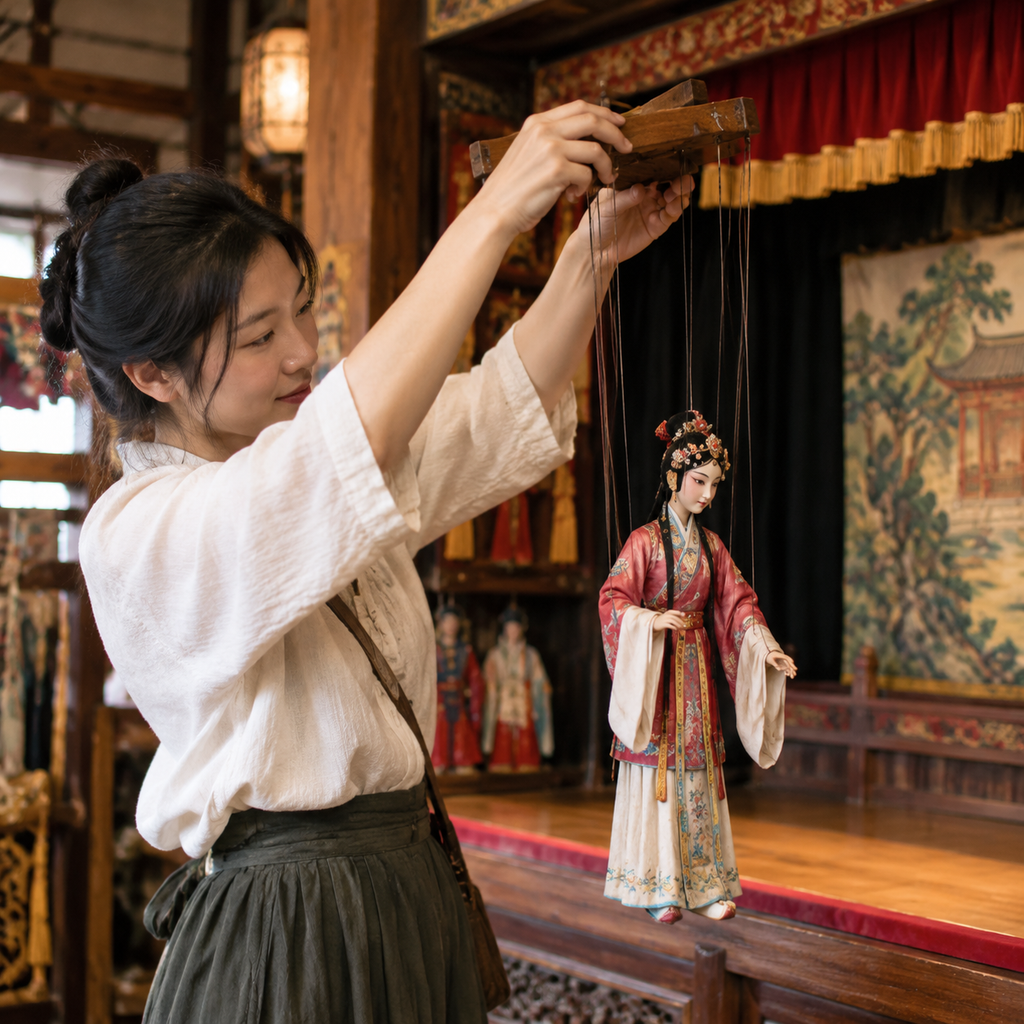
我注意到,提线木偶的“像人”并不来自它拥有一张足够逼真的脸。它更像人,是因为操作者让它保留了迟疑、重量和节奏。手臂抬起之前有极小的准备,转身时身体不会立刻完全到位,停下来时也不是突然冻结,而是经过一丝回落。这样的细节让木偶摆脱了机械摆动。它没有真正的肌肉,却通过线的张力获得了身体感;没有自己的声音,却在表演结构中拥有了性格。
A string puppet does not seem human because its face is realistic enough. It seems human because the puppeteer allows it hesitation, weight, and rhythm. Before an arm rises, there is a tiny preparation. During a turn, the body does not arrive all at once. When it stops, it does not freeze abruptly but settles by a fraction. These details lift the puppet beyond mechanical swinging. It has no muscles, yet tension gives it a sense of body. It has no voice of its own, yet within the structure of the performance it acquires character.
体验结束后,我的手掌并没有留下什么壮观的纪念品,只留下了提线板边缘压出的浅浅触感,以及手指反复调整线头后的酸。那点酸很重要,因为它把“传统技艺”从墙上的说明文字拉回到肌肉和关节。看别人操作时,动作似乎连续而自然;轮到自己,才知道每一个自然动作都需要很多判断。手指要放松,却不能松到失去线;要敏感,却不能因为一点小偏差就慌乱。
After the practice, my palm carried no spectacular souvenir. It held only a faint pressure from the edge of the control board and a mild ache in the fingers from repeatedly adjusting the threads. That ache mattered. It pulled the phrase “traditional technique” away from a wall label and back into muscles and joints. Watching an expert, movement appears continuous and effortless. When it is your turn, you discover that every effortless action contains many decisions. Fingers must relax without losing the thread, remain sensitive without panicking at a small deviation.
从那间空间出来时,泉州的街巷已经换了颜色。店铺门口的灯逐渐亮起来,骑楼或老屋的阴影延长,空气里有食物蒸汽、潮湿石面和海边城市特有的咸味。街上的人没有因为一场表演而停下脚步,他们照常买东西、聊天、骑车、把塑料袋挂在车把上。正是这种照常,让木偶戏不显得像被玻璃罩起来的古董。它与一座活着的城市共处,后台的专注和街头的喧响彼此并不冲突。
When I stepped back outside, Quanzhou’s lanes had changed color. Shop lights were coming on, shadows lengthened beneath old arcades or along older houses, and the air carried food steam, damp stone, and the saltiness common to a coastal city. People did not stop their routines because a performance had taken place. They shopped, talked, rode, and hung plastic bags from handlebars. That ordinariness kept puppetry from feeling like an antique sealed behind glass. Its backstage concentration and the noise of daily streets could coexist without contradiction.
我沿着街巷继续走,才更清楚地感到泉州的海风并不总是直接扑面而来。它有时藏在墙缝的凉意里,有时从转角吹过来,把树叶和衣角同时掀动一下;有时只是让湿热的空气稍微松开。提线木偶的线也有相似的存在方式:看不见时仍然在支撑动作,显露出来时提醒你不要把自由误解成无牵无挂。风与线,一个来自海面,一个来自掌心,却都在教人辨认看不见的力量。
Walking on through the lanes, I understood more clearly that Quanzhou’s sea wind does not always arrive as a dramatic gust. Sometimes it hides in the coolness of a wall crack, sometimes it turns a corner and lifts a leaf and a shirt hem together, and sometimes it merely loosens the humid air. The strings behave in a similar way. They support movement even when unseen, and when visible they warn us not to confuse freedom with having no ties. One force comes from the sea, the other from the palm, yet both teach attention to what cannot always be seen.
旅行者若想把提线木偶放进泉州行程,不必把它安排成匆忙打卡的一站。更合适的做法,是先确认当日可公开查询的演出、展陈或体验信息,再预留一段不被下一班交通追赶的时间。提线动作需要慢,观看也需要慢。若把它塞进连续景点之间,只会记住“看过木偶”;若为它留出完整的前后时段,就能把入场前的街巷、演出中的声音、离场后的海风连成一条感官上的路线。
Travelers who want to include string puppetry in a Quanzhou itinerary do not need to treat it as a rushed check-in stop. A better approach is to confirm publicly available performance, exhibition, or workshop information for the day and leave enough time so that the next transport connection is not pressing against the experience. String movement asks for slowness, and so does viewing. Wedged between back-to-back attractions, it becomes only “a puppet show I saw.” Given a proper before-and-after window, the lane before entry, the sounds during the performance, and the sea air afterward become one sensory route.
行程安排上,我会把提线木偶放在一天中不太疲惫的时段。上午可以先在老城区步行,观察门楣、巷口、庙宇周边和小店如何共同构成城市尺度;中间留出吃饭、喝水和避暑的余地;下午或傍晚再去看演出或参加体验。具体地点和时间必须以官方当日信息为准,不能只依赖旧攻略截图。若同行者有老人或孩子,还要提前确认步行距离、座位情况、体验是否需要预约,以及现场是否允许拍摄。
For planning, I would place puppetry at a time of day when the body is not already exhausted. The morning can be used for walking through the old city, noticing how door lintels, lane entrances, temples, and small shops create a human-scale environment. Time should remain for food, water, and shade. A performance or workshop can follow in the afternoon or evening. Exact locations and times must be checked through current official information rather than an old screenshot. With older travelers or children, confirm walking distance, seating, whether a workshop requires booking, and what photography is permitted.
第一次带孩子去看木偶戏,成年人很容易先替孩子解释:“这是传统艺术,这是文化传承。”但孩子真正记住的,可能是木偶为什么会突然转头,是谁让袖子动起来,是后台为什么不能随便跑进去。与其要求孩子立刻理解宏大概念,不如让他先找一个具体动作:看提线板如何改变方向,数一数一个停顿前身体发生了什么,演出后用自己的话说出最清楚的一个瞬间。文化理解往往从一个可复述的动作开始。
When adults take a child to a puppet performance, they may be tempted to explain first: “This is traditional art; this is cultural heritage.” A child may remember something more concrete: why the puppet suddenly turns, who makes the sleeve move, or why one cannot run backstage. Instead of demanding an immediate grasp of a grand concept, invite the child to follow one action. Notice how the control board changes direction, observe what happens to the body before a pause, and ask the child to describe the clearest moment afterward. Cultural understanding often begins with an action that can be retold.
对不熟悉汉语的旅行者来说,观看提线木偶也是一种不依赖完整语言理解的入口。唱腔、节拍、视线和身体方向会提供线索;即使听不懂每个词,也能判断人物何时犹豫、靠近、离开或回应。可是在进入剧场前,仍然值得学会几句简单而实用的话,例如询问入口、确认座位、表达感谢,或礼貌地问能否拍照。真正的参与不是假装自己什么都懂,而是知道什么时候可以问,什么时候应该安静观察。
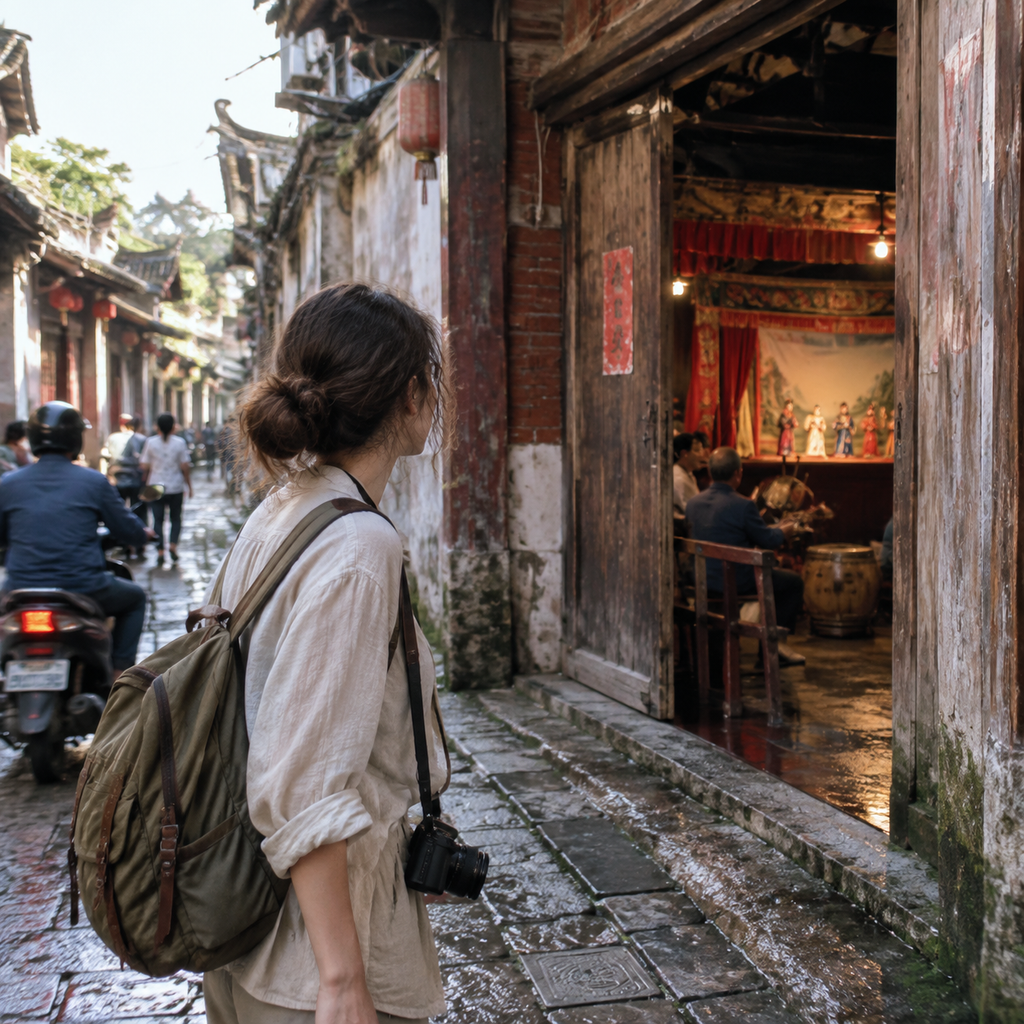
For travelers unfamiliar with Chinese, string puppetry can be an entry point that does not depend on understanding every sentence. Singing, rhythm, gaze, and body direction offer clues. Even without catching each word, one can sense when a figure hesitates, approaches, leaves, or responds. Before entering the theater, it is still useful to learn a few practical phrases for finding the entrance, confirming a seat, saying thank you, or asking whether photography is allowed. Participation does not mean pretending to understand everything. It means knowing when to ask and when to observe quietly.
我也会提醒同行者,不要把后台的手艺人只当成“很有故事的人”。当一个人长时间练习提线动作,身体会形成自己的记忆:哪一根线容易打结,哪一种转身需要提前准备,怎样让木偶落地时不显得突然。这些知识未必都能在一次旅行里被说清楚,也不一定适合被陌生人追问。尊重传统表演,首先是尊重它的工作属性;它不是为游客即时消费而存在的神奇表演,而是有人反复承担、校正和维护的职业实践。
I also remind companions not to treat puppeteers merely as “people with an interesting story.” Long practice gives the body its own memory: which thread tends to tangle, which turn needs preparation, and how to let the puppet settle without an abrupt landing. Such knowledge may not be explainable in a single visit, and it may not be appropriate for a stranger to demand. Respecting a traditional performance begins by respecting its nature as work. It is not a magical display created for instant tourist consumption; it is a professional practice repeatedly carried, corrected, and maintained by people.
泉州的街巷让这种理解继续向外延伸。走过窄巷时,人的速度会自动变慢,因为要避开迎面而来的居民和车;经过店门时,要注意不要堵住出入口;在拍摄门窗、摊位和路人时,要先判断对方是否愿意进入画面。城市文化不是只藏在展柜里的对象,也写在通行、让路、招呼和停步这些微小动作中。提线木偶教我观察线的边界,街巷则教我观察人与人之间的边界。
Quanzhou’s lanes extend that understanding into ordinary life. In a narrow passage, one naturally slows down to avoid residents and vehicles. At a shop entrance, one must not block the way. When photographing doors, stalls, or passersby, it is worth considering whether people want to appear in the frame. Urban culture is not only an object behind exhibition glass; it is also written in small actions of passing, yielding, greeting, and stopping. The puppets taught me to notice the boundary of a thread. The lanes taught me to notice boundaries between people.
关于拍照,我最后只留下了几张没有打扰演出的画面:一角戏台、一段收好的线、木偶服饰的纹理,以及离开后被晚风吹动的树影。没有把每个瞬间都举到镜头前,反而让我看得更完整。提线木偶的魅力不适合被压缩成一张“造型漂亮”的照片,因为它的核心藏在动作发生之前和结束之后。手如何准备,木偶如何停住,观众如何从笑声回到安静,这些过程比单独的姿态更接近戏的骨骼。
For photography, I kept only a few images that did not disturb the performance: one corner of the stage, a coil of stored thread, the texture of a puppet costume, and tree shadows moving in the evening breeze after I left. Not raising the camera for every moment allowed me to see more fully. The appeal of string puppetry cannot be compressed into one beautiful pose. Its core lies before and after the visible movement: how the hand prepares, how the puppet comes to rest, and how an audience returns from laughter to silence. Those processes are closer to the skeleton of the theater.
如果时间允许,泉州可以用“一个表演加一段散步”的方式来安排,而不是把文化体验隔离成封闭单元。看戏前,走一小段与日常生活相连的街道;看戏后,不急着立刻打车离开,沿着光线逐渐暗下来的方向走几分钟,听城市声音从锣鼓换成车轮、谈话和店铺收摊。这样的安排不需要额外编造景点,也不要求把一座城市全部走完。它只是让观众有机会把舞台上的节奏,放回真实的城市节奏里。
When time allows, Quanzhou works well as “one performance plus one walk,” rather than as a cultural experience sealed off from the rest of the city. Before the show, walk a short stretch of street connected to daily life. Afterward, do not rush straight into a taxi; follow the fading light for a few minutes and hear the city change from percussion to wheels, conversation, and shops closing. This arrangement does not require inventing extra attractions or pretending to cover the whole city. It gives viewers a chance to place the rhythm of the stage back into the rhythm of the city.
我把提线板交还时,手指还保持着一种不自然的半弯,好像下一秒仍要去寻找线头。那根线停在掌心的时间其实很短,却改变了我看木偶戏的角度:我不再只问它“讲了什么”,也开始问它“怎样站起来”“为什么这个停顿有分量”“谁在台下替台上守住秩序”。海风从街口吹过来,带着潮湿、食物和夜色的味道。木偶已经收好,戏台也安静了,但掌心对那条线的记忆还没有立刻松开。
When I returned the control board, my fingers remained half-curved, as if they were still searching for a thread. The string had rested in my palm only briefly, but it changed how I looked at puppetry. I no longer asked only what the performance meant; I also asked how the figure learned to stand, why a pause carried weight, and who protected the order of the stage from below. Sea wind crossed the lane with dampness, food, and night in it. The puppets had been put away and the stage had gone quiet, yet my palm did not release the memory of that thread at once.
让手先学会安静 / Let the Hand Learn Stillness First
在体验提线动作时,最容易犯的错误不是不会抬手,而是太急着证明自己已经会了。我的手一开始总想追赶木偶:木偶头偏了,我马上拉线把它扳回来;袖子垂下,我又同时去找另一根线。结果动作越来越密,身体却越来越不像身体。后来我把速度压下来,先让木偶保持一个能够被看清的姿态,再观察线的松紧。只要手掌不乱跑,很多问题会自己显形:有的线已经绷得太紧,有的动作其实不需要补救,有的停顿正是表演的一部分。
The easiest mistake in a string-puppet workshop is not failing to lift the hand. It is rushing to prove that one has already learned. My hand kept chasing the puppet at first: when its head tilted, I pulled immediately to correct it; when a sleeve dropped, I searched for another thread at the same time. The gestures became crowded, while the body stopped looking like a body. I slowed down and let the puppet hold a pose long enough to be seen. Once the palm stopped wandering, the problems became visible: one thread was too tight, another did not need correction, and a pause could itself be part of the performance.
提线板上的线头并不替我标注“这是头”“这是手”“这是脚”,我只能通过试探建立关系。轻轻触碰后,木偶给出的回应很小,却足以让人判断方向。那种判断不像操作电子设备时的即时反馈,更像摸黑走路时用脚尖确认下一块地面。掌心接收的是张力,手指负责微调,眼睛则要同时看整体。只盯着一个局部,木偶就会失去平衡;只看整体,又容易错过哪一根线正在把动作推向错误的位置。
The control board does not label each thread as “head,” “hand,” or “foot.” I had to build those relationships through testing. The response after a light touch was tiny, but enough to indicate direction. It felt less like operating a digital device and more like using a toe to test the next patch of ground in the dark. The palm received tension, the fingers made fine adjustments, and the eyes watched the whole figure at once. Staring at one part made the puppet lose balance; watching only the whole made it easy to miss the thread pushing a movement off course.
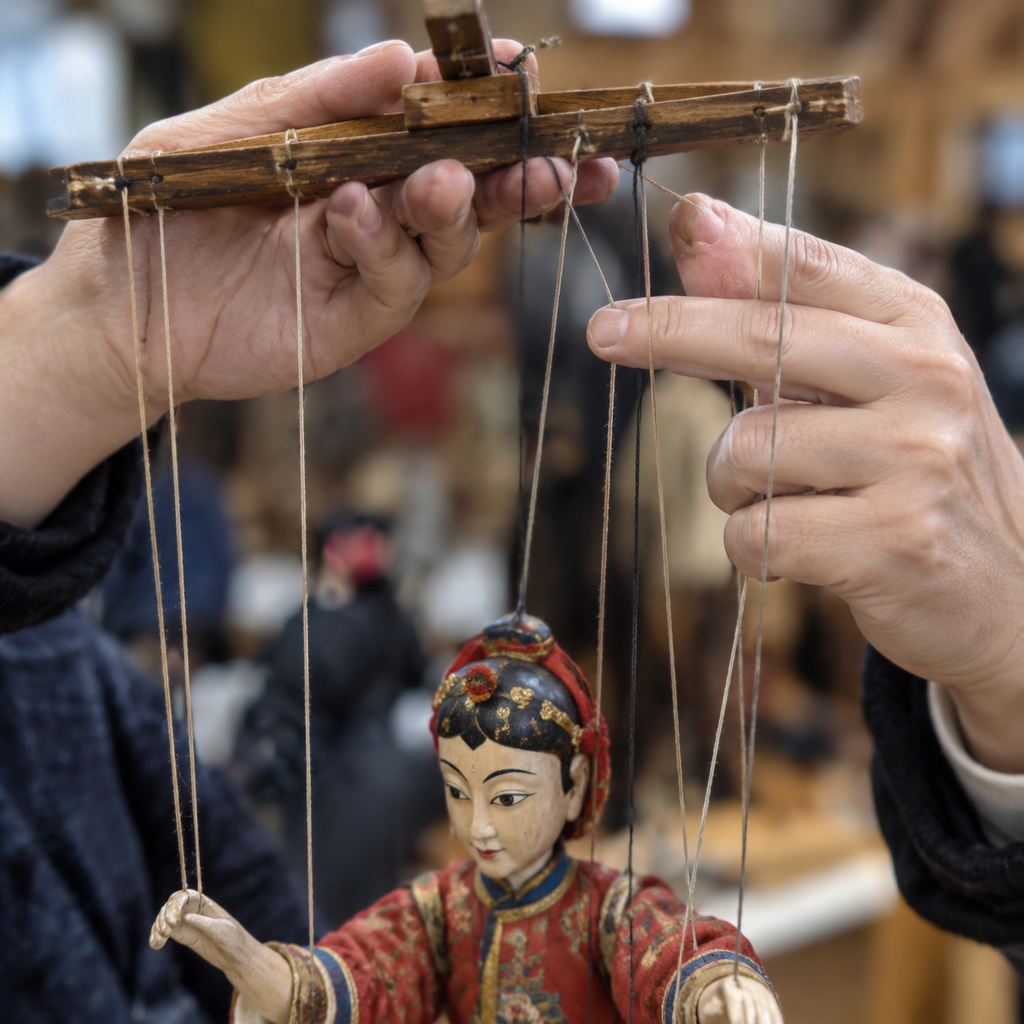
真正让人疲惫的还有注意力。一次短暂的动作里,操作者不能只想着“抬起来”,还要考虑抬起之前的准备、抬起时的速度、停住后的余势,以及下一动作是否会把刚刚建立的平衡打散。台上看似一挥袖,手上可能包含了几次微小的松紧变化。观众不会逐一数出这些变化,但正是它们让袖子有了重量,让转身不至于像突然被风吹走。木偶戏的细腻,藏在观众不必说出口的感觉里。
Attention is tiring for another reason. In a brief gesture, the puppeteer cannot think only “lift.” There is preparation before the lift, speed during it, residual motion after the pause, and the risk that the next gesture will destroy the balance just created. A sleeve may appear to sweep once, while the hand makes several tiny changes in tension. The audience does not count them, but those changes give the sleeve weight and keep a turn from looking as if the wind had blown it away. The delicacy of puppetry lives in sensations the audience does not need to name.
这也是我愿意把体验放在观看之前的原因。先让游客经历一次不听话的木偶,再去看熟练操作者如何让它落脚,眼睛会突然多出一层参照。原来“自然”不是没有控制,而是控制已经被练习藏进了节奏;原来“灵动”也不是动作越大越好,而是力量到达边缘时知道收住。体验不必持续很久,却能把一台戏从“漂亮的传统节目”变成一项需要耐心、协调和判断的工作。
That is why I value practice before viewing. After handling one stubborn puppet, I watched an experienced puppeteer let a figure place its feet, and my eyes gained a new reference. “Natural” did not mean uncontrolled; control had been hidden inside practiced rhythm. “Liveliness” did not mean making the gestures larger; it meant knowing when to stop at the edge of force. The practice need not last long to change the show from “a beautiful traditional program” into work requiring patience, coordination, and judgment.
后台不是幕后的另一座城市 / Backstage Is Not Another City
站在后台附近时,我最先感到的是空间被切成了许多层。台口向观众打开,操作者的身体却常常退在视线之外;木偶必须进入光里,线又不能喧宾夺主;服装要有足够的垂坠,才不会因为一个小动作显得轻飘。这里没有一种单独的“后台气氛”,只有许多事情同时发生:确认道具、整理线、找准进出位置、等待声响给出提示。每一项工作都不抢镜,却共同决定台前是否从容。
Near the backstage area, I first noticed how the space was divided into layers. The stage opening faced the audience, while the puppeteer’s body often remained outside the main view. The puppet had to enter the light without allowing the threads to take over the scene. Costumes needed enough fall and weight to keep a small movement from looking flimsy. There was no single “backstage mood,” only many tasks happening together: checking props, arranging threads, locating entrances and exits, and waiting for sound cues. None sought attention, yet together they determined whether the front of the stage felt composed.
我没有把看见的设备、人物和流程强行整理成一个戏剧化故事,因为现场本身已经足够具体。线缠在一起时,解决它需要的是耐心,不是传奇;一个位置需要重新确认时,重要的是准确,不是情绪。旅游文章很容易只写“幕后辛苦”,这四个字说完便没有了内容。真正值得写的是辛苦怎样落在手指上,怎样表现为反复检查,怎样让工作人员在开演前把一个可能出错的细节提前处理掉。
I did not turn the equipment, people, and procedures I saw into a dramatic backstage tale. The space was already specific enough. When threads tangled, solving the problem required patience rather than legend. When a position needed checking, accuracy mattered more than emotion. Travel writing often says “backstage work is hard” and stops there. The useful detail lies in how that labor reaches the fingers, appears as repeated checks, and allows staff to remove a possible mistake before the curtain opens.
台前与后台之间并不是一道绝对的墙。声音从后台出来,观众的反应又回到操作者那里;一个笑声变长,可能影响下一次停顿的节奏;掌声提前出现,也会让人感到台下正在接住台上的动作。即使观众看不见操作手,表演也不是单向输送。木偶、操作者、乐声、灯光和观众共同组成一条回路。提线连接木偶,注意力连接所有人。
The boundary between front and backstage is not absolute. Sound travels outward, while audience reactions travel back to the puppeteer. A laugh that lasts a little longer may affect the rhythm of the next pause. Applause arriving early can reveal that the audience has caught and returned a gesture. Even when the audience cannot see the hand at work, the performance is not one-way delivery. Puppet, puppeteer, music, light, and audience form a circuit. The thread connects the figure; attention connects everyone.
对旅行者来说,后台参观尤其需要边界感。若空间开放,应先看清楚哪些区域可以进入、哪些物件可以触碰、哪些时刻适合提问;若没有明确说明,就停在不妨碍工作的地方。不要为了拍到一根线而伸手拨弄,也不要在演出转换时要求工作人员重新摆出动作。一次体验的价值不在于把所有东西都拿到手,而在于知道哪些东西应该只用眼睛看,哪些知识要通过安静等待才能得到。
For a traveler, visiting backstage requires a sense of boundaries. If an area is open, first notice where one may stand, what may be touched, and when questions are appropriate. Without clear permission, remain where work is not obstructed. Do not move a thread just to photograph it, and do not ask staff to recreate a gesture during a transition. The value of a visit does not lie in handling everything. It lies in learning what should be seen only with the eyes and what can be understood only through patient waiting.
观众席里的泉州 / Quanzhou Inside the Audience
坐进观众席之后,我开始留意大家如何分配自己的注意力。有人盯着木偶的脸,有人追着衣袖的线条,有人听锣鼓,有人把孩子轻轻拉回座位。不同的观看方式并不互相排斥。一个人可能先被颜色吸引,再注意到操作者的技巧;孩子先笑于木偶的动作,成年人却从一个停顿里想到时间和秩序。戏台没有要求所有人用同一种方式理解它,观众各自带着生活经验进入,又带着不同的疑问离开。
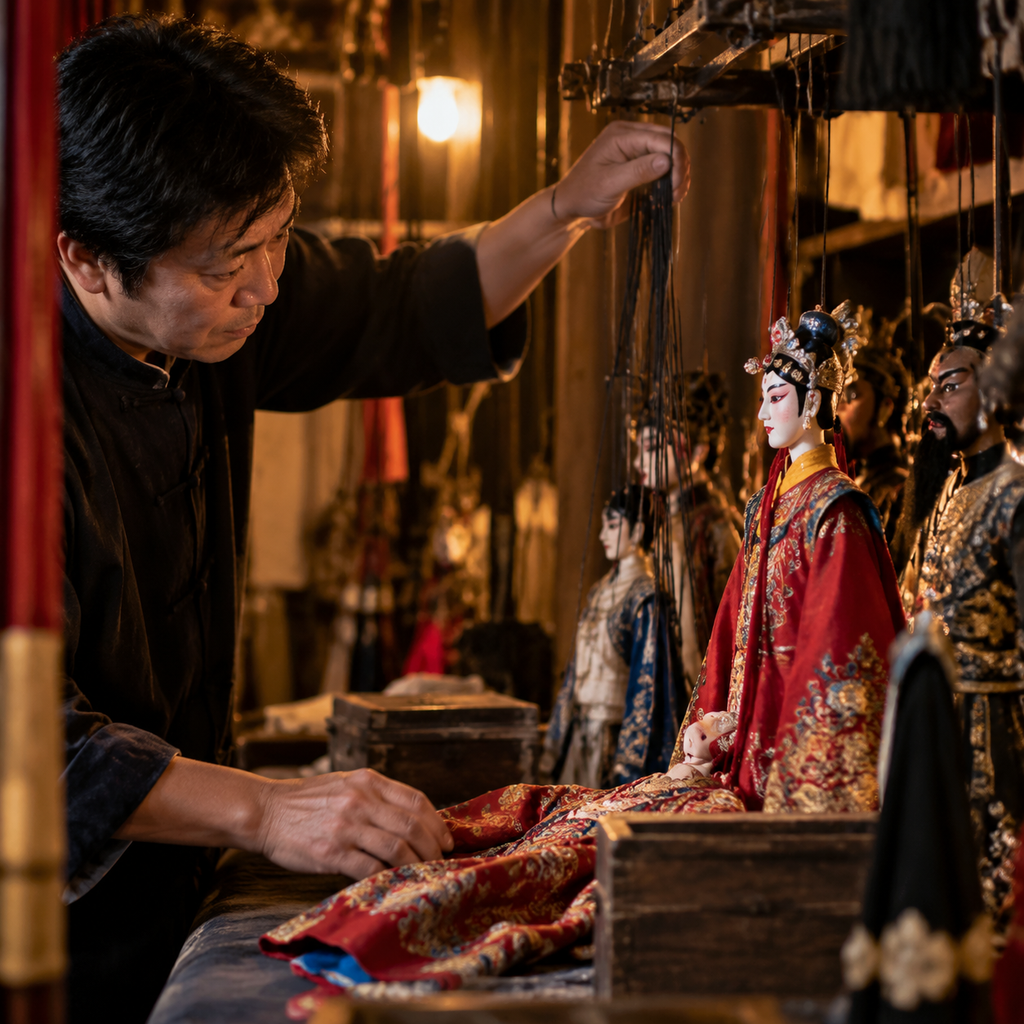
Once seated, I watched how people distributed their attention. Some followed the puppet’s face, some tracked the line of a sleeve, some listened to percussion, and some gently guided a child back into the seat. These ways of watching did not cancel one another. A person might be drawn in by color and only later notice technique. A child might laugh at a movement while an adult considered the meaning of a pause and an order of actions. The stage did not demand one approved interpretation. Each spectator entered with a different life experience and left with different questions.
小朋友常常比成年人更快发现木偶戏的秘密:它明明由人操纵,却能够在某个瞬间让人忘记那只手。孩子会问“线在哪里”“为什么它会自己走”,这些问题没有必要马上被宏大答案盖住。可以把问题留在现场,让孩子观察木偶停下时线是否仍然有张力,转身时身体哪个部分先动,操作者是否在台上露出身体。这样的观察既是游戏,也是对表演结构的第一次拆解。
Children often discover the secret of puppetry faster than adults: it is operated by a person, yet for a moment the hand disappears from awareness. A child may ask, “Where are the strings?” or “Why does it walk by itself?” Such questions do not need to be covered immediately by grand explanations. Leave them in the room and observe whether the threads remain tense when the puppet stops, which part moves first during a turn, and whether the puppeteer’s body becomes visible. This is play, but it is also a child’s first dismantling of performance structure.
如果同行者对传统戏曲不熟,最好不要在开场前塞进一整套背景知识。先告诉他两个观看任务就够了:第一,观察木偶如何从静止进入动作;第二,留意观众什么时候一起安静、什么时候一起笑。等演出结束,再把看到的动作与声音、人物关系和舞台调度连起来。这样做可以避免文化介绍变成考试,也让陌生的唱腔和节奏有机会先以身体感被接受。
For companions unfamiliar with traditional theater, there is no need to deliver a complete background lecture before the show. Two viewing tasks are enough: watch how the puppet moves out of stillness, and notice when the audience becomes quiet or laughs together. Afterward, connect those observations to sound, relationships, and stage movement. This keeps cultural introduction from becoming an examination and allows unfamiliar singing and rhythm to be received first as bodily sensation.
我喜欢看演出结束后的那几分钟。观众起身时,讨论往往不是完整的评论,而是一些小判断:“刚才那个转身很快”“袖子怎么会动”“我没看见手在哪里”。这些零碎话比一句“很好看”更有价值,因为它们说明观看已经变成了追问。文化体验的后续不一定是背下术语,也可以是回到街上后仍然对某个动作感到疑惑,并愿意为这个疑惑再找资料、再看一场。
I like the few minutes after a performance ends. Audience comments are rarely polished reviews. They are small judgments: “That turn was fast,” “How did the sleeve move?” or “I could not see the hand.” These fragments are more valuable than saying simply “It was beautiful,” because they show that viewing has become questioning. The afterlife of a cultural experience does not require memorizing terminology. It may be the willingness to keep wondering about one gesture after returning to the street, then look for another source or another performance.
用步行把戏台接回城市 / Walking the Stage Back into the City
离开演出空间后,我没有立刻把手机里的地图放大到下一站,而是先沿着附近街道走了一段。泉州的老城步行并不总是笔直、宽阔和专门为游客准备的。门口可能有人搬货,路边可能停着摩托车,巷子里也会突然出现一辆需要让行的车。步行的意义不只是消耗时间,它让人重新适应地方的速度:看见居民如何使用街道,也看见旅行者自己的身体怎样占据空间。
After leaving the performance space, I did not immediately zoom in on the next destination. I walked through nearby streets for a while. Quanzhou’s old city is not always straight, broad, or designed for tourists. Someone may be moving goods at a doorway; a motorcycle may be parked along the side; a vehicle may suddenly need passage through a lane. Walking is not merely a way to spend time. It resets the traveler to the city’s pace, revealing how residents use the street and how the traveler’s own body occupies it.
街巷里的声音也会改变对木偶戏的理解。白天,店铺招呼声、锅铲碰撞和车轮摩擦混在一起;入夜后,声音的空隙变大,远处的谈话和近处的脚步更容易被听见。戏台里的锣鼓并不是凭空出现的,它与城市本来就有的节奏发生叠加。一个表演之所以能在这里被感到,不只是因为它属于某种传统,也因为观众刚刚从这些街道的声音里走来。
The street sounds also changed how I understood the puppetry. During the day, shop calls, spatulas, and wheels overlapped. At night, the gaps widened, making distant conversation and nearby footsteps easier to hear. The percussion inside the theater did not appear from nowhere; it layered itself onto rhythms already present in the city. A performance can be felt here not only because it belongs to a tradition, but because its audience has just walked in from these very sounds.
海风靠近时,城市的材质会显出另一面。墙面不再只是颜色,石板也不只是路面;潮气让它们变得有触感,盐分和湿度让空气贴在皮肤上。提线动作同样需要触感:没有足够的手感,操作者很难判断线是正在承受力量,还是已经失去方向。旅行中所谓“感受一座城”,如果不落在皮肤、脚底、耳朵和手指上,就很容易只剩下形容词。
When the sea breeze comes nearer, the city’s materials reveal another side. Walls become more than colors, and stone becomes more than pavement; dampness gives them texture, while salt and humidity settle against the skin. String movement also depends on touch. Without tactile awareness, it is difficult to tell whether a thread is carrying force or has lost direction. To “feel a city” must land on skin, soles, ears, and fingers. Otherwise, the travel experience easily collapses into adjectives.
我在街边短暂停下时,身后有人推着车经过,前方一扇门半开,屋里亮着白光。这个画面没有地标,却比一张景点清单更能说明旅行安排该怎样留白:不要把每一小时都预先填满,不要把所有转场都压缩到最短,也不要认为只有进入景区才算获得内容。对于提线木偶这样的体验,留白不是浪费,而是让感官把前后两段连接起来的必要空间。
When I paused by the street, someone pushed a cart behind me and a half-open door ahead revealed bright indoor light. There was no landmark in the frame, yet it explained itinerary design better than a checklist could. Do not fill every hour in advance, compress every transfer to its shortest form, or assume that content exists only inside attractions. For an experience such as string puppetry, empty space is not wasted time. It is the room needed for the senses to connect what came before with what follows.
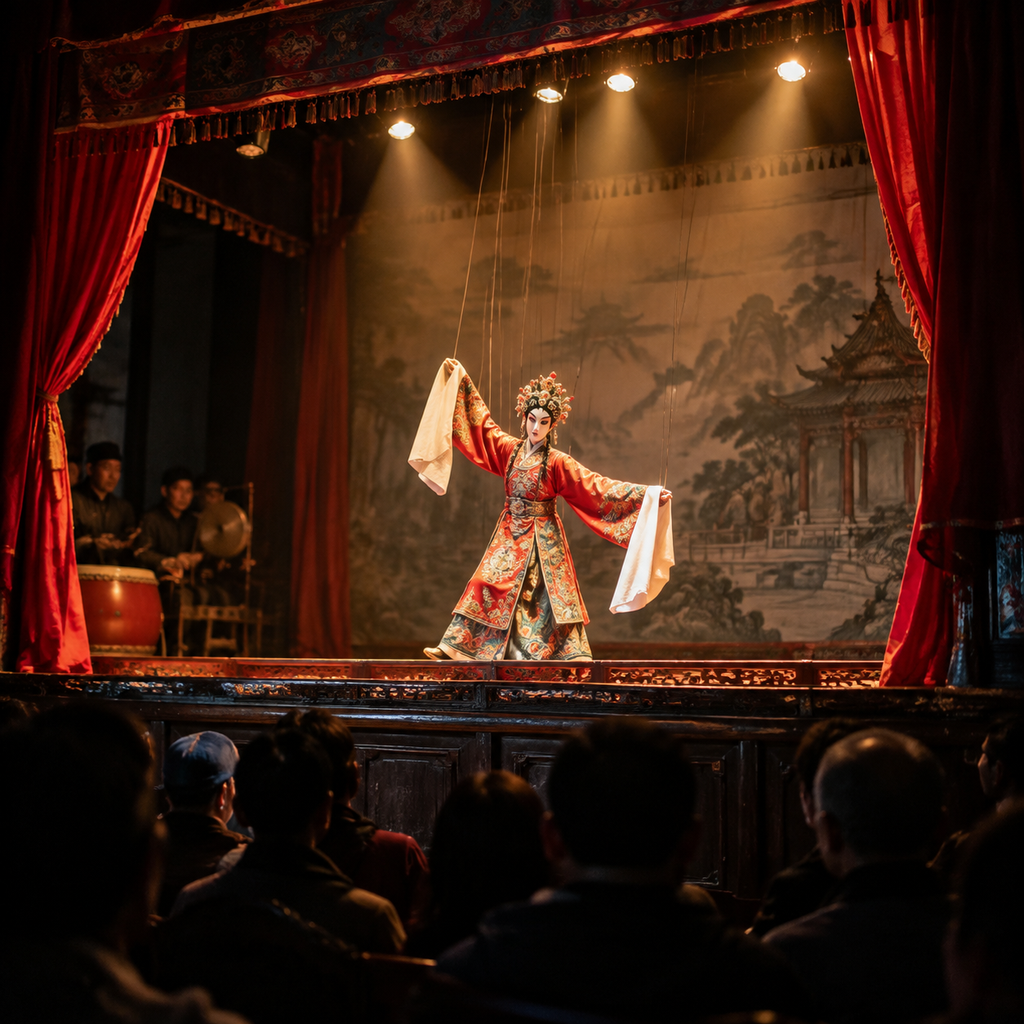
一次合适的安排 / A Practical Shape for the Visit
若把提线木偶作为泉州行程的重点之一,我会先做三件事。第一,查看当日仍有效的官方演出、展览或体验信息,确认地点、预约方式和拍摄规则;第二,把交通时间之外再留出缓冲,不让迟到风险迫使自己在后台或观众席里不断看手机;第三,提前告诉同行者这不是只看“造型”的项目,真正有意思的地方包括等待、观察和对动作的猜测。三件事都不复杂,却能把旅行从匆忙抵达改成有准备地进入。
If string puppetry is one of the main purposes of a Quanzhou visit, I would do three things first. Check current official information for performances, exhibitions, or workshops, including location, booking method, and photography rules. Leave a buffer beyond transport time so the risk of lateness does not keep the phone in your hand. And tell companions that this is not only a project for looking at costumes; waiting, observing, and guessing the mechanics are part of it. None of this is complicated, but together it changes arrival from a rush into a prepared entry.
第二层安排是体力。泉州老城适合步行,但热、湿、拥挤或突发降雨都可能改变脚程。把一场需要安静坐下的演出放在长距离暴走之后,同行者可能只剩下耐心的边角。相反,先在街巷里走一小段,再找地方休息、补水,最后进入剧场,身体会更有能力接收细节。若带小孩,不妨允许他在演出前问问题、在演出后画线条或模仿木偶动作;这种轻松的准备比要求他全程端坐更有效。
The second layer is physical energy. Quanzhou’s old city invites walking, but heat, humidity, crowds, or sudden rain can change the pace. If a quiet performance follows a long march, companions may have little patience left. A better sequence is to walk a short section of the lanes, rest and drink water, then enter the theater. With children, allow questions before the show and let them draw lines or imitate a puppet afterward. Such relaxed preparation is more effective than demanding perfect stillness throughout.
第三层安排是信息的可靠性。不要把无法确认的剧目名称、演员话语、票价或营业时间写进行程,也不要把旧页面上的“每天都有”当成今天一定成立。旅行者可以把可核实的信息与个人感受分开:前者来自当前公开渠道,后者来自现场的声音、触感和观察。这样写,也这样安排,既不会削弱文章的生动性,反而会让读者知道哪些内容可以参考,哪些内容需要自己到场判断。
The third layer is information reliability. Do not build an itinerary around an unverified title, a supposed quotation, a price, or an opening hour, and do not assume that an old page saying “every day” remains true today. Separate verifiable information from personal response. The former comes from current public channels; the latter comes from sound, touch, and observation on site. This distinction does not make a travel account less vivid. It tells readers which details they can use and which judgments require their own presence.
如果当天没有合适的演出或体验,也不必把泉州的提线木偶从计划里完全删掉。可以先查找公开展陈、剧团资料或地方文化机构发布的内容,了解木偶的结构、提线关系和观看礼仪;到现场后,再把这些知识用于观察戏台或相关展品。旅行不是只有“成功参加”与“完全错过”两种结果。知道如何在信息不完整时调整目标,也是成熟行程的一部分。
If no suitable performance or workshop is available that day, string puppetry need not disappear entirely from a Quanzhou plan. Look for public exhibitions, troupe materials, or information released by local cultural institutions, and learn about puppet structures, thread relationships, and viewing etiquette. On site, use that knowledge to observe a stage or related objects. Travel does not have only two outcomes—successful participation or total absence. Knowing how to adjust a goal when information is incomplete is part of a mature itinerary.
海风吹过之后 / After the Sea Wind Passes
回到住处后,我没有马上整理成一张“今日完成事项”清单。手指仍然记得那种需要克制的弯曲,耳朵还留着锣鼓与街声交替的节奏。我反而把当天最清楚的几个问题写下来:为什么一个小小停顿能让木偶显得有重量?为什么观众会在同一个时刻安静?为什么走出戏台后,街巷里的风会让刚才的线变得更容易理解?问题没有立刻得到完整答案,但它们让旅行继续发生在离场之后。
When I returned to where I was staying, I did not immediately turn the day into a checklist of completed tasks. My fingers still remembered the restrained curve they had needed, and my ears held the alternating rhythm of percussion and street noise. Instead, I wrote down the clearest questions: Why can a small pause give a puppet weight? Why does an audience become quiet at the same moment? Why does the wind in the lane make the threads easier to understand afterward? The questions had no immediate complete answers, but they allowed the visit to continue after leaving.
泉州提线木偶带给旅行者的并不是一种可以快速领取的“地方特色”。它要求人承认自己看不懂全部,也承认手的笨拙有价值。先看木偶,再看操作者;先看台前,再想后台;先听唱腔和锣鼓,再听街道与海风;先接受一个动作,再慢慢追问它背后的秩序。文化理解因此不再是把几个知识点装进脑袋,而是改变自己观看、等待和靠近的方式。
Quanzhou string puppetry is not a “local feature” that travelers can collect quickly. It asks us to admit that we will not understand everything and that awkward hands can still be valuable. Look at the puppet, then consider the puppeteer. See the front of the stage, then imagine the backstage. Hear the singing and percussion, then hear the street and sea wind. Accept one gesture before asking about the order behind it. Cultural understanding becomes less about storing facts and more about changing how we watch, wait, and approach.
那天夜里,泉州的风没有把所有声音吹散。巷口仍有车经过,远处仍有人说话,某家店的门帘被风掀起又落下。我想起体验时那根不肯立刻听话的线:它让我知道,所谓灵活并不是随意,所谓自由也不是没有牵引。木偶只有在关系里才能动起来,城市也只有在街巷、戏台、后台、观众和海面彼此交叠时,才显出完整的呼吸。
That night, Quanzhou’s wind did not erase every sound. Vehicles still passed at the lane entrance, people still talked in the distance, and a shop curtain lifted and fell. I thought of the thread that refused to obey immediately during the practice. It taught me that flexibility is not randomness, and freedom is not the absence of guidance. A puppet moves through relationships; a city breathes fully when lanes, stages, backstage labor, audiences, and the sea overlap.
第二天若要继续走,我会把那只手带上。不是把它当作已经学会了什么的证明,而是带着一点新的谨慎:经过一扇半开的门时先让路,遇到不确定的信息时先核实,进入一场演出时先观察别人怎样安静,看到一个动作时不要急着下结论。旅行安排可以写在手机里,真正的节奏却要由现场重新教会身体。泉州的海风吹过掌心,留下的不是一根看得见的线,而是一种愿意慢下来辨认牵引的能力。
If I continued walking the next day, I would bring that hand with me—not as proof that I had mastered anything, but with a new caution. Yield before a half-open doorway, verify uncertain information, notice how others become quiet before a performance, and resist rushing to define a gesture. An itinerary can live on a phone, but the body must relearn its rhythm from the place itself. Quanzhou’s sea wind passed over my palm and left not a visible thread, but the ability to slow down and recognize what is guiding movement.
还有一个很实际的安排常被忽略:把演出或体验的确认信息保存下来,同时记下自己真正想观察的两三个问题。同行者可以分别负责声音、手部动作和观众反应,结束后再交换各自看到的细节。这样既不会让所有人全程举着手机,也不会把文化体验变成一个人独自完成的任务。对于第一次接触提线木偶的家庭,这种分工尤其合适:孩子负责找线,成年人负责留意礼仪,大家在离场时一起把“看见了什么”说清楚。
One practical detail is easy to overlook: save the confirmed information for the performance or workshop, and write down two or three things you genuinely want to observe. Companions can divide their attention among sound, hand movements, and audience reactions, then compare notes afterward. This keeps everyone from holding up a phone throughout the show and turns the cultural visit into a shared task. For a family encountering string puppetry for the first time, the division works particularly well: the child looks for the threads, adults watch the etiquette, and everyone explains what they noticed after leaving.
让动作留在记忆里 / Letting the Gestures Remain
如果想把提线木偶看得更深,可以在离场前回想三个层次:木偶本身呈现了什么,操作者的手怎样完成了隐藏的劳动,观众又怎样用安静、笑声和身体移动回应戏台。这样的回想不需要立刻整理成标准答案,也不必把每个细节都拍下来。更值得保留的,可能是一个极短的停顿、一次线条突然收紧,或者木偶转身时重心迟疑的瞬间。它们提醒人,传统表演并不是静止保存的物件,而是一套在当下由许多人共同维持的关系。旅行者若愿意把注意力放在关系上,就会发现自己看到的并非单独的木偶,而是手、线、木架、灯光、声音、台口和座位之间不断调整的秩序。
If you want to look more closely at string puppetry, consider three layers before leaving: what the puppet presents, how the puppeteer’s hands perform hidden labor, and how the audience responds through silence, laughter, and bodily movement. There is no need to turn these reflections into a standard answer or record every detail. What deserves to remain may be a very brief pause, a sudden tightening of a thread, or a moment of hesitation in the puppet’s balance as it turns. These details remind us that traditional theater is not a static object preserved behind glass. It is a set of relationships maintained by many people in the present. When travelers focus on those relationships, they see not only a puppet but an order continually adjusted among hands, threads, wood, light, sound, the stage opening, and the seats.
在泉州安排这类体验时,街巷与戏台之间最好保留一段不被任务占满的时间。可以先从较安静的路段走向演出空间,观察门楣、骑楼、店铺和居民出入的节奏;演出结束后,再沿着不必重复原路的方向慢慢走,让耳朵从台上的唱腔和锣鼓回到城市的日常声部。海风有时并不强,却会改变皮肤对湿度和温度的判断,也会让人更清楚地意识到线的轻重不是抽象概念,而是掌心能够感知的变化。若遇到天气、交通或现场安排改变,行程可以缩短为一次展陈观看和一段街区散步,重点不在于完成多少地点,而在于是否仍然保持观察的连贯性。
When planning this kind of visit in Quanzhou, leave a stretch of time between the lanes and the stage that is not crowded with tasks. You might walk from a quieter section toward the performance space, noticing the rhythm of doorways, arcades, shops, and residents coming and going. After the performance, take a different route at an unhurried pace and let your ears move from singing and percussion back to the city’s ordinary soundscape. The sea breeze may be gentle, yet it changes how the skin reads humidity and temperature. It also makes clear that the weight of a thread is not an abstract idea but a change the palm can feel. If weather, transport, or local arrangements shift, the plan can become an exhibition visit followed by a neighborhood walk. The goal is not to complete the greatest number of places, but to keep observation connected.
我也会提醒同行者,不要把后台想象成一个可以随意闯入的神秘空间。后台首先是工作人员整理、等待和交接的工作场所,任何观看都要服从现场规则。若允许参观,应当站在不挡路的位置,避免触碰提线板、木偶服饰和未明确开放的道具;若不便进入,就从台前的变化去推测幕后需要怎样的配合。一个角色能够及时抬头,可能意味着多根线在极短时间里完成了分工;一片衣袖能够保持流动,也离不开手腕、线的张力和身体距离的共同控制。尊重边界并不会减少理解,反而让旅行者意识到,所谓“看见传统”也包括看见支撑它的劳动条件。
I would also remind companions not to imagine backstage as a mysterious room one may enter at will. It is first of all a workplace where staff arrange, wait, and hand things over, so any viewing must follow local rules. If access is permitted, stand where work is not blocked and avoid touching control boards, puppet costumes, or props that are not clearly open to visitors. If entry is not appropriate, infer the backstage coordination from changes in the visible performance. A character lifting its head at the right moment may mean that several threads have been divided among tasks in a very short interval. A sleeve retaining its flow depends on the wrist, thread tension, and bodily distance working together. Respecting boundaries does not reduce understanding; it helps travelers recognize that “seeing a tradition” also means seeing the labor conditions that sustain it.
把这些观察带回旅行记录时,语言可以具体一些。与其写“很震撼”,不如写清楚自己看见了哪一次停顿、听见了哪一种声音、在哪个位置意识到观众正在跟随节奏。与其说“泉州很有文化”,不如说明一段街巷如何让人从戏台的秩序重新听见城市,或一次笨拙的提线练习如何改变了对“灵活”的理解。这样的记录不会替读者完成判断,却能为下一次到访留下可追踪的线索:哪些信息需要再次核实,哪些场所应提前确认规则,哪些问题值得继续观看。海风仍会吹过石板路和掌心,真正留下来的则是更耐心的观看方法,以及在陌生地方保持分寸、好奇和准确的能力。
When bringing these observations into a travel journal, use concrete language. Instead of writing “it was astonishing,” describe the pause you saw, the sound you heard, and the moment when you realized the audience was following a rhythm. Instead of saying “Quanzhou is very cultural,” explain how a lane led you from the stage’s order back to the city, or how an awkward practice changed your understanding of flexibility. Such notes do not decide for the reader, but they leave traceable clues for another visit: which information needs checking again, which places require rules to be confirmed in advance, and which questions deserve another act of watching. The sea wind will still cross stone streets and palms. What remains is a more patient way of seeing, along with the ability to stay careful, curious, and accurate in an unfamiliar place.
Public Source Notes
Official public tourism information; public materials from puppet troupes or theaters; publicly visible theater information; public city-culture and transport information.
- 在中国高铁站学会像本地人一样换乘 | How I Learned to Transfer Like a Local at a Chinese High-Speed Railway Station
- 北京最怕第一次来的人一上来就把所有重量景点挤在同一天 | Beijing Is Hardest on First-Time Visitors When They Pack All the Heaviest Sights into One Day
- 微信与支付宝双钱包搭配策略 | Using WeChat Pay and Alipay Together
- 西安夜市排队课:别盲追最长队伍 | A Xi’an Night Market Lesson: Don’t Chase the Longest Queue Blindly
- 中国的户籍制度到底是怎么回事? | What Exactly Is China's Hukou System?
- 那本被果汁弄湿的拼音本,让本人第一次学会声调不是唱歌,而是方向 | A Pinyin Notebook Spilled with Juice Taught Me That Tones Are Not Singing but Direction
- 云南雨季反向玩法:人少、景美、预算可控 | Yunnan in Rainy Season: Fewer Crowds, Better Value
- 外国人在中国买东西被拒收现金怎么办? | What To Do When a Chinese Shop Refuses Your Cash
- 十个值得你慢下来的中国古镇 | Ten Chinese Ancient Towns Worth Slowing Down For
- 落地后的第一笔钱:在中国旅行建立支付备用方案 | Your First Payment After Landing: Building a Backup Plan for Travel in China
Comments (0)