
大理先让我学会的,不是看风景,而是在古城外把脚步放稳 | What Dali Taught Me First Was Not the View, but How to Steady My Steps Outside the Old Town
第一次到大理,我先学会观察路口和人流 | On My First Day in Dali, I Learned to Read Crossroads and Crowds
01
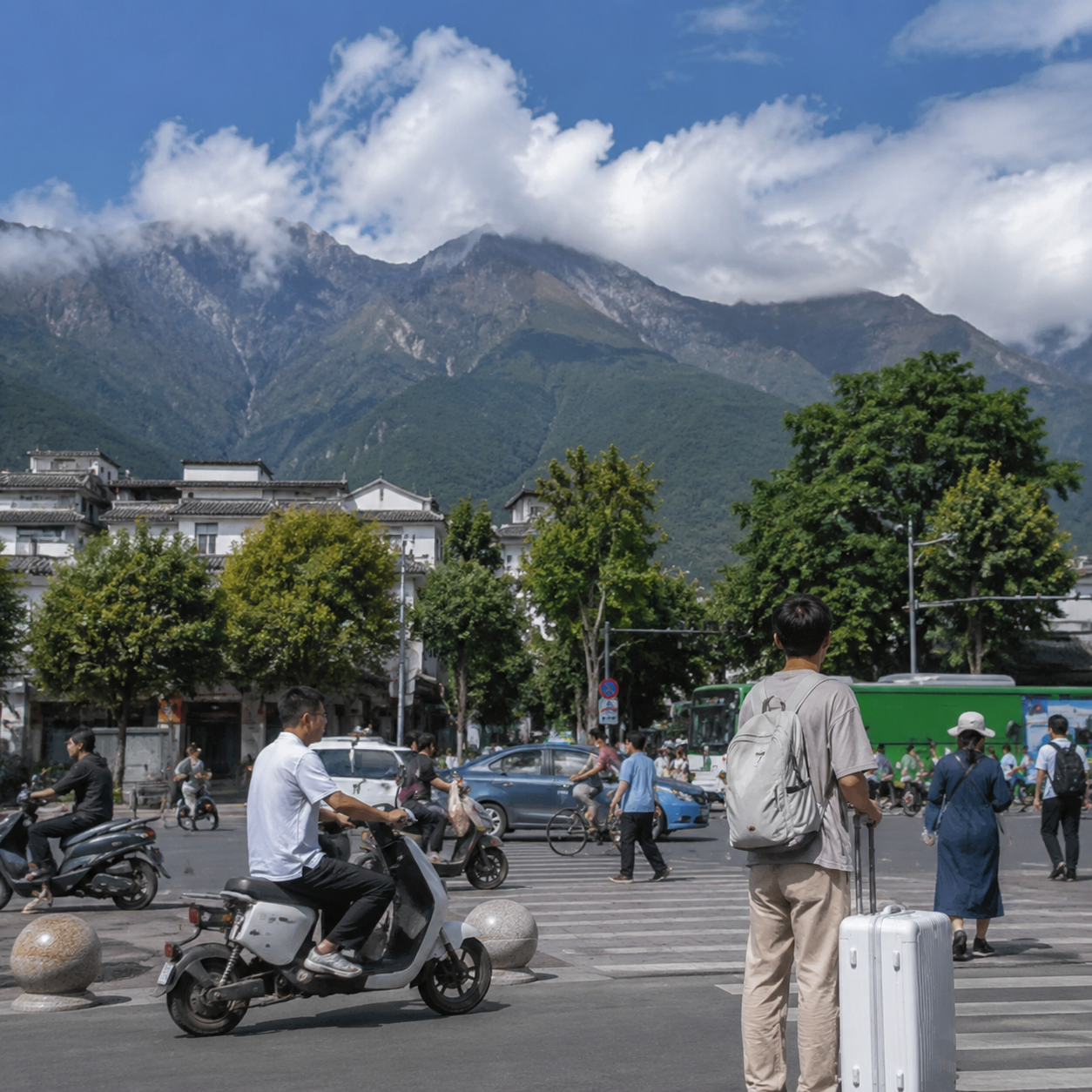
到大理的第一天,我没有急着给它下任何关于“松弛”“浪漫”或“治愈”的判断。那些词太容易从短视频和民宿文案里跳出来,先替城市完成自我介绍。真正让我开始理解大理的,反而是古城外的几个路口。它们不漂亮,也不安静,甚至有点混乱:电动车从斑马线边缘擦过去,出租车在路口短暂停顿,背包客拖着行李箱站在路牌下看手机,租车店的人把小电驴一辆辆推到门前,公交车慢慢挤进人流。苍山在远处稳稳地站着,洱海在另一边发亮,但第一天的现实入口不是山海,而是路口。你要先学会在这些路口读懂方向、速度和人的犹豫,才可能真正进入大理。
On my first day in Dali, I did not rush to judge it with words like “relaxed,” “romantic,” or “healing.” Those words too easily leap out of short videos and guesthouse copywriting, introducing the city before the city can introduce itself. What actually began to teach me Dali was several intersections outside the old town. They were not beautiful or quiet; they were even a little chaotic: electric scooters brushed past the edges of crosswalks, taxis paused briefly at corners, backpackers dragged suitcases while checking phones under road signs, rental shops pushed small e-bikes one by one to the door, and buses slowly squeezed into the flow. Cangshan stood steadily in the distance, and Erhai glimmered on the other side, but the first real entrance was not mountain or lake. It was the intersection. You have to learn to read direction, speed, and people’s hesitation there before you can truly enter Dali.
02
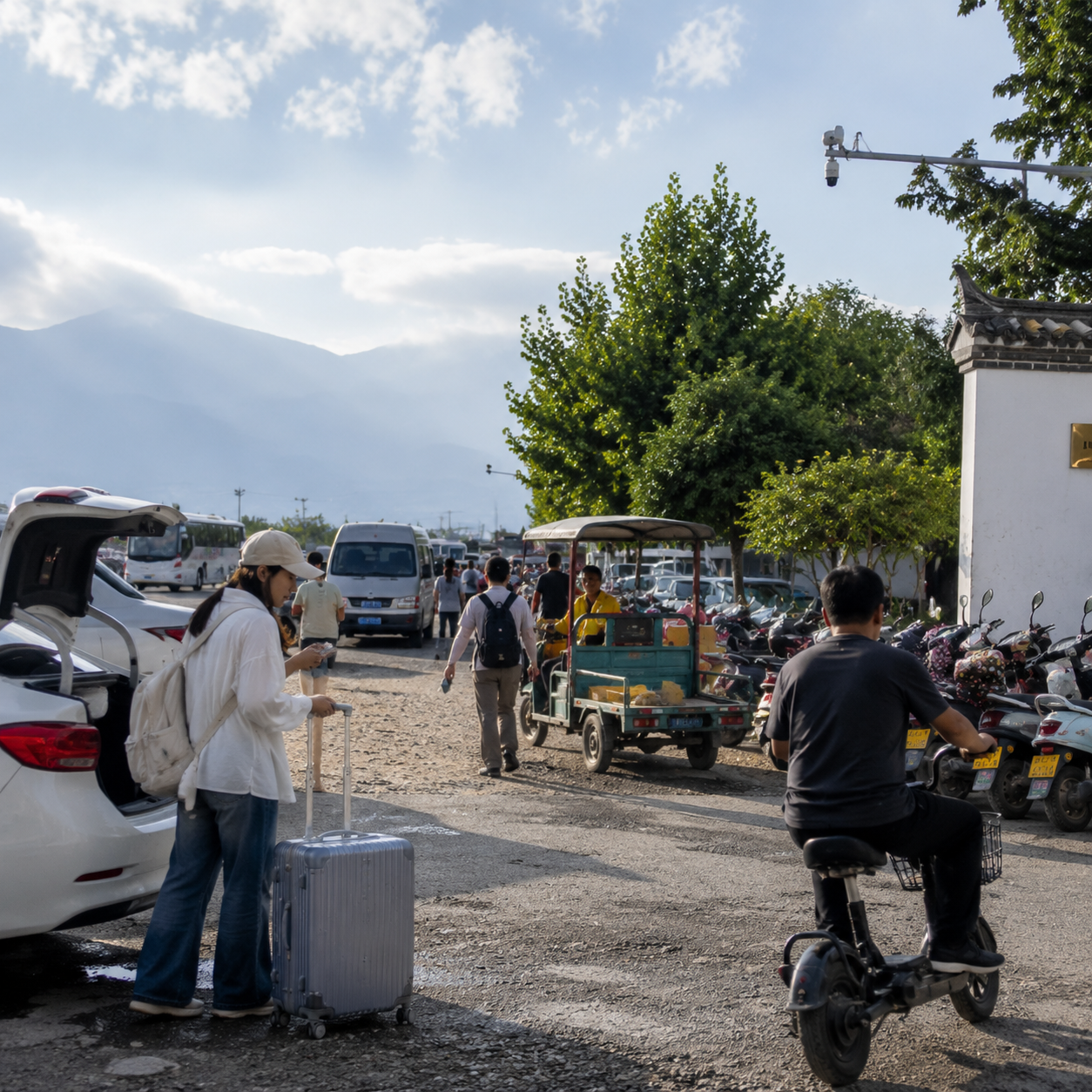
古城外的道路像一层缓冲带,把想象中的大理和实际运转的大理隔开。城门以内是石板路、店招、银饰、鲜花饼、披肩和拍照的人;城门以外则是停车场、客运车、共享电单车、外卖骑手、三轮车、旅行团集合点和不断变化的导航路线。很多游客从车上下来时,表情还停留在“终于到了”的轻松里,可身体已经被交通推着行动:先躲一辆电动车,再跨过一段不太平整的路面,然后寻找民宿老板发来的定位。古城不是孤岛,它的外侧有一圈很现实的边缘。这个边缘决定你是拖着箱子走十分钟,还是坐摆渡车;是租车绕海,还是先把行李寄存;是立刻进入风景,还是先被路况教育一遍。
The roads outside the old town are like a buffer zone separating imagined Dali from Dali as it actually operates. Inside the gates are stone paths, shop signs, silver jewelry, flower cakes, shawls, and people taking photos. Outside the gates are parking lots, passenger vans, shared e-bikes, delivery riders, three-wheelers, tour group meeting points, and navigation routes that keep changing. Many visitors step out of vehicles with the relaxed expression of “finally arrived,” but their bodies are already pushed into motion by traffic: first dodging an electric scooter, then crossing an uneven patch of pavement, then searching for the location sent by a guesthouse owner. The old town is not an island. Around its outer side lies a very real edge. That edge decides whether you drag your suitcase for ten minutes or take a shuttle; whether you rent a vehicle to circle the lake or store luggage first; whether you enter the scenery immediately or receive a lesson from the road conditions.
03
我站在一个路口看了很久。红绿灯有自己的节奏,但人流并不完全服从它。当地人判断空隙的速度很快,电动车在车流里找到一条细线就过去,车头微微一偏,身体重心跟着一让,像一种长期训练出的本能。游客则慢半拍,常常先看灯,再看车,再看旁边有没有人走。两种速度在路口相遇,形成大理第一天最明显的差异:一种是熟悉道路的人在生活里穿行,一种是刚抵达的人在风景前校准自己。这里没有谁绝对正确。当地人的快,是因为日子不能停;游客的慢,是因为每一步都还在确认。路口把这种差异暴露得很清楚,也把城市的耐心考验出来。
I stood at one intersection for a long time. The traffic light had its own rhythm, but the flow of people did not completely obey it. Locals judged gaps quickly. Electric scooters found a thin line through traffic and slipped across, the front wheel tilting slightly, the rider’s weight shifting with it, like an instinct shaped by long practice. Visitors were half a beat slower. They often looked first at the light, then at the cars, then at whether anyone beside them was crossing. Two speeds met at the intersection, forming the clearest difference of my first day in Dali: one belonged to people familiar with the road moving through daily life, the other to people newly arrived, calibrating themselves before the scenery. Neither was absolutely right. The locals’ speed came from life’s inability to stop; the visitors’ slowness came from the need to confirm every step. The intersection exposed this difference clearly and tested the city’s patience.
04
租车店是古城外最能说明大理旅行方式的地方。门口排着电动车、小摩托、敞篷吉普、甲壳虫样式的小车,颜色鲜亮,像一排可以被购买的自由。店员熟练地介绍路线:今天顺时针还是逆时针,去喜洲要多久,双廊能不能当天来回,环海西路哪段适合拍照,哪段风大,哪里查车严。游客听的时候,眼睛里常常已经出现洱海边的蓝色和公路照片里的自己。可是租车这件事也把边界摆了出来。会不会骑,敢不敢上路,能不能接受晒、风、堵、停车难,能不能在陌生路口迅速判断方向,这些问题比“想不想自由”更具体。大理的自由不是抽象的,它要通过押金、头盔、电量、限速和路权来兑现。
Rental shops outside the old town explain Dali’s travel style better than many scenic spots. At their doors stand rows of e-bikes, small motorcycles, open-top jeeps, and Beetle-like cars in bright colors, like a line of freedom available for purchase. The staff introduce routes skillfully: clockwise or counterclockwise today, how long it takes to reach Xizhou, whether Shuanglang can be done in one day, which section of the western lakeside road is good for photos, where the wind is strong, and where traffic checks are strict. As visitors listen, the blue of Erhai and the version of themselves in road-trip photos often already appear in their eyes. But renting a vehicle also lays out boundaries. Can you ride? Do you dare to enter traffic? Can you accept sun, wind, congestion, parking difficulty? Can you judge direction quickly at an unfamiliar intersection? These questions are more concrete than “Do you want freedom?” Freedom in Dali is not abstract. It must be cashed out through deposit, helmet, battery level, speed limits, and right of way.
05
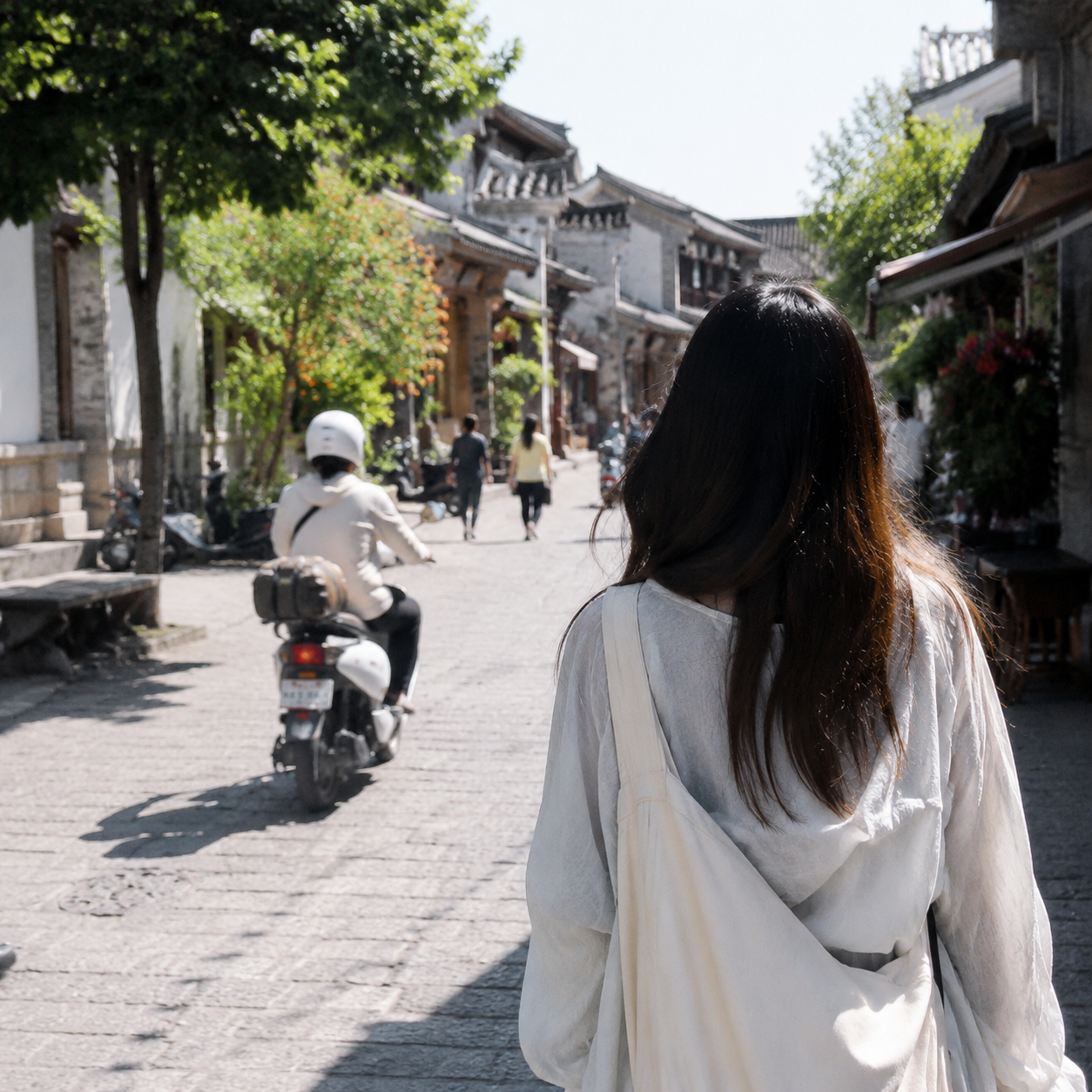
步行的边界也很明显。古城里适合慢走,适合在店铺之间被香味、音乐和招牌吸引,适合随时停下来拍一扇门、一盆花、一只睡在台阶上的狗。可一旦走到古城外,步行就开始显得笨重。人行道有时被电动车占用,有时被临停车辆切断,有时突然变窄,让拖箱子的人不得不下到车道边缘。地图上看起来很近的距离,在太阳、风和车流里会变长。洱海边也是如此。湖面看似邀请你一直走下去,但真正能舒服步行的段落并不连续。某些地方适合散步,某些地方更适合骑行,某些地方你只是在车流和景观之间寻找一个不尴尬的位置。大理的慢,不等于每条路都适合慢走。
The boundary of walking is also obvious. Inside the old town, walking slowly feels right. You can be drawn from shop to shop by smells, music, and signs, stopping anytime to photograph a door, a pot of flowers, or a dog asleep on a step. But once you reach the outside, walking begins to feel clumsy. Sidewalks are sometimes occupied by e-bikes, sometimes cut off by temporarily parked vehicles, sometimes suddenly narrowed so that people dragging suitcases have to step down near the roadway. Distances that look short on the map grow longer under sun, wind, and traffic. The same is true by Erhai. The lake surface seems to invite you to keep walking, but the sections comfortable for walking are not continuous. Some places suit strolling, some suit cycling better, and in some places you are simply searching for a position between traffic and scenery that does not feel awkward. Dali’s slowness does not mean every road is suitable for slow walking.
06
下午我往洱海边去,路上的人流开始换一种形态。古城外的人流是分散的、寻找方向的,带着行李和刚到达的疑问;洱海边的人流则更像被同一幅画吸引过去。大家的身体朝向变得一致,手机举起的角度也相似。有人骑电动车经过,披肩被风吹到身后;有人把租来的车停在路边,急着寻找能把海、树和自己放在一起的角度;有人只是坐在石阶上发呆,看太阳把水面切成碎银。交通在这里没有消失,只是暂时退到景观的边缘。车轮声、喇叭声、游客笑声、摄影师提醒站位的声音,都被湖面的大光线稀释了。可是只要往后退几步,现实立刻回来:停车、会车、掉头、避让、等人。
In the afternoon I went toward Erhai, and the flow of people on the road changed shape. Outside the old town, the flow was scattered and direction-seeking, carrying luggage and the questions of new arrival. By the lake, the flow seemed drawn by the same picture. Bodies turned toward the same direction, and phones lifted at similar angles. Someone rode past on an e-bike, a shawl blown backward by the wind; someone parked a rented vehicle at the roadside, eager to find an angle that could hold the sea-like lake, the trees, and themselves together; someone simply sat on stone steps, staring as the sun cut the water into broken silver. Traffic did not disappear here. It merely retreated temporarily to the edge of the view. Wheel sounds, horns, tourist laughter, and photographers telling people where to stand were diluted by the lake’s great light. But step back a few paces and reality immediately returns: parking, passing, turning around, yielding, waiting for someone.
07
洱海边最有意思的,不是风景本身,而是人如何安排自己与风景的距离。有人一定要贴近水面,哪怕那一小段路并不好走;有人更愿意站在路对面,把湖、车和行道树都放进照片里;有人骑车不停,像是要用速度证明环海的完整;有人走走停停,把一下午拆成很多个小停顿。租车和步行在这里不只是交通方式,也代表两种观看方式。租车让你拥有更大的范围,可以追光、追云、追一个没那么拥挤的角落;步行让你拥有更细的触感,可以听见树叶声、摊主叫卖声、鞋底踩过砂石的声音。但两者都有代价。租车会让你错过细节,步行会让你被距离限制。第一天的大理,就是不断在这两种代价之间做选择。
The most interesting thing by Erhai is not the scenery itself, but how people arrange their distance from it. Some insist on getting close to the water even if that short section is not easy to walk. Some prefer standing across the road, putting the lake, vehicles, and roadside trees into one photo. Some keep riding, as if using speed to prove the completeness of circling the lake. Some walk and stop, breaking an afternoon into many small pauses. Renting and walking are not only modes of transportation here; they are also two modes of seeing. Renting gives you a larger range, allowing you to chase light, clouds, or a less crowded corner. Walking gives you a finer touch, allowing you to hear leaves, vendors calling, and shoe soles crossing gravel. But both have costs. Renting can make you miss details; walking can confine you by distance. The first day in Dali is a repeated choice between these two costs.
08
我后来意识到,古城外和洱海边其实构成了两套阅读系统。古城外读的是路口:哪里能过,哪里要等,哪条路通向住宿,哪条路通向停车场,哪条路看似近却拖着箱子不好走。洱海边读的是人流:人群在哪里停下,哪里开始拍照,哪里因为风太大而没人久留,哪里因为树影好看而形成临时的队列。前者训练你理解城市的实际秩序,后者训练你理解旅行欲望的流动。大理不是只靠自然景观成立的,它还靠这些不断被人使用、误读、调整和重新选择的路线成立。第一天如果只看山海,可能会觉得它过于简单;但如果看路口和人流,就会发现它很复杂。
I later realized that the outside of the old town and the edge of Erhai form two reading systems. Outside the old town, you read intersections: where you can cross, where you must wait, which road leads to lodging, which road leads to parking, which road looks close but is hard with a suitcase. By Erhai, you read people flows: where crowds stop, where photos begin, where wind is too strong for people to stay long, where good tree shadows create temporary lines. The former trains you to understand the city’s practical order; the latter trains you to understand the movement of travel desire. Dali does not exist only through natural scenery. It also exists through routes that are constantly used, misread, adjusted, and chosen again. If on the first day you look only at mountains and lake, Dali may seem too simple. But if you look at intersections and people flows, you will find it complex.
09
傍晚回到古城外,路口比白天更难读。天光变低,车灯亮起来,摊位开始占据路边,吃饭的人和回住处的人交织在一起。白天还显得清楚的方向,到了这时会被气味和灯光打乱。烤乳扇的甜味、菌汤的热气、烧烤烟、鲜花饼店的香味一起飘出来,让人忘记原本要往哪边走。交通也变得更情绪化:有人赶着还车,有人找不到停车位,有人刚租到车还不熟悉刹车,有人站在路边等同伴。路口像一个临时剧场,每个人都带着自己的小任务登场。大理的傍晚不是简单的温柔,它是一种密度:风景的密度、胃口的密度、移动的密度、选择的密度。
At dusk, returning to the outside of the old town, the intersections became harder to read than in the daytime. The sky lowered, headlights came on, stalls began to occupy the roadside, and people going to dinner mixed with people returning to lodging. Directions that had seemed clear by day were disrupted by smells and lights. The sweetness of grilled rushan cheese, the steam of mushroom soup, barbecue smoke, and the fragrance from flower cake shops drifted together, making people forget which way they had meant to go. Traffic also became more emotional: someone hurried to return a rental, someone could not find a parking space, someone had just rented a scooter and was not yet familiar with the brake, someone stood by the road waiting for companions. The intersection became a temporary theater, each person entering with a small task. Dali’s evening is not simply gentle. It is a kind of density: the density of scenery, appetite, movement, and choice.
10
这一天结束时,我没有觉得自己已经“看完”大理,反而觉得刚刚学会看它的边缘。很多城市会把最好看的部分放在中心,要求你抵达、拍照、离开;大理的中心当然也好看,可它真正让人停下思考的地方,常常在中心和边缘之间:古城门外的停车点,租车店门口的头盔架,洱海边道路突然变窄的地方,游客停下来犹豫要不要继续走的路口,居民骑车穿过人群时毫不夸张的熟练。第一天读懂这些,不会让旅行更省事,却会让它更真实。你会知道所谓松弛并不是没有秩序,而是在山、海、人、车之间不断协商出一个可移动的位置。
At the end of the day, I did not feel that I had “finished seeing” Dali. Instead, I felt I had just learned to see its edges. Many cities place their most photogenic parts at the center and ask you to arrive, photograph, and leave. Dali’s center is certainly beautiful, but the places that truly make one pause and think are often between center and edge: the parking points outside the old town gate, the helmet racks at rental shop doors, the places where the road by Erhai suddenly narrows, the intersections where visitors stop and wonder whether to continue, the unexaggerated skill with which residents ride through crowds. Understanding these on the first day does not make travel easier, but it makes it more real. You learn that so-called relaxation is not the absence of order, but a movable position constantly negotiated among mountain, lake, people, and vehicles.
11
如果说大理给人的第一印象常常是颜色,那么我第一天记住的却是流向。人从车站、停车场、古城门、租车店、客栈和湖边不断流动,像几股不同温度的水在同一片地面上汇合。有人向内走,想进入古城;有人向外走,想靠近洱海;有人在两者之间反复横跳,既舍不得店铺的热闹,又想追一段湖边的落日。交通工具改变了这种流向的速度,也改变了人的脾气。骑车的人更相信远方,步行的人更依赖附近;开车的人先考虑停车,打车的人先考虑堵不堵;拖箱子的人最现实,只想知道这段路到底平不平。所有这些小判断,组成了大理第一天的底层地图。
If Dali’s first impression is often color, what I remembered on my first day was flow. People moved continuously from stations, parking lots, old town gates, rental shops, inns, and the lakeside, like streams of different temperatures meeting on the same ground. Some moved inward, wanting to enter the old town; some moved outward, wanting to approach Erhai; some jumped repeatedly between the two, unwilling to give up the bustle of shops yet eager to chase a stretch of lakeside sunset. Transportation changed the speed of these flows and also changed people’s tempers. Riders believed more in distance; walkers depended more on nearby places. Drivers thought first about parking; taxi passengers thought first about congestion. People dragging suitcases were the most realistic: they only wanted to know whether the road was flat. All these small judgments formed the underlying map of my first day in Dali.
12
所以我愿意把第一天的大理写成一张正在移动的草图,而不是一张明信片。明信片会选择最干净的角度,把苍山、洱海、蓝天和白墙放在一起;草图则保留路口的犹豫、车流的噪声、租车时的讨价还价、步行到一半的后悔、湖边拍照的人群、居民穿行时的平常。明信片让你相信大理只负责美,草图提醒你美也需要道路、规则、体力和耐心来支撑。第一天我还没有进入太深的巷子,也没有抵达太远的村庄,但我已经知道,大理不是一个只适合远看的地方。它需要被走近,被绕行,被等待,被避让,也被重新选择。读懂路口和人流,就是读懂它如何把风景变成生活,又如何把生活留在风景里。
So I prefer to write my first day in Dali as a moving sketch rather than a postcard. A postcard chooses the cleanest angle and places Cangshan, Erhai, blue sky, and white walls together. A sketch keeps the hesitation at intersections, the noise of traffic, bargaining at rental shops, regret halfway through a walk, crowds taking photos by the lake, and residents passing through as usual. A postcard makes you believe Dali is responsible only for beauty; a sketch reminds you that beauty also needs roads, rules, stamina, and patience to support it. On the first day I had not yet entered very deep alleys or reached distant villages, but I already knew Dali was not a place meant only to be viewed from afar. It needs to be approached, detoured around, waited through, yielded to, and chosen again. To read the intersections and people flows is to read how it turns scenery into life, and how it keeps life within scenery.
- 潮州早茶的一张小桌 | A Small Table at Chaozhou Morning Tea
- 花椒烫过舌尖之后,你才算见过川菜 | Sichuan Cuisine Begins Where the Pepper Numbs You
- 夏季避暑胜地:高原与海岛 | Summer Escapes: Plateaus & Islands
- 云南雨季反向玩法:人少、景美、预算可控 | Yunnan in Rainy Season: Fewer Crowds, Better Value
- 一根提线停在掌心时,我在泉州听见了海风 | When a Puppet String Rested in a Palm, I Heard the Sea Wind in Quanzhou
- 五月去绍兴的那场朋友旅行,最后记住我们的不是黄酒,是雨里那段走错的路 | On a May Friend Trip to Shaoxing, What Stayed with Us Was Not the Wine but the Road We Missed in the Rain
- 在成都点微辣,我才知道辣度不是翻译能完全解决的 | Ordering Mild Spice in Chengdu Taught Me Translation Cannot Fully Explain Heat
- 低价团不是不能报,但合同要比宣传页更重要 | Cheap Tours Are Not Always Bad, but the Contract Matters More Than the Brochure
- 去济南之前,我先把会让人慌张的那几样信息收进同一屏 | Before Jinan, I Gathered the Few Panic-Making Essentials onto One Screen
- 川藏线进藏路线拆解与海拔应对 | Sichuan-Tibet Highway: Route Breakdown & Altitude Tips
Comments (0)