
乌鲁木齐老街的灯一亮,孜然和人声就把夜晚烤热了 | Once the Old-Street Lights Came On in Urumqi, Cumin and Voices Warmed the Night
乌鲁木齐老街的一盏灯,让我看见生活比景点更耐看 | One Lamp on an Old Street in Urumqi Showed Me Daily Life Outlasts Attractions
乌鲁木齐的夜不是一下子落下来的,它像从天山脚下慢慢推来的一层蓝色绒布,先盖住远处的楼顶,再盖住街口的树梢,最后落在老街一盏盏亮起的灯上。黄昏时我走进这片街区,白天残留的热气还贴在墙面,烤包子的香味从巷子深处传出,混着孜然、煤火、葡萄干和尘土的味道。老街的灯并不整齐,有的挂在门楣上,有的从小吃摊的铁架子下垂下来,有的被塑料棚布遮住半边,光线因此有明有暗,像城市自己写下的手稿。它们没有商场灯光那种统一的亮度,却更像人的眼睛,带着疲惫、热情、警觉和温柔。我放慢脚步,看第一盏灯把水果摊上的哈密瓜切面照成蜜色,看第二盏灯落在老人手里的茶杯上,看第三盏灯把孩子奔跑的影子拉长。乌鲁木齐的老街灯不是单纯照明,它们像夜晚的开场白,把一座边疆城市的记忆一点点说亮。
Night in Urumqi does not fall all at once. It comes like a piece of blue velvet slowly pushed from the foot of the Tianshan Mountains, first covering distant rooftops, then treetops at intersections, and finally resting on the lamps that light up one by one along the old street. At dusk I walked into this neighborhood, where the day’s remaining heat still clung to the walls and the smell of baked buns drifted from deep lanes, mixed with cumin, coal fire, raisins, and dust. The lamps of the old street were not orderly. Some hung above doorframes, some drooped from iron frames of food stalls, and some were half-covered by plastic awnings, making the light uneven, like a manuscript written by the city itself. They did not have the standardized brightness of shopping malls, but they felt more like human eyes, carrying fatigue, warmth, alertness, and tenderness. I slowed down and watched the first lamp turn the cut surface of a melon into honey, the second fall on a tea glass in an old man’s hand, and the third stretch the shadow of a running child. The old street lamps of Urumqi are not merely for illumination; they are the opening lines of night, gradually brightening the memory of a frontier city.
街道两侧的店铺一家接一家亮起来,招牌有汉字,也有维吾尔文,笔画和弯曲的字母在灯下相互靠近。卖馕的炉口吐着红光,师傅用长钩把圆馕从炉壁上取下,动作熟练得像从时间里取出一轮小月亮。旁边的羊肉串摊已经围了几个人,铁签在火上翻动,油脂落下时火苗猛地一亮,照得摊主的脸一瞬间清晰,又很快退回烟雾里。灯光在烟里散开,带着一种柔软的颗粒感,让所有东西都像隔着回忆。有人站在路边讲电话,声音里夹着笑;有人骑着电动车穿过人群,车筐里放着刚买的菜;还有游客举着手机找角度,想把灯、烟、招牌和人流都收进同一张照片。可是老街灯的美很难被完整拍下,因为它不只在画面里,也在气味里、温度里、叫卖声里,在脚下旧砖轻微不平的触感里。
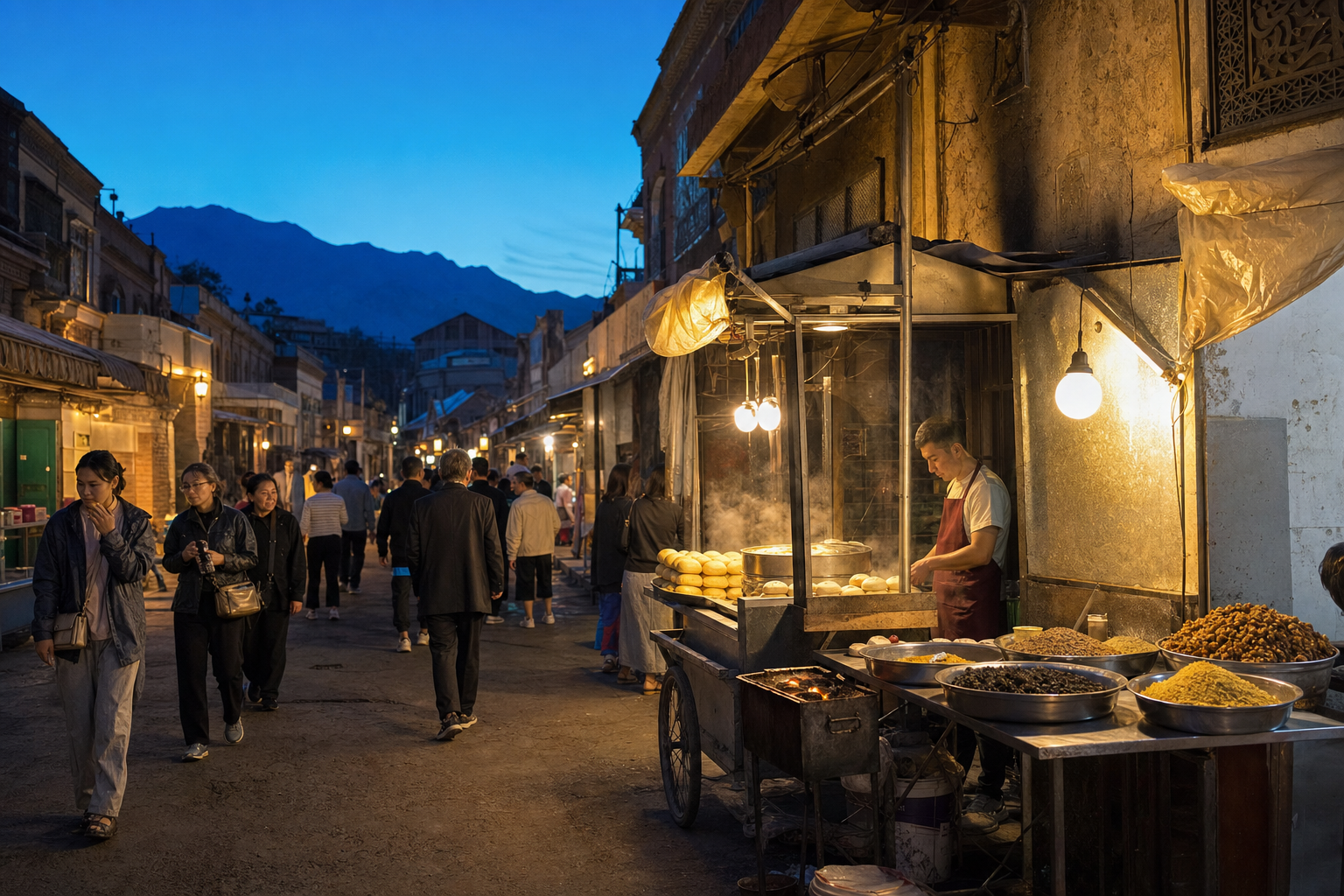
Shops on both sides of the street lit up one after another. Their signs carried Chinese characters and Uyghur script, straight strokes and curved letters leaning toward each other under the lamps. The naan oven glowed red at its mouth, and the baker used a long hook to remove round breads from the oven wall with a skill that made it seem as though he were lifting small moons out of time. Next to him, several people had gathered around a lamb skewer stall. Iron skewers turned over the fire, and when fat dripped down, flames leapt up, lighting the vendor’s face clearly for a second before it retreated into smoke. The light spread through the smoke with a soft graininess, making everything appear as if seen through memory. Someone stood by the road talking on the phone with laughter in his voice; someone rode an electric scooter through the crowd with vegetables in the basket; tourists raised phones, trying to place lamps, smoke, signs, and pedestrians inside one frame. But the beauty of old street lights is difficult to capture whole, because it does not live only in images. It lives in smells, temperature, vendors’ calls, and the slight unevenness of old bricks underfoot.
我在一处卖干果的摊前停下,摊主把无花果、巴旦木、杏干、葡萄干分成一堆堆小山,灯泡悬在上方,把它们照得像低声发光的矿石。他递给我一颗葡萄干试吃,甜味浓得几乎带着阳光晒过的厚度。我问这些干果从哪里来,他说有的从吐鲁番来,有的从南疆来,说到地名时语气平常,却让我觉得一张辽阔地图在灯下展开。乌鲁木齐就是这样,它把很远的地方收进一条街,把山地、盆地、绿洲、沙漠和城市生活折叠在摊位之间。老街灯照着的不只是买卖,也照着迁徙、相遇和停留。一个城市的身份有时不在高楼的轮廓里,而在夜市摊主随口说出的地名里,在一颗葡萄干的甜里,在你突然意识到自己站在许多道路交汇处的那一秒。
I stopped at a stall selling dried fruit, where the vendor arranged figs, almonds, dried apricots, and raisins into small hills. A bulb hung above them, making the piles look like quiet glowing stones. He handed me a raisin to taste, and its sweetness was so dense that it seemed to carry the weight of sunlight. I asked where the dried fruit came from. He said some from Turpan, some from southern Xinjiang, and his tone was ordinary when naming these places, yet I felt a vast map opening under the lamp. This is what Urumqi does: it gathers distant places into one street, folding mountains, basins, oases, deserts, and city life between stalls. The old street lamps illuminate not only trade, but also migration, encounter, and staying. A city’s identity is sometimes not in the outline of tall buildings, but in place names casually spoken by a night-market vendor, in the sweetness of a raisin, and in the second when you realize you are standing at the crossing of many roads.
继续往前走,老街变得更热闹。音乐从一家小店里飘出来,节奏轻快,门口几个年轻人跟着拍子晃动肩膀。另一边的餐馆里,服务员端着大盘鸡穿过桌子之间,盘里的辣椒和土豆在灯下泛着油亮的光。玻璃窗上贴着菜单,字迹被室内外两层光反复映照,重叠得有些模糊。门口排队的人不急,边等边聊天,有人用普通话,有人用维吾尔语,也有人夹杂着几种口音。语言在这里不像界线,更像夜风里交错的线,绕过灯柱,绕过摊位,绕过每个愿意停下来吃点东西的人。我听不懂所有话,却能听懂笑声和讨价还价的语气。老街灯把这些声音照得有了形状,让我觉得一座城市真正的开放并不只在口号里,而在夜晚人们可以一起站在同一片光下。
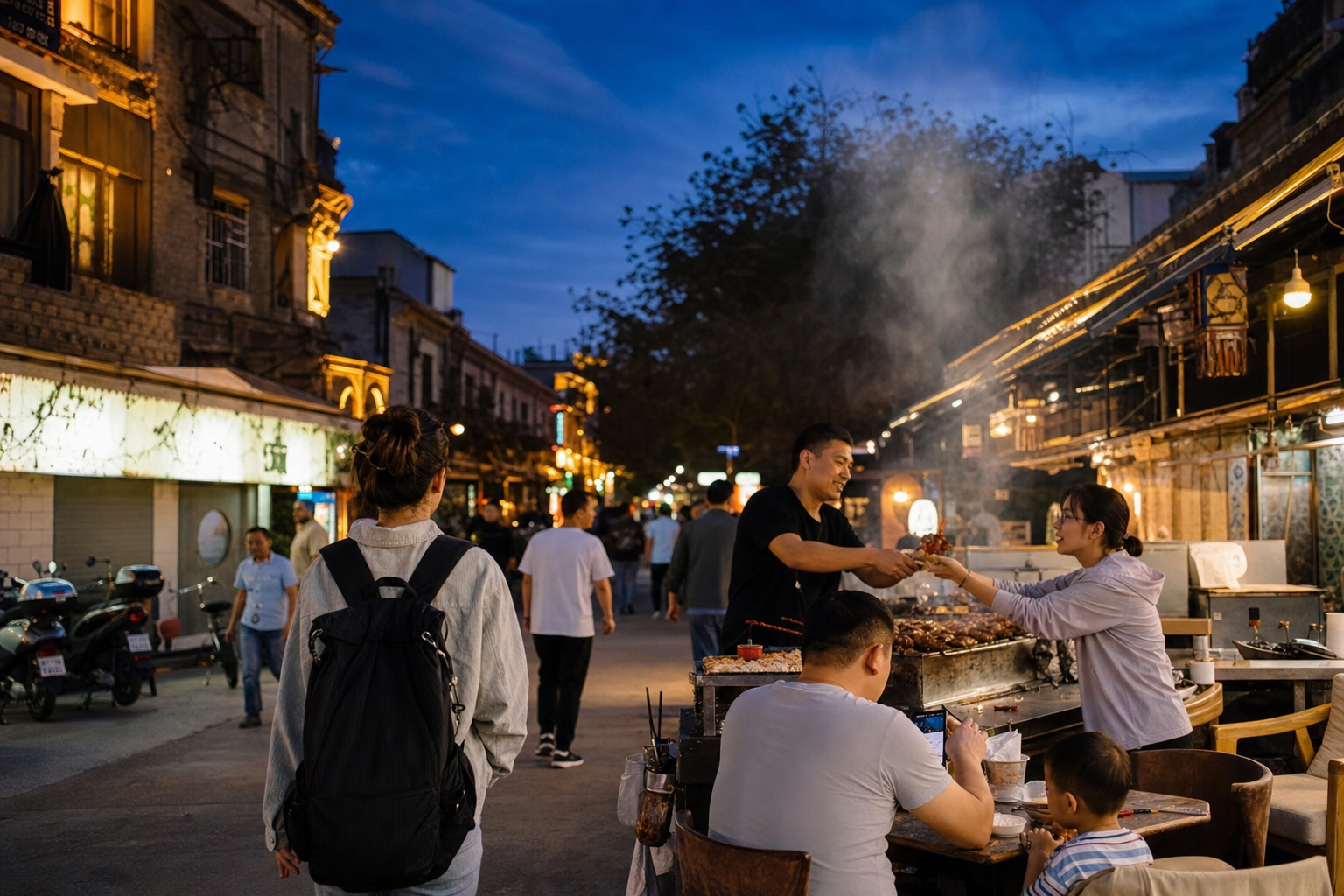
As I continued forward, the old street grew livelier. Music drifted from a small shop, its rhythm brisk, and several young people at the entrance moved their shoulders to the beat. Across the way, in a restaurant, a waiter carried a large plate of chicken between tables, the peppers and potatoes shining with oil under the lights. Menus were pasted on the glass window, and the writing blurred slightly as indoor and outdoor light reflected over it again and again. People waiting at the entrance did not seem impatient. They chatted while standing in line: some in Mandarin, some in Uyghur, and some in accents mixed from several places. Here language does not feel like a boundary. It feels more like lines crossing in the night wind, winding around lamp posts, stalls, and everyone willing to stop for something to eat. I could not understand every word, but I understood laughter and the tones of bargaining. The old street lamps gave these sounds a shape, making me feel that a city’s openness is not only in slogans, but in the ability of people at night to stand together under the same patch of light.
有一段路灯光尤其昏黄,墙面上挂着旧空调外机和一排电线,影子交错得像一张粗糙的网。这样的地方很容易被游客快速走过,因为它不够漂亮,不够整洁,也没有明显的打卡标志。但我偏偏在那里停了很久。墙角坐着一个修鞋师傅,面前摆着小凳、胶水、针线和几双等待修补的鞋。他的灯是一盏夹在木板上的小台灯,光圈只够照亮手里那只鞋,却也把他的侧脸照出一种专注的平静。每一次针线穿过鞋面,都像把一个人的路程重新缝合。那些鞋可能走过市场、车站、学校、工地和家门口,带着不同人的重量来到这盏小灯下。比起霓虹招牌,这盏修鞋灯更让我感到老街的真实:它不负责热闹,只负责让生活继续。
One section of the road was lit with a particularly dim yellow. Old air-conditioning units and rows of wires hung from the wall, their shadows crossing like a rough net. Such places are easy for tourists to pass quickly because they are not pretty enough, not tidy enough, and have no obvious sign for taking photos. Yet I stayed there for a long time. In the corner sat a shoe repairman with a small stool, glue, needles, thread, and several pairs of shoes waiting to be mended. His lamp was a small desk light clipped to a board; its circle of light was only large enough to illuminate the shoe in his hands, but it also revealed a focused calm on the side of his face. Each stitch passing through the leather seemed to sew together someone’s journey again. Those shoes may have walked through markets, stations, schools, construction sites, and doorways, carrying different bodies to this little lamp. Compared with neon signs, the shoe repair lamp made the old street feel more real to me: it is not responsible for excitement, only for allowing life to continue.
夜更深时,风从街口吹进来,带着一点干凉。乌鲁木齐的风很有辨识度,不像南方城市那样湿软,而是带着远处山和荒野的清醒。灯泡在风里轻轻晃动,摊位上的塑料布发出哗啦声,烤肉的烟被吹成斜线。人们把外套拉紧一点,却没有散去,反而更靠近火和灯。一个卖热饮的小车前排起队,锅里冒着白气,杯子递来递去,手和手在灯下短暂相接。这样的夜晚让人理解,灯从来不是孤立存在的,它总要和寒意相互说明。没有风,灯光只是亮;有了风,灯光才显出庇护的意味。老街灯照着每个暂时停靠的人,像在说,无论你从哪里来,夜里总有一处热气和光可以让你把脚步放缓。
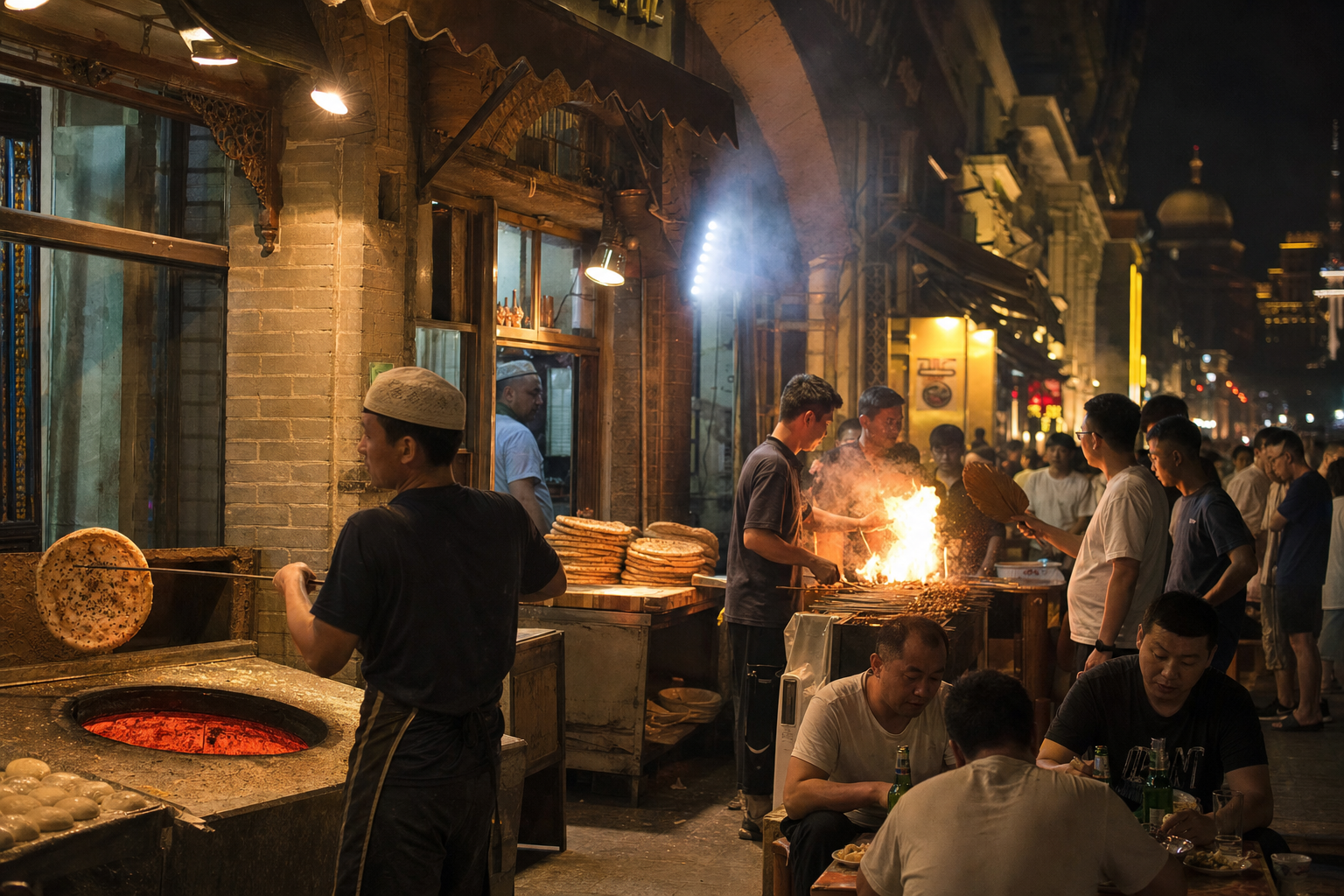
As the night deepened, wind entered from the street corner with a dry coolness. Urumqi’s wind is distinctive, unlike the damp softness of southern cities; it carries the clarity of distant mountains and open land. Bulbs swayed gently, plastic sheets on stalls rustled, and barbecue smoke was blown into slanting lines. People pulled their jackets closer, but they did not leave. Instead, they moved nearer to fire and light. A line formed before a cart selling hot drinks; white steam rose from the pot, cups passed from hand to hand, and fingers briefly met under the lamp. Nights like this make one understand that light never exists alone. It always explains itself through cold. Without wind, light is merely brightness; with wind, it gains the meaning of shelter. The old street lamps shine on everyone who has paused for a while, as if saying that no matter where you come from, there is always a place at night with warmth and light where you can slow your steps.
我走到一个十字路口,交通灯和老街灯叠在一起,红绿变化把行人的脸照得忽明忽暗。汽车从更宽的道路上驶过,带着现代城市的速度和噪声;转身看回老街,摊位、招牌、灯串和人影仍然密密地连在一起,像另一种更慢的时间。乌鲁木齐并不是只有一张面孔,它有高架桥、写字楼和新商圈,也有这样在夜里亮着旧灯的街巷。两种时间并不完全冲突,它们在路口相遇,互相让行,又各自继续。一个外卖骑手停在斑马线前,手机屏幕的冷光映着他的脸,身后小吃摊的暖光又给他肩膀镶了一圈金边。他像站在新旧两层城市之间,下一秒绿灯亮起,他便骑车穿过去,消失在车流里。那一瞬间,我觉得老街灯并不是过去的遗物,而是现代城市仍然需要的慢速心跳。
I reached an intersection where traffic lights overlapped with the old street lamps, red and green changes making pedestrians’ faces brighten and dim. Cars moved along the broader road with the speed and noise of a modern city; turning back toward the old street, I saw stalls, signs, strings of lights, and human silhouettes still tightly connected, like another, slower kind of time. Urumqi does not have only one face. It has overpasses, office towers, and new shopping districts, and it also has lanes like this, lit by old lamps at night. The two kinds of time are not entirely in conflict. They meet at intersections, yield to each other, and then continue separately. A delivery rider stopped before the crosswalk, the cold light of his phone shining on his face, while warm light from the food stall behind him edged his shoulders in gold. He seemed to stand between two layers of the city. The green light came on, and he rode across, disappearing into traffic. In that instant I felt that old street lights are not relics of the past, but the slow heartbeat a modern city still needs.
回到街里,我买了一份烤包子。纸袋很烫,我在路边换着手拿,咬开时羊肉和洋葱的香味一下子涌出来,油汁差点滴到手上。头顶一串小灯泡被风吹得微微摇晃,光点落在纸袋、手背和地面的尘土上。我站着吃完,没有找座位,也没有急着离开。旁边一位老人也在吃,他看我被烫得吸气,笑着说慢一点。我点点头,真的慢了下来。旅行中许多相遇都短得来不及交换名字,却足够改变一个瞬间的速度。那句“慢一点”在老街灯下显得很合适,像这条街给每个外来者的提醒:不要只把这里当作风味的集合,也不要只追逐热闹的表面。慢一点,灯光会带你看见食物背后的手、手背后的日子、日子背后的路。
Back inside the street, I bought a baked bun. The paper bag was hot, and I shifted it from hand to hand by the roadside. When I bit into it, the smell of lamb and onion rushed out, and the juice nearly dripped onto my fingers. Above me a string of small bulbs swayed in the wind, spots of light falling on the paper bag, the back of my hand, and dust on the ground. I finished eating while standing, without looking for a seat and without hurrying away. An old man beside me was eating too. Seeing me inhale because of the heat, he smiled and said, “Slow down.” I nodded and truly slowed down. Many encounters during travel are too brief for names, yet enough to change the speed of a moment. That phrase, “slow down,” felt right under the old street lamps, like the reminder this street gives every outsider: do not treat this place merely as a collection of flavors, and do not chase only the surface of liveliness. Slow down, and the lights will show you the hands behind the food, the days behind the hands, and the roads behind the days.
临近午夜,摊主们开始收拾。灯并没有立刻熄灭,而是一个区域一个区域地暗下去。水果被盖上布,烤炉里的火被压低,桌椅叠起来,地面留下油点、水渍和被踩碎的纸屑。热闹退去之后,老街显出另一种面貌,像卸妆后仍然精神的脸。几个清洁工推着车过来,扫帚声重新成为街上的主要声音。剩下的灯把他们的影子拉得很长,也把这场夜市最后的劳动照得清清楚楚。人们常常记住夜晚最亮、最香、最拥挤的时刻,却容易忘记收尾的人。可没有这些收尾,第二天的灯就不会再次干净地亮起。我站在路边看了一会儿,忽然觉得老街灯真正照亮的不是某一类人,而是整个循环:准备、迎客、喧闹、疲惫、清扫、等待天亮。
Near midnight, vendors began packing up. The lamps did not go out all at once; sections of the street darkened one by one. Fruit was covered with cloth, fires in ovens were lowered, tables and chairs were stacked, and the ground kept oil spots, water marks, and crushed paper. After the liveliness withdrew, the old street revealed another face, like someone still spirited after removing makeup. Several cleaners pushed carts in, and the sound of brooms again became the street’s main sound. The remaining lamps stretched their shadows long and clearly illuminated the final labor of the night market. People often remember the brightest, most fragrant, most crowded moments of night, but easily forget those who close it. Without this closing work, the next evening’s lamps could not shine cleanly again. I stood by the road watching for a while, suddenly feeling that the old street lamps do not illuminate one kind of person, but the entire cycle: preparation, welcome, noise, fatigue, cleaning, and waiting for dawn.
离开时,我回头看最后几盏还亮着的灯。它们不耀眼,甚至有些旧,灯罩边缘沾着灰,电线也并不笔直,可正是这种不完美让人相信它们属于真实生活。乌鲁木齐的老街灯让我想到许多白天看不见的东西:远方果园里的阳光,炉壁上烤熟的面香,修鞋师傅指尖的茧,骑手穿过路口的背影,清洁工扫过砖缝的耐心。它们把这些分散的生活片段连成一条夜色中的线,让陌生人也能顺着线索短暂进入城市的内部。旅行的意义也许不是看见一个地方最整齐的样子,而是看见它怎样在不整齐中维持温度。走出老街,身后的灯光渐渐被街角挡住,但那种暖仍在。我知道很多城市都有灯,可不是每座城市的灯都能让人感觉,自己正在被一段辽阔而具体的生活轻轻照见。
As I left, I looked back at the last few lamps still burning. They were not dazzling; they were even a little old, with dust on the edges of their shades and wires that were not perfectly straight. Yet this imperfection made them believable as part of real life. The old street lamps of Urumqi made me think of many things unseen by day: sunlight in distant orchards, the fragrance of bread baked on oven walls, calluses on the shoe repairman’s fingers, the back of a rider crossing an intersection, the patience of cleaners sweeping between bricks. The lamps tied these scattered fragments of life into a line through the night, allowing even a stranger to follow it briefly into the city’s interior. Perhaps the meaning of travel is not to see a place at its neatest, but to see how it preserves warmth amid disorder. When I walked out of the old street, the lights behind me were gradually blocked by the corner, but their warmth remained. I know many cities have lamps, but not every city’s lamps can make you feel that you are being gently seen by a life both vast and specific.
- 第一次在中国地铁安检口,我学会把保温杯先拿在手上 | The First Time at a Chinese Metro Security Check, I Learned to Hold My Thermos Before I Reached the Belt
- 雨后的绍兴黄酒馆里,老板一句话让我重新理解“慢” | In a Shaoxing Yellow Wine Tavern After Rain, One Sentence Changed How I Understood Slowness
- 五月在南浔陪孩子看雨落到河面,我们全家第一次接受“今天少去一个景点也没关系” | Watching Rain Touch the Canal in Nanxun, Our Family Finally Accepted That One Less Stop Could Still Mean a Full Day
- 来华必备手机应用 | Mobile Apps You Need in China
- 扬州早茶的一场耐心训练 | A Lesson in Patience at Yangzhou Morning Tea
- 宁波老街傍晚亮灯的时候,桥边的人情味比河面更深 | At Dusk on Ningbo’s Old Street, the Human Warmth Ran Deeper Than the Canal
- 我在公寓快递架前学会的第一课,是别把自己的方便放在别人通道中间 | The First Lesson I Learned at My Apartment Delivery Shelf Was Not to Put My Convenience in Other People’s Way
- 中秋赏月最美地点推荐 | Best Places to Enjoy the Mid-Autumn Moon
- 西安兵马俑:完整参观指南 | Xi an Terracotta Warriors: A Complete Guide
- 秋季红叶最佳观赏地 | Best Autumn Foliage Spots in China
Comments (0)