
宁波老街傍晚亮灯的时候,桥边的人情味比河面更深 | At Dusk on Ningbo’s Old Street, the Human Warmth Ran Deeper Than the Canal
宁波老街的一盏灯,让我看见生活比景点更耐看 | One Lamp on an Old Street in Ningbo Showed Me Daily Life Outlasts Attractions
宁波的老街到了傍晚,灯不是突然亮起来的。它们像从墙缝、屋檐、木门和青石板里慢慢醒来,一盏接着一盏,把白天收起的旧时光重新摊开。天色还没有完全暗下去,河面已经先变得深了,桥洞里积着蓝灰色的影子。沿街的店铺开始点灯,灯光从窗格里透出来,有的偏黄,有的偏暖白,有的被红色灯笼染过,落在石板路上,像一层柔软的旧绸。人走在这样的街上,很容易放轻声音,因为灯光让空间变得亲近,仿佛每一步都踩在某段还没有讲完的故事里。
On an old street in Ningbo at dusk, the lights do not come on all at once. They seem to awaken slowly from cracks in the walls, from eaves, wooden doors, and stone paving, one after another, spreading out the old time that daylight had folded away. The sky has not yet fully darkened, but the river surface has already deepened, and blue-gray shadows gather under the bridge arches. Shops along the street begin to light up. Light seeps through window lattices, some yellow, some warm white, some tinted by red lanterns, falling onto the stone road like a layer of soft old silk. Walking here, one naturally lowers the voice, because the lights make the space intimate, as if every step lands inside a story not yet finished.
老街灯最先照亮的,往往不是招牌,而是门口人的脸。卖汤圆的阿姨把锅盖掀开,蒸汽一下子涌出来,在灯下变成白色的云。她低头盛碗,眉眼被光照得很温和。旁边修鞋的小摊还没有收,师傅戴着老花镜,手里的针线在小灯泡下闪一下又暗下去。游客举着手机拍照,本地人则从他们身边穿过,熟门熟路地买一袋酱鸭、一把青菜或一杯热茶。灯光把陌生和熟悉放在一起,却没有让它们互相打扰。老街像一张宽厚的桌子,允许每个人在这里短暂停留,带走自己需要的味道和画面。
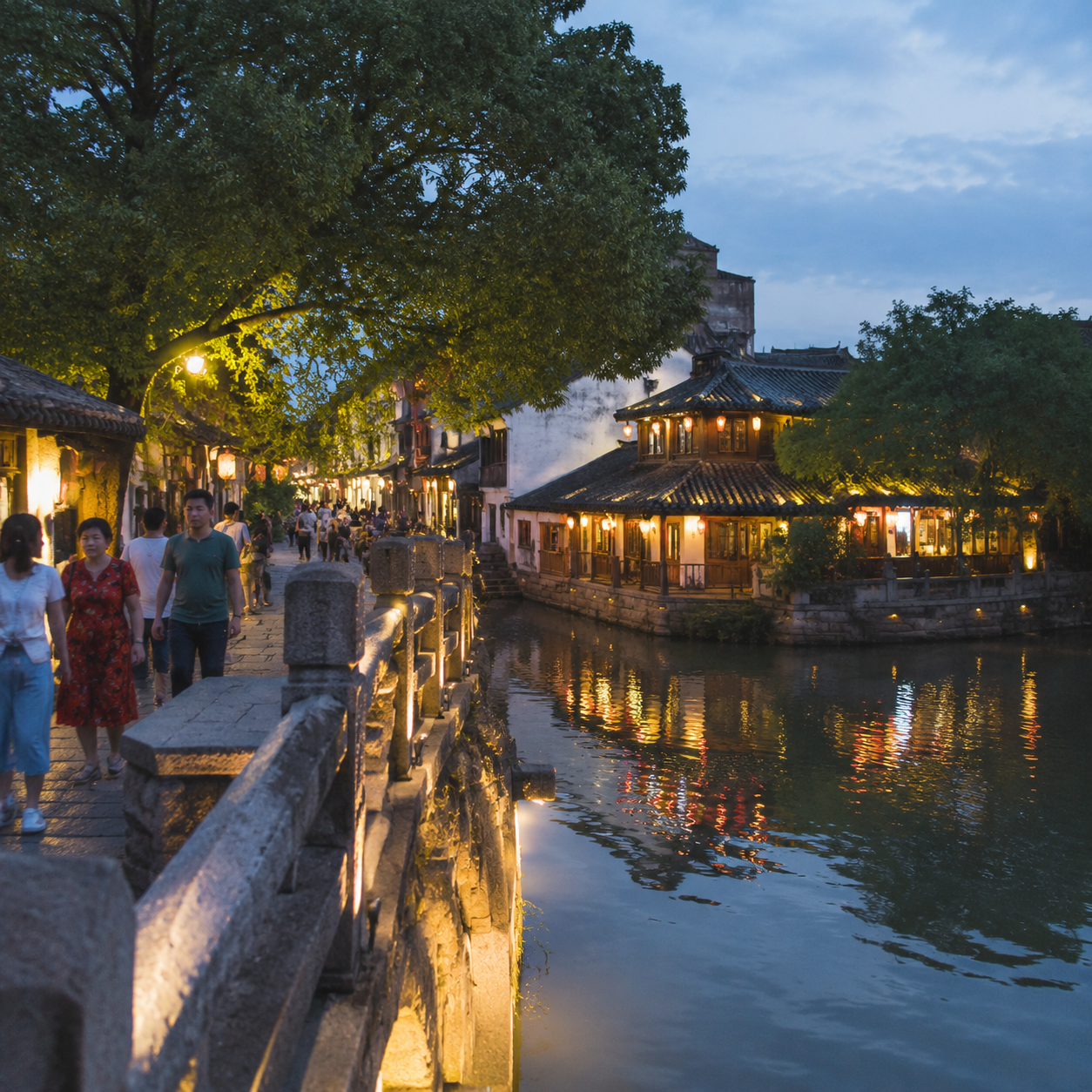
The first thing the old-street lights illuminate is often not a signboard but a human face at a doorway. An auntie selling sweet rice balls lifts a pot lid, and steam rushes out, turning into a white cloud under the light. She bends to fill a bowl, her eyes and brows softened by the glow. Nearby, a shoe-repair stall has not yet closed; the craftsman wears reading glasses, and the needle and thread in his hand flash briefly under a small bulb before fading again. Tourists raise phones for photographs, while locals pass beside them with practiced ease, buying a bag of soy-braised duck, a bundle of greens, or a cup of hot tea. Light places the unfamiliar and the familiar together without making them disturb one another. The old street is like a generous table, allowing everyone to pause briefly and carry away the taste or image they need.
宁波的老街有水的气息。即使不看见河,也能在空气里感到一点潮润。灯光靠近水面时,会被拉长、揉碎,又重新拼成晃动的金线。桥边有人停下来看,倒影比灯本身更不稳定,却也更有生命。水让灯有了呼吸,灯让水有了记忆。那些斑驳的墙面、乌黑的瓦片、窄窄的巷口,在水光和灯影之间显出一种含蓄的美。它不大声告诉你这里有多少历史,只是在你经过时轻轻提醒:许多人曾经也在这样的夜色里走过,买过东西,等过人,听过船声,望过同一片河面。
Ningbo’s old streets carry the scent of water. Even when the river is not visible, a trace of dampness can be felt in the air. When light approaches the water, it is stretched, broken, and then pieced together again into trembling golden threads. People stop by the bridge to watch; the reflection is less stable than the light itself, yet more alive. Water gives the lamps breath, and the lamps give water memory. Weathered walls, dark roof tiles, and narrow lane entrances reveal a restrained beauty between water-glow and lamp-shadow. It does not loudly announce how much history rests here. It only reminds you softly as you pass: many people once walked through a night like this, bought things, waited for someone, heard boat sounds, and looked at the same river surface.
沿着老街往里走,灯的种类越来越多。店招上的字被灯管勾出边,茶馆门前挂着纸灯,民宿窗边有小小的台灯,巷子深处则常常只有一盏孤灯。那种孤灯最让人难忘。它可能挂在一扇木门上方,照着门环、门槛和一小块湿亮的地面。没有人特意欣赏它,可它一直亮着,像为晚归的人留的一句无声问候。老街的灯因此不只是装饰,也是一种照看。它们照看生意,照看路,照看旧房子的轮廓,也照看人心里关于故乡、归途和安稳的想象。
Walking deeper into the old street, the kinds of lights become more varied. Neon outlines the characters on shop signs; paper lamps hang before teahouses; small table lamps glow beside guesthouse windows; deep inside a lane there is often only a solitary lamp. That solitary lamp is the most unforgettable. It may hang above a wooden door, lighting the door ring, the threshold, and a small patch of wet ground. No one admires it deliberately, yet it keeps shining, like a silent greeting left for someone returning late. Thus the lights of the old street are not merely decoration; they are a form of care. They watch over business, over the road, over the outlines of old houses, and over people’s imagination of hometown, return, and steadiness.
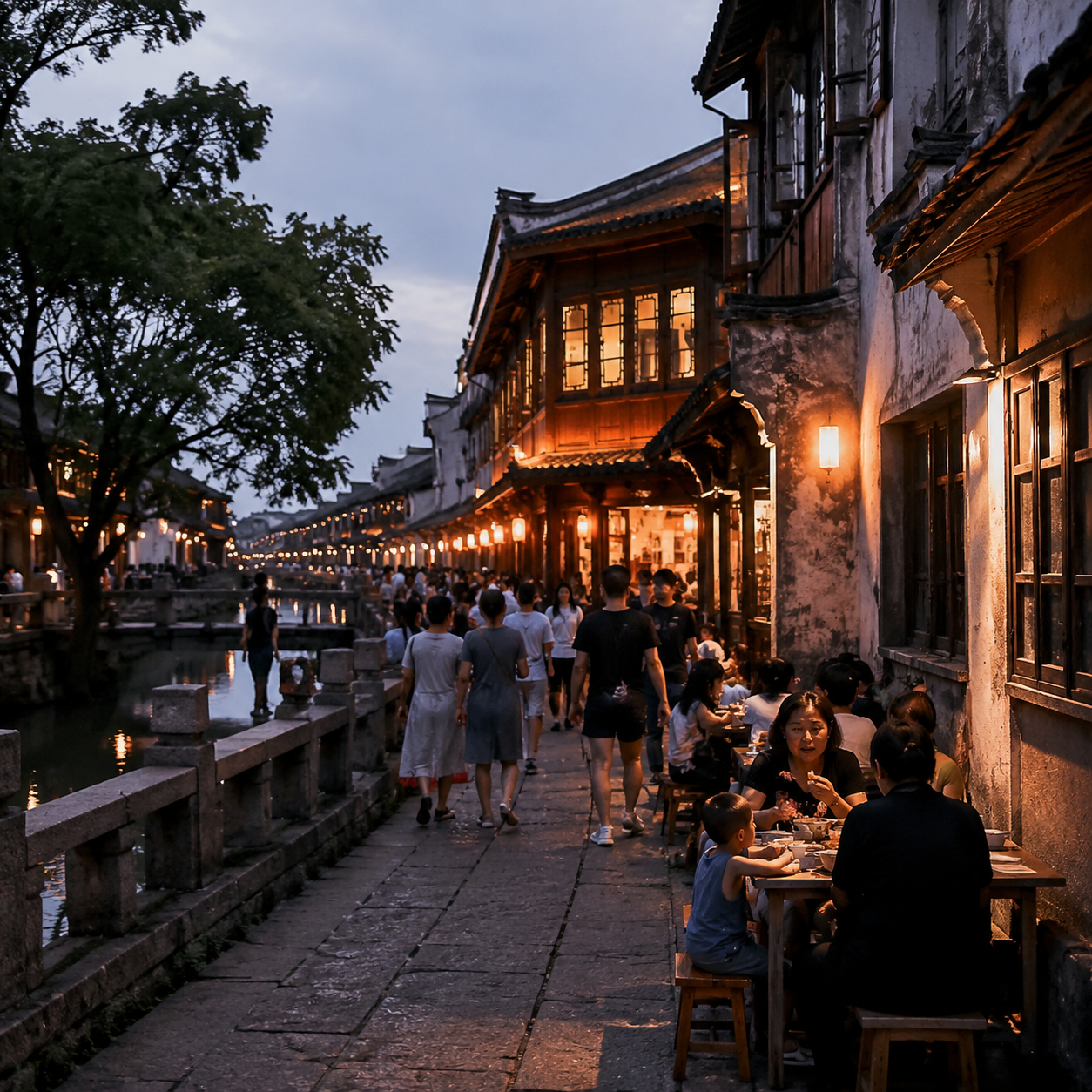
有时候,一盏灯能把时间分成两半。灯外是现在:外卖骑手匆匆经过,年轻人排队买奶茶,导航的声音从手机里传出来。灯内却像仍停在过去:木桌上放着茶杯,墙上挂着旧照片,柜台后的人慢慢拨算盘或整理零钱。宁波的老街并不拒绝新的生活,它只是用灯光把新旧之间的边界调得很柔。现代的脚步可以从老门前经过,古旧的屋檐也可以接受新的招牌。两者在夜色里并排存在,像河上的两道倒影,偶尔交叠,偶尔分开,却共同组成了这条街的夜晚。
Sometimes a single lamp can divide time into two halves. Outside the lamp is the present: delivery riders hurry past, young people line up for milk tea, and navigation voices come from phones. Inside the lamp it seems that the past still pauses: teacups sit on wooden tables, old photographs hang on the wall, and someone behind the counter slowly works an abacus or sorts coins. Ningbo’s old street does not reject new life. It merely softens the boundary between old and new with light. Modern footsteps can pass before an old doorway, and ancient eaves can accept new signboards. The two exist side by side in night, like two reflections on a river, sometimes overlapping, sometimes separating, yet together forming the street’s evening.
我在一家小店门口停下来,玻璃柜里摆着宁波的点心。灯照在年糕、油赞子和各色糕团上,使它们看起来比白天更有温度。店主说话带着宁波口音,语速不快,像在和熟人闲聊。灯光从他身后照来,把墙上的影子拉长。那一刻,食物、方言和灯聚在一起,形成一种很具体的地方感。所谓城市记忆,很多时候不是博物馆里陈列的说明牌,而是这样一间亮着灯的小店,是一句听得懂又听不全的乡音,是热气扑到脸上的瞬间。老街灯把这些瞬间留住,让它们不至于在夜里散开。
I stop at the entrance of a small shop where Ningbo pastries are arranged in a glass case. Light falls on rice cakes, fried twists, and colorful glutinous sweets, making them look warmer than they do by day. The shopkeeper speaks with a Ningbo accent, unhurried, as if chatting with an old acquaintance. Light comes from behind him and stretches his shadow across the wall. In that moment, food, dialect, and lamp gather together to create a very concrete sense of place. Urban memory is often not an explanatory plaque in a museum, but a small shop with its light on, a local voice partly understood and partly missed, and a moment when steam touches the face. The old-street lights hold these moments so they do not scatter into the night.
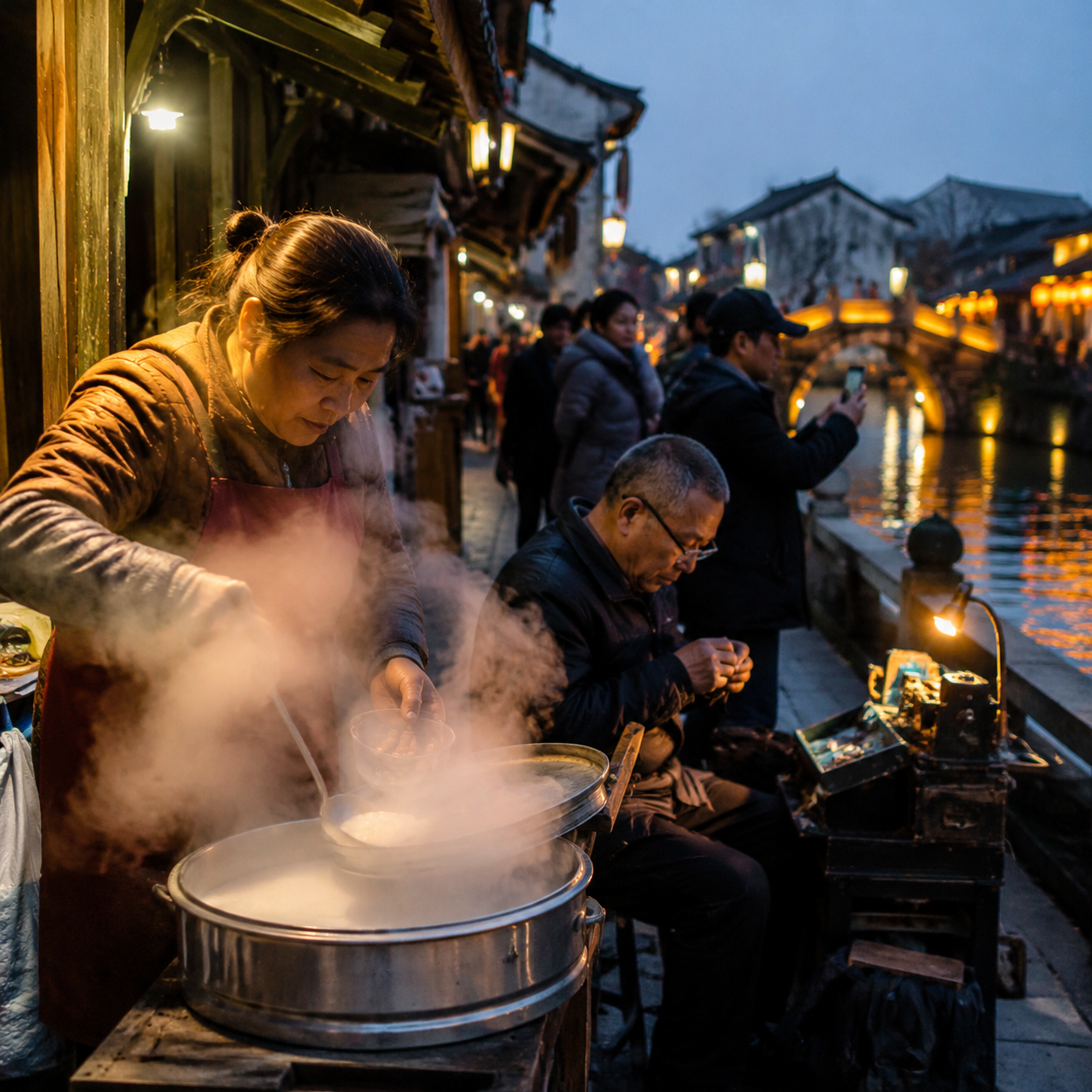
越到夜深,老街灯越显出层次。主街上的灯热闹,照着来来往往的人;支巷里的灯安静,照着墙根和自行车;屋内的灯更私密,透过窗帘露出一小块生活的颜色。有人在灯下洗碗,有人在灯下算账,有人在灯下给孩子讲故事。游客看到的是一条适合拍照的街,而住在这里的人看到的是回家的路、邻居的门、常买东西的铺子和每晚都会亮起的窗。灯光对不同的人说不同的话,这正是老街迷人的地方。它既可以成为风景,也可以仍然是日常。
As the night deepens, the lights of the old street reveal more layers. The lights on the main street are lively, shining on people coming and going; the lights in side lanes are quiet, shining on wall bases and bicycles; the lights inside homes are more private, showing a small piece of life through curtains. Someone washes dishes under a lamp, someone calculates accounts, someone tells a child a story. Tourists see a street suitable for photographs, while residents see the road home, neighbors’ doors, familiar shops, and windows that light up every evening. Light speaks differently to different people, and this is the charm of the old street. It can become scenery and still remain daily life.
宁波老街的灯也常常带着海港城市的气质。它们不像北方大街上的光那样开阔直白,也不像大都市商业区的霓虹那样密集闪耀。它们更像潮水,悄悄涨上来,又慢慢退下去。灯光贴着屋檐、石桥和河岸行走,不急着覆盖一切,只在需要的地方停留。它让旧木头显出纹路,让青砖露出深浅,让行人的影子在墙上短暂停靠。这样的光有分寸,也有耐心。它知道老街的美不在一瞬间的强烈,而在反复经过后仍会被记住的余味。
The lights of Ningbo’s old streets often carry the temperament of a port city. They are not as open and direct as lights on broad northern avenues, nor as dense and glittering as neon in a metropolitan commercial district. They are more like the tide, rising quietly and then slowly falling back. Light moves along eaves, stone bridges, and riverbanks, not hurrying to cover everything, but pausing where it is needed. It brings out the grain of old wood, the shades of blue brick, and the brief resting of pedestrians’ shadows on walls. Such light has restraint and patience. It knows the beauty of an old street does not lie in a single strong instant, but in an aftertaste remembered after repeated passing.
走到街尾时,夜已经完全落下。回头望去,灯连成一条温暖的线,弯弯曲曲地穿过屋檐和人群。远处有桥,桥上有人影,桥下有水光。风从巷子里出来,带着一点海的湿意,也带着厨房里的香气。此时的老街不再只是一个地点,而像一种被灯守住的时间。它让人相信,城市可以变化,店铺可以更替,道路可以翻修,但只要夜里还有几盏灯以相似的方式亮起,某些深处的联系就不会断。灯是街的眼睛,也是街的记忆。
At the end of the street, night has fully settled. Looking back, the lights form a warm line, winding through eaves and crowds. There is a bridge in the distance, figures on the bridge, and water-light below it. Wind comes from the lane, carrying a damp hint of the sea and the fragrance of kitchens. At this hour, the old street is no longer merely a place, but a kind of time kept by lamps. It makes one believe that a city may change, shops may be replaced, and roads may be repaired, but as long as several lights still come on in a similar way at night, certain deep connections will not break. Lamps are the eyes of the street, and also its memory.
离开老街后,灯光还会在心里亮一阵。它不是刺眼的亮,而是像走远后仍能闻到的茶香,淡淡的,却不肯马上散去。宁波老街灯的好,就在于它不急着证明自己多么古老或多么漂亮。它只是安静地照着,让石板路继续成为路,让老门继续成为门,让每一个经过的人在短暂的停留中感到自己被温柔地接住。也许这就是老街夜晚最珍贵的东西:不是热闹本身,而是热闹背后那种稳定的、有人间烟火的光。它让夜色不空,让回忆有处落脚,也让一座城市在不断向前的时候,仍记得怎样回头。
After leaving the old street, its light continues to glow in the heart for a while. It is not a dazzling brightness, but like the scent of tea still noticed after walking away, faint yet unwilling to disappear at once. The beauty of Ningbo’s old-street lights lies in their refusal to prove how ancient or beautiful they are. They simply shine quietly, allowing the stone road to remain a road, the old door to remain a door, and every passerby to feel gently received during a brief pause. Perhaps this is the most precious thing about an old street at night: not the liveliness itself, but the steady, human warmth behind it. It keeps night from becoming empty, gives memory a place to rest, and lets a city remember how to look back even as it keeps moving forward.
后来我在别处看见更明亮的灯,商场的灯,车站的灯,高楼外墙上变幻的屏幕灯,却总会想起宁波老街那种不声张的光。它像一位熟悉路况的老人,不催促,不炫耀,只在拐弯处给你一点提醒。它照见小吃摊前的热气,照见木窗里的一方安静,照见石桥上停顿的脚步,也照见一个人心里对慢生活的渴望。老街灯并不把夜晚赶走,而是把夜晚安排得更适合人停留。正因为如此,那些灯会长久地留在记忆里,像河面上的倒影,被风吹散之后,仍能在心里重新聚拢。
Later, when I see brighter lights elsewhere—mall lights, station lights, changing screens on high-rise walls—I still think of the quiet glow of Ningbo’s old streets. It is like an elder who knows the road well, neither urging nor showing off, offering only a small reminder at the turn. It illuminates steam before snack stalls, a square of quiet inside a wooden window, paused footsteps on a stone bridge, and a person’s longing for a slower life. The old-street lights do not drive the night away; they arrange the night so that people may stay within it. For this reason, those lamps remain in memory for a long time, like reflections on the river surface, scattered by wind yet able to gather again in the heart.
- 一个普通工作日的公交站,让我学会了中国排队不是只看队形 | On an Ordinary Weekday Bus Stop, I Learned That Queueing in China Is Not Just About the Shape of the Line
- 我在北京学会别把最后一班地铁当成唯一计划 | In Beijing I Learned Not to Treat the Last Metro as My Only Plan
- 外国人在中国用高铁:从订票到进站全流程 | China High-Speed Rail for Foreign Travelers: End-to-End Guide
- 从贵阳到荔波的慢线 | The Slow Line from Guiyang to Libo
- 从灰色水泥到绿荫长廊:中国城市道路绿化的二十年蜕变 | From Grey Concrete to Green Canopies: Two Decades of Urban Road Greening in China
- 一张桌角二维码,让我先核对店名再付款 | A Table-Corner QR Code Taught Me to Check the Shop Name Before Paying
- 张家界的山还没出现以前,我先学会把手机变成一把可靠的小工具 | Before Zhangjiajie’s Peaks Even Appeared, I Learned to Turn My Phone into a Reliable Tool
- 在上海弄堂里学会慢下来 | Learning to Slow Down in Shanghai's Lanes
- 夜市不是景点,是一座城市的另一副面孔 | Night Markets Aren't Tourist Attractions — They're a City's Other Face
- 夏季避暑胜地:高原与海岛 | Summer Escapes: Plateaus & Islands
Comments (0)