
苏州园林不是用来赶场的,我在一扇漏窗前停了十分钟 | Suzhou Gardens Are Not for Rushing; I Stopped Ten Minutes Before One Lattice Window
苏州园林不是用来赶场的,我在一扇漏窗前停了十分钟 | Suzhou Gardens Are Not for Rushing; I Stopped Ten Minutes Before One Lattice Window
到苏州的第二天早上,我原本给自己排了一张很像考试卷的路线:拙政园、狮子林、平江路、沧浪亭,如果脚力还够,再去山塘街看夜色。纸面上每一项都合理,距离不远,名字熟悉,门票也早早订好。可真正走进园林之后,我发现这张计划最大的问题不是太满,而是它假定园林可以像清单一样被勾掉。
On my second morning in Suzhou, I had arranged a route that looked almost like an exam sheet: Humble Administrator’s Garden, Lion Grove Garden, Pingjiang Road, Canglang Pavilion, and, if my legs still worked, Shantang Street at night. On paper every item made sense. The distances were short, the names were familiar, and the tickets had been booked. But once I truly stepped into a garden, I realized the biggest problem with the plan was not that it was too full. It assumed a classical garden could be checked off like an item on a list.
那天的天空有一点薄灰,光线不刺眼,正适合看园林。入口处人很多,队伍慢慢往前挪,游客举着手机确认预约,导游的小旗子在人群上方晃动。我也跟着人流进去,第一反应是想快一点找到“最有名的角度”。我知道自己带着某种旅行惯性:既然来了,就要把主要景点看全,把相机里的素材拍够,把时间用得显得有效率。
The sky that day was lightly gray, and the light was soft rather than sharp, a good kind of weather for looking at gardens. Many people gathered at the entrance. The line moved forward slowly, visitors checked reservations on phones, and tour-guide flags swayed above the crowd. I entered with everyone else, and my first impulse was to find the “most famous angle” quickly. I knew I had brought a kind of travel inertia with me: since I had come, I should see all the main sights, collect enough photos, and make time look efficiently used.
拙政园一开始并没有用宏大的方式迎接我。它不是那种把全部景观摊开给你看的地方,而是用墙、门、廊、树影和水面不断把视线折起来。走几步,前方像是被堵住;再转一下,池塘突然露出一角;以为已经看见亭子,旁边的竹影又把它遮住一半。园林不急着证明自己,它更像在试探一个外来者有没有耐心。
Humble Administrator’s Garden did not greet me with grandeur at first. It was not a place that spread the whole view out for you. Instead, it folded your sight with walls, doors, corridors, tree shadows, and water surfaces. After a few steps, the way ahead seemed blocked; after a small turn, a corner of pond appeared; just when I thought I had seen a pavilion, bamboo shadows covered half of it again. The garden was in no hurry to prove itself. It felt as if it were testing whether an outsider had patience.
我起初仍然走得很快。看见一座亭子,就拍一张正面;看见水边的石头,就拍一张横构图;看见墙上的花窗,就靠近一点拍纹样。照片看起来都不差,却没有一张让我愿意多看。它们像是从园林身上撕下来的小标签,能说明我来过,却不能说明我看懂了什么。直到我在一扇漏窗前停下来,节奏才突然变慢。
At first I still walked quickly. When I saw a pavilion, I took a frontal photo. When I saw stones by the water, I took a horizontal shot. When I saw a patterned window in a wall, I moved closer to photograph the design. The photos looked fine, but none made me want to keep looking. They were like small labels torn from the garden: they could prove I had been there, but not that I had understood anything. Only when I stopped before one lattice window did my pace suddenly slow.
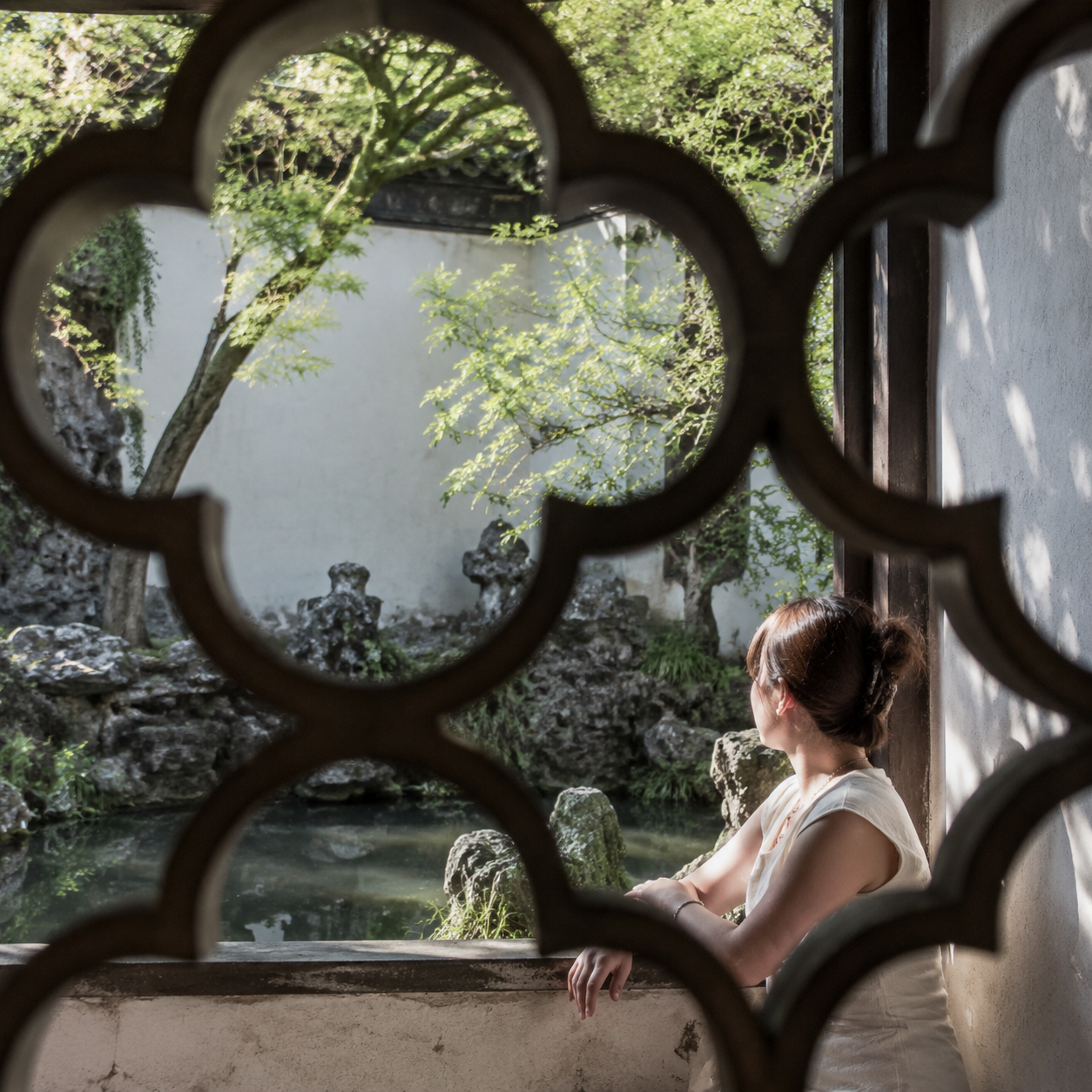
那扇窗并不在最拥挤的位置。它嵌在白墙里,窗洞不大,图案像被仔细梳理过的枝条,又像一段安静的水纹。透过窗,可以看见后面的树、石和一小块灰绿的池水。奇妙的是,窗本身并没有把景物完全展示出来,而是有意留下许多遮挡。树干只露一段,假山只露边缘,水面也只是闪了一下。它让人看见,同时提醒人不能看尽。
The window was not in the most crowded position. It was set into a white wall, not large, with a pattern like carefully combed branches or a quiet ripple of water. Through it I could see trees, rocks, and a small gray-green patch of pond behind. What was wonderful was that the window did not fully display the scenery. It deliberately left many obstructions. Only part of a trunk appeared, only the edge of a rockery showed, and the water flashed only briefly. It allowed me to see while reminding me that I could not see everything.
我站在那里先是为了等人少一点,好拍一张没有游客的照片。等了两分钟后,我发现自己已经忘了按快门。风从廊下穿过来,树叶在窗格后面轻轻移动,原本固定的图案被活的影子打乱。白墙不是背景那么简单,它像一张纸,把园林的层次压得更清楚;漏窗也不是装饰那么简单,它像一只慢慢眨眼的眼睛,把景色切成可以呼吸的小片。
At first I stood there simply to wait for fewer people, hoping to take a photo without visitors in it. After two minutes, I realized I had forgotten to press the shutter. Wind came through the corridor, leaves moved gently behind the lattice, and the fixed pattern was disturbed by living shadows. The white wall was not merely a background; it was like paper, making the layers of the garden clearer. The lattice window was not merely decoration; it was like an eye blinking slowly, cutting the view into small pieces that could breathe.
十分钟听起来很短,但在景区里它会显得反常。身边不断有人走过,有人停下拍照,拍完就走;有人对着窗说一句“这个好看”,然后去追同伴;也有人完全没有注意它,只把它当作通道旁的一处墙面。我站在那里,慢慢意识到园林里的美并不总是以“景点”的形式出现。有些美需要你先停止寻找,才会从细节里浮上来。
Ten minutes sounds short, but inside a scenic area it can feel unusual. People kept passing by. Some stopped to take a photo and left immediately. Some said, “This is pretty,” then hurried to catch up with companions. Others did not notice it at all, treating it as just part of a wall beside the path. Standing there, I gradually realized that beauty in a garden does not always appear as a “sight.” Some beauty rises from details only after you stop searching for it.
我想起出发前读过的介绍,里面讲到借景、框景、移步换景。那些词在屏幕上很熟悉,像考试可以背出的概念。可站在漏窗前时,它们不再是术语,而变成了身体经验。所谓框景,不是给游客一个漂亮相框;它更像是在告诉你,观看需要边界。所谓移步换景,也不是让你多走几步多拍几张;它提醒你,景色会随着你的耐心改变。
Before leaving, I had read introductions that mentioned borrowed scenery, framed views, and changing scenes with each step. On a screen those terms felt familiar, like concepts one could memorize for an exam. But before the lattice window, they were no longer terms. They became bodily experience. A framed view was not simply a pretty frame for visitors; it told me that seeing needs boundaries. A changing scene did not merely mean walking a few more steps and taking more pictures; it reminded me that scenery changes with patience.
我又退后了半步。只是半步,窗后的树影就换了位置,池水少了一点,石头多了一点。再往左移一点,原本被窗格分割的枝叶突然连成一条斜线。园林的精密不在于它把某个角度设计得完美,而在于许多不完美的角度都能成立。它允许你偏一点、慢一点、停一下,然后把不同的关系交给你。
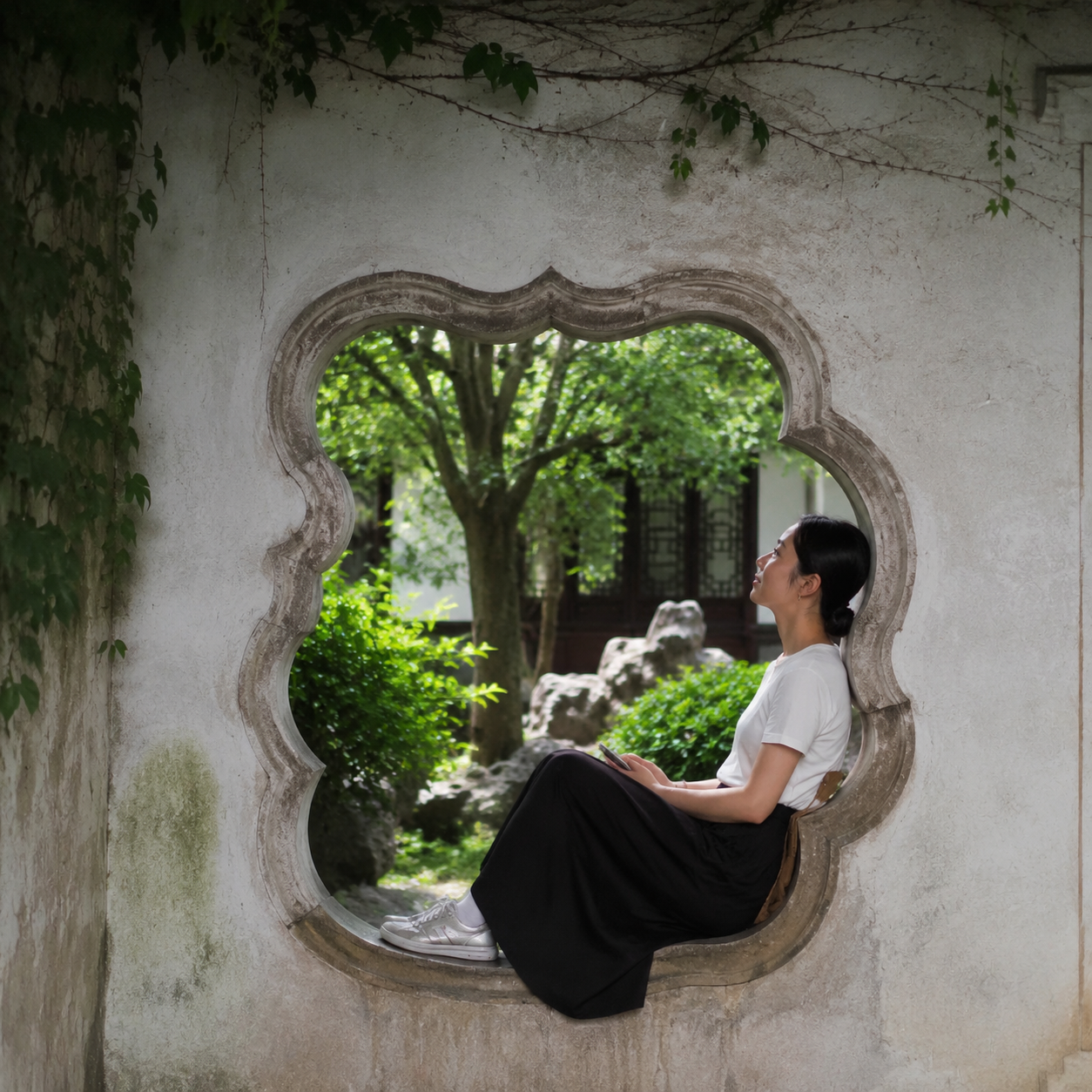
I stepped back half a step. Only half a step, and the tree shadows behind the window changed position; the pond became less visible, the rock more visible. When I moved slightly left, branches that had been divided by the lattice suddenly formed a diagonal line. The precision of the garden did not lie in designing one perfect angle. It lay in allowing many imperfect angles to work. It allowed me to be a little off-center, a little slow, a little still, and then handed me different relationships.
从那一刻起,我把当天的行程改了。不是在手机上正式删除什么,而是在心里把“看完”改成了“看一会儿”。我不再急着找下一处名称,也不再把每个亭台楼阁都当作必须记录的证据。园林像一杯温度刚好的茶,喝得太快只会知道它不烫,慢下来才知道香气在哪里回头。
From that moment, I changed the day’s itinerary. I did not formally delete anything on my phone; I simply changed “finish seeing” into “look for a while” in my mind. I stopped rushing to find the next named place and stopped treating every pavilion or hall as evidence that had to be recorded. A garden is like tea at the right temperature: if you drink too fast, you only know it is not hot; if you slow down, you discover where the fragrance returns.
我沿着廊子往前走,脚步自然轻了。廊柱把视线一段一段分开,屋檐下的阴影让外面的光更柔。有人从对面走来,声音被木结构吸收了一部分,听起来像远处传来的谈话。廊不是简单的通道,它把时间拉长了。你以为自己只是从一个点走向另一个点,其实是在一格一格地练习延迟抵达。
I walked along the corridor, and my steps naturally became lighter. The corridor columns divided the sight line into sections, and the shade under the eaves made the outside light softer. People walked toward me from the opposite direction, their voices partly absorbed by the wooden structure, sounding like conversations from far away. A corridor is not a simple passage. It stretches time. You think you are merely moving from one point to another, but you are practicing delayed arrival section by section.
水面也是这样。苏州园林里的水并不以开阔取胜,它常常被岸、桥、树和建筑切成不规则的形状。站在池边看,水不像湖,更像一面被不断折叠的小镜子。它照出亭子的檐角,也照出一片摇晃的天空;照出游客的衣角,也照出石头上细小的青苔。水把许多互不相干的东西放在同一层,让园林变得更深。
The water worked in the same way. Water in Suzhou gardens does not win by vastness. It is often cut into irregular shapes by banks, bridges, trees, and buildings. Standing beside a pond, the water did not feel like a lake but like a small mirror repeatedly folded. It reflected a pavilion’s eaves and a shaking piece of sky; it reflected a visitor’s hem and the tiny moss on stone. Water placed unrelated things on the same layer and made the garden deeper.
有一座小桥,我走上去时几乎没有注意它。桥身很短,栏杆也不高,若是赶路,三秒钟就能通过。可站在桥中间,左右两边的水面忽然分出不同的性格。一边靠近建筑,倒影规整;一边靠近植物,光斑散乱。桥不是为了让人跨过水而已,它给了人一个正好可以比较的停点。苏州园林很少大声解释,但它一直在安排你的眼睛。
There was a small bridge I almost failed to notice when stepping onto it. The bridge was short, the railing low, and if I were hurrying I could cross it in three seconds. But standing in the middle, the water on the two sides suddenly developed different characters. One side lay near buildings, with orderly reflections; the other lay near plants, with scattered patches of light. The bridge was not only for crossing water. It offered a stopping point from which comparison became possible. Suzhou gardens rarely explain loudly, but they keep arranging your eyes.
假山前的人最多。很多人想在石头之间拍出曲折幽深的感觉,我也曾经想过。可当我绕到侧面,发现它真正有意思的地方并不是像不像山,而是怎样让小空间产生远意。石缝里长着草,洞口暗下来,转角处只露出一段路。它不试图复制一座山,而是提取山给人的不确定感:不知道后面还有什么,不知道下一步会不会豁然开朗。
The rockery drew the largest crowd. Many people wanted to photograph a sense of winding depth among the stones, and I had wanted the same. But when I walked to the side, I found that its real interest was not whether it resembled a mountain. It was how it gave a small space a feeling of distance. Grass grew in cracks, openings darkened, and a turn revealed only a short piece of path. It did not try to copy a mountain. It extracted the uncertainty a mountain gives: not knowing what lies behind, not knowing whether the next step will open up.
在假山里穿行时,我不得不低头、侧身、放慢速度。这样的身体姿态会改变人的心情。你不能昂首阔步地穿过一段狭窄石洞,也不能用很快的步伐理解它。园林有时不是用文字劝你慢,而是用尺度让你慢。低一点的洞口、窄一点的转角、忽然出现的台阶,都在把游客从旁观者变成参与者。
Moving through the rockery, I had to lower my head, turn sideways, and slow down. Such bodily posture changes one’s mood. You cannot stride proudly through a narrow stone opening, and you cannot understand it at high speed. Sometimes the garden does not persuade you to slow down with words; it slows you through scale. A lower opening, a narrower turn, an unexpected step all change a visitor from observer into participant.
我后来坐在一处不太显眼的长椅上,看一棵树的影子落在墙上。那棵树本身并不奇特,墙也只是白墙,可影子在风里不断变化,像有人用淡墨反复修改一幅画。旁边一位老人拿着保温杯,也坐了很久。他没有拍照,只是不时抬头看一眼。我忽然觉得,他可能比很多拿着专业相机的人看得更完整。
Later I sat on a quiet bench and watched the shadow of a tree fall on a wall. The tree itself was not unusual, and the wall was only white, but the shadow kept changing in the wind, as if someone were revising a painting again and again with pale ink. An elderly man beside me held a thermos and sat for a long time too. He took no photos, only raised his head now and then. I suddenly felt he might be seeing more completely than many people carrying professional cameras.
苏州园林最难拍的,也许正是这种变化。照片能留下某一秒的构图,却留不下等待那一秒的过程;能留下窗、桥、亭、树,却留不下你从急到缓的转换。旅行照片当然有意义,它们帮人记住地点和天气,记住同行者的表情。但在园林里,如果拍照变成唯一的观看方式,很多真正细微的东西会从镜头边缘溜走。
Perhaps the hardest thing to photograph in a Suzhou garden is exactly this change. A photo can keep the composition of one second, but not the process of waiting for that second. It can keep windows, bridges, pavilions, and trees, but not your own shift from haste to calm. Travel photos certainly matter. They help us remember places, weather, and the faces of companions. But in a garden, if photography becomes the only way of seeing, many truly delicate things slip away from the edge of the lens.
中午前后,游客变得更多,园内的声音也变亮了。孩子在桥边问鱼在哪里,导游讲解某座建筑的来历,有人讨论午饭吃什么。我没有觉得这些声音破坏了园林,反而觉得它们让园林回到日常。古典园林不是只能在无人时成立。它的安静并不等于没有声音,而是在各种声音之间仍然保留一处可以让心放慢的缝隙。
Around noon, there were more visitors, and the sounds in the garden grew brighter. A child asked where the fish were, a guide explained the history of a building, and someone discussed what to eat for lunch. I did not feel these sounds ruined the garden. Instead, they returned it to everyday life. A classical garden does not exist only when empty. Its quietness does not mean the absence of sound; it means that among many sounds there remains a gap where the mind can slow.
我走到一间厅堂前,门楣上的字我不能完全说出典故,只觉得笔画和空间很相称。室内陈设克制,木色沉稳,窗外的绿意被框成一幅幅小画。这里的建筑没有把自己抬得很高,而是愿意成为观看的工具。它提供阴影、边框和停留的位置,让外面的树和水显得更有层次。这样的谦逊反而让人记得住。
I came to a hall whose inscription I could not fully explain, though the strokes felt well matched with the space. The interior was restrained, the wood color steady, and the greenery outside was framed into small pictures. The building did not raise itself too high. It was willing to become a tool for looking. It provided shade, borders, and places to pause, making the trees and water outside appear more layered. This humility made it more memorable.
下午我没有按原计划去追第二座园林,而是在附近慢慢吃了一碗面,又回到园外的街上走了走。白墙黛瓦从景区延伸到生活里,店铺招牌、晾晒的衣服、电动车铃声,把“苏州”从想象里的雅致拉回真实。园林如果只被当作古典美的标本,会显得太轻。它和街巷、河道、居民生活连在一起时,才有了更稳的重量。
In the afternoon I did not rush to a second garden as planned. I slowly ate a bowl of noodles nearby and then walked along the streets outside. White walls and dark tiles extended from the scenic area into daily life. Shop signs, drying clothes, and electric scooter bells pulled “Suzhou” back from imagined elegance into reality. If a garden is treated only as a specimen of classical beauty, it becomes too light. Connected with lanes, waterways, and residents’ lives, it gains steadier weight.
回看那天,我最清楚记住的不是哪座亭子的名字,也不是哪一处被介绍为必看的角度,而是那扇漏窗前的十分钟。它让我明白,慢看不是少看,而是让看见的东西发生关系。窗后的树因为窗格而更像树,池水因为只露一角而更像远处,白墙因为有影子经过而不再空白。园林把有限做成了丰富。
Looking back on that day, what I remember most clearly is not the name of a pavilion or any angle introduced as a must-see. It is the ten minutes before that lattice window. It taught me that slow looking is not seeing less; it allows what is seen to form relationships. The tree behind the lattice became more tree-like because of the lattice. The pond felt farther away because only a corner showed. The white wall stopped being blank because shadows passed over it. The garden turned limitation into richness.
如果第一次去苏州园林,我会建议把行程排得松一点。不要急着把同一天塞进太多园子,也不要把每个空间都变成拍照任务。可以选一座主要园林,给它一整个上午或下午;可以在一扇窗、一座桥、一段廊下停久一点;可以允许自己看不懂所有典故,只先感受光、风、比例和遮挡。园林不怕你知识少,怕你走得太快。
If you visit Suzhou gardens for the first time, I would suggest leaving the schedule loose. Do not hurry to pack too many gardens into one day, and do not turn every space into a photo assignment. Choose one main garden and give it a whole morning or afternoon. Stay longer before a window, on a bridge, or under a corridor. Allow yourself not to understand every historical reference at first; feel the light, wind, proportion, and concealment. A garden is not afraid of your limited knowledge. It is afraid of your speed.
离开时,我又从那面白墙附近经过。人比早上更多,我没有再挤过去拍照,只在远处看了一眼。窗后的树影已经换了方向,池水的颜色也深了一点。它像是同一个句子在下午换了语气。我知道自己没有“完成”这座园林,也不需要完成。它给我的不是结论,而是一种以后看风景时愿意多停一会儿的能力。
When leaving, I passed near that white wall again. There were more people than in the morning, and I did not squeeze in for another photo. I only looked from a distance. The tree shadow behind the window had changed direction, and the pond had deepened in color. It was like the same sentence spoken in a different afternoon tone. I knew I had not “completed” the garden, and I did not need to. What it gave me was not a conclusion, but the ability to stay a little longer when looking at scenery in the future.
- 中秋赏月最美地点推荐 | Best Places to Enjoy the Mid-Autumn Moon
- 我在重庆磁器口边走边吃陈麻花:现金和扫码怎么备份 | Walking and Snacking in Ciqikou, Chongqing: Payment Backup Plan
- 在景德镇看一只碗如何被做出来 | Watching a Bowl Take Shape in Jingdezhen
- 在青岛,海不会一上来就把你征服,它先让你顺着坡和街区慢慢靠近 | In Qingdao, the Sea Does Not Conquer You at Once; It First Draws You Through Slopes and Streets
- 菜市场早餐摊前,我靠一个“这个”吃到了热豆浆 | At a Wet Market Breakfast Stall, One “This One” Got Me Hot Soy Milk
- 签证与入境要求 | Visa and Entry Requirements
- 中国陶瓷文化之旅:景德镇与官窑遗址 | Ceramic Heritage Trail: Jingdezhen & Imperial Kilns
- 广西山水5日行程:桂林阳朔龙脊梯田 | 5-Day Guangxi: Guilin, Yangshuo & Longji Terraces
- 苏州一到雨天,最容易失灵的不是路线图,而是那种“这里本来很好走”的自信 | When Rain Comes to Suzhou, What Fails First Is Not the Map but the Confidence That the City Is Easy to Walk
- 我在杭州菜市场学会了不装懂:真正的文化融入,常常从承认自己不会开始 | In a Hangzhou Wet Market I Learned Not to Pretend: Real Cultural Integration Often Starts by Admitting You Don't Know
Comments (0)