
桂林米粉先拌还是先喝汤,我在一张小桌前改了吃法 | Mix First or Taste the Broth First? My Guilin Noodle Lesson
桂林米粉先拌还是先喝汤,我在一张小桌前改了吃法 | Mix First or Taste the Broth First? My Guilin Noodle Lesson
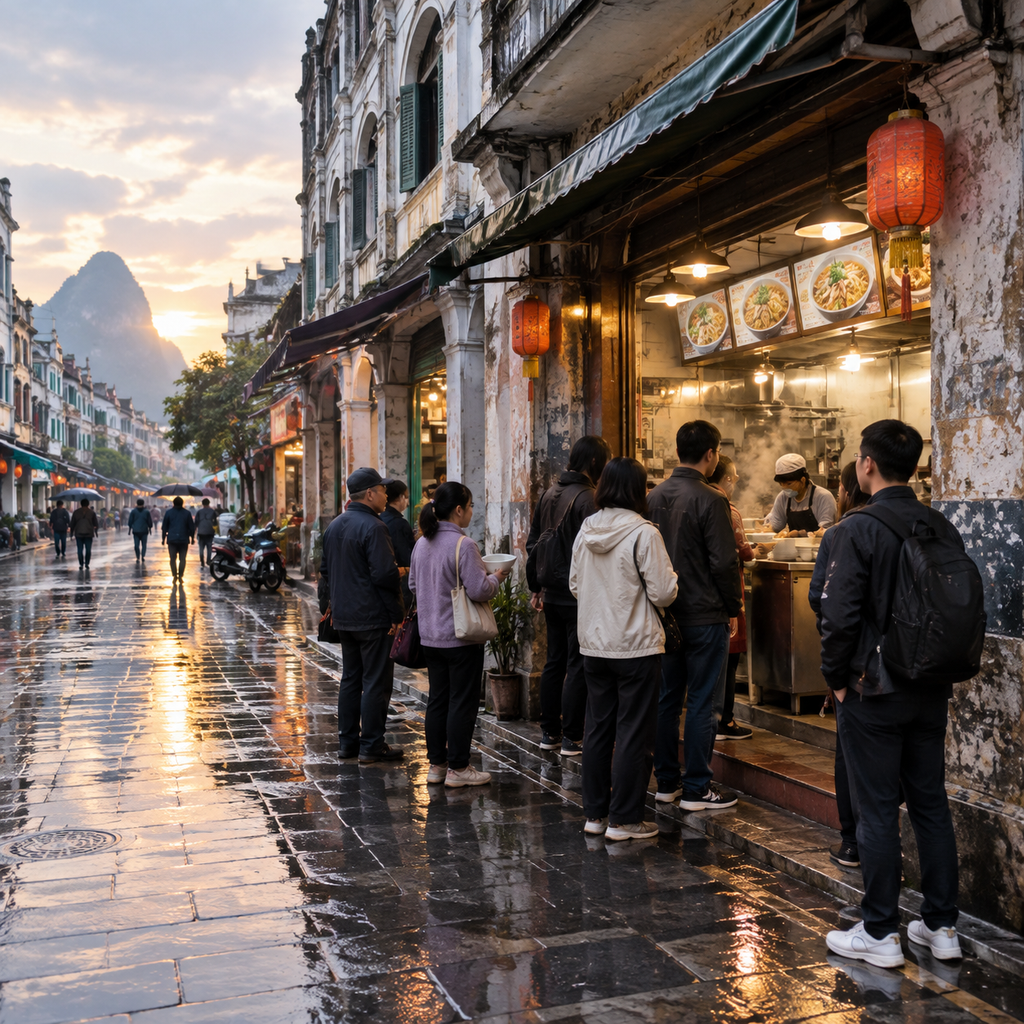
早上七点多,我在桂林一条还没有完全醒来的街上找早餐。前一晚下过一阵雨,骑楼边的水泥地湿得发暗,店门口的灯光落在积水里,像一小块被揉皱的金纸。米粉店外已经排了几个人,有人端着空碗往里挪,有人把手机收回口袋,抬头看柜台上的动作。我站在队尾,闻到卤水、葱花和热米粉混在一起的味道,肚子先替我做了决定:今天一定要吃得很快。
A little after seven in the morning, I went looking for breakfast on a Guilin street that had not fully woken up. It had rained the night before, and the concrete beside the covered walkway was dark with moisture. Shop light trembled in the puddles like crumpled gold foil. A few people were already queuing outside the noodle shop. Some moved inward with empty bowls; others slipped their phones back into their pockets and watched the counter. At the end of the line, I smelled brine, scallions, and hot rice noodles together. My stomach made the decision before I did: I was going to eat quickly.
我以前吃面有一个很固定的习惯:先喝两口汤,确认咸淡,再动筷子。这个习惯来自我熟悉的面馆,也来自一种对热汤的安全感。汤能告诉我这碗东西大概是什么性格,清不清,重不重,胡椒是不是抢在别的味道前面。那天我甚至没有先问店里的人,端到桌边后便把碗朝自己拉近,低头吹开表面的热气,准备按照自己的顺序开始。我以为这只是吃一顿早餐,没想到一张小桌会把我的判断整个拧过来。
I have a fixed habit when I eat noodles: I taste two spoonfuls of broth first, checking the salt before touching the noodles. It comes from familiar noodle shops and from the comfort of hot soup. Broth tells me what kind of bowl I am facing—light or heavy, clean or peppery, balanced or dominated by one flavor. That morning I did not ask anyone in the shop. Once the bowl reached the table, I pulled it closer, blew across the steam, and prepared to follow my own order. I thought I was simply having breakfast. I did not expect one small table to overturn my judgment.
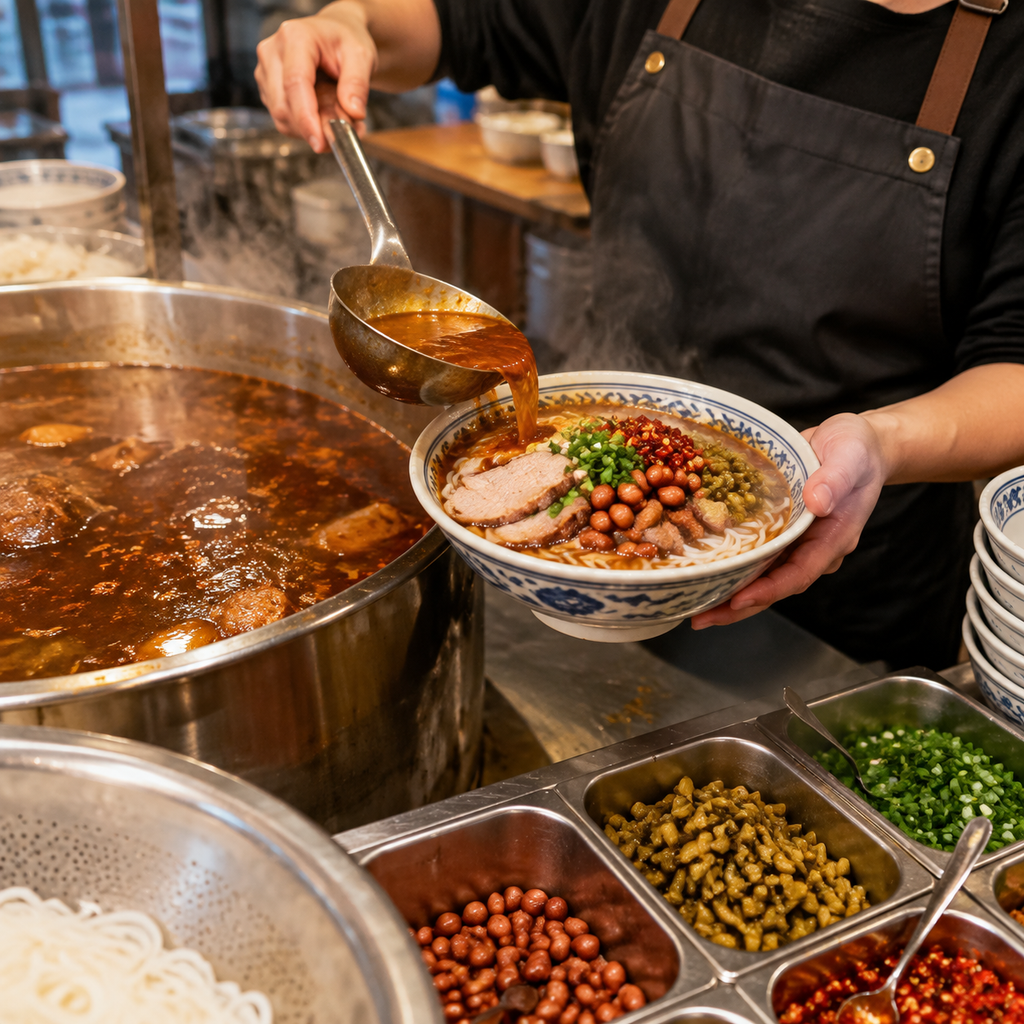
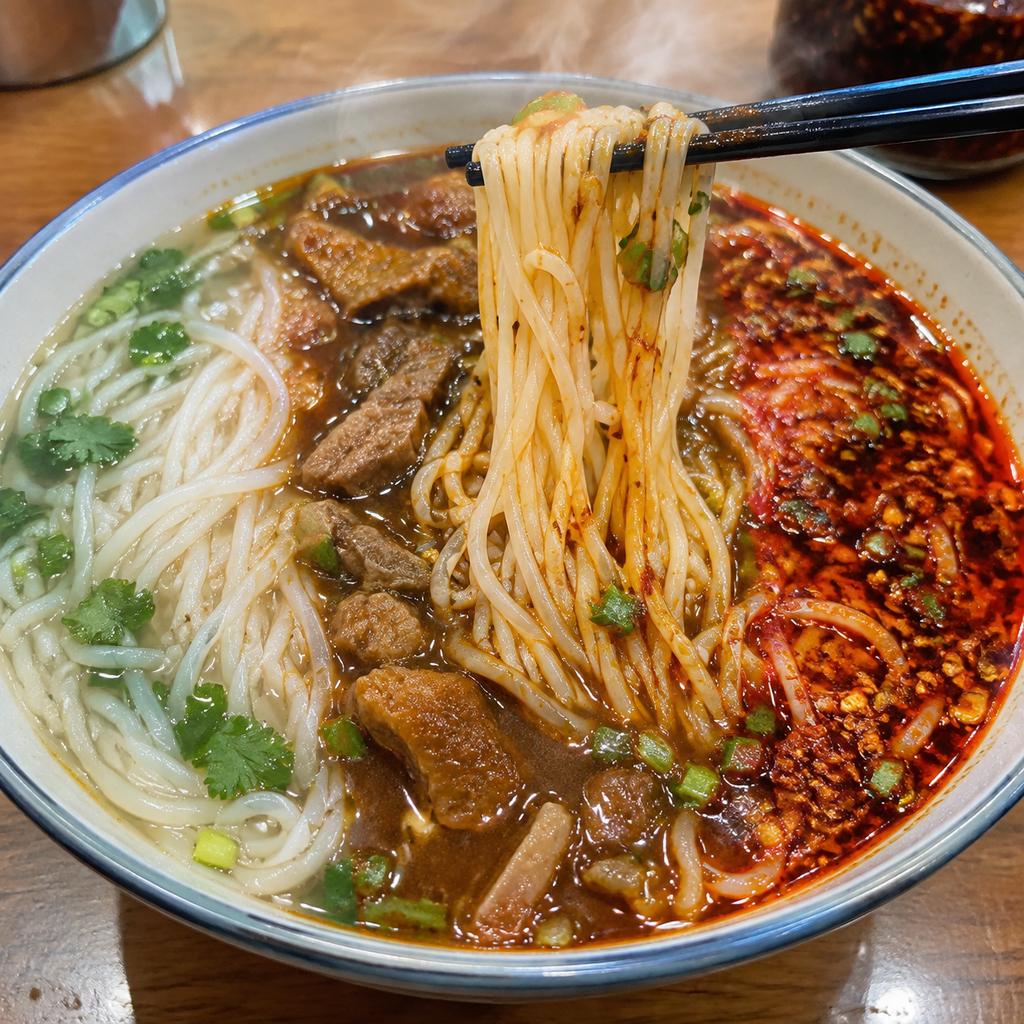
排队向前移动时,我看见柜台后的卤水桶。它不是我想象中夸张的深色浓汁,更像一锅安静守在热气里的老味道。店里的人把米粉捞进碗里,动作快,却不是乱:粉先落下,卤水随后沿着碗边淋进去,再加上肉片、花生、酸豆角、葱花和辣椒等配料。每一碗看起来都差不多,可是卤水碰到粉的那一刻,颜色和光泽会有细微变化。有人要干拌,碗里卤水少一些;有人要汤粉,碗里的液面更高。原来“怎么吃”在柜台前就已经开始了。
As the queue moved, I noticed the brine container behind the counter. It was not the dramatic, almost black sauce I had imagined, but a quiet old flavor sitting inside the steam. The worker placed rice noodles in the bowl with speed and order: noodles first, then brine poured along the rim, followed by sliced meat, peanuts, pickled beans, scallions, and chili among the available toppings. The bowls looked similar, yet the moment brine touched the noodles, their sheen changed. A dry-mixed bowl received less liquid; a soup bowl had a visibly higher level. The question of how to eat had already begun at the counter.
轮到我时,我只说了想吃米粉,随后又凭感觉选了几样配料。没有店名、价格、营业时间这些需要我假装确定的细节,我能确认的只有眼前这套动作:粉很快被装好,配料落在白色的粉面上,卤水的气味比颜色更先抵达鼻子。我端着碗找位置,桌子不大,桌面有被热碗反复烘过的浅浅水印,旁边放着筷子、勺子和几碟公共调料。座位之间隔得近,却没有人因此停下自己的节奏。
When my turn came, I asked for rice noodles and then chose a few toppings by instinct. I will not pretend to know details I could not verify, such as a shop name, price, or opening hours. What I can confirm is what happened in front of me: the noodles were assembled quickly, toppings landed on their white surface, and the smell of brine reached my nose before its color registered. I carried the bowl to a small table marked with faint rings left by hot bowls. Chopsticks, spoons, and shared condiments sat nearby. The seats were close, but nobody seemed to lose their own rhythm because of it.
我先喝汤。勺子舀起的液体不厚,入口却有一种熟成后的咸香,里面混着肉和香料的影子。它不像我在北方常喝的面汤那样需要长时间解释,也不是单纯靠辣椒把人叫醒的味道。第一口让我觉得这碗粉很温和,甚至有些薄。我又喝了一口,仍然没有急着拌。那时的我已经准备下结论:桂林米粉或许适合清淡地吃,配料只是附加,真正的主角应该是汤。
I tasted the broth first. It was not thick, but it carried a seasoned saltiness with traces of meat and spice. It did not need the long explanation of some northern noodle soups, nor did it rely on chili simply to jolt the eater awake. My first impression was gentle, almost a little thin. I took another sip and still did not mix the bowl. I was already preparing a conclusion: perhaps Guilin rice noodles were meant to be eaten lightly, with the toppings as decoration and the broth as the real protagonist.
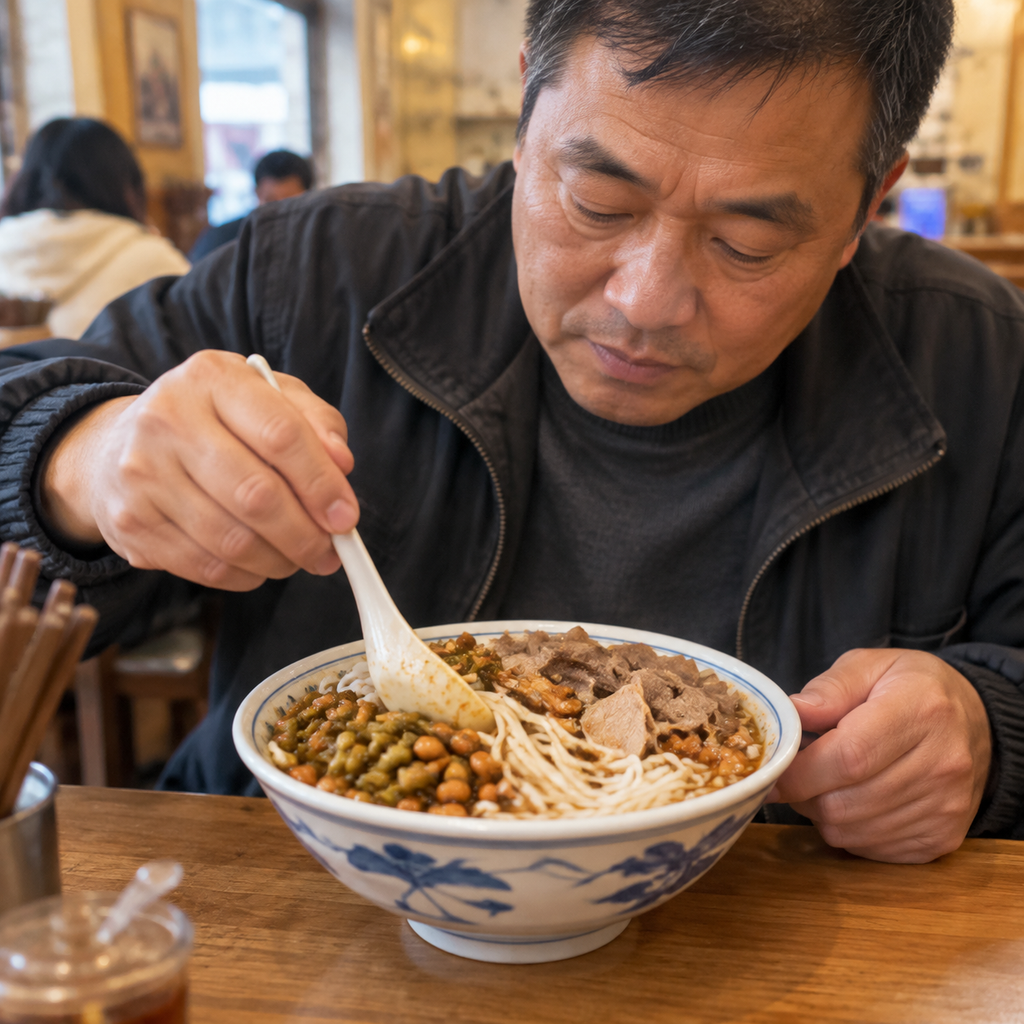
就在我准备夹粉的时候,邻桌一位中年人把筷子停在碗上方,先用勺柄把花生、酸豆角和肉片拨到一边,又把粉从碗底翻了上来。他没有搅成一团,而是从靠近自己的一侧慢慢推开,让卤水、配料和米粉一层层接触。这个动作看起来很熟练,却不炫耀,像是在整理抽屉。接着他吃了一口,又低头添了一点辣椒。我注意到他并没有把整碗都变辣,只在一小片区域试味道。我的判断突然出现了一个缺口:也许我刚才喝到的只是没有被唤醒的卤水。
At the next table, a middle-aged diner paused his chopsticks over the bowl. He used the handle of his spoon to move the peanuts, pickled beans, and meat aside, then lifted noodles from the bottom. He did not turn everything into a tangled mass. Instead, he worked from the side nearest him, letting brine, toppings, and noodles meet gradually, as if arranging a drawer. He took a bite and added a little chili. He did not make the whole bowl spicy; he tested one small area. A gap opened in my conclusion. Perhaps I had tasted only brine that had not yet been awakened.
我学着他的动作,先把碗里堆在最上面的配料拨开,再从底部挑起米粉。粉条比我想象中更有弹性,湿润但不拖沓,卤水裹在表面后,花生的脆、酸豆角的酸和肉片的咸香才同时出现。第一口拌粉让我意识到,汤里的味道是被稀释、展开的,拌食却把它们集中到米粉表面。两种吃法并不是同一碗东西的强弱版本,而是两种不同的阅读方式:喝汤先读底色,拌粉先读关系。
I copied his method. I moved the toppings resting on top aside and lifted noodles from the bottom. They were more springy than I expected—moist without becoming limp. Once coated with brine, they brought together the crunch of peanuts, the sourness of pickled beans, and the savory meat. That first mixed bite showed me that broth spreads flavor out, while mixing concentrates it on the surface of the noodles. These were not merely stronger and weaker versions of the same bowl. They were two ways of reading it: tasting broth first reads the background; mixing first reads the relationships between ingredients.
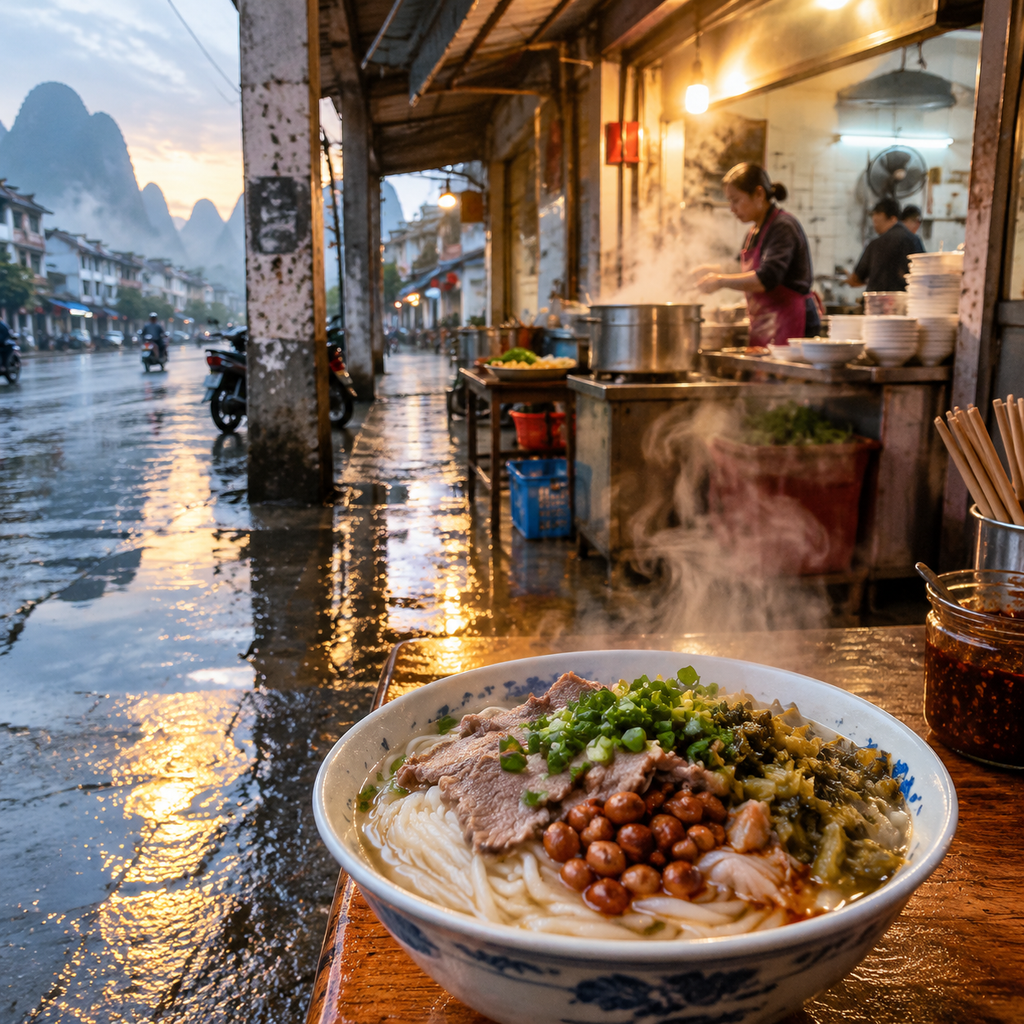
我没有立刻把剩下的粉全部拌匀,而是把碗分成几个小区域。左边保留原来的汤和粉,中间多放一些卤水,右边试着加入一点辣椒。这样做并不符合我以前对“正确吃法”的想象,可它让我能清楚感觉到变化。原汤区柔和,卤水区更紧,辣椒区先有香气再有热度。米粉本身没有消失,反而像一条白色的线,把三种味道串起来。邻桌那个人偶尔抬头,看见我照着他的办法试,并没有说什么,只把自己的碗往里收了收,给端碗经过的人让出位置。
I did not mix the rest of the bowl all at once. I divided it into small zones. On the left I kept the original broth and noodles; in the middle I added more brine; on the right I tested a little chili. This was not what I had previously imagined as the “proper” way to eat, but it let me feel the changes clearly. The broth area was mild, the brine area tighter, and the chili area fragrant before it became hot. The rice noodles did not disappear; they became the white thread connecting the three flavors. The diner beside me occasionally looked up. He said nothing when he saw me copy him, only pulled his bowl closer to make room for people carrying food past the table.
我后来才明白,配料不是一份固定的装饰清单。肉片给卤水一个可以停留的咸香,花生把软粉的口感拉出响声,酸豆角让味道有了转弯的地方,葱花和辣椒则像在碗面上开了两扇小窗。不同配料碰到卤水的方式不同,入口顺序也会随之改变。若把所有东西一开始就拌到完全均匀,当然仍然能吃,但你会少掉一些变化;若始终不拌,只喝汤再夹粉,又可能让配料各自孤零零地待在上面。
I later understood that toppings are not a fixed decorative list. Meat gives the brine a place to settle into savory saltiness; peanuts make soft noodles audible; pickled beans give the flavor a turn; scallions and chili open two small windows on the surface. Each topping meets the brine differently, so the order of bites matters. If everything is mixed perfectly from the beginning, the bowl still works, but some changes vanish. If one never mixes at all, tasting broth and then lifting noodles can leave the toppings isolated on top.
早餐高峰的队伍一直没有真正停下来。有人吃完把碗叠到指定的位置,擦一下嘴就起身;有人端着汤粉坐在门边,边吃边看街上的车轮把雨水压成细碎的亮线。桌子小,食客的动作自然被压缩:夹一筷子,喝一口汤,侧身给后面的人让路,再把纸巾折到碗旁。这里没有谁专门教我礼貌,可我从人们如何收碗、如何不占着空位、如何让端碗的人通过里学到了早餐店的秩序。排队不是一个等待的空白,而是吃法的一部分。
The breakfast queue never truly stopped. Some diners stacked their bowls where they belonged, wiped their mouths, and stood up. Others sat near the doorway with soup noodles, watching car tires press the rainwater into broken strips of light. The tables were small, so movements naturally became compact: a bite, a sip, a sideways shift to let someone pass, a tissue folded beside the bowl. Nobody gave me a lesson in manners. I learned from the way people returned bowls, avoided occupying an empty seat, and made room for those carrying food. The queue was not empty waiting; it was part of the meal’s rhythm.
我开始留意汤粉和拌粉的差别,不再把它们简单归为“有汤”和“没汤”。汤食会把米粉放在一个温热的整体里,适合刚走进店、身体还带着清晨凉意的时候;拌食则更像一段逐步调节的过程,卤水多少、辣椒多少、配料先后都可以由自己控制。那天我先喝汤,是因为我需要知道底味;我随后拌粉,是因为邻桌让我看见了如何让底味和配料见面。顺序并非规则题,而是根据当时的身体和碗的状态做判断。
I began to notice the difference between soup noodles and mixed noodles without reducing it to “with broth” versus “without broth.” Soup holds the rice noodles in a warm whole, which suits a body still carrying the coolness of early morning. Mixed noodles are more like a gradual adjustment: the amount of brine, chili, and toppings can be controlled bite by bite. I tasted broth first because I needed to know the base. I mixed afterward because the neighboring diner showed me how the base could meet the toppings. The order was not a rulebook answer; it was a judgment based on my body and the bowl in front of me.
吃到一半,我又加了一点辣椒。以前我会把调味一次性完成,仿佛只有立刻做出选择才算果断。可那张小桌让我改变了这个习惯:先试小口,再决定下一口;先让卤水和米粉相处,再让辣椒进去;如果某种味道太强,就用未拌的粉把它拉回来。这个方法不仅适合米粉,也适合我在陌生地方面对一碗没有吃过的东西。不要急着把所有不确定性搅成一个结论,留一点分区,判断反而更准确。
Halfway through, I added a little chili. I used to season everything at once, as if making an immediate decision were the same as being decisive. That small table changed the habit. I tested one small bite, then decided about the next; I let brine and noodles meet before bringing chili into the conversation; if one flavor became too strong, I used unseasoned noodles to pull it back. The method applies beyond Guilin noodles. In an unfamiliar place, I do not need to stir every uncertainty into one conclusion. Keeping a few zones separate can make judgment clearer.
我还试了把一部分粉送进汤里。刚才拌开的米粉遇到汤,表面的卤水被冲淡,花生仍然保持脆,酸豆角则让汤多了一个明显的酸点。它不像一开始直接喝汤那么平,也不像干拌时那么集中,介于两者之间。有人会喜欢汤食的连贯,有人会喜欢拌食的层次,我那天更喜欢这种来回切换,因为它让我感觉自己不是在接受一道固定答案,而是在跟这碗早餐协商。
I also sent part of the mixed noodles into the broth. The brine on the noodles thinned, the peanuts stayed crisp, and the pickled beans gave the soup a distinct sour point. It was neither as plain as the first sip of broth nor as concentrated as the dry mix. It sat between the two. Some people may prefer the continuity of soup noodles; others may prefer the layers of a mixed bowl. That morning I liked moving back and forth, because breakfast felt less like receiving a fixed answer and more like negotiating with the bowl.
邻桌的人吃得比我快,却没有显得匆忙。他把最后几根粉挑起来时,碗里还留着一点卤水,便用勺子沿着碗底轻轻刮了一圈,把花生碎和酸豆角带到一起。这个动作让我想到,熟悉并不等于粗略。真正熟悉的人知道哪里可以快,哪里必须慢,什么时候配料已经够了,什么时候还值得再尝一口。他没有把吃米粉变成仪式,可他的顺序里有经验留下的痕迹。
The diner beside me ate faster than I did, but he never looked rushed. When he lifted the last strands, a little brine remained. He drew the spoon around the bottom of the bowl and gathered the peanut crumbs and pickled beans. It made me realize that familiarity is not the same as carelessness. Someone who knows a dish knows where to move quickly, where to slow down, when the toppings are enough, and when one more bite is worth taking. He did not turn noodles into a ceremony, but experience had left a trace in his order of movements.
我吃完以后没有马上离开。不是因为还想再要一碗,而是嘴里仍然留着卤水的咸香和辣椒的热,雨后的空气从门口一阵阵吹进来,把热气从额头带走。我把纸巾压在碗边,起身时先看了一眼身后的队伍,确认没有挡住端碗的人。离开早餐店后,我没有立刻坐车去远处的景点,而是沿着街道慢慢走。早晨的桂林还在开门:卷帘门一扇扇升起,菜篮被放到路边,湿树叶在脚下发出轻响。
I did not leave immediately after eating. It was not because I wanted another bowl, but because the brine’s savory salt and the chili’s warmth still lingered, while cool post-rain air came through the doorway and lifted the heat from my forehead. I pressed a tissue against the rim and checked the queue before standing, making sure I was not blocking anyone carrying a bowl. Instead of taking a ride straight to a distant attraction, I walked slowly along the street. Guilin was opening itself: shutters rising one by one, vegetable baskets set outside, wet leaves whispering under my shoes.
我的路线因此变得很简单,也更像一顿早餐之后自然长出来的路线。我先沿着街边走,看看刚开门的铺子和骑楼下的生活,再找一段靠近水边、可以不急着拍照的步行路。那天我没有给自己安排“吃完必须立刻打卡”的任务,只有一个方向感:让米粉的热度慢慢退下去,让口中的味道跟街上的湿气混在一起。走路时我还在想,如果我一开始就把整碗搅匀,或许会吃得更快,却不会看见邻桌那几个小动作。
My route after breakfast became simple, and it grew naturally out of the meal. I walked past the newly opened shops and the everyday life under the covered walkways, then looked for a waterside stretch where I would not need to rush into taking photographs. I had no task that said I must check in somewhere immediately. I only had a direction: let the heat of the noodles fade slowly, and let the flavor mingle with the dampness in the street. As I walked, I wondered whether mixing the whole bowl at once would have made me eat faster but prevented me from noticing those small movements next door.
这段经历也让我重新看待“当地人怎么吃”这个问题。它不是要我复制一个陌生人的每个手势,更不是把某一种动作宣布为唯一标准。邻桌的人改变我的地方,在于他让我看见了一种可观察、可调整的过程。他先整理配料,再从底部翻粉,辣椒只试一小块,最后才把剩余的味道收拢。这个过程给了我一个判断框架,却没有替我决定。我仍然可以先喝汤,也可以偏爱拌食;重要的是,我知道每一步会改变什么。
The experience also changed how I think about the question, “How do locals eat this?” It does not mean copying every gesture of a stranger, nor declaring one motion the only correct standard. What changed me was that the diner made an adjustable process visible. He arranged the toppings, lifted noodles from below, tested chili in one small area, and only then gathered the remaining flavors. He gave me a framework without making the decision for me. I could still prefer broth first or mixed noodles; now I understood what each step changed.
如果第一次吃桂林米粉,我会建议自己先别急着把它想成一道需要考试的地方名吃。先看碗里的液体多少,再闻一下卤水的香气,喝一小口确认底味;如果配料集中在上面,可以从碗底挑一点粉,轻轻拌开一小块。喜欢汤,就把粉送进汤里,让卤水变得柔和;喜欢拌,就逐步增加配料和辣椒,不要一次覆盖所有味道。最实用的判断不是“先拌”或“先喝汤”四个字,而是先让自己知道,这碗粉此刻在说什么。
If it is your first time eating Guilin rice noodles, I would not treat the dish as a test with one official answer. Look at how much liquid is in the bowl, smell the brine, and take a small sip to understand the base. If the toppings are gathered on top, lift a little noodle from below and mix only a small section. If you prefer soup, send noodles into the broth to soften the brine. If you prefer a dry mix, add toppings and chili gradually instead of covering every flavor at once. The most useful question is not “mix first or broth first?” It is whether you have listened to what the bowl is saying before making it uniform.
我现在仍然会先喝汤,但已经不再把这当成必须坚持的秩序。若碗里的卤水香气很足,我会先尝一口,然后拌开一小片;若配料看起来干爽而集中,我会先从底部翻粉,让它们接触;若清晨走了很久,身体需要暖起来,我会多喝几口汤,再慢慢吃粉。吃法从来不是一条刻在桌面上的规定,它会随着天气、饥饿程度、配料分布和同桌人的动作改变。那天邻桌的人没有教我一句话,却把这个变化示范得很清楚。
I still taste the broth first, but I no longer treat that as a rule I must defend. If the brine smells especially full, I take one sip and mix a small section. If the toppings are dry and concentrated, I lift noodles from underneath so they can meet. If I have walked through a cool morning, I drink more broth before eating slowly. Eating is not a regulation carved into the tabletop. It changes with the weather, hunger, the distribution of toppings, and the movements of people sharing the room. The diner beside me never taught me with a sentence; he demonstrated the possibility of change.
走到一段有水声的路边时,我回头看见早餐店门口的队伍已经换了一批人。有人端着新碗进门,有人站在檐下抖伞,店里的热气还一阵阵往外冒。我忽然觉得,桂林米粉最有意思的地方不在于它能被我用一句“拌的更好”或“汤的更好”概括,而在于一碗粉允许人从自己的习惯出发,又在别人的动作里发现新的入口。我的路线也没有被这顿饭打乱;它只是从一处匆忙的早餐,变成了沿着湿街慢慢走开的早晨。
When I reached a roadside stretch where I could hear water, I looked back and saw that the queue outside the noodle shop had changed completely. New diners carried fresh bowls inside; someone shook an umbrella under the eave; steam still drifted through the doorway. I suddenly felt that the charm of Guilin rice noodles was not something I could summarize as “mixed is better” or “soup is better.” A bowl lets you begin with your own habit and discover another entrance through someone else’s movements. My route was not disrupted by breakfast. It simply grew from a hurried meal into a morning walk along wet streets.
后来每当我在陌生城市面对一碗当地面食,都会先把自己的习惯放在一旁几分钟。不是放弃它,而是给现场留一点机会:看看别人如何端碗,配料是不是已经调好,汤和主食之间有没有本地人熟悉的顺序。然后我再决定先喝、先拌,还是两边都试一点。这个动作让我少了一点“我原来就是这样吃”的固执,多了一点“我可以先看看”的耐心。对旅行来说,这样的耐心很小,却常常比一张排得满满的路线表更能把我带进一座城市。
Since then, whenever I face a local noodle dish in an unfamiliar city, I put my own habit aside for a few minutes. I do not abandon it; I simply leave room for the scene to teach me. I watch how people hold their bowls, whether the toppings are already seasoned, and whether there is a familiar local order between soup and noodles. Then I decide whether to sip first, mix first, or try both. That small pause has softened my insistence that “this is how I eat.” It gives me patience to look first. In travel, that patience is tiny, but it often brings me into a city more deeply than a tightly packed itinerary.
那张小桌已经不会再出现在我的照片里了,可我记得桌面上热碗留下的水印,记得邻桌把碗往里收的动作,也记得第一口拌粉让味道突然聚拢的感觉。现在有人问我桂林米粉到底应该先拌还是先喝汤,我不会替他做决定。我会说,先喝一口,认识卤水;再拌一小块,看看配料如何进入米粉;如果邻桌有人吃得自然,就留意一下他的手。至于最后走哪条路,等碗空了再说。那时街还湿着,早餐的热气会替你把方向感慢慢叫醒。
That small table will never appear in my photographs, but I remember the rings left by the hot bowl, the way the neighboring diner pulled his bowl inward, and the moment the first mixed bite gathered the flavors together. When someone asks whether Guilin rice noodles should be mixed first or tasted as broth first, I do not decide for them. I say: take a sip and meet the brine; mix a small section and see how the toppings enter the noodles; if someone nearby eats naturally, watch their hands. As for the route afterward, wait until the bowl is empty. The street will still be wet, and the steam of breakfast will slowly wake your sense of direction.
回想那碗粉,我最先想到的其实不是“卤水很香”这样笼统的形容,而是卤水落入碗里的位置。它沿着碗边滑下来,先碰到外圈的粉,再慢慢往中间渗。这个细节解释了为什么刚端上桌时,靠近边缘的几口和碗底的几口不完全一样。卤水不是一道盖在米粉上的厚酱,它更像一条在粉之间寻找路径的暗流。你如果马上大力搅拌,所有地方很快变得相似;你如果先留意它的走向,就会发现一碗粉里也有先后和远近。
When I remember that bowl, I do not first think of the general statement that the brine was fragrant. I remember where the brine entered the bowl. It slid down along the rim, touched the noodles around the outside, and slowly worked toward the center. That detail explained why the first bites near the edge did not taste exactly like the bites at the bottom. The brine was not a thick sauce laid over the noodles; it was more like an underground current looking for a path among them. Stir everything forcefully and the bowl quickly becomes uniform. Watch its movement first, and you notice distance and sequence even in a simple breakfast.
我开始把卤水理解成这碗米粉的骨架,而不是单独拿来评判的味道。它承担咸味,也承担香味的方向,却不应该把肉片、酸豆角和葱花压成同一个声音。卤水重不重,不能只看颜色深浅;还要看它和米粉接触以后是否仍然留有回味,看配料入口时有没有位置可站。对我来说,好的卤水不是越浓越好,而是能让粉有依托,让每种配料仍保留自己的轮廓。这个判断只有在几种吃法之间来回比较时才会慢慢清楚。
I began to understand the brine as the bowl’s frame rather than as a flavor to judge in isolation. It carries salt and gives the aroma a direction, but it should not press the meat, pickled beans, and scallions into one indistinguishable voice. Its strength cannot be read from color alone. You also need to notice whether it leaves an aftertaste on the noodles and whether the toppings still have room to stand when they reach your mouth. For me, good brine is not simply the strongest brine. It supports the noodles while allowing every topping to keep its outline. That judgment becomes clear only when you compare several ways of eating.
米粉本身也值得单独吃一口。刚出锅的粉没有强烈的气味,表面看起来平静,入口却会告诉你它是否适合继续吸收卤水。太软的粉很快失去边缘,配料一多就只剩黏连;太硬的粉又会让卤水停在表面,咀嚼时像两件没有谈拢的东西。那天我从碗底挑出的粉带着热度和韧性,既能卷住一点卤水,也能承受花生的碰撞。我以前总把米粉当作盛放味道的容器,后来才发现它本身就是一位参与者,决定味道怎样被送到舌头上。
The rice noodles themselves deserved a separate bite. Freshly prepared noodles have a quiet aroma, but their texture tells you whether they can continue absorbing brine. Noodles that are too soft lose their edges quickly; with many toppings, everything becomes sticky. Noodles that are too firm leave the brine sitting on the surface, as if two ingredients have failed to reach an agreement. The noodles I lifted from the bottom that morning were warm and resilient. They could hold a little brine and withstand the crunch of peanuts. I used to think of noodles as a container for flavor. I now see them as a participant that determines how flavor reaches the tongue.
配料的排列也像一张没有写字的提示。肉片如果被放在粉顶上,通常会先被筷子碰到;花生容易滚到碗边,稍不注意就会在最后才吃到;酸豆角颜色不一定显眼,却会在某一口里突然改变方向。葱花散在表面,香气来得轻,辣椒则需要更谨慎,因为它的影响可能延续到后面几口。我没有把这些当成店里规定的顺序,只把它们看成碗面上可以观察的线索。先看清楚再动筷子,能让第一次尝试少一些手忙脚乱。
The arrangement of the toppings was also a wordless set of hints. Meat placed on top is usually the first thing the chopsticks encounter. Peanuts can roll toward the rim and remain until the final bites. Pickled beans may not look prominent, yet one sudden mouthful can change the direction of the flavor. Scallions scatter across the surface and arrive gently, while chili needs more care because its effect can continue into later bites. I did not treat these as official shop instructions. I treated them as clues visible in the bowl. Looking before moving the chopsticks made the first attempt less awkward.
我还注意到,拌食不是把粉和卤水变成一块颜色一致的东西,而是让不同材料逐步建立联系。先拌粉,能让卤水均匀沾在一部分粉上;再把肉片带进来,咸香会变得更厚;最后让酸豆角和花生加入,口感才会出现跳动。如果一上来就把勺子和筷子同时用力,配料很容易沉到底部,表面看似拌匀,实际每一口分到的东西并不一样。慢慢翻、分区吃,并不是矫饰,而是在给自己留出辨认的时间。
I also noticed that mixing does not mean turning noodles and brine into one identical color. It lets different ingredients build a connection step by step. First, brine coats part of the noodles. Then the meat joins and makes the savory taste fuller. Finally the pickled beans and peanuts add movement to the texture. If you use spoon and chopsticks forcefully from the start, toppings can sink to the bottom. The surface may look mixed while each bite remains uneven. Turning gently and eating by small zones is not affectation; it leaves time to recognize what is happening.
汤食的好处则在于它把每个变化放慢了。热汤托住米粉,卤水的咸味被拉开,肉片不容易显得突兀,酸豆角的刺激也会变得圆一些。对刚起床、胃口还没有完全打开的人来说,先喝汤是一种温和的进入方式。可汤食也有自己的限制:米粉在液体里停留久了,口感会继续变化,花生的脆会逐渐减弱,辣椒一旦落入汤中,也很难只影响某一小口。所以汤并不是更保险,它只是把判断交给了时间和温度。
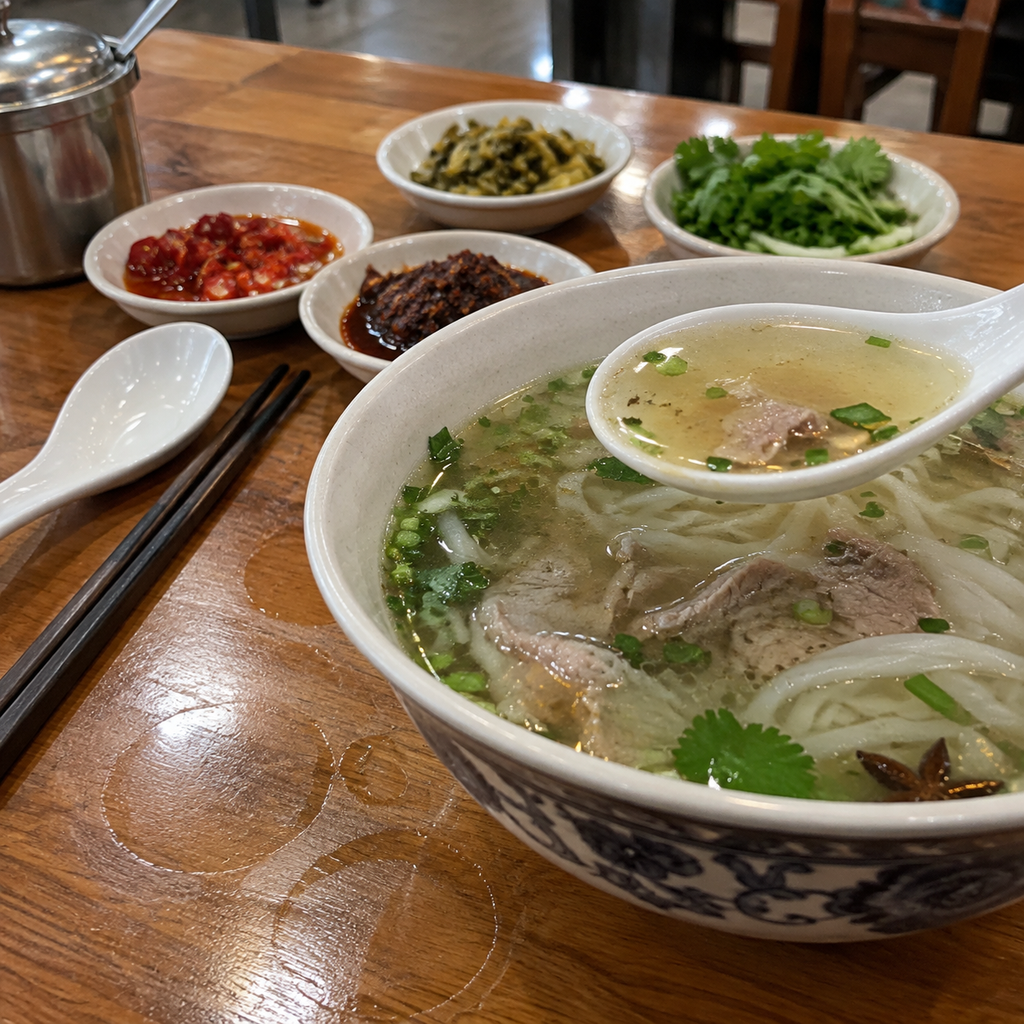
Soup eating has a different advantage: it slows every change down. The hot liquid holds the noodles, spreads the saltiness of the brine, keeps the meat from feeling abrupt, and rounds the sharper edge of the pickled beans. For someone whose appetite has not fully opened after waking, tasting soup first is a gentle entry. But soup has limits too. Noodles continue changing while they sit in liquid, peanuts gradually lose their crunch, and once chili falls into the soup it is difficult to make it affect only one bite. Soup is not automatically safer; it hands part of the judgment to time and temperature.
早餐排队时,我还学会了观察一个人如何面对“还没轮到自己”的几分钟。有人已经在心里选好了要不要辣,队伍往前挪一步便把视线投向调料;有人看着前面的人端走一碗,临时改变了主意,转而选择汤粉;也有人不看别人,只把雨伞收好、把肩膀让开,安静等着。那些动作没有被说成攻略,却比菜单上的词更能说明这里的节奏。排队的人并非完全被动,他们在等待里预先调整了自己的胃口和手势。
While waiting in the breakfast queue, I learned to watch how people used the few minutes before their turn. Some had already decided whether they wanted chili and looked toward the condiments whenever the line moved. Some changed their minds after seeing a bowl carried away and chose soup noodles instead. Others did not watch anyone; they folded an umbrella, moved a shoulder aside, and waited quietly. None of these gestures was presented as a guide, yet they explained the room’s rhythm better than menu words. People in line were not passive. They adjusted appetite and movements before reaching the counter.
队伍变短以后,店里的空间反而显得更忙。端粉的人要在桌边寻找一个不会碰到别人手肘的位置,离开的人要把椅子推回去,后来的人则会先扫一眼有没有空位。我那时把背包放在脚边,而不是占在旁边的椅子上;喝汤时也把碗往自己这一侧收,避免手臂伸到过道。这样的细节不影响味道,却决定一顿早餐是否顺畅。小店里的“方便别人”不是额外表演,而是每个人都知道自己下一步还要给别人让出一点地方。
As the queue shortened, the shop seemed busier rather than quieter. Diners carrying bowls searched for a place that would not collide with another person’s elbow. Those leaving pushed chairs back, while newcomers scanned for an open seat. I kept my backpack by my feet instead of using another chair, and pulled the bowl toward my side whenever I drank so my arm would not reach into the passage. These details did not alter the flavor, but they determined whether breakfast flowed smoothly. In a small shop, making room for others is not a performance. Everyone knows that the next movement must leave space for someone else.
邻桌动作最有用的地方,不是它看起来熟练,而是它很少浪费。那位食客没有反复把整碗翻来翻去,也没有一次拿很多调料。他知道先处理哪一处,知道什么时候停下,知道碗底还剩什么。后来另一位食客坐下时,我看见她先用勺子喝了汤,再把一半米粉挑起来,剩下的留在汤里慢慢吃。两个人的动作并不相同,却都在根据自己的偏好调整同一类食物。所谓“当地吃法”原来不是一个统一姿势,而是一组能够适应碗、身体和时间的经验。
The most useful thing about the neighboring diner’s movements was not their apparent skill but their lack of waste. He did not repeatedly overturn the whole bowl or add a large amount of seasoning at once. He knew what to handle first, when to stop, and what remained at the bottom. Later, another diner sat down, tasted the soup with a spoon, lifted half the noodles, and left the rest to eat slowly in the liquid. Their movements differed, yet both adjusted the same kind of food to personal preference. A “local way” was not one fixed posture but a set of experiences that adapted to the bowl, the body, and the available time.
这让我在后面的几顿早餐里不再急着询问别人“正确答案”。我会先确认端上来的是什么状态:卤水已经混开,还是只落在一侧;汤是单独盛着,还是米粉已经泡在里面;配料是集中堆在中央,还是分散在表面。状态不同,适合的第一步也不同。若粉已经很湿,继续加汤可能会让口感变得松散;若粉比较干,先从底部翻动几下,卤水才不会只停在最上面。选择先喝还是先拌,应该从眼前这碗开始,而不是从想象中的标准开始。
This made me stop asking for a single correct answer during later breakfasts. I first checked the bowl’s condition: had the brine already spread, or was it sitting on one side? Was the soup separate, or were the noodles already soaking in it? Were the toppings piled in the center, or scattered across the surface? Different conditions called for different first moves. If the noodles were already very wet, adding more liquid could loosen their texture. If they were relatively dry, lifting from below helped the brine reach more than the top layer. The decision to sip or mix should begin with this bowl, not with an imagined standard.
吃完之后的路线安排也因此变得更有层次。米粉入口快,真正需要留意的是吃完后的身体状态:汤粉让人暖得更快,拌粉和辣椒则可能让口腔保持较长时间的兴奋。若下一站要在室外走很久,我会给自己留一段缓步时间,不把刚吃完的热量直接交给一段上坡或密集的奔走。若天气闷湿,我会选择先沿着阴影多的街道移动;若雨刚停,便留意地面是否打滑,优先走平整、有人经过的路。早餐不是路线的附属品,它会影响我接下来怎么走。
The route after breakfast also gained more layers. Guilin noodles are easy to eat quickly, but what matters afterward is how the body feels. Soup warms you sooner, while mixed noodles and chili may keep the mouth stimulated for longer. If the next stop requires a long outdoor walk, I leave time for an easy pace instead of sending a full stomach straight into a climb or a dense sequence of errands. In humid weather I favor streets with more shade. After rain, I pay attention to slippery ground and choose level paths where people are passing. Breakfast is not an accessory to the route; it affects how I move through the next hours.
那天我没有把吃完后的空档塞进更多景点,反而把它当成观察城市的缓冲。走过一段街区时,我看见早餐铺前的队伍从门口延伸到檐下,又随着人离开而缩短;有人吃得很快,转身便去赶自己的事情,有人还站在路边整理袋子,把没吃完的配料小心收好。不同人的下一步不同,正说明一顿饭没有把所有人带向同一条路线。我的选择是慢慢走,等卤水和辣椒的味道退下去,再决定是否继续往远处移动。
That day I did not fill the gap after breakfast with more attractions. I used it as a buffer for observing the city. Along one block, I saw the queue stretch from the doorway beneath the eaves, then contract as people left. Some diners ate quickly and turned toward their own errands. Others stood by the street, arranging a bag and carefully securing remaining toppings. Their next steps differed, which showed that a meal did not send everyone along one route. I chose to walk slowly, let the brine and chili fade, and decide only afterward whether to continue farther.
我也重新估量了“吃饱以后还能走多远”这件事。旅行中的路线常常只写景点之间的距离,却很少写早餐的温度、油润程度、辣味强弱和坐下时间。实际走起来,身体会给出比地图更诚实的反馈。那天我原本想吃完便加快脚步,后来因为一边回味一边观察湿街,速度自然放慢。放慢并不等于耽误,反而让我在转弯处看见刚开门的铺面,在水边听到比车辆更清楚的水声,也让下一段行程没有被饥饿或过饱催着走。
I also reconsidered how far one can walk after feeling full. Travel routes often record distances between attractions but rarely record the temperature, richness, heat, or time spent sitting at breakfast. In practice, the body gives feedback more honestly than a map. I had intended to speed up after eating, but while remembering the flavors and watching the wet street, my pace naturally slowed. Slowing down was not wasting time. It let me notice newly opened storefronts at corners and hear water more clearly than traffic near the river. The next part of the route was not driven by hunger or heaviness.
关于卤水,我最后留下的判断也比早晨复杂了一点。它既可以作为汤的底色,也可以成为拌粉时附着在米粉表面的密度。汤里喝到的是它被热水托开的香气,干拌里吃到的是它和粉的贴合;当肉片、花生、酸豆角进入以后,卤水又从单一味道变成了连接各部分的媒介。判断一碗卤水是否合适,不能只问“香不香”,还可以问它是否给米粉留出空间,是否让配料之间有清楚的区别,是否在咽下之后仍然保持稳定而不过分。
My final judgment of the brine became more complicated than it had been that morning. It can be the background of a soup, or it can become a concentrated layer clinging to the noodles in a mixed bowl. In soup, its aroma is opened by heat and liquid. In a dry mix, it is tasted through its contact with the noodles. Once meat, peanuts, and pickled beans enter, brine becomes a medium connecting the parts rather than a single flavor. To judge it, I should not ask only whether it is fragrant. I can ask whether it leaves room for the noodles, keeps the toppings distinct, and remains steady rather than excessive after swallowing.
关于配料,我也不再把“多”当成“好”。一碗米粉若放进太多互相抢位置的味道,吃到后面会疲惫;若只有米粉和卤水,可能又少了口感的折叠。适合自己的组合,往往取决于早餐前已经走了多久、当天是否还要在外面活动、自己能否接受酸和辣同时出现。花生适合在粉已经带上卤水之后加入,酸豆角则可以少量试过再决定是否增加,辣椒更要留在局部。每一种配料都像一个可调的旋钮,而不是必须全部推到最大。
As for toppings, I no longer equate more with better. If too many competing flavors occupy one bowl, the palate becomes tired. If there is only noodle and brine, the texture may lack folds and contrast. A suitable combination depends on how long I walked before breakfast, how much outdoor activity remains, and whether I want sourness and heat together. Peanuts work well after the noodles have taken on brine. Pickled beans can be tested in a small amount before adding more. Chili is best kept local at first. Each topping is an adjustable dial, not a switch that must be turned all the way up.
我后来发现,先喝汤和先拌粉并不是互相排斥的两种阵营。真正重要的是有没有给第一口留出观察的位置。可以先喝半勺汤,再把一小撮粉拌开;也可以先吃一口原味米粉,再让卤水和花生加入;如果一开始就知道自己想吃汤粉,仍然可以在入口前看一眼配料分布。这样做不会让早餐变得复杂,反而减少了因为不了解而胡乱添加调料的可能。吃法的自由不是随意,而是知道自己正在改变什么。
I later realized that tasting broth first and mixing first are not rival camps. The essential thing is to leave the first bite enough room for observation. One may taste half a spoon of soup and then mix a small pinch of noodles. One may try a plain bite before bringing in brine and peanuts. Even when choosing soup noodles from the beginning, it helps to notice the topping arrangement before eating. This does not make breakfast complicated. It reduces the chance of adding seasonings blindly. Freedom in eating is not randomness; it is knowing what you are changing.
那张小桌的大小还让我记住了另一件事:空间会影响吃法。桌面不够大,碗、手机、纸巾和调料不能同时占据中心,人就会自然把注意力放回碗里。座位靠得近,邻桌的筷子起落、碗底碰桌的声音、有人让路时椅脚的轻响都会进入感官。这样的环境不一定适合长时间摆拍,却适合观察一顿早餐怎样在短时间里完成。人们没有把吃饭说成表演,可每个动作都在回应热度、拥挤、队伍和下一站。
The small table also taught me that space affects how one eats. When the surface is limited, the bowl, phone, tissues, and condiments cannot all occupy the center, so attention naturally returns to the food. With seats close together, the neighboring chopsticks, the bowl touching the tabletop, and chair legs shifting to make room all enter the senses. Such a setting may not suit a long photo session, but it is ideal for observing how breakfast is completed in a short span. Nobody called it a performance, yet every movement answered heat, crowding, the queue, and the next destination.
从那以后,我在早餐店里会把“看”安排在真正的第一步。看队伍如何移动,看柜台怎样处理卤水,看端出来的碗是干拌还是带汤,看邻桌有没有在碗底翻粉。看完以后才轮到我的习惯:先闻、先喝、先拌,或者三者交替。这个顺序让我意识到,旅行不是把自己带到一个新地方,再强行用旧习惯覆盖它;更像是先让现场提供几个选项,再决定哪些旧习惯值得保留。桂林米粉给我的提醒,就藏在一勺汤和一筷子粉的间隙里。
Since then, I have placed looking before the first deliberate bite in breakfast shops. I watch how the queue moves, how brine is handled at the counter, whether the bowl is dry-mixed or filled with soup, and whether diners lift noodles from the bottom. After that, my own habits can enter: smell first, sip first, mix first, or alternate among them. This order reminds me that travel is not simply arriving somewhere new and covering it with old habits. It is allowing the scene to offer several options, then deciding which familiar habits deserve to remain. Guilin noodles placed that reminder between one spoonful of soup and one lift of noodles.
如果让我给这顿早餐写一个非常实际的判断,我会把它分成三层。第一层是身体:冷不冷、饿不饿、接下来要不要走很久;第二层是碗:卤水在哪里、粉的干湿、配料的多少;第三层是环境:队伍是否拥挤、桌边是否需要让路、自己有没有时间慢慢试。身体需要温暖时,汤可以先来;碗面需要重新建立联系时,拌一小块更好;环境催促离开时,则不必追求复杂调味。判断不是抽象心得,而是三层条件碰在一起后的选择。
If I had to give this breakfast a practical decision method, I would divide it into three layers. First is the body: am I cold, hungry, and about to walk for a long time? Second is the bowl: where is the brine, how wet are the noodles, and how many toppings are present? Third is the setting: is the queue crowded, do people need room beside the table, and do I have time to test things slowly? When the body needs warmth, soup can come first. When the bowl needs its parts connected, mixing a small section helps. When the room is urging me to leave, there is no need to pursue elaborate seasoning. Judgment is the choice produced by these conditions meeting.
这三层判断也影响我安排后面的路线。我不再只看地图上“早餐店到景点”的直线距离,而会给自己留出从店里走出来、让身体适应、顺便辨认方向的时间。若早餐吃得偏汤,我会优先安排一段开阔而平缓的步行;若拌粉和辣椒让身体很热,我会先走有遮蔽的街段,不急着进入拥挤的室内空间;若队伍很长、自己站了较久,吃完后则把下一站安排得松一点。路线不是餐后才开始,它在排队时已经被身体悄悄改写。
These three layers also affect the route that follows. I no longer look only at the straight-line distance from a breakfast shop to an attraction. I leave time to walk out, let the body adjust, and recognize the direction. After a soup-heavy breakfast, I prefer an open, level walk. If mixed noodles and chili leave me warm, I choose a shaded stretch before entering a crowded indoor space. If I stood in a long queue, I make the next stop less demanding. The route does not begin after the meal; the body quietly rewrites it while I am still waiting.
我并不想把邻桌那个人写成一个替我解答问题的导师,因为他可能根本没有注意到我。他只是按照自己熟悉的方式吃完一碗粉,而我恰好在旁边看见了其中的秩序。旅行中很多改变都不是来自正式介绍,而是来自一个没有被安排的瞬间:有人如何把椅子推回去,如何把辣椒留在一角,如何把最后一点卤水和碎花生送入口中。对观察者来说,这些动作很小;对理解一座城市的日常来说,它们又足够具体。
I do not want to turn the neighboring diner into a mentor who solved my question, because he may not have noticed me at all. He simply finished a bowl in his familiar way, and I happened to see the order within it. Many changes during travel come not from formal explanations but from unscheduled moments: the way someone pushes a chair back, keeps chili in one corner, or gathers the last brine with peanut crumbs. To an observer these movements are small. To understanding a city’s ordinary life, they are specific enough.
回到这碗粉本身,最让我留恋的还是入口顺序带来的差别。先喝汤时,我感到的是清晨被热气托起来的安静;先拌一小块后,卤水把粉的表面变得有光,配料的脆和酸开始出现;把其中一部分重新送进汤里,又得到一种被放慢的浓淡。每次变化都不大,却足以让一碗早餐有了几个转身。旅行中的记忆往往也是这样形成的,不靠一个轰动的瞬间,而靠一连串可以复述的细部:碗边、卤水、筷子、队伍,以及吃完后那段没有目的地的路。
Returning to the bowl itself, what stays with me is the difference created by sequence. Tasting soup first brought the quiet warmth of morning. Mixing a small section made the noodles shine with brine and released the crunch and sourness of the toppings. Sending part of that mixture back into the soup created a slower balance of intensity. None of the changes was dramatic, yet together they gave breakfast several turns. Travel memories often form this way—not through one spectacular instant but through details that can be retold: the rim of a bowl, brine, chopsticks, a queue, and the first purposeless stretch of road after eating.
所以,若下一次又有一碗桂林米粉放到我面前,我大概仍会先喝一口汤。那是我的起点,不再是我的终点。喝完以后,我会看卤水在粉间怎样铺开,挑起底部的一小撮,先让米粉和一两样配料接触,再决定要不要加入更多酸豆角、花生或辣椒。若旁边的人动作自然,我会继续观察,但不会把自己变成模仿者。吃完后,我会根据脚下的路、身体的热度和街上的天气安排下一步。这样一来,先拌还是先喝汤不再是二选一,而是一顿早餐里可以反复调整的次序。
So, if another bowl of Guilin rice noodles is placed in front of me, I will probably still taste a spoonful of broth first. That is my starting point, not my final destination. Afterward I will watch how the brine spreads among the noodles, lift a small portion from below, let it meet one or two toppings, and then decide whether to add more pickled beans, peanuts, or chili. If a nearby diner moves naturally, I will keep observing without turning myself into a copy. After eating, I will choose the next step according to the ground, the warmth in my body, and the weather on the street. Mix first or broth first is no longer an either-or question, but an order that can be adjusted throughout breakfast. The route afterward begins with leaving the table in a way that respects the room around it.
我还会把最后一口留给自己做一个小判断:是卤水让米粉成立,还是米粉让卤水变得可亲近。答案并不固定。卤水太单独,会像没有落脚处的香气;米粉没有卤水,也只剩下温度和口感。肉片、花生、酸豆角、葱花和辣椒把两者之间的距离缩短,却没有取消区别。正因为每一部分都还能被辨认,拌食才有层次,汤食才有回旋。吃完以后,碗里留下的不是一个标准答案,而是我根据当天状态做出的记录。
I also leave the final bite for a small judgment: does the brine make the noodles work, or do the noodles make the brine approachable? The answer is not fixed. Brine without a place to settle is only an aroma without footing; noodles without brine have only warmth and texture. Meat, peanuts, pickled beans, scallions, and chili shorten the distance between them without erasing their differences. Because each part remains recognizable, mixed noodles can have layers and soup noodles can have movement. What remains after eating is not one standard answer, but a choice shaped by that morning.
还有一个容易被忽略的判断,是碗里剩下多少卤水。刚开始时,卤水决定第一口的底色;吃到后面,它则决定最后几口会不会发干。若我把粉拌得很彻底,却没有留意碗底,最后可能只剩下吸收过味道的粉和零散配料;若一直把粉浸在汤里,最后几口又会失去刚入口时的弹性。因此我会在中途看一次碗底,必要时用勺子把液体带到还没有接触过卤水的地方。这个动作很轻,却让一碗粉从开头到收尾保持同一条线,而不是前面浓、后面散。
Another judgment is easy to overlook: how much brine remains at the bottom. At the beginning, it sets the background for the first bite; later, it determines whether the final bites become dry. If I mix everything thoroughly without checking the bottom, I may be left with flavored noodles and scattered toppings. If I leave the noodles submerged, the last bites may lose the springiness they had at the start. I now look into the bowl halfway through and, when needed, use the spoon to bring liquid toward noodles that have not met it. The movement is small, but it keeps the meal connected from opening to finish.
早餐店里的声音也会提醒我什么时候该停下观察,什么时候该继续吃。柜台上碗与碗轻轻相碰,过道里有人说了声借过,门外车轮压过潮湿路面的声音忽远忽近。声音多起来时,我会把手机收好,不在桌边停留太久;店里稍微安静时,则能听见勺子碰到碗底的清脆。食物并没有脱离环境单独存在,卤水的香气、米粉的温度和周围人的动作一起组成了早餐。也正因为如此,吃完后走向哪里,不必急着套进预先写好的安排,先把自己从这间小店的节奏里平稳地带出去,路线才会真正开始。
The sounds of a breakfast shop also tell me when to pause and when to keep eating. Bowls touch lightly at the counter, someone says excuse me in the passage, and tires pass over the damp road outside. When the sounds grow busy, I put my phone away and do not linger beside the table. When the room quiets, I can hear the spoon touch the bottom of a bowl. Food does not exist apart from its setting. The aroma of brine, the warmth of noodles, and the movements of other diners form breakfast together. That is why the route afterward need not be forced into a schedule already written. First carry yourself calmly out of the shop’s rhythm; only then does the walk truly begin.

- 风沙把莫高窟的时间吹慢了 | The Sandstorm Slowed Time at the Mogao Caves
- 第一次在中国水果店买西瓜,我学会先说想现场切还是带走 | The First Time I Bought Watermelon in a Chinese Fruit Shop, I Learned to Say Whether I Wanted It Cut to Eat Now or Taken Home
- 零下二十多度的哈尔滨,先考验的不是勇气,是手机电量 | In Harbin Below Minus Twenty, the First Test Was Not Courage but Phone Battery
- 五月黄山脚下的一场雨,让本人第一次明白赶景点不如先安顿情绪 | A Rainy May Day at the Foot of Huangshan Taught Me to Settle My Mood Before Chasing Views
- 一次小小的药店交流,怎么让我开始信任在中国开口求助这件事 | How a Small Pharmacy Interaction Taught Me to Trust Asking for Help in China
- 地铁、打车、便利店:三大场景手机支付实战 | Subway, Taxi & Convenience Store: Mobile Pay in Action
- 第一次在中国药店买感冒药,我学会先说症状再看品牌 | The First Time I Bought Cold Medicine in a Chinese Pharmacy, I Learned to Describe Symptoms Before Looking at Brands
- 在社区修理铺门口等十分钟,我才明白中国人为什么总说“先看看能不能修” | Waiting Ten Minutes Outside a Neighborhood Repair Shop, I Finally Understood Why People in China Always Say, “Let’s See If It Can Be Fixed First”
- 中国货币与支付 | Chinese Currency and Payment
- 我在苏州学会先找一条不费力的厕所路线 | In Suzhou I Learned to Find a Low-Effort Restroom Route First
Comments (0)