
合肥路口那些半秒钟的互让,比任何介绍都更像城市说明书 | The Half-Second Acts of Yielding at Hefei Crossings Explain the City Better Than Any Guide
第一次到合肥,我先学会观察路口和人流 | On My First Day in Hefei, I Learned to Read Crossroads and Crowds
合肥的路口在早高峰里像一只缓慢而有力的肺,红灯时收拢,绿灯时舒展,四面八方的人流便随着信号一呼一吸。我站在长江中路附近的一个路口,天刚亮透,楼宇玻璃上还留着清晨的淡灰,公交车靠站时吐出一阵气声,电动车从非机动车道上排成密密的线。这里没有海边城市那种湿咸的风,也没有高原城市辽阔的天光,合肥的清晨更像一杯温度适中的茶,实在、清醒、带着一点不张扬的热度。路口的人很多,却不混乱。上班的人夹着电脑包,学生背着书包,老人拎着菜袋,外卖骑手盯着手机上的路线,每个人都像带着自己的小目的地,却又不得不在斑马线前共享同一个暂停。红灯的几十秒里,城市把所有人的速度暂时叠在一起,让陌生人并肩站成一段短暂的队伍。
A Hefei intersection during the morning rush feels like a slow but powerful lung: it contracts at the red light, expands at the green, and streams of people from every direction move with the signal’s breathing. I stood near an intersection around Changjiang Middle Road as the morning had just brightened, pale gray still resting on the glass of buildings. A bus released a hiss as it pulled into the stop, and electric scooters lined the non-motorized lane in dense rows. There was no salty damp wind of a coastal city here, nor the vast sky of a plateau city. Hefei’s morning was more like a cup of tea at the right temperature: practical, clear, and quietly warm. There were many people at the intersection, but it was not chaotic. Office workers held laptop bags, students carried backpacks, elders held vegetable bags, and delivery riders checked routes on their phones. Everyone seemed to carry a private destination, yet all had to share the same pause before the crosswalk. During those dozens of seconds of red light, the city layered everyone’s speed together and made strangers stand side by side in a temporary line.
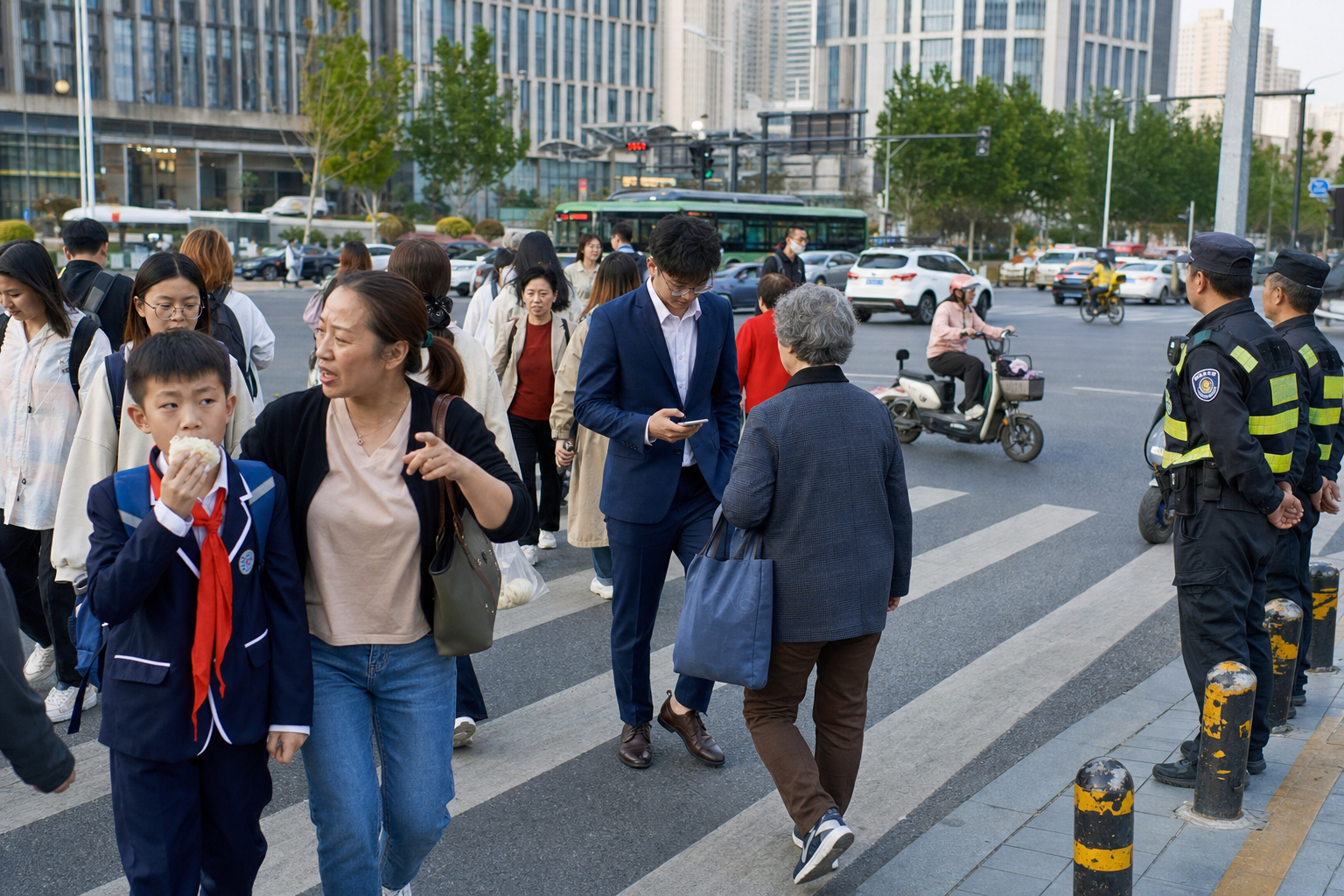
绿灯亮起的一刻,路口像被轻轻打开的闸门。人群并不是同时冲出去,而是先有最前排的人迈步,接着后面的人顺势跟上,电动车铃声、鞋底声、公交报站声混在一起,形成一种日常的合奏。斑马线被脚步迅速填满,白色横线在移动的人影下时隐时现。一个穿校服的男孩一边走一边咬着包子,母亲在旁边提醒他看车;一位穿西装的年轻人低头回消息,差点撞到前面停了一下的老人,又立刻抬头道歉;两个保洁员推着工具车从侧面慢慢通过,车轮在路面接缝处轻轻颠了一下。合肥的路口人流没有戏剧性的故事,却有许多微小的调整和互让。城市秩序并不是完全靠标线和信号灯维持,也靠每个人在半秒钟内做出的判断:快一点、慢一点、让一下、提醒一句。
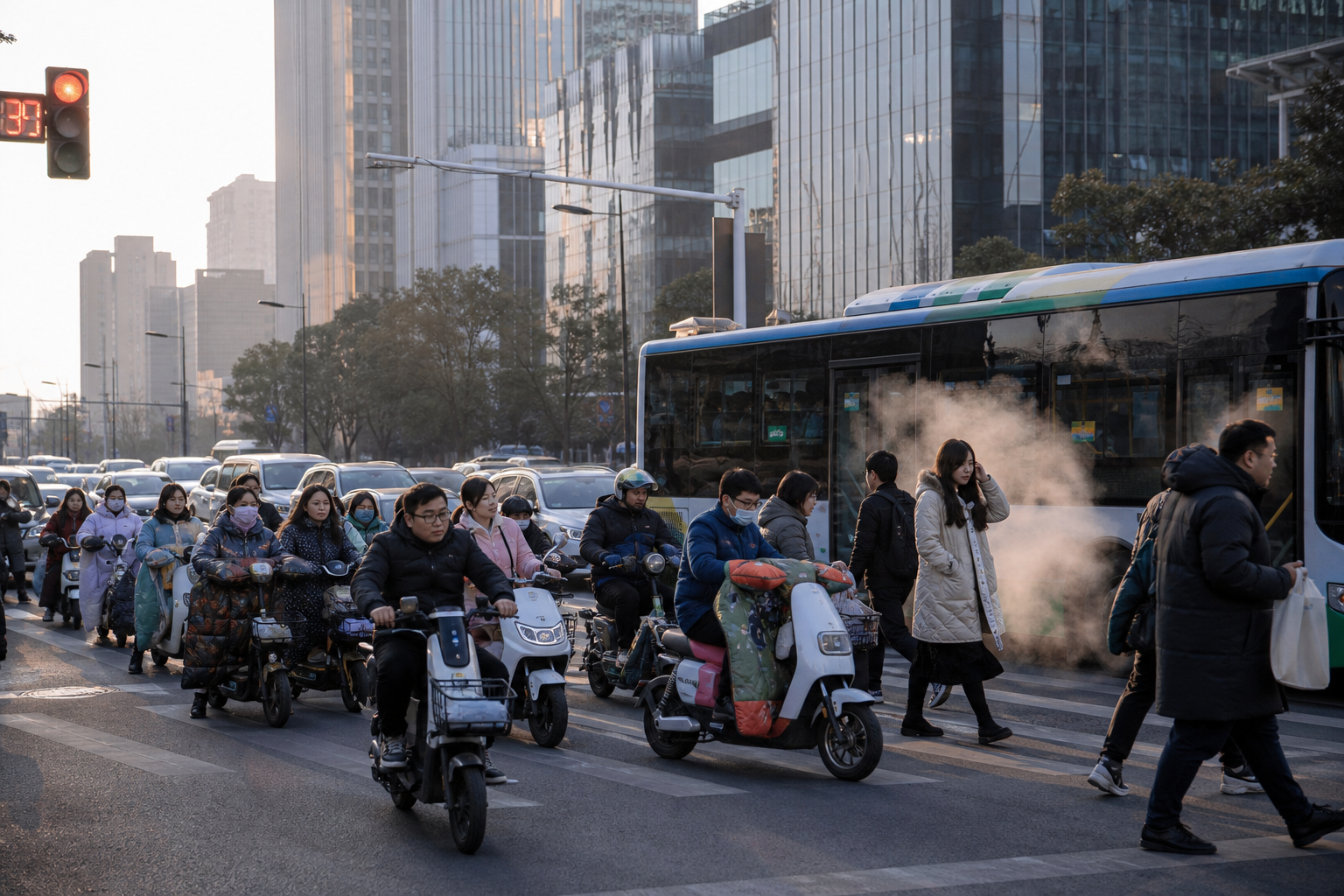
When the green light came on, the intersection seemed like a gate gently opened. The crowd did not rush out all at once. First the front row stepped forward, then those behind followed, and the bells of electric scooters, the sound of soles, and bus announcements mixed into an ordinary ensemble. The crosswalk filled quickly with footsteps, white stripes appearing and disappearing under moving silhouettes. A boy in a school uniform walked while biting into a steamed bun, his mother beside him reminding him to watch the cars. A young man in a suit lowered his head to reply to a message and nearly bumped into an elder who had paused ahead, then immediately looked up and apologized. Two sanitation workers pushed a tool cart slowly from the side, its wheels bumping softly over a seam in the road. The human flow at a Hefei intersection does not offer dramatic stories, but it contains countless tiny adjustments and courtesies. Urban order is not maintained only by markings and traffic lights, but also by judgments each person makes in half a second: faster, slower, give way, say a reminder.
我在路边买了一杯豆浆,摊主的动作快得像早已与路口节奏同步。纸杯递过来时很烫,雾气在冷一点的空气里散开。摊车旁边放着油条、糍粑、鸡蛋饼,许多人不坐下,只是买了就走,把早餐带进下一段通勤。合肥是一座很懂得“顺路”的城市,很多生活片段都被安放在路口附近:早餐摊、共享单车点、公交站、地铁口、便利店、修钥匙的小摊。它们不是风景名胜,却撑起一天开始时最实际的需求。等红灯的人顺手买一份早点,赶地铁的人在便利店门口拿一瓶水,骑车的人停下来给轮胎打气。人流在这里并不只是穿过空间,也不断与空间交换:把钱递出去,把食物接过来,把消息发出去,把一天的精神一点点召回来。
I bought a cup of soy milk by the roadside, and the vendor moved so quickly that he seemed synchronized with the rhythm of the intersection. The paper cup was hot when he handed it to me, steam spreading in the slightly cool air. Beside the cart were fried dough sticks, glutinous rice cakes, and egg pancakes. Many people did not sit down; they bought breakfast and carried it into the next part of their commute. Hefei is a city that understands the phrase “on the way.” Many fragments of life are placed near intersections: breakfast carts, shared bike docks, bus stops, subway entrances, convenience stores, and key-repair stalls. They are not scenic landmarks, yet they support the most practical needs at the beginning of the day. Someone waiting for the light buys breakfast, someone rushing to the subway grabs a bottle of water at a convenience store entrance, and someone on a bike stops to inflate a tire. The human flow here does not merely pass through space; it continually exchanges with it: handing out money, receiving food, sending messages, and slowly summoning the spirit needed for the day.
上午九点以后,路口的人流稍微松了一些,但并没有真正停下来。高峰像潮水退去,留下比较清晰的个体。快递员把车停在路边,低头整理一摞包裹;一位阿姨牵着孙女过马路,小女孩蹦着去踩斑马线的白条;几个大学生模样的年轻人从地铁口出来,边走边讨论课程和实习。合肥的城市气质在这些人身上显得很具体,它既有省会的忙碌,也有日常生活的亲近。这里的路口不像超大城市那样让人觉得被吞没,也不像小城镇那样过于熟悉,它处在一种适中的密度里,让人可以感到自己是人流的一部分,却仍然保留个人的轮廓。阳光升高后,树影落在斑马线上,行人的影子和叶影重叠,像城市把自然也编进了通勤的图案。
After nine in the morning, the flow at the intersection loosened a little, but it did not truly stop. The rush hour receded like tidewater, leaving clearer individuals behind. A courier parked by the roadside and sorted a stack of parcels; an auntie held her granddaughter’s hand while crossing, and the little girl hopped from one white stripe to another; several young people who looked like university students came out of the subway, discussing classes and internships as they walked. Hefei’s urban character became concrete in these people. It carries the busyness of a provincial capital and the closeness of everyday life. This intersection does not make one feel swallowed, as in some megacities, nor does it feel overly familiar like a small town. It holds a moderate density, allowing you to feel part of the human stream while still keeping your own outline. As the sun rose higher, tree shadows fell across the crosswalk, and pedestrian shadows overlapped with leaves, as if the city had woven nature into the pattern of commuting.
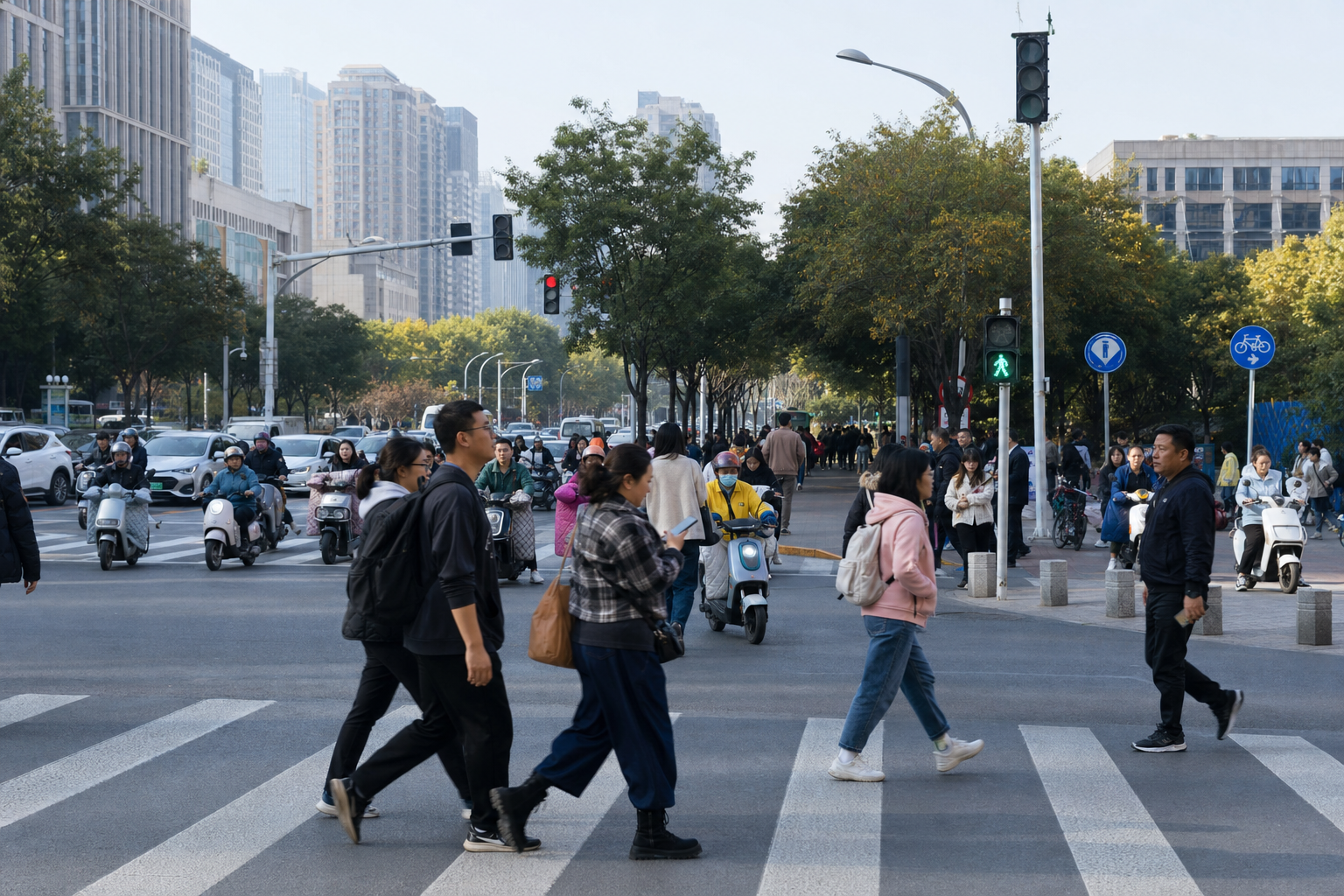
中午时,路口换了一种节奏。写字楼里的人出来吃饭,三三两两地穿过马路,讨论附近哪家快餐今天不用排太久。外卖骑手变得更多,他们的车箱颜色鲜明,在车流边缘快速移动。太阳照在路面上,空气里有热油、咖啡、汽车尾气和香樟树叶的味道。一个交通协管员站在路中间,手势简洁,哨声短促,把几股人流和车流分开又合拢。他的存在让我注意到,路口其实是一种持续的协商。每一次通过都需要规则,也需要人的临场感。红灯不能回答所有细节,标线也不能处理所有犹豫,因此总有人用眼神、手势或一句话补上空隙。城市的运转看似宏大,落到路口却很具体:谁先走,谁等一等,谁被看见,谁被提醒。
At noon, the intersection changed rhythm. People came out of office buildings for lunch, crossing the road in twos and threes while discussing which nearby fast-food place would not have too long a line today. Delivery riders became more numerous, their boxes brightly colored as they moved quickly along the edges of traffic. Sunlight struck the road, and the air smelled of hot oil, coffee, exhaust, and camphor leaves. A traffic assistant stood in the middle, his gestures concise and whistle short, separating and merging several streams of people and vehicles. His presence made me notice that an intersection is actually a continuing negotiation. Every crossing needs rules, but it also needs human presence. Red lights cannot answer every detail, and road markings cannot handle every hesitation, so someone always fills the gaps with a look, a gesture, or a sentence. The operation of a city seems grand, but at an intersection it becomes specific: who goes first, who waits, who is seen, and who is reminded.
下午的路口有短暂的倦意。阳光从楼间斜下来,路面泛出白亮的反光,等车的人站到树荫下,连电动车的速度也显得没那么急。便利店门口的快递柜不时响起提示音,有人取件后把包装拆开,又把纸盒压扁放进回收箱。一个修伞修鞋的小摊靠在路边,摊主坐在小马扎上打盹,旁边的灯牌还没亮。城市在下午三四点常常露出一种背面,不是清晨的紧张,也不是夜晚的热闹,而是一种暂时松开的状态。人流仍在,只是更稀疏,像一条河到了平缓处。这样的时刻很容易被忽略,可它让人看见路口并不只服务高峰,也容纳等待、停顿和无所事事。一个城市如果只有速度,会让人疲惫;有了这些下午的空隙,速度才有地方喘气。
In the afternoon, the intersection carried a brief weariness. Sunlight slanted between buildings, the road reflecting a pale brightness. People waiting for rides stood under tree shade, and even the electric scooters seemed less hurried. At the entrance of a convenience store, parcel lockers sounded from time to time. Someone picked up a package, opened it, flattened the cardboard, and placed it in a recycling bin. A small umbrella-and-shoe repair stall leaned by the roadside, its owner dozing on a low stool while the sign beside him had not yet lit up. Around three or four in the afternoon, cities often reveal their reverse side: not the tension of morning or the liveliness of night, but a temporarily loosened state. The human flow remains, only thinner, like a river reaching a gentle stretch. Such moments are easily overlooked, yet they show that intersections do not only serve peaks; they also hold waiting, pauses, and idleness. If a city had only speed, it would exhaust people. With these afternoon gaps, speed has a place to breathe.
傍晚来临,路口重新被点燃。下班的人从写字楼和地铁口涌出,公交站前排起长队,家长接孩子的电动车在路边形成一片闪烁的尾灯。天空还没完全黑,路灯已经亮了,暖黄的光和车辆的白光交错在一起。合肥的傍晚有一种很平民的热闹,不夸张,却扎实。有人拎着菜往家走,有人约朋友去吃龙虾,有人站在路边等网约车,有人在电话里问“到哪了”。这些声音拼在一起,就是城市从工作状态切换到生活状态的过程。路口人流也因此变得更有情绪:早晨多是向外出发,傍晚则更多是向家、向饭桌、向朋友、向休息处回流。每个人脸上都带着一天留下的痕迹,疲惫、轻松、焦急或期待,在灯光下短暂显现。
As evening arrived, the intersection was lit again. People off work poured from office buildings and subway exits, long lines formed before bus stops, and electric scooters of parents picking up children created a field of blinking taillights by the roadside. The sky was not fully dark, but streetlamps had already come on, warm yellow light crossing with the white light of vehicles. Hefei’s evening has a very ordinary liveliness: not exaggerated, but solid. Someone carries vegetables home, someone plans to eat crayfish with friends, someone waits by the road for a ride-hailing car, and someone asks over the phone, “Where are you now?” These sounds assembled together are the city’s shift from work mode to life mode. The human flow at the intersection therefore gains more emotion. In the morning most people move outward; in the evening more people flow back toward home, dinner tables, friends, and rest. Every face carries traces left by the day: fatigue, relief, anxiety, or expectation, briefly appearing under the lights.
我跟着人流过了一次又一次马路,故意不急着离开这个路口。走到对面,再走回来,站在不同角度看同一组信号灯和斑马线,竟然会看到不同的城市。站在公交站旁,路口像一张时间表,人们关心车什么时候来、会不会有座位;站在早餐摊的位置,路口像一张饭桌,所有人都在寻找一天中最方便的一口热食;站在天桥下,路口像一台机器,车轮、脚步、灯光和指示牌互相咬合;站在树荫里,路口又像一个邻里空间,老人聊天,孩子等人,骑车的人停下来擦汗。同一个地方因为观察点不同而层次不断变化,这让我觉得所谓城市理解,并不是找到一个总答案,而是愿意从多个角度反复看一个普通地点。
I crossed with the crowd again and again, deliberately not leaving the intersection too soon. I walked to the opposite side and back, standing at different angles to watch the same traffic lights and crosswalks, and surprisingly saw different versions of the city. From beside the bus stop, the intersection was a timetable, and people cared when the bus would arrive and whether seats would be available. From the breakfast stall’s position, it was a dining table, with everyone seeking the most convenient warm bite of the day. From under the pedestrian bridge, it was a machine, with wheels, footsteps, lights, and signs meshing together. From the tree shade, it became a neighborhood space, where elders chatted, children waited, and cyclists stopped to wipe sweat. The same place changed layers according to the point of observation. This made me feel that understanding a city is not about finding one total answer, but about being willing to look repeatedly at an ordinary place from several angles.
夜晚完全落下后,路口的人流没有消失,只是换成了另一批人。商场里的年轻人出来,手里拎着奶茶和购物袋;夜跑的人沿着人行道经过,手环在腕上发着小光;摊贩把小车推到更显眼的位置,炒饭和烤冷面的香味开始占据空气。白天强调效率的路口,到了夜里多了一点停留的权利。有人不再只是赶路,而是在路边等人、聊天、看手机、吃东西。信号灯仍然按固定节奏变化,可人的心情已经松开。一个女孩站在斑马线前整理被风吹乱的头发,旁边的男孩替她拿着包;一位司机摇下车窗问路,行人指了指前方;几个孩子在家长身边数着倒计时灯,绿灯一亮便兴奋地迈出去。夜色让路口的规则没有变,却让规则里的温度更容易被看见。
After night fully arrived, the human flow at the intersection did not disappear; it changed into another group. Young people came out of the mall carrying milk tea and shopping bags. Night runners passed along the sidewalk, bracelets glowing faintly on their wrists. Vendors pushed carts to more visible positions, and the smell of fried rice and grilled cold noodles began to fill the air. The intersection that emphasized efficiency by day gained a little right to linger at night. People were no longer only rushing; they waited for friends, chatted, checked phones, and ate by the roadside. The traffic lights still changed in a fixed rhythm, but people’s moods had loosened. A girl stood before the crosswalk fixing hair blown messy by wind, while the boy beside her held her bag. A driver rolled down his window to ask for directions, and a pedestrian pointed ahead. Several children beside their parents counted down with the signal timer, stepping out excitedly when the light turned green. Night did not change the rules of the intersection, but it made the warmth inside those rules easier to see.
合肥的路口人流让我想到这座城市更大的性格。它不像一些旅游城市那样总把最漂亮的一面摆在前面,也不像一些巨型都市那样用压倒性的速度展示自己。合肥更愿意在日常里显形,在上班路、买菜路、接孩子路、回家路里显形。它的变化很快,高楼和新区不断出现,地铁线路延伸,科创园区和大学校园把新的节奏带进城市;可在路口,最基本的人间秩序仍然清晰可见。再先进的城市,也要有人等红灯,也要有人赶公交,也要有人为一杯豆浆停下,也要有人在斑马线前牵紧孩子的手。路口像城市最朴素的切片,切开之后,看见的不是抽象发展,而是具体生活如何一秒一秒地向前移动。
The human flow at a Hefei intersection made me think of the city’s broader character. It does not always place its prettiest side in front like some tourist cities, nor does it display itself through overwhelming speed like some megacities. Hefei is more willing to appear through daily routines: the road to work, the road to buy vegetables, the road to pick up children, the road home. Its changes are fast, with towers and new districts rising, subway lines extending, and science parks and university campuses bringing new rhythms into the city. Yet at the intersection, the most basic human order remains clear. No matter how advanced a city becomes, someone still waits for a red light, someone still rushes for a bus, someone still stops for a cup of soy milk, and someone still tightens their grip on a child’s hand before the crosswalk. An intersection is the city’s plainest slice. When cut open, it shows not abstract development, but how concrete life moves forward second by second.
离开那个路口时,已经过了晚上九点。车流比傍晚少了一些,路面在灯下显得宽了,清洁车慢慢驶过,水雾从车后铺开,把白天留下的灰尘压下去。最后一批下班晚的人匆匆穿过马路,几个摊主还在招呼客人,公交车站只剩下零散等待的身影。我回头看信号灯,它依旧不知疲倦地变换颜色,像城市一只永远睁着的眼睛。也许明天早晨,同样的人流还会重新聚集,也许其中大多数人彼此永远不会认识,但他们会继续在这里共享红灯和绿灯,共享一段斑马线,共享城市给予每个人的短暂停顿与重新出发。合肥的路口没有把我带到远方,却让我看见近处的丰盛。所谓人流,并不是没有面孔的流动,而是无数个具体的人,把自己的生活带到同一个交点,又从那里向不同方向散开。
When I left the intersection, it was already past nine at night. Traffic was lighter than in the evening, and the road seemed wider under the lamps. A cleaning vehicle moved slowly by, mist spreading behind it and pressing down the dust left by the day. The last group of late workers hurried across the road, a few vendors still called to customers, and only scattered figures remained waiting at the bus stop. I looked back at the traffic lights, which continued changing colors tirelessly, like an eye of the city that never closes. Perhaps tomorrow morning the same human flow will gather again, and perhaps most of those people will never know one another. Still, they will continue sharing red and green lights here, sharing a crosswalk, sharing the brief pause and renewed departure that the city gives each person. The Hefei intersection did not take me far away, but it showed me the richness nearby. So-called human flow is not faceless movement; it is countless specific people bringing their lives to one crossing point, then scattering from there in different directions.
- 一顿家常饭把我教会了中国式礼貌:什么时候该夹菜,什么时候别急着说不 | One Home-Style Meal Taught Me Chinese Politeness: When to Accept Food and When Not to Refuse Too Fast
- 上次七月从贵阳绕到昆明,我才把暑假旅行走顺了 | Last July, I Only Got Summer Travel Right After Rerouting from Guiyang to Kunming
- 我把证件照片存进手机后,排队时少慌了很多 | Saving ID Photos on My Phone Made Queues Less Stressful
- 张家界最难写的,不是山有多像电影,而是两次惊叹之间身体怎么喘口气 | The Hardest Part of Writing Zhangjiajie Is Not How Cinematic the Peaks Look but How the Body Breathes Between Two Moments of Awe
- 五月第一次去北京,我是怎么把暴走行程改成舒适慢线的 | My First Beijing Trip in May: How I Turned an Exhausting Route into a Gentle Slow-Paced Plan
- 第一次用中国公共厕所,我学会提前看标识和纸巾 | My First Public Toilet Lesson in China Was to Check Signs and Tissue First
- 中国景区门口的安检队伍,其实有自己的节奏 | Security Lines at Chinese Scenic Spots Have Their Own Rhythm
- 如何在中国使用网约车应用 | How to Use Ride-Hailing Apps in China
- 我原以为汉代节日只是热闹,后来才发现真正难忘的是厨房里那股蒸汽 | I Used to Think Han Festivals Were Only About Excitement, Until I Realized the Kitchen Steam Was What Stayed With Me
- 云贵川大环线15日自驾 | 15-Day Yunnan-Guizhou-Sichuan Road Trip
Comments (0)