
在西安城墙下走慢一点,历史才不是一张照片 | Walking Slowly Under Xi’an City Wall Made History More Than a Photo
在西安城墙下走慢一点,历史才不是一张照片 | Walking Slowly Under Xi’an City Wall Made History More Than a Photo
到西安的那个清晨,风从城墙的砖缝里吹下来,带着一点干燥的土味。我站在永宁门外,看见城楼在晨光里慢慢显出轮廓,像一艘停在陆地上的旧船。许多游客先举起手机,再抬头看城墙;我也差点这样做。可就在按下快门之前,一辆自行车从墙根经过,铃声短促,影子贴着青砖滑过去。我忽然觉得,如果只把这里拍成一张照片,历史会变得太轻。
On the morning I arrived in Xi’an, wind came down through the seams of the city wall, carrying a dry smell of earth. I stood outside Yongning Gate and watched the gate tower slowly gain shape in the early light, like an old ship resting on land. Many visitors raised their phones before lifting their eyes to the wall; I almost did the same. But just before pressing the shutter, a bicycle passed along the base, its bell brief, its shadow sliding across gray bricks. I suddenly felt that if I turned this place into only a photograph, history would become too light.
西安城墙的厚重,不只是因为它高、宽、长,也因为它把时间放得很慢。你站在墙下,不能立刻看完它。它不肯像一件展品那样被你绕一圈就理解,也不肯像一段说明文字那样把自己交代清楚。它只是沉默地横在那里,让车流从门洞里穿过,让行人从阴影里走出,让鸽子在城楼檐角停一会儿。它把古老和日常放在同一条街上,没有解释,也不急着证明。
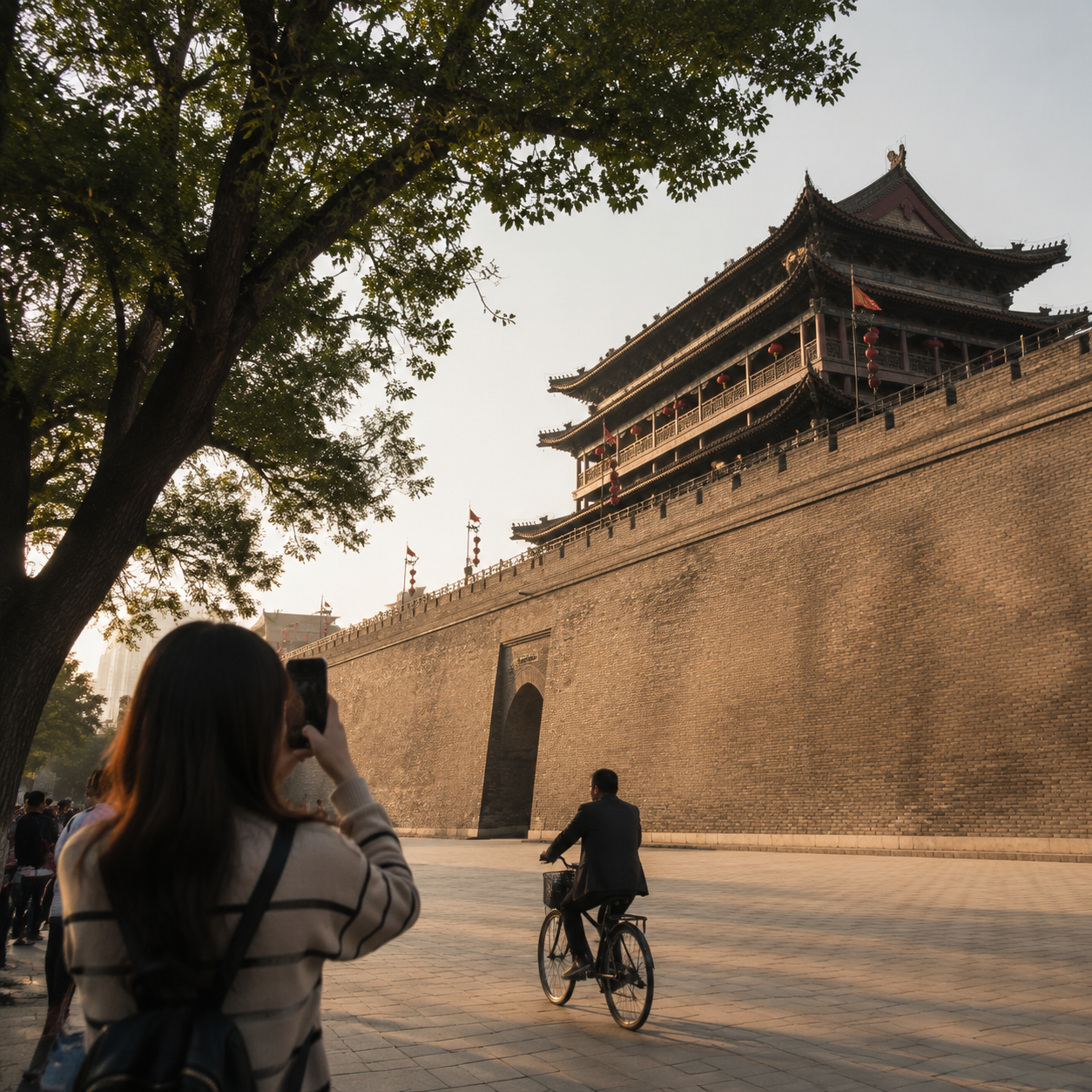
The weight of Xi’an City Wall comes not only from its height, width, and length, but from the slowness with which it holds time. Standing beneath it, you cannot finish seeing it at once. It refuses to be understood like an exhibit after one circle around it, and it refuses to explain itself like a paragraph on a sign. It simply lies there in silence, letting traffic pass through the gate opening, pedestrians emerge from shade, and pigeons pause on the eaves of the tower. It places the ancient and the everyday on the same street, without explanation and without hurry to prove anything.
我没有马上登城,而是沿着墙根往东走。清晨的护城河水面很安静,树叶把阳光筛成细碎的亮点,落在慢跑者的肩上。墙砖有些地方颜色深,有些地方颜色浅,像一段被反复翻阅的书页。偶尔能看见修补过的痕迹,新旧之间并不完全一致,却因此更真实。历史如果只剩完整无缺的表面,反而像被擦得太干净的玻璃,看得见形状,却看不见手温。
I did not climb the wall immediately, but walked east along its base. The moat was quiet in the morning, and leaves sifted sunlight into small bright flecks that fell on joggers’ shoulders. Some bricks were darker, some paler, like pages repeatedly turned in a book. Here and there, repairs were visible; old and new did not match perfectly, and that made the wall feel more real. If history kept only a flawless surface, it would resemble glass wiped too clean: shape visible, human warmth missing.
在城墙下走路,会不断遇见今天的生活。有人拎着早点从门洞里出来,塑料袋里冒着热气;有人把电动车停在阴凉处,低头回消息;有老人坐在河边石凳上,手里的蒲扇一下一下摇着。城墙并没有把他们变成背景,反而因为这些人而继续活着。所谓古都,不是把现代生活赶到远处,再把古迹单独摆出来,而是让旧砖和新脚步彼此承认。
Walking beneath the wall, you keep meeting the life of today. Someone carries breakfast out through the gate opening, steam rising inside a plastic bag. Someone parks an electric scooter in the shade and bends over a message. An old man sits on a stone bench by the moat, moving a palm-leaf fan again and again. The wall does not turn them into background; because of them, it remains alive. An ancient capital is not a place that pushes modern life away and displays relics separately. It lets old bricks and new footsteps acknowledge each other.
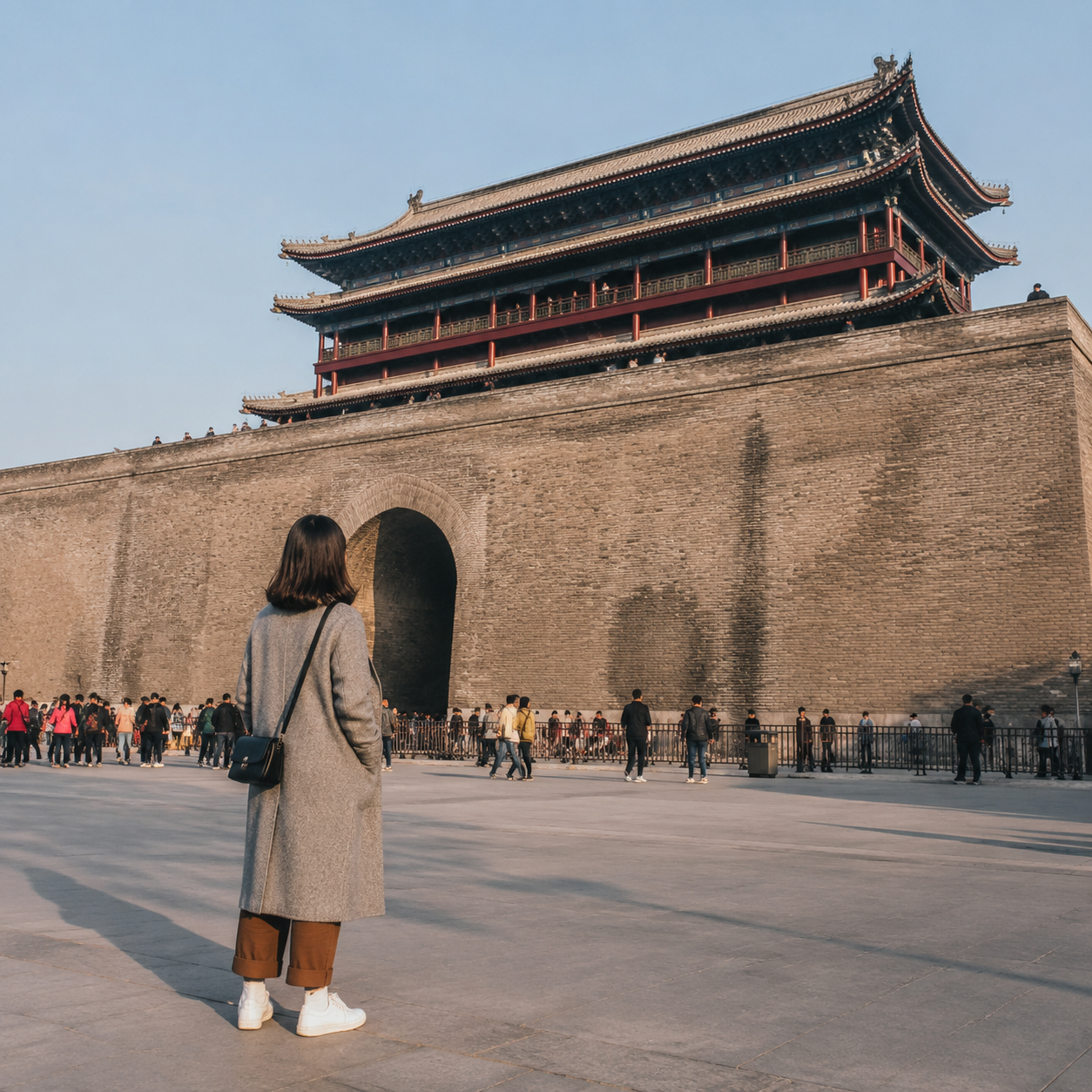
等我登上城墙,城市的声音变了。下面的车声被墙体挡住,变成低低的浪,风在垛口之间来回穿行。城墙上很宽,宽到足以让人忘记自己站在一条边界上。远处有高楼,有寺塔,有被阳光照亮的屋顶,也有尚未完全醒来的街巷。你会突然明白,城墙不是把城市关起来的线,它更像一条可以行走的记忆,把不同年代的西安轻轻缝在一起。
When I finally climbed onto the wall, the city’s sound changed. Traffic below was blocked by the body of the wall and became a low tide, while wind moved back and forth through the battlements. The top was wide enough to make me forget I was standing on a boundary. In the distance were high-rises, temple pagodas, sunlit roofs, and lanes not fully awake. You suddenly understand that the wall is not merely a line that encloses the city. It is a walkable memory, gently stitching different eras of Xi’an together.
我见过一些游客在城墙上走得很快。他们租了车,计算一圈需要多久,停在城楼前拍照,再继续向下一个点移动。这当然也是一种旅行方式,风从耳边过去,砖路在轮下发出轻响,城市被迅速展开。但我那天更想慢一点。每隔一段,我就停下来看看墙外和墙内的差别:一边是宽路和车流,一边是巷子和屋檐;一边声音明亮,一边声音含蓄。城墙像一条分界,却不是隔绝,而是提醒你城市有许多层。
I have seen visitors move quickly along the wall. They rent bicycles, calculate how long a full loop will take, stop before a tower for a photograph, and continue to the next point. That is also a way to travel: wind passing the ears, brick road sounding softly under wheels, the city unfolding fast. But that day I wanted to go more slowly. Every so often I stopped to compare inside and outside the wall: on one side broad roads and traffic, on the other lanes and eaves; on one side brighter noise, on the other more reserved sound. The wall seemed like a boundary, yet not a separation. It reminded me that a city has many layers.
历史场景最动人的地方,往往不是宏大的瞬间,而是细节让你相信过去真的有人生活过。垛口的阴影落在砖面上,像一格一格迟缓移动的时间;城楼的木门带着旧色,仿佛还记得许多手掌推过它;一只麻雀跳到墙沿,又很快飞走,把庄严的空间弄得轻了一点。这样的细节不会在匆忙里主动靠近你,只有当脚步慢下来,它们才从背景里浮出来。
The most moving part of a historical scene is often not a grand moment, but details that convince you people truly lived in the past. Shadows of battlements fall on the bricks like slow-moving squares of time. The wooden doors of the tower carry an old color, as if remembering many palms that once pushed them. A sparrow hops onto the wall edge and quickly flies away, making the solemn space a little lighter. Such details do not approach you in haste. Only when your steps slow do they rise from the background.
我在一处角楼附近遇到一位父亲给孩子讲城墙。他没有讲太多朝代和年份,只是指着墙体说:“你看,它这么厚,是因为以前要保护里面的人。”孩子摸了摸砖,又问:“那现在还保护吗?”父亲想了想,说:“现在保护我们记得。”这句话很简单,却比很多讲解更接近我当时的感受。城墙今天不再以同样的方式抵御兵马,但它仍然抵御遗忘。
Near a corner tower, I met a father explaining the wall to his child. He did not recite many dynasties or dates. He pointed at the body of the wall and said, “Look, it is this thick because it once protected the people inside.” The child touched a brick and asked, “Does it still protect now?” The father thought for a moment and said, “Now it protects our remembering.” The sentence was simple, yet closer to my feeling than many formal explanations. The wall no longer resists armies in the same way, but it still resists forgetting.
这也是我喜欢西安的原因。它不会只用遗址和博物馆告诉你自己古老,它会在一碗热汤、一段城门洞的回声、一块被雨水磨亮的石阶里提醒你:过去并没有彻底离开,只是换了方式留在今天。你如果走得太快,就只能看见“著名”;你如果慢下来,就能看见“相连”。照片记录的是你站在这里,缓慢记录的则是这里怎样进入你。
This is also why I like Xi’an. It does not tell you it is ancient only through ruins and museums. It reminds you through a bowl of hot soup, the echo inside a gate passage, and a stone step polished by rain that the past has not completely left; it has only found another way to remain in the present. If you move too fast, you see only what is famous. If you slow down, you see what is connected. A photograph records that you stood here; slowness records how this place entered you.
下城墙时,太阳已经高了,游客比早晨多,城门口重新热闹起来。有人整理帽子,有人排队买票,有人对着城楼比出手势。那种热闹并没有破坏我的心情,反而让我觉得城墙完成了一次转换:它清晨像一部低声翻开的史书,午前又像城市广场的一部分。历史如果只能安静地被观看,未免太脆弱;它能承受喧闹,能和日常并肩,才说明它真的扎根在这里。
When I came down from the wall, the sun was higher, visitors had increased, and the gate area was lively again. Some adjusted hats, some lined up for tickets, and some posed with gestures before the tower. That liveliness did not spoil my mood. Instead, it made me feel the wall had completed a transformation: in the morning it was like a history book opened in a low voice, and before noon it became part of the city square. If history could only be watched in silence, it would be too fragile. Its ability to endure noise and stand beside daily life proves that it is truly rooted here.
离开前,我回头看了一眼城楼。手机里当然也有照片,可我知道真正留下来的不是那几张画面,而是砖面粗糙的触感、门洞里忽然变凉的风、孩子问出的那个问题,以及我在墙上一次又一次放慢脚步的决定。西安城墙教人的不是如何把历史装进相册,而是如何让自己在历史面前恢复耐心。走慢一点,时间才会从景点里走出来,站到你身边。
Before leaving, I looked back at the gate tower. Of course there were photographs on my phone, but I knew what truly remained was not those images. It was the rough feel of brick, the sudden coolness of wind inside the gate passage, the child’s question, and my repeated decision to slow my steps on the wall. Xi’an City Wall does not teach you how to place history into an album. It teaches you how to recover patience before history. Walk a little slower, and time will step out of the attraction and stand beside you.
- 沈阳的雨刚收住,街边烧烤味就把傍晚重新点亮了 | As Shenyang’s Rain Let Up, the Smell of Street Barbecue Lit the Evening Again
- 一块豆腐的两千年旅程 | A Block of Tofu's Two-Thousand-Year Journey
- 我如何在中国换城时给自己留出不慌张的缓冲 | How I Build Calm Buffers When Changing Cities in China
- 苏州运河边的一碗早面 | A Morning Bowl Beside a Suzhou Canal
- 中国时区与营业时间指南 | China Time Zones and Business Hours
- 海河风正冷的时候,一家小馆先把我的天津安顿下来了 | On a Cold Haihe Evening, a Small Eatery Settled Me into Tianjin
- 我在杭州把西湖走成一天慢电影:从晨雾到夜船都不赶 | I Turned West Lake into a Slow Day Film from Morning Mist to Night Boat
- 签证与入境要求 | Visa and Entry Requirements
- 中国签证申请全流程 | Complete China Visa Application Guide
- 中国书法用品 | Chinese Calligraphy Supplies
Comments (0)