
夜市烧烤摊的烟火气,教我别只找网红餐厅 | Smoke from a Night Grill Taught Me Not to Only Chase Viral Restaurants
夜市烧烤摊的烟火气,教我别只找网红餐厅 | Smoke from a Night Grill Taught Me Not to Only Chase Viral Restaurants
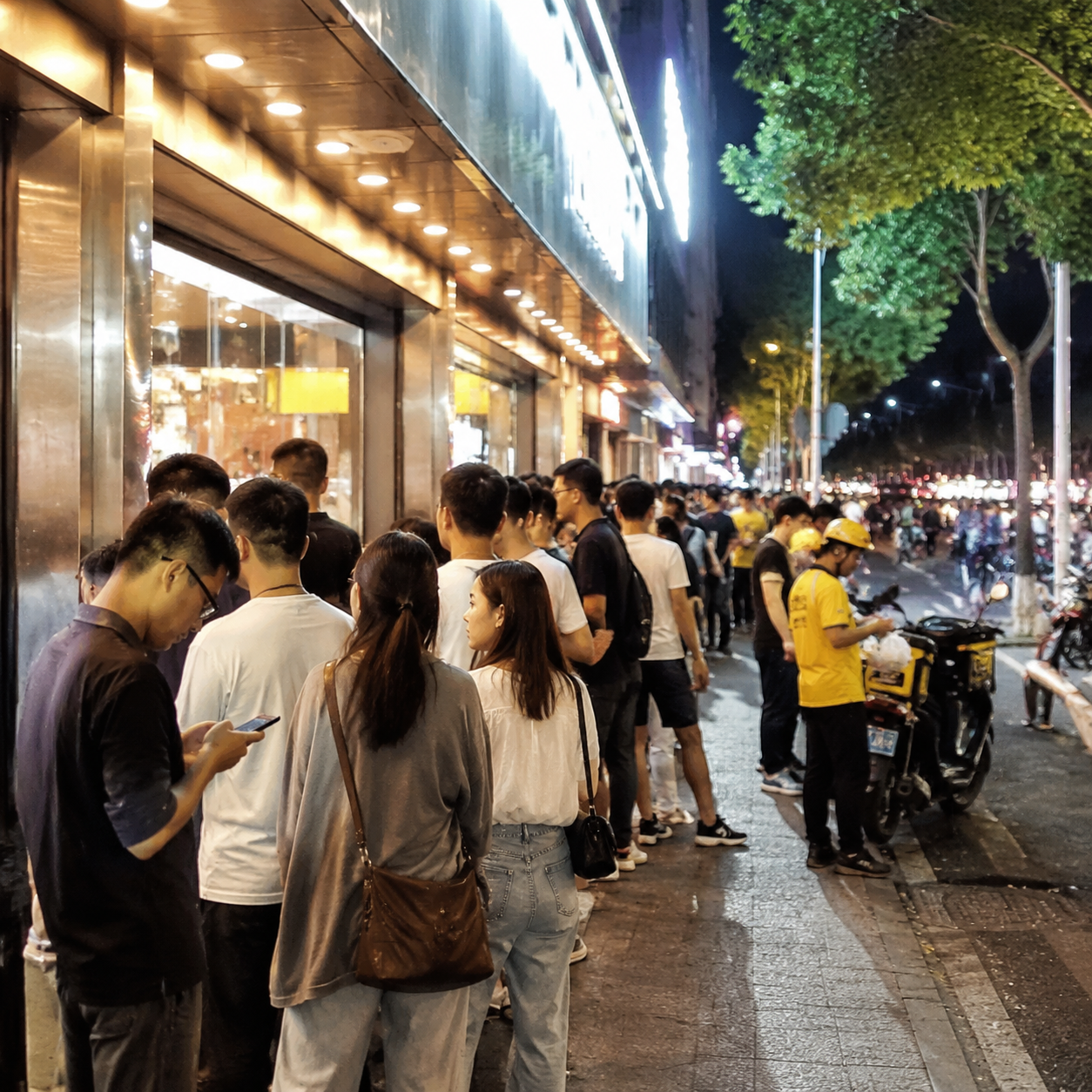
到那座北方城市的第二个晚上,我本来已经把晚饭安排得很清楚。手机收藏夹里有三家餐厅,都是短视频里反复出现的名字:一家门口有巨大的招牌,一家号称本地人也排队,还有一家每个博主都说“必吃”。我按照地图走到第一家,队伍已经从店门口弯到路边,排队的人举着号码牌,外卖骑手在旁边进进出出。空气里当然有香味,可那种香味被灯牌、喊号声和拍照的人群挤得很紧。我站了十分钟,忽然发现自己并不是特别饿那家店的菜,我只是害怕错过一个被很多人证明过的答案。
On my second evening in that northern city, I thought dinner had already been arranged. I had saved three restaurants on my phone, all names repeated again and again in short videos: one with a huge sign, one said to be popular even with locals, and one that every blogger called a “must eat.” I followed the map to the first place, and the line had already bent from the door to the roadside. People held number tickets, delivery riders moved in and out beside them, and of course there was fragrance in the air. But the fragrance felt squeezed between neon signs, number calls, and people taking photos. After standing there for ten minutes, I suddenly realized I was not especially hungry for that restaurant’s food. I was only afraid of missing an answer that many others had already approved.
和我同行的是公司里的一位本地同事,姓周。他见我盯着手机上的收藏列表来回滑动,没有马上说“别排了”,只是问我:“你今晚想吃饭,还是想完成任务?”这个问题把我问住了。我当然想吃饭,可我的动作确实像在完成任务:打卡、排队、拍照、确认自己来过。周同事笑了笑,说如果我不介意走一段路,他可以带我去一条没有那么出名的街,那里没有夸张的店名,也不保证每一家都好吃,但只要鼻子还灵,就不会太差。
My companion that evening was a local colleague from the company, surnamed Zhou. When he saw me sliding back and forth through my saved list, he did not immediately say, “Don’t line up.” He only asked, “Do you want to eat dinner tonight, or do you want to finish an assignment?” The question stopped me. Of course I wanted dinner, but my movements really did look like completing an assignment: check in, line up, take photos, confirm that I had been there. Zhou smiled and said that if I did not mind walking a bit, he could take me to a street that was not so famous. It did not have dramatic shop names, and he could not promise every stall was delicious, but as long as my nose still worked, it would not go too wrong.
我们离开主路,拐进一条被树影遮住的支路。白天这里大概只是普通街区,到了夜里却像慢慢打开的厨房。先出现的是烟,灰白色,从几处炭炉上低低地飘出来,被晚风推到路灯下面;然后是声音,铁签碰到铁盘的脆响,啤酒瓶盖被撬开的轻响,摊主喊“好了”的短促声音;最后才是人,几张塑料桌摆在人行道边,矮凳颜色不一样,有红的、蓝的、褪成粉色的。没有人把这里布置成景点,可它比刚才那条长队更像晚饭应该发生的地方。
We left the main road and turned into a side street shaded by trees. In the daytime it was probably just an ordinary neighborhood, but at night it opened slowly like a kitchen. First came the smoke, gray-white, drifting low from several charcoal grills and pushed by the evening wind under the streetlights. Then came sound: metal skewers tapping against trays, beer caps being pried open, vendors calling “ready” in short bursts. Only after that did the people come into focus. Plastic tables stood along the sidewalk, and low stools came in mismatched colors: red, blue, and faded pink. No one had arranged the place as an attraction, yet it felt far more like where dinner should happen than the long line we had just left.
第一家烧烤摊前,我又犯了游客的老毛病,想问“哪一个最好吃”。摊主是个中年男人,手上戴着厚手套,正把一排羊肉串翻过来。他没有直接回答最好吃什么,而是反问我能不能吃辣、吃不吃肥肉、今天想喝不喝啤酒。周同事在旁边补了一句,说别一上来就问招牌,先让老板知道你的口味。摊主点点头,说羊肉串要趁热,鸡胗要嚼劲,烤韭菜容易吸油,烤馒头片适合最后垫一下肚子。那一刻我才明白,真正会点烧烤的人不是把菜单背下来,而是会把自己的胃口说清楚。
At the first grill stall, I made the old tourist mistake again and wanted to ask, “What is the best thing here?” The vendor was a middle-aged man wearing thick gloves, turning a row of lamb skewers. He did not answer directly. Instead, he asked whether I could handle spice, whether I ate fatty meat, and whether I wanted beer that evening. Zhou added from the side that I should not begin by asking for the signature item; I should first let the owner know my taste. The vendor nodded and said lamb skewers should be eaten hot, chicken gizzards were for chewiness, grilled chives absorbed oil easily, and toasted mantou slices were good at the end to settle the stomach. In that moment I understood that people who truly know how to order barbecue are not those who memorize the menu, but those who can explain their appetite clearly.
我们没有坐进室内,而是在路边找了两张塑料凳。凳子很矮,我一坐下,膝盖几乎顶到桌沿,背包只能放在两脚中间。桌面刚擦过,边角还有一点油光,纸巾盒被风吹得轻轻动。起初我有点不自在,总觉得自己坐得不够体面。周同事却说,烧烤摊的舒服不在椅背,而在距离:离火近一点,可以看见食物怎么熟;离老板近一点,可以听见什么时候该拿;离同桌近一点,说话不用端着。旅行里有些地方不是让你保持漂亮姿势的,而是让你把身体放低,和城市坐到同一个高度。
We did not sit indoors. Instead, we found two plastic stools by the roadside. The stools were low, and once I sat down my knees almost touched the table edge, while my backpack could only fit between my feet. The tabletop had just been wiped, but a little oil still shone at the corners, and the tissue box moved lightly in the wind. At first I felt awkward, as if I was not sitting in a sufficiently proper way. Zhou said the comfort of a grill stall was not in the chair back, but in the distance: close enough to the fire to see how food cooks, close enough to the vendor to hear when to pick things up, close enough to your tablemates that conversation does not need to be formal. Some places in travel are not meant to keep your posture elegant. They ask you to lower your body and sit at the same height as the city.
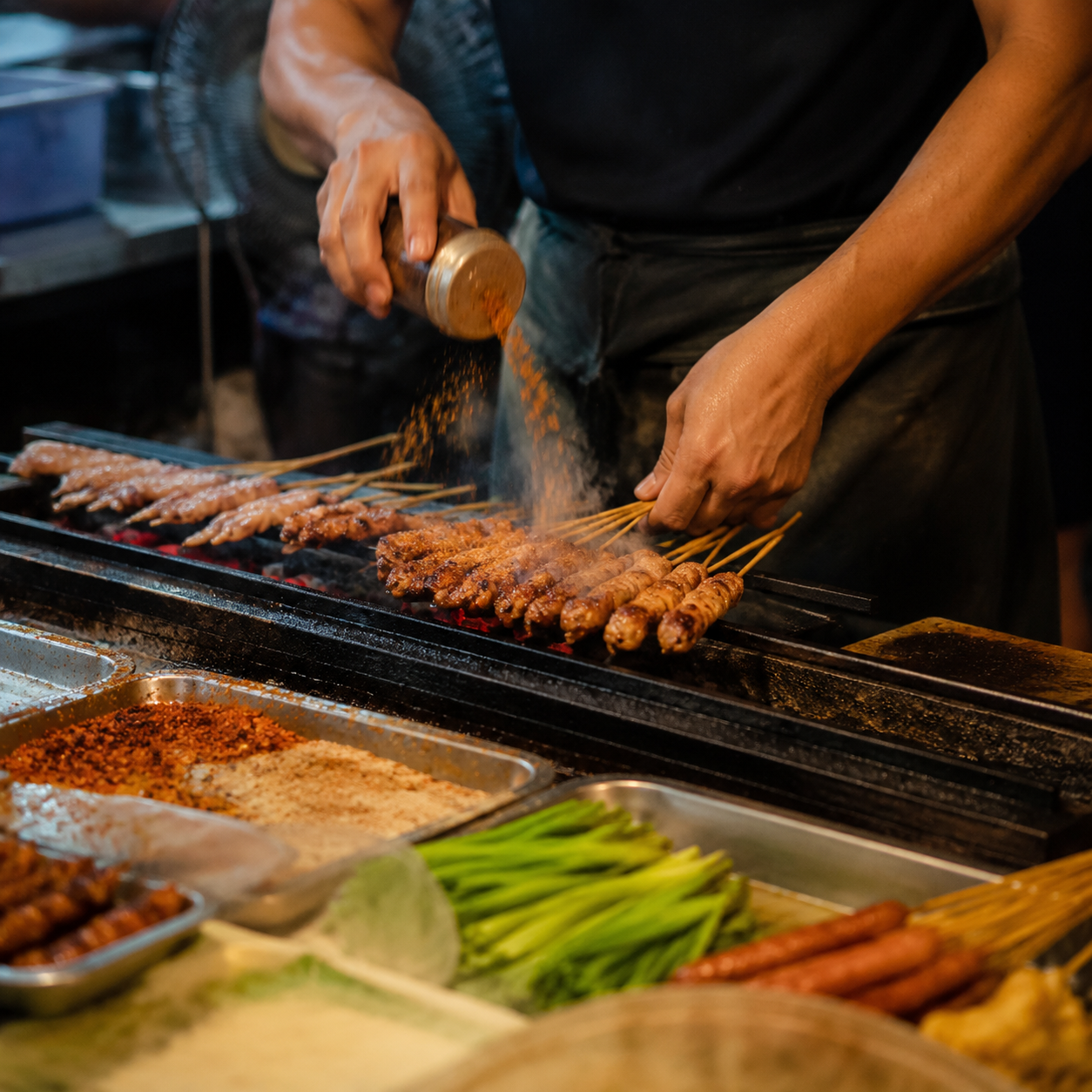
点菜的节奏也和餐厅不一样。不是一次把所有菜交给厨房,然后坐着等,而是先点一小把,吃着看着,再决定要不要加。摊主把我们的羊肉、鸡翅、土豆片和青椒分别放到不同位置,火大的地方烤肉,边上的位置慢慢烤蔬菜。他一边撒盐和孜然,一边提醒我别催,火候急不得。旁边一桌年轻人吃到一半,又伸手喊:“老板,再加十串。”他们的语气很自然,好像这顿饭本来就是一段一段续出来的。周同事说,夜宵摊最怕一上来点太多,冷了不好吃,也容易浪费;慢慢加,才跟得上火和胃。
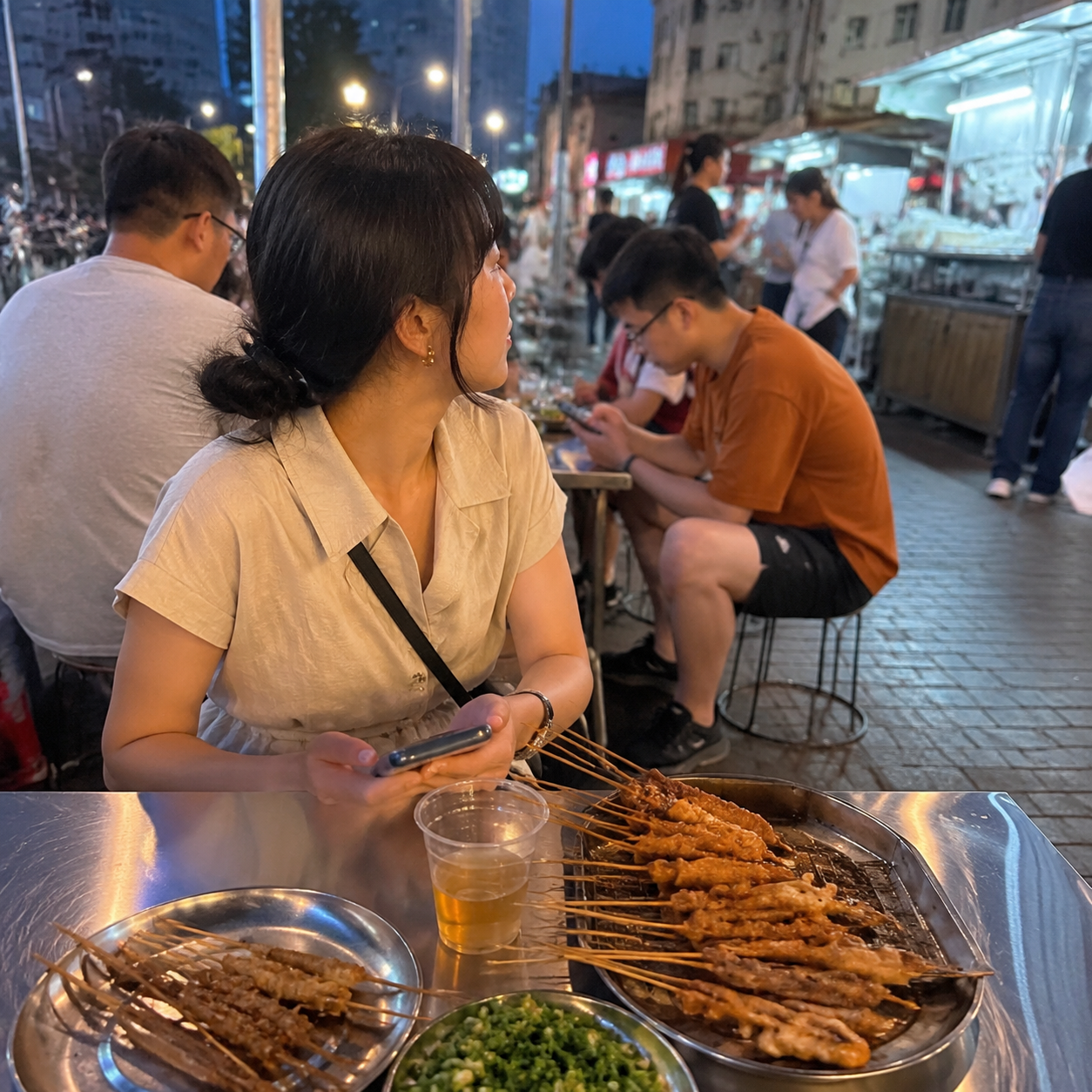
The ordering rhythm was different from a restaurant too. You did not hand over the entire meal to the kitchen at once and then sit waiting. You ordered a small handful first, ate while watching, and then decided whether to add more. The vendor placed our lamb, chicken wings, potato slices, and green peppers in different spots: meat over stronger heat, vegetables slowly grilling near the side. As he scattered salt and cumin, he reminded me not to rush him; heat cannot be hurried. At a nearby table, a group of young people halfway through eating called out, “Boss, ten more skewers.” Their tone was natural, as if the meal was meant to be extended section by section. Zhou said the worst thing at a late-night grill was ordering too much at the beginning. Food cools, taste drops, and waste becomes easy. Adding slowly keeps pace with both the fire and the stomach.
第一串羊肉递到我手上时,油还在签子上微微冒泡。我急着咬,摊主立刻说:“烫,吹一下。”那不是客套提醒,而是很实在的保护。我把串拿远一点,看见肉边被烤出焦色,肥的部分透明发亮,孜然粒贴在表面。咬下去时,外面有一点脆,里面还保留着汁水,辣椒面先到,随后是炭火的香。它并不比我收藏夹里的名店更精致,但它更准确地回答了当晚的饥饿:风吹着,火亮着,人坐在路边,食物从火上下来,几秒钟后就进嘴里。
When the first lamb skewer reached my hand, oil was still bubbling slightly along the metal stick. I was eager to bite, and the vendor immediately said, “Hot, blow on it first.” It was not polite filler; it was practical protection. I held the skewer a little farther away and saw the meat edges charred, the fatty parts clear and shiny, and cumin seeds clinging to the surface. When I bit down, the outside was slightly crisp while the inside still held juice. Chili powder arrived first, followed by the fragrance of charcoal. It was not more refined than the famous shops saved in my phone, but it answered that evening’s hunger more precisely: wind moving, fire glowing, people sitting roadside, food leaving the heat and entering the mouth a few seconds later.
吃了几串以后,我开始理解“跟着烟走”并不等于盲目。周同事让我看几个细节:炭火是不是稳定,食材是不是分开放,生熟签子有没有混在一起,摊主收钱和拿食物的手有没有简单区分,桌边垃圾有没有及时清理。他说这些不是挑剔,而是常识。一个摊位可以朴素,可以没有漂亮招牌,但不能让人觉得混乱到无法判断。旅行里所谓安全感,有时不是找最贵的店,而是看见对方做事有顺序,自己也不把基本警惕丢掉。
After a few skewers, I began to understand that “following the smoke” did not mean being blind. Zhou asked me to watch several details: whether the charcoal heat was steady, whether ingredients were separated, whether raw and cooked skewers were mixed, whether the vendor roughly distinguished between the hand used for money and the hand used for food, and whether trash near the tables was cleared in time. He said this was not fussiness, but common sense. A stall could be plain and have no beautiful sign, but it should not feel so chaotic that judgment becomes impossible. In travel, safety sometimes does not mean choosing the most expensive place. It means seeing that the other person has a working order, while you do not throw away basic caution.
付款时也有细节。摊主的二维码贴在调料盒旁边,边缘被油烟熏得有点卷。我拿出手机,周同事提醒我先确认摊名和金额,不要在人最多的地方长时间亮着付款页面。付完以后,摊主那边响起提示音,我也看了一眼账单。整个动作不到半分钟,却让我安心很多。周同事说,夜市里大多数人只是来吃东西、做生意、下班放松,不需要紧张兮兮;但护照不要放在外套口袋,手机不要随手搁桌角,背包拉链朝向自己,这些小事做了就不用一直担心。
Payment had its own details too. The vendor’s QR code was pasted beside the seasoning box, its edges slightly curled from oil smoke. I took out my phone, and Zhou reminded me to confirm the stall name and amount first, and not to keep the payment screen shining for a long time in the busiest spot. After I paid, the vendor’s device made a confirmation sound, and I glanced at my bill as well. The whole action took less than half a minute, but it made me feel much calmer. Zhou said most people in a night market are simply eating, doing business, or relaxing after work, so there is no need to be tense. But do not put your passport in an outer coat pocket, do not leave your phone casually on the table corner, and keep your backpack zipper facing you. When these small things are done, you do not have to worry constantly.
第二轮我们加了烤茄子和馒头片。茄子被剖开后铺上蒜蓉,油和汁水在锡纸里咕嘟作响;馒头片边缘烤得金黄,撒一点辣椒和孜然,吃起来像把主食也变成了夜晚的一部分。我旁边坐着一位刚下班的阿姨,她看我用筷子笨拙地夹茄子,笑着提醒我可以先从边上拨开,不要一整块往嘴里送。她不是导游,也不是服务员,只是一个同在桌边吃夜宵的人。那句提醒比任何攻略都具体,因为它来自同一张油光闪闪的桌面。
For the second round, we added grilled eggplant and mantou slices. The eggplant was split open and covered with minced garlic, oil and juices bubbling inside the foil. The mantou slices had golden edges, scattered with a little chili and cumin, making even the staple food feel like part of the night. Beside me sat an auntie who had just finished work. Seeing me clumsily use chopsticks to pick up the eggplant, she smiled and reminded me to separate it from the edge first instead of trying to put a whole piece into my mouth. She was not a guide and not a server, just another person eating a late snack at the table. That reminder was more concrete than any travel guide because it came from the same oil-shiny tabletop.
我原本担心自己听不懂摊位上的秩序,后来发现很多秩序不完全靠语言。谁先到、谁后加、谁已经付过钱,摊主心里大多有数;熟客会在火边短暂停一下,但不会挡住出餐口;等串的人会站到旁边,让出扫码的位置;吃完的人把签子放到同一个盘里,老板一眼就能估算数量。这个节奏不是安静的,却很清楚。它有喊声、有催促、有笑骂,也有一种大家都懂的分寸。作为外来者,我只要先慢半拍,看清楚再动作,就能少添很多乱。
I had worried that I would not understand the order of the stall, but later I found that much of the order did not depend entirely on language. The vendor usually knew who arrived first, who added more later, and who had already paid. Regular customers might pause briefly near the fire, but they did not block the pickup area. People waiting for skewers stood to the side, leaving space for scanning the payment code. Those who finished eating placed their sticks on the same plate, allowing the owner to estimate the number at a glance. This rhythm was not quiet, but it was clear. It had shouting, urging, teasing complaints, and a shared sense of measure. As an outsider, if I simply slowed down half a beat, watched first, and moved afterward, I created much less confusion.
那天晚上我没有再去找收藏夹里的第二家和第三家。并不是因为网红餐厅不好,也不是因为排队一定不值得。有些店能火,确实有它的道理;有些长队,背后也是真本事。但如果每一餐都只交给榜单,我就会把自己的判断力越用越少。中国城市的夜晚给人的信息太丰富了:哪条巷子灯亮,哪口炉子烟稳,哪张桌子翻台快,哪位老板忙而不乱,哪群客人吃得踏实。这些信息不会整齐地出现在攻略里,却会在你愿意停下来时,一点一点露出来。
That night I did not go looking for the second and third restaurants in my saved list. Not because viral restaurants are bad, and not because lines are always worthless. Some places become popular for real reasons; some long queues are backed by real skill. But if I hand every meal over to rankings, I use my own judgment less and less. A Chinese city at night offers too much information to ignore: which lane is lit, which grill has steady smoke, which table turns over quickly, which owner is busy but not messy, and which group of customers eats with relaxed confidence. These clues do not appear neatly in travel guides, but if you are willing to stop, they reveal themselves little by little.
回酒店的路上,我的外套沾了一层很轻的烧烤味。电梯里有一瞬间我还觉得不好意思,怕别人闻到。可进房间以后,那味道反而让我想起火边的画面:摊主翻动铁签时手腕的动作,周同事提醒我先点少一点的语气,阿姨教我吃茄子时的笑,塑料凳因为路面不平而轻轻晃动。旅行中很多记忆不是靠漂亮照片留下的,而是靠这种不太干净、不太整齐、却很真实的气味。它证明我那晚不是隔着屏幕选择城市,而是真的坐进了城市的烟火里。
On the walk back to the hotel, my jacket carried a light layer of barbecue smell. For a moment in the elevator I even felt embarrassed, afraid others would notice it. But after entering my room, that smell instead brought back the scene beside the fire: the vendor’s wrist turning metal skewers, Zhou’s tone when he reminded me to order a little first, the auntie’s smile when she taught me how to eat the eggplant, and the plastic stool wobbling slightly because the pavement was uneven. Many travel memories are not preserved by beautiful photos, but by smells like this: not very clean, not very orderly, yet completely real. It proved that I had not chosen the city through a screen that night. I had truly sat inside its smoke and daily warmth.
后来我把那三家收藏的网红餐厅删掉了两家,只留下最想试的一家,准备第二天中午去。这个改变很小,却让我轻松很多。我不再把热门推荐当作命令,而把它们当作可能性;不再把本地人的一句提醒当作神秘秘诀,而当作现场判断的一部分;不再觉得安全和冒险是相反的。真正好的旅行常常在两者之间:既愿意走向一股让你停步的烟,也知道看火、看人、看路;既愿意坐上矮凳,也记得管好手机和包。
Later I deleted two of the three viral restaurants from my saved list and kept only the one I truly wanted to try for lunch the next day. The change was small, but it made me much lighter. I stopped treating popular recommendations as commands and began treating them as possibilities. I stopped treating a local person’s reminder as a mysterious secret and began seeing it as part of on-site judgment. I also stopped thinking safety and adventure were opposites. Good travel often lives between them: willing to walk toward a stream of smoke that makes you pause, yet still watching the fire, the people, and the road; willing to sit on a low stool, yet still remembering your phone and bag.
如果有人问我在中国夜市吃烧烤最重要的经验是什么,我不会先说哪种肉最好吃,也不会给出一串固定店名。我会说,先别急着把手机里的答案执行完。站到不挡路的位置,闻一闻烟,看看火,听听老板和客人怎么配合;先少点,热着吃,喜欢再加;不懂就把口味说清楚,请本地朋友或摊主帮你判断;付款和随身物品保持基本小心,但不要把每个人都想成麻烦。那晚的烟火气教我的,正是这种朴素的平衡:不要只追逐被算法推到眼前的热闹,也不要假装自己比攻略聪明太多。带着好奇心走近,带着常识坐下,一座城市的夜晚就会慢慢把真正的味道递到你手里。
If someone asks me what the most important lesson is when eating grill food in a Chinese night market, I will not begin by naming the best meat or listing fixed stall names. I will say: do not rush to execute every answer saved in your phone. Stand somewhere that does not block the way, smell the smoke, watch the fire, and listen to how the owner and customers cooperate. Order a little first, eat it hot, and add more if you like it. If you do not understand, explain your taste clearly and let a local friend or the vendor help you judge. Stay basically careful with payment and belongings, but do not turn every person into a potential problem. What the smoke and fire taught me that night was this plain balance: do not only chase the excitement pushed in front of you by algorithms, and do not pretend you are much smarter than guides either. Walk closer with curiosity, sit down with common sense, and the night of a city will slowly place its real flavor into your hands.

- 我们班来了一个新同学,他把“可以”说成“可乐”之后,大家反而更快熟起来了 | When the New Kid in Class Said “Cola” Instead of “Okay,” Everyone Somehow Became Friends Faster
- 春节期间最值得去的古镇 | Best Ancient Towns to Visit During Spring Festival
- 我在中国小区楼下听懂收废品吆喝后,第一次不再把它当噪音 | After I Learned to Understand the Scrap Collector’s Call Below My Chinese Apartment, I Stopped Hearing It as Noise for the First Time
- 苏州园林不是用来赶场的,我在一扇漏窗前停了十分钟 | Suzhou Gardens Are Not for Rushing; I Stopped Ten Minutes Before One Lattice Window
- 到了郑州才明白,一顿不必介绍来历的晚饭也能让人放松下来 | In Zhengzhou, I Learned That an Unpretentious Dinner Can Let the Body Unclench
- 成都出发的周末逃离:三条路线,三种节奏 | Weekend Escapes from Chengdu: Three Routes, Three Rhythms
- 我在中国学会求助,不是因为无助,而是因为这里的回应速度太真诚 | I Learned to Ask for Help in China Not Because I Was Helpless, but Because People Responded So Honestly
- 微信与支付宝双钱包搭配策略 | Using WeChat Pay and Alipay Together
- 在地铁口停好共享单车那一刻,我才明白锁车并不等于结束 | The Moment I Properly Parked a Shared Bike Outside the Metro, I Understood That Locking It Is Not the End
- 呼和浩特被雨洗亮以后,连烧麦店门口的白雾都值得慢慢看 | After Rain Brightened Hohhot, Even the Steam Outside a Shaomai Shop Was Worth Slowing For
Comments (0)