
外国人第一次夜游中国城市的安全感 | The Sense of Safety I Felt on My First Night Walk in a Chinese City
外国人第一次夜游中国城市的安全感 | The Sense of Safety I Felt on My First Night Walk in a Chinese City
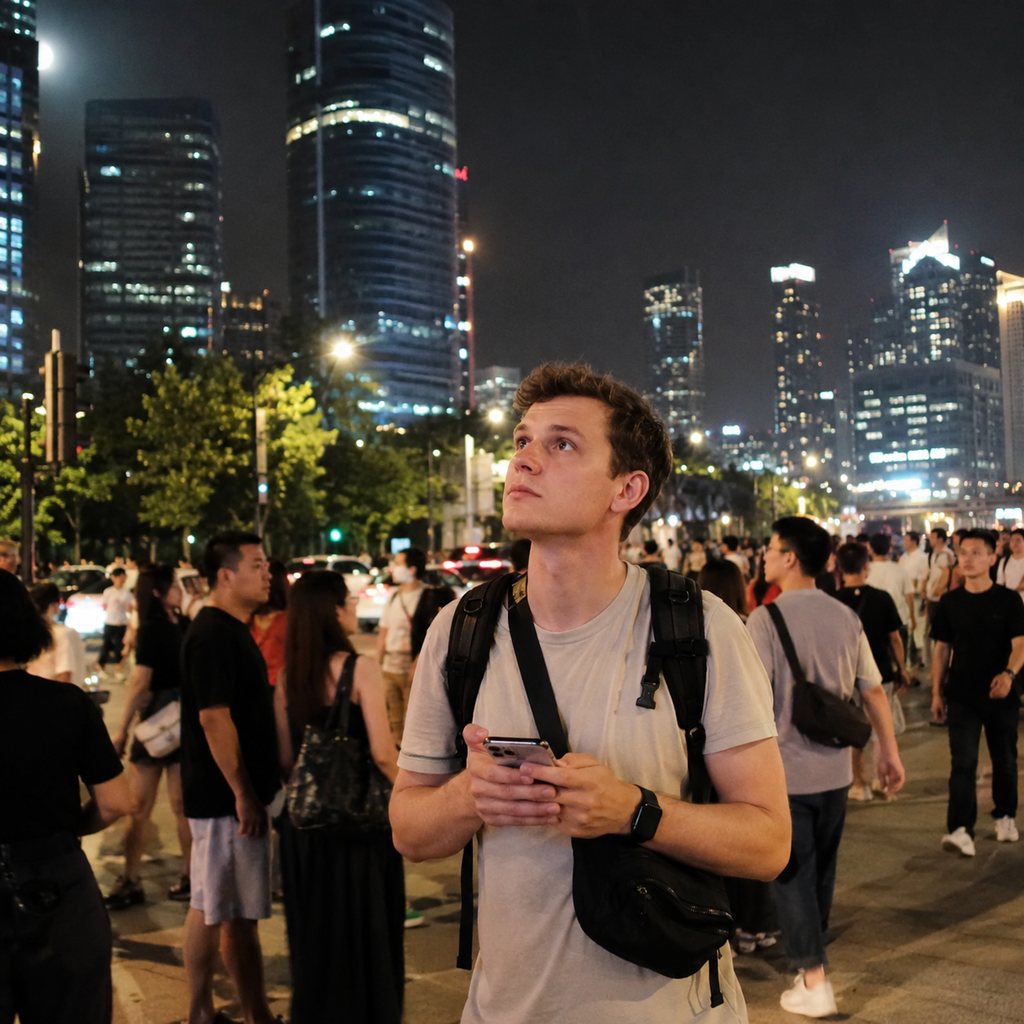
那天夜里,我从酒店大堂走出来时,手机显示九点四十七分。城市白天的热气还没有完全散开,玻璃门后面的冷气像一层薄薄的水,被我留在身后。门口不是想象中的空街,而是一条还在慢慢呼吸的路:路灯把梧桐叶照成浅绿色,非机动车道上有外卖骑手压低速度经过,路边的便利店亮着白色灯箱,收银台旁边的热柜冒着一点水汽。我原本只打算走到路口看看,可脚步很自然地往前挪,像是在试探这座城市夜晚的边界。
When I stepped out of the hotel lobby that night, my phone showed 9:47 p.m. The heat of the day had not completely left the pavement, and the cool air behind the glass doors felt like a thin sheet of water I had just walked through. Outside, the street was not empty in the way I had imagined. It was still breathing slowly: plane trees under pale green streetlights, delivery riders gliding past in the bike lane, a convenience store glowing at the corner, steam fogging the glass of a hot-food cabinet near the cashier. I had meant only to walk to the intersection and look around, but my feet kept moving, as if I were quietly testing the night limits of the city.
最先让我放松的不是某个宏大的印象,而是细节的密度。人行道并不宽,石砖有几处被树根顶起,走路需要稍微低头;可每隔几十米就有一盏灯,灯和灯之间没有特别黑的空档。公交站牌下面还有两个人在等车,一个中年男人看着短视频,一个年轻女孩把耳机摘下一边,低头回消息。街口的小卖部外面摆着塑料凳,老板正在把一箱矿泉水搬进店里。他看见我停在门口研究地图,只是抬眼点了一下头,没有招呼,也没有盯着看。这种不被打扰的普通感,反而比热情欢迎更让我觉得踏实。
What calmed me first was not any grand impression but the density of small details. The sidewalk was not wide, and several tiles had been lifted by tree roots, so I had to look down from time to time. Yet every few dozen meters there was another light, and there were no deep dark gaps between them. Two people were waiting under a bus sign: a middle-aged man watching short videos, a young woman with one earbud removed as she replied to a message. Outside a tiny shop, the owner was carrying a case of bottled water inside. When he saw me pause at the doorway to check my map, he only nodded once, neither calling me in nor staring. That ordinary feeling of not being interrupted made me feel steadier than any warm welcome would have.
我沿着主路往北走,左手边是几栋住宅楼,阳台上有衣服还没收,偶尔能听见碗筷碰到水槽的声音。右手边是一排小店:药房、面馆、手机维修、洗衣店。面馆已经过了晚饭高峰,桌上只剩一个人慢慢喝汤;药房门口的电子屏滚动着温度和湿度;洗衣店里有一台烘干机还在转。夜晚没有把生活收起来,它只是把节奏调低了一档。对一个第一次独自走在这里的外国人来说,这种还在运行的日常,像一条不显眼的扶手。
I walked north along the main road. On my left were apartment buildings with laundry still hanging from balconies, and now and then I could hear dishes tapping against a sink. On my right was a row of small businesses: a pharmacy, a noodle shop, a phone repair counter, a laundry. The noodle shop had passed its dinner rush, with only one customer slowly drinking soup. The pharmacy’s electronic sign kept scrolling temperature and humidity. A dryer was still turning inside the laundry. The night had not packed daily life away; it had only lowered the tempo. For a foreigner walking alone there for the first time, that continuing routine felt like an unobtrusive handrail.
我进便利店买水,真正的安全感又换了一种形状。店里有两个学生在挑冰淇淋,一个穿工装的外卖员把头盔放在胳膊弯里,正在等微波炉里的饭。收银员问我要不要袋子,我没听清,她就用手指了指袋子,又指了指我的水瓶,笑了一下。我扫码付款的动作很慢,后面的人没有催,只是把自己的东西放在柜台边缘。冷柜的门关上时发出轻轻的吸合声,店门口的感应铃响了一次又一次。这里没有戏剧性的保护,只有流程清楚、灯光明亮、每个人都知道自己下一步要做什么。
I went into the convenience store for water, and the sense of safety changed shape again. Two students were choosing ice cream. A delivery worker in a uniform held his helmet in the crook of his arm while waiting for a meal in the microwave. The cashier asked whether I wanted a bag; when I failed to catch the sentence, she pointed to the bag, then to my bottle, and smiled. I paid by scanning a code slowly, and the person behind me did not rush me. He simply placed his items near the edge of the counter. The refrigerator door closed with a soft suction sound, and the sensor bell at the entrance kept ringing. There was no dramatic protection here, only clear procedure, bright light, and people who knew what they were doing next.
离开便利店后,我没有立刻回酒店,而是拐进一条更窄的支路。主路的车声被楼房挡住,空气里有桂花、烧烤炭火和雨后泥土混在一起的味道。支路并不空,路边停着共享单车,几只猫从电动车下面钻出来,又像对我完全没兴趣似的消失在绿化带里。一个老人牵着小狗慢慢走,狗在每棵树前都停一下。两个女孩从我身后超过去,其中一个手里提着奶茶,另一个把手机贴在耳边说:“我到楼下了。”这句话很短,却把夜路变成了许多人回家的最后一段。
After leaving the store, I did not return to the hotel immediately. I turned into a narrower side street. The noise of the main road was blocked by apartment buildings, and the air smelled of osmanthus, barbecue charcoal, and damp soil after rain. The street was not empty. Shared bikes stood along the curb; a few cats slipped out from under electric scooters and disappeared into the shrubs as if I were of no concern. An older man walked a small dog that stopped at every tree. Two young women passed me from behind, one carrying milk tea, the other pressing a phone to her ear and saying, “I’m downstairs.” The sentence was brief, but it turned the night road into the final stretch of many people’s journey home.
在别的城市,我夜里独行时常常会提前规划撤退路线:哪里能叫车,哪家店还开着,哪条街看起来不要走。那晚我也保留着这种习惯,但它没有一直占据我的脑子。我注意到地铁口的标志在远处发光,注意到路口有治安岗亭,注意到路边有摄像头,也注意到这些东西并没有让街道变得紧张。它们像背景里的基础设施,不需要被反复说明,却让一个陌生人知道,自己并不是走在完全无人照看的地方。
In other cities, when I walked alone at night, I often planned my exits in advance: where I could call a car, which shop would still be open, which street looked best avoided. I kept that habit that night too, but it did not occupy my mind the whole time. I noticed the metro sign glowing in the distance, the small public-security booth near an intersection, and the cameras along the road. I also noticed that these things did not make the street feel tense. They were infrastructure in the background, not something that had to be announced repeatedly, but enough to tell a stranger he was not walking through a place entirely unattended.
我走到地铁站时,已经快十点半。入口处还有人进出,扶梯向下送出一阵凉风。站厅的灯比地面更白,地砖反射着行人的影子。安检口前没有长队,工作人员坐得很直,旁边的塑料筐整齐地摞着。我把背包放上机器,拿回来时拉链还是我放进去时的样子。闸机前,一个父亲蹲下来给孩子系鞋带,孩子的气球绳缠在手腕上;另一边,一个穿衬衫的上班族边走边把工牌塞进包里。深夜地铁没有喧闹,却也不是荒凉。
By the time I reached the metro station, it was almost 10:30. People were still entering and leaving, and the escalator sent up a draft of cool air. The station hall was brighter than the street, its tiles reflecting the shapes of passengers. There was no long line at security; the staff sat upright, with plastic trays stacked neatly beside them. I placed my backpack on the machine, and when I picked it up again, the zipper looked exactly as it had before. At the gates, a father crouched to tie his child’s shoelace while a balloon string circled the child’s wrist. On the other side, an office worker tucked his ID badge into his bag as he walked. Late-night metro did not feel noisy, but it did not feel deserted either.
我没有坐很远,只坐了两站,像是在给自己做一个小小的实验。车厢里的人各自占着自己的沉默:有人靠着扶手刷剧,有人把购物袋放在脚边,有人闭眼休息但没有真正睡着。站名播报用中文和英文轮流响起,我跟着屏幕确认方向。到站后,车门打开,大家没有拥挤,也没有彼此寒暄,只是按照熟悉的节奏下车、上车、站稳。对我来说,这种可预测性很重要。陌生城市最吓人的往往不是距离,而是你不知道下一步会不会突然失控。
I rode only two stops, almost as a small experiment for myself. Inside the carriage, people occupied their own forms of silence: one person watched a drama against the handrail, another kept shopping bags beside their shoes, someone else closed their eyes without fully sleeping. Station names were announced in Chinese and English, and I checked my direction against the screen. When the doors opened, people did not shove or chat; they simply got off, got on, and found their balance in a familiar rhythm. That predictability mattered to me. What can frighten you most in an unfamiliar city is not distance, but the feeling that the next step might suddenly stop making sense.
出站后,我决定走回酒店,而不是换乘或叫车。导航给了我一条穿过商业街的路线。许多店铺已经关门,卷帘门上贴着第二天的促销海报,但街并没有死掉。奶茶店还在打扫,店员把拖把从门口推到里面;水果店在收摊,老板把西瓜切面盖上保鲜膜;一家24小时药店门口,有人正在给家里打电话确认买哪种退烧药。凌晨前的城市像一台慢慢降噪的机器,声音少了,但按钮仍然亮着。
After leaving the station, I decided to walk back to the hotel instead of transferring or calling a car. My map sent me through a commercial street. Many stores had closed, their metal shutters covered with posters for the next day’s discounts, but the street was not dead. A milk-tea shop was being cleaned, a worker pushing a mop from the entrance toward the back. A fruit seller was closing up and covering cut watermelon with plastic wrap. At the doorway of a twenty-four-hour pharmacy, someone was calling home to confirm which fever medicine to buy. The city before midnight felt like a machine slowly reducing its noise, but its buttons were still lit.
外卖骑手是那晚最鲜明的移动坐标。他们从路口出现,停在小区门口,低头核对手机,再把袋子挂在电动车前面。有一个骑手找不到门牌,停下来问保安,保安从岗亭里探出身,指了指里面第二栋。另一个骑手把车靠边,给顾客发语音:“我放到架子上了,你下来拿。”这些对话很短,甚至有点机械,却让夜晚充满了确认。有人在送,有人在收,有人在门口等,有人在屏幕后面回复。独行的人看见这些往返,会觉得自己处在一个还在互相连接的网络里。
Delivery riders were the clearest moving coordinates of that night. They appeared at intersections, stopped at residential gates, checked their phones, and hung bags from the front of their scooters. One rider could not find a building number and asked the guard; the guard leaned out of the booth and pointed toward the second building inside. Another parked by the curb and sent a voice message to a customer: “I put it on the shelf. You can come down for it.” These exchanges were brief, even mechanical, but they filled the night with confirmation. Someone was delivering, someone was receiving, someone was waiting at a gate, someone was replying behind a screen. A person walking alone could see those back-and-forth movements and feel inside a network still connected.
我也遇到过需要判断的瞬间。某段路施工,围挡把人行道挤得很窄,只能从临时通道通过。通道尽头有一盏灯坏了,地上有水。我停了几秒,观察前后有没有行人,最后选择绕到马路另一侧。安全感不是盲目地相信所有地方都一样好,而是环境给了你足够的信息去做选择:哪里亮,哪里有人,哪里能退出,哪里不必逞强。那一晚让我安心的地方,并不是我完全不用思考,而是我的思考有地方落脚。
I also met moments that required judgment. One section of road was under construction, and temporary barriers squeezed the sidewalk into a narrow passage. At the end of the passage, a light was broken and water had collected on the ground. I stopped for a few seconds, looked for other pedestrians ahead and behind, and chose to cross to the other side of the road. A sense of safety is not the blind belief that every place is equally fine. It is the environment giving you enough information to choose: where it is bright, where there are people, where you can leave, where you do not need to prove anything. What reassured me that night was not that I stopped thinking, but that my thinking had places to land.
走到一个路口时,信号灯还在正常切换,虽然车不多,行人还是等着绿灯。一个年轻人骑电动车停在斑马线前,脚踩在地上,车筐里有一束花。旁边的阿姨推着买菜车,车里露出一把青菜和一包纸巾。绿灯亮时,他们一起过街,谁也没有急着抢先。我站在他们后面,忽然意识到,秩序不一定要庄严才有力量。它有时就是深夜路口的一次等待,是大家都觉得等这几十秒很正常。
At one intersection, the traffic lights were still cycling normally. There were not many cars, but pedestrians still waited for green. A young man on an electric scooter stopped before the crosswalk, one foot on the ground, a bouquet of flowers in his front basket. Beside him, an auntie pushed a shopping trolley with a bundle of greens and a pack of tissues showing inside. When the light changed, they crossed together, and no one rushed to be first. Standing behind them, I realized that order does not have to be solemn to be powerful. Sometimes it is simply a wait at a late-night crossing, with everyone treating those few dozen seconds as ordinary.
我经过一所小学外墙,墙上贴着孩子们画的交通安全海报。校门紧闭,保安室还有灯,里面的电视声音很小。再往前是一段河边步道,栏杆外的水面反射着楼群的灯。这里人少一些,我没有把耳机戴上,只让自己听见脚步声、自行车铃声和远处车流。一个跑步的人从对面过来,手臂上绑着反光带;一对夫妻推着婴儿车慢慢走,婴儿车上盖着薄毯。夜里遇见这些人,不是为了证明没有风险,而是提醒我:这条路不是只属于孤单和警惕,也属于运动、散步、哄孩子睡觉。
I passed the outer wall of a primary school, where children’s posters about traffic safety were displayed. The gate was locked, but the guardroom was lit and a television murmured inside. Farther on, there was a riverside path. Beyond the railing, the water reflected the lights of apartment towers. Fewer people were there, so I did not put on my earphones; I let myself hear my own steps, bicycle bells, and distant traffic. A runner came from the opposite direction with a reflective band on his arm. A couple pushed a stroller slowly, a thin blanket covering the child inside. Meeting people like that at night did not prove there was no risk. It reminded me that the road did not belong only to loneliness and caution; it also belonged to exercise, strolling, and easing a child to sleep.
那晚我不断把手机拿出来,又不断把它放回口袋。导航给我方向,支付给我便利,翻译软件让我在需要时有办法开口,但真正让我继续往前走的,不是手机本身,而是手机之外的世界愿意接住我。路牌清楚,店门可见,地铁可用,便利店可以买到水,行人对我的存在没有过度反应。这些小事一件件叠起来,构成一种很具体的安全感:不是“我不会遇到任何麻烦”,而是“如果有小麻烦,我大概知道可以怎样处理”。
I kept taking my phone out and putting it back in my pocket. The map gave me direction, payment apps gave me convenience, and translation software meant I could speak if I needed to. But what made me keep walking was not the phone itself; it was the world beyond the phone being ready to hold me. Street signs were clear, shop doors were visible, the metro was usable, the convenience store could sell me water, and passersby did not overreact to my presence. These small things stacked one by one into a very concrete sense of safety: not “nothing bad can happen to me,” but “if a small problem happens, I probably know how to handle it.”
回酒店前,我又进了一家便利店。不是因为缺什么,只是想买一杯酸奶,把这段夜路用一个平常的动作收尾。店里只剩一名收银员和一个整理货架的员工,冰柜旁边有清洁剂的味道。我拿着酸奶去结账,收银员扫完码,把小票推到我面前。我说了声谢谢,发音大概不标准,她还是很自然地回了一句不客气。门外,一辆网约车停下又开走,车尾灯在湿润的路面上拖出红色的光。
Before returning to the hotel, I entered another convenience store. I did not need anything; I simply wanted to buy a cup of yogurt and end the walk with an ordinary action. Only one cashier and one shelf-stocking employee were inside, and the area near the freezer smelled faintly of cleaning fluid. I took the yogurt to the counter. The cashier scanned it and pushed the receipt toward me. I said thank you; my pronunciation was probably imperfect, but she answered naturally. Outside, a ride-hailing car stopped and then pulled away, its tail lights dragging red across the damp pavement.
酒店门口的保安认出了我,或者至少认出了我手里的房卡。他没有问我去了哪里,只帮我把旋转门推慢一点。大堂里有一对旅客正在办理入住,行李箱轮子在地砖上响。电梯上升时,我看见镜子里的自己有一点疲惫,也有一点轻松。第一次夜游没有改变我对城市的全部理解,却改变了我对夜晚的第一反应。我不再只把夜晚看成需要缩短的时间,而是看成可以谨慎使用的空间。
The guard at the hotel entrance recognized me, or at least recognized the room card in my hand. He did not ask where I had been; he only slowed the revolving door for me. In the lobby, two travelers were checking in, their suitcase wheels tapping over the floor tiles. As the elevator rose, I saw myself in the mirror looking a little tired and a little relieved. That first night walk did not change my entire understanding of the city, but it changed my first reaction to night. I no longer saw it only as time to be shortened, but as space that could be used carefully.
第二天早上回想起来,我最清楚记得的不是某个景点,也不是某条著名街道,而是一连串琐碎画面:便利店微波炉倒计时的数字,地铁站里孩子的气球,外卖袋上打结的塑料绳,施工围挡旁那块积水,河边跑步者手臂上的反光带。它们没有任何一件足够成为旅行宣传的中心,却共同解释了为什么一个陌生人能在夜里走出一段路,并且愿意再多走一段。
The next morning, what I remembered most clearly was not a landmark or a famous street, but a chain of ordinary images: the countdown numbers on the convenience-store microwave, the child’s balloon in the metro station, the knotted plastic handles of a delivery bag, the puddle beside construction barriers, the reflective band on a runner’s arm by the river. Not one of them would be important enough to center a travel advertisement, yet together they explained why a stranger could walk a stretch of road at night and be willing to walk a little farther.
这种安全感也许很难拍成一张照片。它不总是出现在最亮的地方,也不总是由制服、标语或摄像头单独提供。它更像一套共同运转的习惯:店铺按时开关,交通按灯行走,地铁继续播报,外卖准确送达,路人保持距离但不冷漠,工作人员在需要时给出一句简单指引。对第一次夜游的人来说,这些习惯把城市的陌生感磨得不那么锋利,让每一个转角都有可读的线索。
This sense of safety may be difficult to capture in a single photograph. It does not always appear in the brightest place, and it is not supplied only by uniforms, slogans, or cameras. It is more like a set of habits working together: shops opening and closing on schedule, traffic moving by lights, the metro continuing its announcements, deliveries arriving accurately, strangers keeping distance without becoming cold, staff offering a simple direction when needed. For someone walking at night for the first time, these habits file down the sharpness of an unfamiliar city and give each corner readable clues.
我当然知道,一次夜行不能代表所有城市、所有街区、所有时刻。安全永远不该被浪漫化,谨慎也不该被嘲笑。可我也愿意承认,那一晚给我的感受是真实的:我可以一个人走进便利店,可以坐两站地铁,可以绕开施工路段,可以听见别人回家的声音,可以在不被特别关注的情况下完成一段属于自己的城市散步。那不是无所畏惧,而是一种更稳定的东西——知道自己在陌生夜色里仍然能判断、能选择、能抵达。
Of course, one night walk cannot represent every city, every district, or every hour. Safety should never be romanticized, and caution should never be mocked. Yet I am also willing to admit that what I felt that night was real: I could walk into a convenience store alone, ride the metro for two stops, avoid a construction section, hear other people returning home, and complete my own city walk without being singled out. It was not fearlessness. It was something steadier: knowing that even in an unfamiliar night, I could still judge, choose, and arrive.
- 在景德镇看一只碗怎么出生:窑火、白粉和老师傅的手势 | Watching a Bowl Be Born in Jingdezhen: Kiln Fire, White Clay Dust, and a Master's Hands
- 七月在杭州安安静静避雨,我终于不再把下雨当行程损失 | My First Rainy July Plan in Hangzhou Taught Me to Stop Treating Rain as Lost Travel Time
- 上海外滩与弄堂文化探索 | Shanghai: The Bund & Longtang Culture
- 长沙一碗米粉的早晨,教我别只看招牌菜 | One Morning Bowl of Rice Noodles in Changsha Taught Me Not to Only Chase Signature Dishes
- 我在杭州小馆里第一次听懂“清淡一点” | In a Hangzhou Eatery, I Finally Understood “A Little Lighter”
- 和爸爸在周庄躲雨的半天,我第一次发现他其实比我更会旅行 | A Rainy Half Day in Zhouzhuang with My Father Showed Me He Was Better at Traveling Than I Was
- 我在西安夜市学会了把付款失败当成流程的一部分 | In a Xi’an Night Market I Learned to Treat Payment Failure as Part of the Process
- 杭州西湖:人间天堂 | Hangzhou West Lake: Paradise on Earth
- 第一次在中国药店买感冒药,我学会先说症状再看品牌 | The First Time I Bought Cold Medicine in a Chinese Pharmacy, I Learned to Describe Symptoms Before Looking at Brands
- 洛阳牡丹花期里,我学会把热闹拆成几个小时 | During Luoyang Peony Season, I Learned to Divide Crowds by the Hour
Comments (0)