
重庆让国外大博主上头的,从来不只是洪崖洞那一层灯火 | What Hooks Major Foreign Creators in Chongqing Is Never Only the Glow of Hongyadong
国外大博主到了重庆以后,拍的其实不只是夜景 | When Major Foreign Creators Reached Chongqing, They Ended Up Filming More Than Just Night Views
这两年,越来越多国外旅行博主把镜头对准中国,其中重庆几乎成了一个高频站点。表面上看,这很容易被解释成一种简单的流量选择:楼层像迷宫、轻轨穿楼、夜景发亮、火锅够红。但如果把几位大博主公开发布的中国旅行内容放在一起看,事情其实比“赛博朋克城市好出片”复杂得多。对他们来说,重庆不仅是一个能拍出强视觉冲击的城市,也是一个能让行程、交通、吃饭、爬坡、观景和城市尺度重新组合起来的地方。
Over the last two years, more and more foreign travel creators have pointed their cameras toward China, and Chongqing has become one of the most repeated stops. On the surface, this is easy to explain as a traffic choice: layered buildings, trains through towers, bright night views, and photogenic hotpot. But once several major creators’ public China videos are placed side by side, the picture becomes more complicated than “cyberpunk city equals easy clicks.” For them, Chongqing is not only a city with strong visual impact. It is also a place where route design, transport, meals, slopes, viewpoints, and urban scale get recombined into a different kind of travel narrative.
这篇想做的,不是把几位博主的视频内容逐段翻译一遍,而是用第三方报道的角度,梳理他们在中国、尤其是在重庆,究竟把哪些东西拍成了值得传播的旅行经验。笔者更关心的不是谁说得最夸张,而是谁在公开行程里,真正抓住了中国城市旅行的层次感。
This article is not trying to translate several creators’ videos line by line. It takes a third-party reporting angle instead, asking what these creators actually turned into shareable travel experience in China, especially in Chongqing. The writer is less interested in who sounded the most dramatic and more interested in who truly captured the layered nature of traveling through a Chinese city.
先被推到台前的,是重庆的“立体感” / What Gets Pushed to the Front First Is Chongqing’s Vertical Layering
无论是 Drew Binsky,还是 Pasta and Panda 这类以城市沉浸感见长的旅行频道,一到重庆,几乎都会先被同一种东西拽住:这座城不是平面展开的。桥不是只拿来过河,电梯不是只服务高楼,街道也不是只往前延伸。一个外地人走进重庆,最先遇到的不是单个景点,而是一种空间判断被反复打乱的感觉——原以为到了一层,结果只是另一个平台;原以为沿着栏杆就会走到尽头,转过去又多出一截楼梯和一条街。
Whether it is Drew Binsky or city-immersion channels like Pasta and Panda, they are almost always pulled first by the same thing when they reach Chongqing: this city does not unfold on a flat plane. Bridges are not just for crossing rivers, elevators do not merely serve towers, and streets do not simply move forward. What confronts an outsider first is not a single attraction, but the repeated disruption of spatial judgment. What seemed like ground level becomes another platform. What looked like the end of a railing turns into another staircase and another street around the corner.
这也是为什么重庆在国外视频平台上特别容易形成“必须亲自去看一次”的效果。很多景点之所以会火,是因为画面好懂;重庆偏偏相反,它火在画面一眼看不完。观众看到的不是一个结论,而是一种“等一下,这里到底怎么连起来的”的反应。对大博主来说,这种延迟理解,恰恰是最适合做叙事推进的素材。
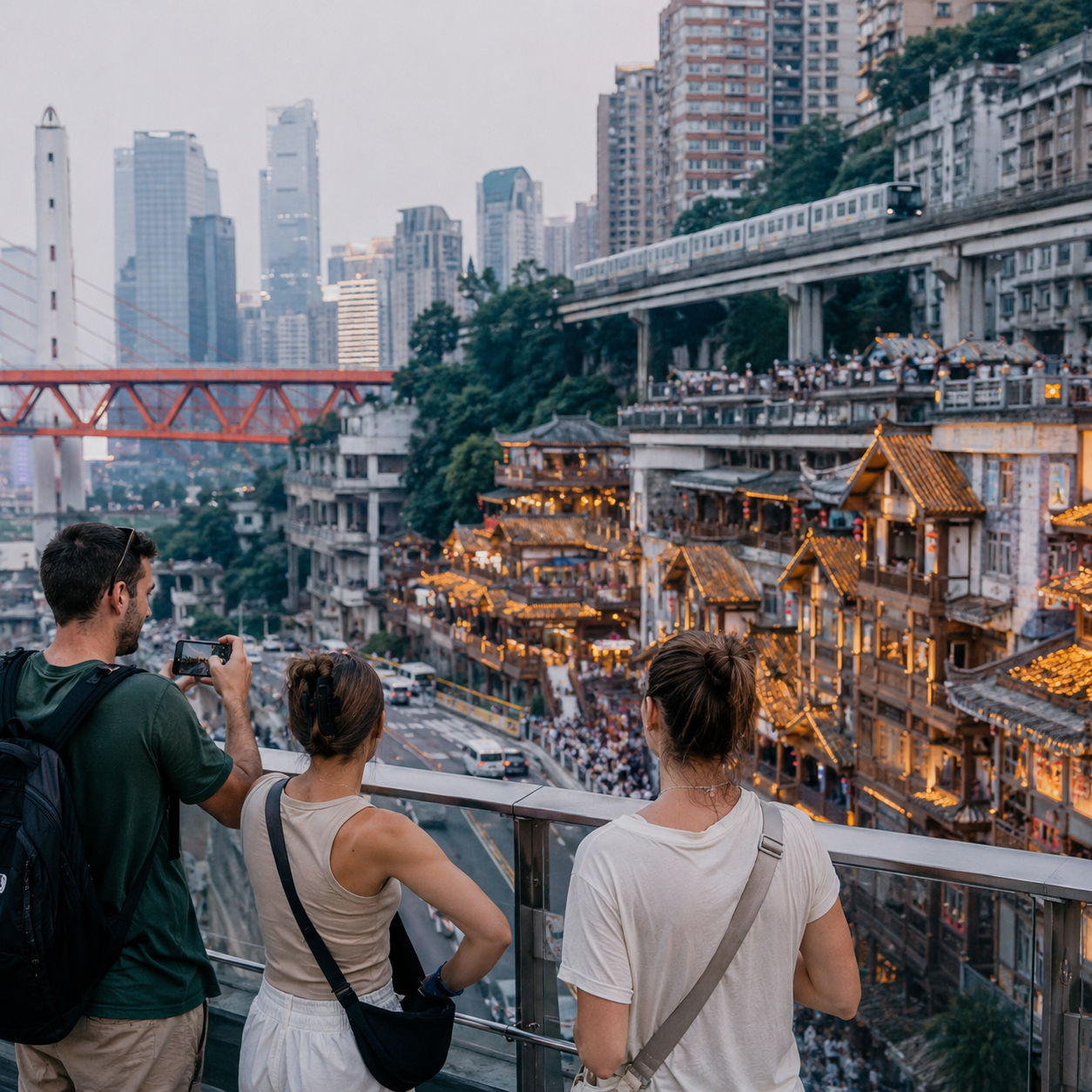
That is also why Chongqing creates such a strong “I need to see this myself” reaction on foreign video platforms. Many destinations go viral because the image is easy to understand. Chongqing works in the opposite way. It goes viral because the image refuses to finish itself in one glance. Viewers are not given a conclusion. They are given a reaction: wait, how exactly does this connect? For major creators, that delayed understanding becomes ideal material for narrative momentum.

上面这类公开视频封面,本身就已经说明了一件事:国外博主在重庆最先卖出的,并不是某一个地标,而是“整座城市像一套要靠身体去解开的结构”。
A public thumbnail like this already reveals something important: what foreign creators sell first in Chongqing is not one landmark, but the sense that the entire city is a structure that must be decoded with the body.
Drew Binsky 这一路拍到的,是“超大城市如何把游客卷进去” / What Drew Binsky Captured Was How a Megacity Pulls a Traveler Inside
Drew Binsky 这类以高频旅行、强节奏切入著称的博主,到了中国之后,重庆显然很适合他的叙事习惯。公开可见的视频标题就已经把焦点放得很直白——“进入世界最大的城市之一”。这样的切口,天然适合把城市规模感、交通系统和陌生人第一次进入时的反应放大。对他的观众来说,重庆不是先从文化名词开始被理解,而是先从“这个地方到底有多大、多绕、多密”开始被理解。
For a creator like Drew Binsky, whose style is built around high-frequency travel and fast narrative entry points, Chongqing clearly fits his method well. Even the public-facing title makes the focus bluntly clear: entering one of the world’s largest cities. That angle naturally magnifies scale, transport systems, and the emotional reaction of a first-time visitor stepping in. For his audience, Chongqing is not first understood through cultural terminology. It is first understood through size, complexity, density, and the basic question of how huge a city can feel from the inside.
这种拍法很聪明,因为它把很多中国城市里原本抽象的“人口”“层级”“坡地”“复合交通”都改写成了直观体验。观众不一定会先关心行政区划和城市发展史,但他们会关心:为什么一座城能把地铁、动物园、老街、观景平台和夜景塞进同一趟移动里;为什么一个旅行者前一秒还在找方向,后一秒已经被一锅热气和一段陡坡改变了节奏。
It is a smart way of filming because it rewrites abstract Chinese urban concepts—population, tiers, hills, layered transport—into bodily experience. Viewers may not initially care about administrative geography or development history. But they do care about why one city can place the metro, a zoo, old streets, viewpoints, and skyline within the same continuous movement. They care about why a traveler can be looking for direction one second and have their pace changed the next by a steep incline and a rising pot of food.
笔者看来,这一类博主对中国行程最大的贡献,不是“发现了一个隐藏目的地”,而是把中国超大城市的进入门槛拍成了可理解的路线。它让原本只存在于新闻或统计里的“巨型城市”,重新变成了一种可以被想象、被模仿、也被挑战的旅行对象。

In the writer’s view, the major contribution of this type of creator is not “discovering a hidden destination.” It is turning the entry threshold of a Chinese megacity into a route that can be understood. A city that might otherwise exist only in news reports or statistics becomes imaginable, repeatable, and challengingly real as a travel object.

这类借图在文章里不宜过多,用一两张点出公开报道对象是谁、行程焦点落在哪儿,就够了。真正该补上的,是读者到了中国以后,怎样把这些“看起来很炸”的内容走成一条实际路线。
This kind of borrowed image should remain limited inside an article. One or two are enough to identify the public subject and show where the route focus landed. What the article should add afterward is the practical layer: once a reader reaches China, how do these dramatic-looking moments become a usable route rather than just a spectacle?
Pasta and Panda 拍出来的,不只是奇观,还有“人在里面怎么生活” / Pasta and Panda Did Not Film Only Spectacle, but Also How People Live Inside It
如果说有些大博主是先把重庆拍成“量级震撼”,那 Pasta and Panda 这类风格会更靠近“沉进去住一阵”的观察。他们公开内容里除了高处夜景、轻轨与观景点,也会反复落回街头吃食、城市步行、居民生活和交通切片。这个角度很重要,因为它把重庆从“网红视觉城市”往“可居住的复杂城市”轻轻推了一步。
If some major creators first frame Chongqing through pure scale and shock, then creators like Pasta and Panda move closer to the perspective of staying long enough to sink into it. In their public material, high viewpoints, trains, and skyline shots repeatedly return to street food, urban walking, daily life, and fragments of transport. That angle matters because it nudges Chongqing one step away from being merely a visual internet city and one step closer to being a complex city that people actually inhabit.
这类拍法对 TravelCN 反而特别有参考价值。因为普通读者真要来中国,不会只想知道“哪一层能看到最亮的楼”,他们还会想知道:中午累了能去哪里坐;陡坡连走两段以后,怎么改路线;火锅和小面之外,步行街区有没有值得放慢的部分;一座看上去很硬核的城市,哪里会突然变得松一点。这些问题,恰恰是沉浸式博主最容易拍出来的。
This approach is particularly useful for TravelCN because ordinary readers coming to China do not only want to know which level gives the brightest skyline. They want to know where to sit when the noon fatigue arrives, how to reroute after two serious climbs, whether there are slower sections worth keeping beyond hotpot and noodles, and where a city that looks intense suddenly becomes loose. Those are exactly the questions immersion-driven creators are most likely to film well.
在第三方报道里,这种内容的价值不在于“他们说这里好吃”或者“他们觉得这里震撼”,而在于他们不知不觉替读者完成了一次路线预演。观众先通过博主的视频知道重庆会累、会绕、会亮、会陡,也会香、会热、会热闹。等他真的落地中国,这座城就不会只剩下一个夸张标签,而会变成一套可以提前准备的动作链。

The value of this material in third-person reporting is not that “they said the food was good” or “they found the city shocking.” Its value lies in the way they accidentally perform a route rehearsal for the audience. Viewers learn in advance that Chongqing is tiring, winding, bright, steep, fragrant, hot, and noisy. By the time they actually land in China, the city is no longer just an exaggerated label. It becomes a sequence of movements that can be prepared for.
这类国外大博主的中国内容,为什么会越来越被转发 / Why This Kind of China Content from Major Foreign Creators Keeps Getting Shared
一部分原因当然是好奇。很多海外观众对中国城市的既有印象,要么停留在几个老地标,要么停留在非常抽象的新闻图景。一旦有大博主带着明显的个人反应走进去,观众就会把这种反应当成一种替代性体验:他替我先迷路、先惊讶、先被火锅的热气扑到,也先搞懂这座城为什么值得停下来。
Part of the answer is obviously curiosity. For many overseas viewers, the prior image of Chinese cities still rests either on a handful of old landmarks or on a very abstract media picture. Once a major creator walks into the city with visible personal reactions, the audience starts using that reaction as a substitute experience. He gets lost first on their behalf, gets surprised first, gets hit by the steam of hotpot first, and then works out why the city is worth staying in.
但另一部分原因更值得注意:大博主的中国行程,一旦不只拍奇观,而是拍移动方式、步行强度、公共交通、街头停顿和吃饭节奏,就会迅速从“看热闹”变成“可参考”。这对中国旅游内容很关键。因为真正能推动读者下决心来的,往往不是一句“太震撼了”,而是那句没那么响亮的话——原来这地方我也能走。
But another reason is even more important. The moment a major creator’s China route stops filming only spectacle and starts filming movement, walking intensity, public transport, street pauses, and meal rhythm, it changes very quickly from “something to watch” into “something to use.” That matters enormously for China travel content. What actually pushes readers into making the trip is often not the loud line—this is unbelievable—but the quieter one: I could probably walk this too.
对 TravelCN 来说,最值得借的不是情绪,而是路线观察法 / For TravelCN, the Most Valuable Thing to Borrow Is Not the Emotion, but the Route Logic
笔者并不认为 TravelCN 应该去复制这些博主的惊叹语气。那些语气本来就属于他们自己的镜头人格。真正值得借来的,是他们在公开行程里反复证明过的东西:重庆这样的大城市,不能按平面城市那套去走;能打动观众的,不是“我到此一游”,而是“我在这里被路线重新教育了一遍”;真正耐看的内容,也从来不只是夜景本身,而是夜景之前的上坡、转乘、街头食物和落脚点。
The writer does not believe TravelCN should imitate these creators’ tones of amazement. Those tones belong to their own camera personalities. What is worth borrowing is something more structural that their public itineraries have repeatedly proven: a city like Chongqing cannot be walked with a flat-city mindset; what moves viewers is not a simple “I was here,” but the sense that the route itself reeducated the traveler; and what stays memorable is never only the skyline, but the climb, transfer, street food, and stopping point that came before it.
这也是为什么,第三方报道体其实很适合把国外大博主内容转化成站内文章。它既能保留“这个人去了哪里、公开拍了什么、为什么会火”的外部视角,又能加上 TravelCN 自己更擅长的部分:把路线拆清楚,把体感讲明白,把中国城市里那些容易被忽略的走法补上。这样写出来的东西,才不会只是“看完就过去”的平台二次搬运,而会变成真正能指导读者的内容。
That is exactly why a third-person reported format suits TravelCN so well when transforming foreign creator content into site articles. It keeps the outside angle—where this person went, what was publicly filmed, and why it spread—while adding the part TravelCN does best: breaking the route down, clarifying bodily rhythm, and filling in the overlooked ways of moving through a Chinese city. Written that way, the article stops being a mere platform reshuffle. It becomes something that can actually guide a reader.
期待会不会继续发生变化 / What May Change Next
从目前公开内容来看,国外大博主拍中国,已经不再满足于只拿一个地标做封面。他们越来越愿意把一整座城市当成故事现场,把交通、地形、食物和夜晚一起拉进镜头里。笔者反而很期待下一轮变化:不只是继续拍重庆有多立体,而是继续往更细的层次走——比如白天和夜里的不同路线、外地游客怎样少走冤枉路、哪些老街和居民区比热门机位更有记忆点。
From the public material available now, major foreign creators filming China are no longer satisfied with using a single landmark as cover art. More and more of them are willing to treat an entire city as the narrative stage, pulling transport, terrain, food, and nightfall into the same frame. The writer is more interested in the next shift: not simply repeating how vertical Chongqing is, but moving into finer layers—day routes versus night routes, how outsiders can avoid wasting effort, and which old streets or residential edges remain more memorable than the most famous viewing platforms.
如果这种变化继续下去,那么国外大博主带来的就不只是“外部视角热度”,还会慢慢变成一种新的中国旅行入门方式。观众先在视频里被震一下,再在文章里把路线读明白,最后自己落地中国把这条路走顺。对于 TravelCN 来说,这正是最值得接住的机会:把别人带来的关注,变成读者真正能用上的旅行判断。
If that shift continues, then major foreign creators will be bringing more than outside attention. They will gradually become a new entry route into China travel itself. The viewer is first jolted by the video, then taught the route more clearly in an article, and finally arrives in China to walk it with fewer mistakes. For TravelCN, that is exactly the opportunity worth catching: turn borrowed attention into travel judgment a reader can genuinely use.
公开素材来源 / Public Source Notes
- Drew Binsky, “Entering the World's Largest City (Chongqing, China)”
- Pasta and Panda (Dav and J), “1 Month In Chongqing: China's Real-Life Cyberpunk Megacity”
- Island Hopper TV, “15 Best Places to Travel in China 2026 | Ultimate China Travel Guide”
以上引用的是公开可见视频标题、频道信息与少量公开缩略图,用于第三方报道体写作和行程分析,不做整段搬运。
The article uses publicly visible video titles, channel identifiers, and a very limited number of public thumbnails for third-person reporting and route analysis rather than wholesale reproduction.
- 我在中国早餐摊前慢慢看懂,大家为什么总有自己的固定搭配 | At Chinese Breakfast Stalls, I Slowly Understood Why Everyone Seems to Have a Usual Combo
- 十月赏银杏:满城尽带黄金甲 | October Ginkgo Season: When China Turns to Gold
- 昆明蓝花楹城市漫步:把春天走成一条紫色街巷 | A Jacaranda Walk in Kunming: Turning Spring into a Purple Street
- 苏州这种地方,最怕人还没看够,词已经先把它写完了 | A Place Like Suzhou Suffers Most When Words Finish It Before the Eyes Do
- 十二月的中国:北方玩雪,南方过冬 | December in China: Snow Up North, Warmth Down South
- 凌晨一点我还敢一个人走回酒店:在中国把安全感走成了日常经验 | At 1 a.m. I Still Walked Back to My Hotel Alone: How Safety in China Became Ordinary to Me
- 免签来中国前,我把这张“入境准备清单”发给了朋友 | Before Coming to China Visa-Free, I Sent This Entry Checklist to a Friend
- 很多人第一次敢把中国行程定下来,往往是因为先在上海找到了顺手感 | Many People Finally Commit to a China Trip Because Shanghai Gives Them a First Sense of Ease
- 那次“低价团”之后,我学会了这样避开旅游强制消费 | After One Cheap Tour, I Learned How to Avoid Forced Shopping in China
- 中国西部丝绸之路探险 | Silk Road Adventures in Western China
Comments (0)