
老城汤馆门口那点热气,比洛阳夜景更早把人留下来 | The Steam Outside an Old-City Soup Shop Held Me Before Luoyang’s Nightscape Did
洛阳老街的一盏灯,让我看见生活比景点更耐看 | One Lamp on an Old Street in Luoyang Showed Me Daily Life Outlasts Attractions
01
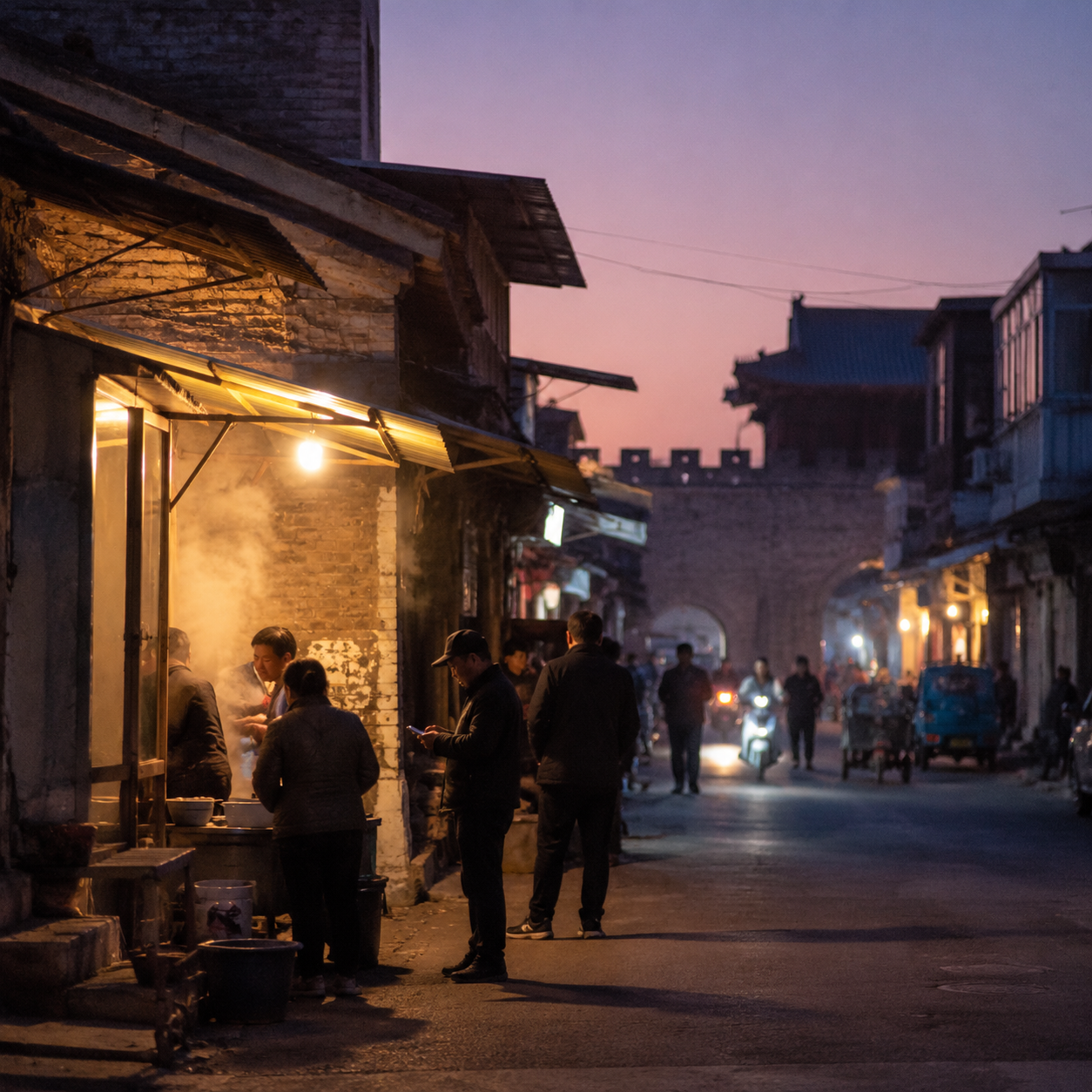
夜色落到洛阳老城时,并不是一下子黑下来的。它先从城墙根的砖缝里渗出来,从旧门楼背面的阴影里漫出来,再慢慢把街口的招牌、屋檐下的电线、摊车边缘的铁皮都涂上一层温热的灰。等我走到老街那盏灯下面,才发现整条街的夜晚其实是被一点一点点亮的:先是汤馆门口的白炽灯,亮得像一只刚盛满热汤的瓷碗;再是水席店招牌上红黄相间的字,像从旧相册里翻出的喜庆;最后是居民楼窗口里漏出的光,颜色更淡,却最让人安心。洛阳老街的夜,不靠宏大的景观取胜,它靠一盏灯、一碗汤、一扇半开的门,把人拉回生活的内部。
When night arrives in Luoyang’s old city, it does not fall all at once. It first seeps from the cracks at the foot of the city wall, spreads from the shadowed backs of old gateways, and slowly coats the signboards, the wires under the eaves, and the tin edges of food carts with a warm gray. When I reached the lamp on the old street, I realized the whole evening was lit piece by piece: first the incandescent bulb at the soup shop, bright like a porcelain bowl just filled with broth; then the red-and-yellow characters on a water banquet restaurant sign, festive as something taken from an old family album; finally the softer light leaking from apartment windows, faint but most reassuring. The night of Luoyang’s old street does not win by grand scenery. It wins by one lamp, one bowl of soup, and one half-open door, pulling a person back inside ordinary life.
02
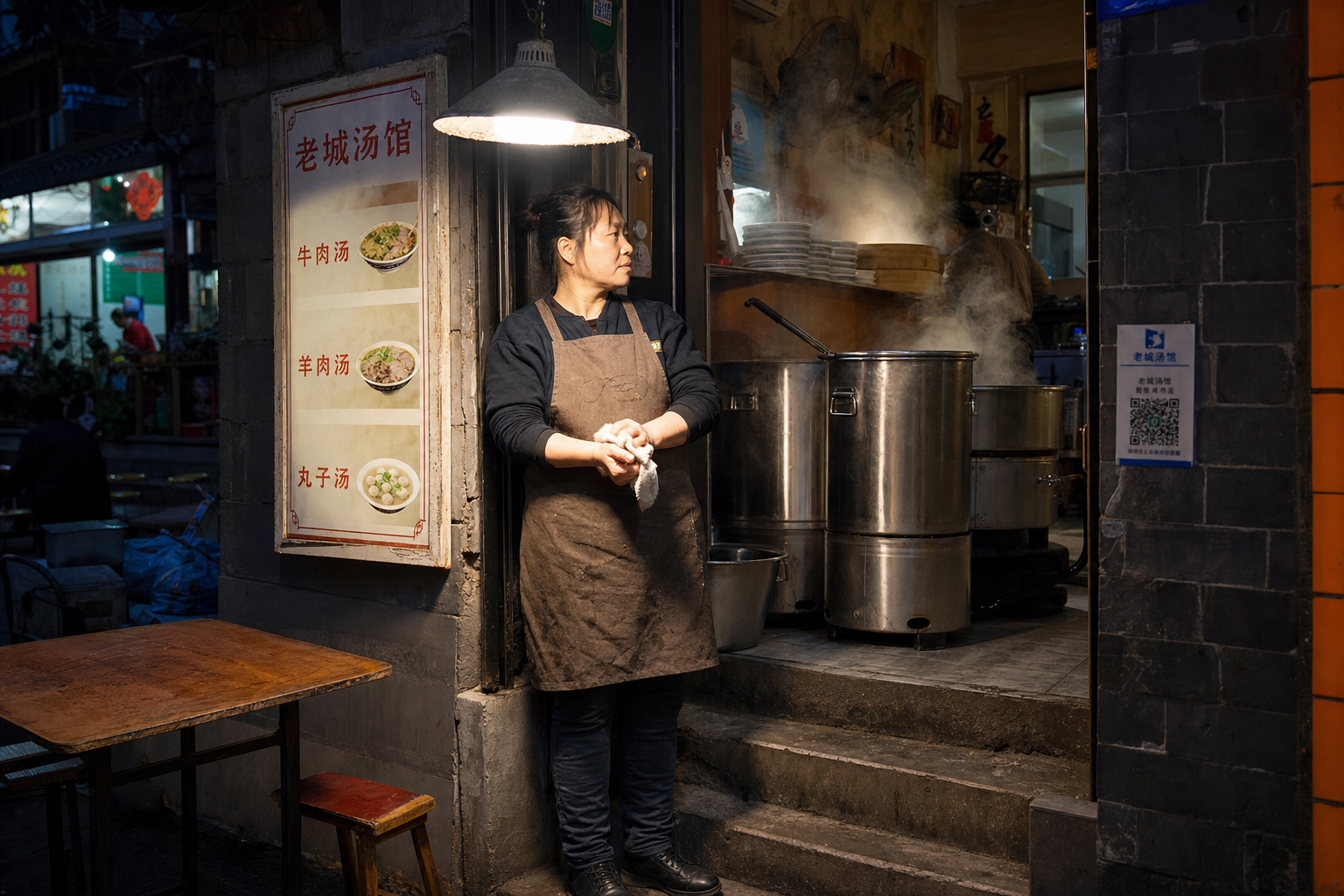
那盏灯挂在一家小汤馆门前,灯罩有些旧,边缘沾着油烟和灰。它不是古风装饰,也不是为游客设计的打卡装置,只是一盏承担实际用途的灯:照着台阶,照着菜单,照着来晚的人看清锅里还有什么。灯下站着老板娘,围裙上有水渍,手里拿着抹布,动作并不急。她把空桌擦一遍,又把凳子往里推一推,像是在整理自家客厅。旁边的锅一直冒着气,牛肉汤、羊肉汤、丸子汤的香味混在一起,雾气里带着胡椒、葱花和骨头熬久后的厚味。有人站在门口问:“还有不翻汤没?”她抬头说:“有,坐吧。”这句“坐吧”说得很轻,却像是老城夜晚最朴素的邀请。
The lamp hung in front of a small soup shop. Its shade was old, its rim touched by soot and dust. It was not antique-style decoration, nor a check-in installation designed for tourists, but a lamp with a practical job: lighting the step, the menu, and the latecomers trying to see what remained in the pot. Under it stood the proprietress, her apron marked by water stains, a rag in her hand, her movements unhurried. She wiped an empty table, pushed a stool inward, and seemed to be tidying her own living room. Beside her the pot kept steaming. The aromas of beef soup, mutton soup, and meatball soup mingled together, carrying pepper, chopped scallions, and the heavy sweetness of bones simmered for a long time. Someone at the door asked, “Do you still have bufan soup?” She looked up and said, “Yes, sit down.” The words were light, but they sounded like the old city’s simplest invitation at night.
03
洛阳的水席在夜里尤其有存在感。白天说起水席,容易想到宴席、名菜、牡丹燕菜、连汤肉片,想到一桌接一桌端上来的碗盘和地方传统;夜里走过老街,水席却从“名片”变回了“饭”。店里坐着三四桌人,有外地游客,也有说话带本地尾音的居民。游客会先拿手机拍汤面,拍那层漂着姜丝和香菜的热气;居民则更直接,筷子伸出去,勺子舀回来,先把胃安顿好。水席的“水”在这里不是抽象的文化符号,而是热汤不断流动的声音:勺碰碗沿,服务员报菜名,后厨铁勺刮锅底,门口有人催孩子别跑太远。它把宴席放低,放到街面和肚子之间。
Luoyang’s water banquet has a special presence at night. In the daytime, when people mention it, they may think of formal meals, famous dishes, peony-shaped yan cai, sliced pork in broth, bowls arriving one after another, and the weight of local tradition. But when you walk through the old street at night, the water banquet turns from a “city calling card” back into “dinner.” Three or four tables are occupied inside: some by visitors from elsewhere, others by residents whose speech carries the local ending tones. Tourists first lift their phones to photograph the soup surface, the steam floating with ginger shreds and cilantro; locals are more direct, chopsticks out, spoons back, settling the stomach first. The “water” in the banquet is not an abstract cultural symbol here, but the sound of hot soup moving continuously: spoon against bowl rim, servers calling dish names, iron ladles scraping the bottom of pots, someone at the doorway telling a child not to run too far. It lowers the banquet until it sits between the street and the belly.
04
我在灯下坐了一会儿,点了一碗汤和一份小菜。桌面有被反复擦过的痕迹,木纹里还藏着一点潮气。邻桌是一对老夫妻,男人把饼撕成小块泡进汤里,女人嫌他撕得太大,伸手拿过半块又掰了一下。两个人没有说太多话,只有这种细小的互相修正,像多年生活磨出来的默契。另一桌坐着几个年轻人,明显是刚下班,工牌还挂在脖子上。他们说今天哪条路堵,哪家店涨价,谁家的孩子又上兴趣班。说着说着,有人忽然把话题转到龙门石窟,说外地朋友来了还是要带去看。老城的夜就是这样,历史和日常不分开,石窟、牡丹、水席、房租、堵车,都能在同一碗汤的热气里出现。
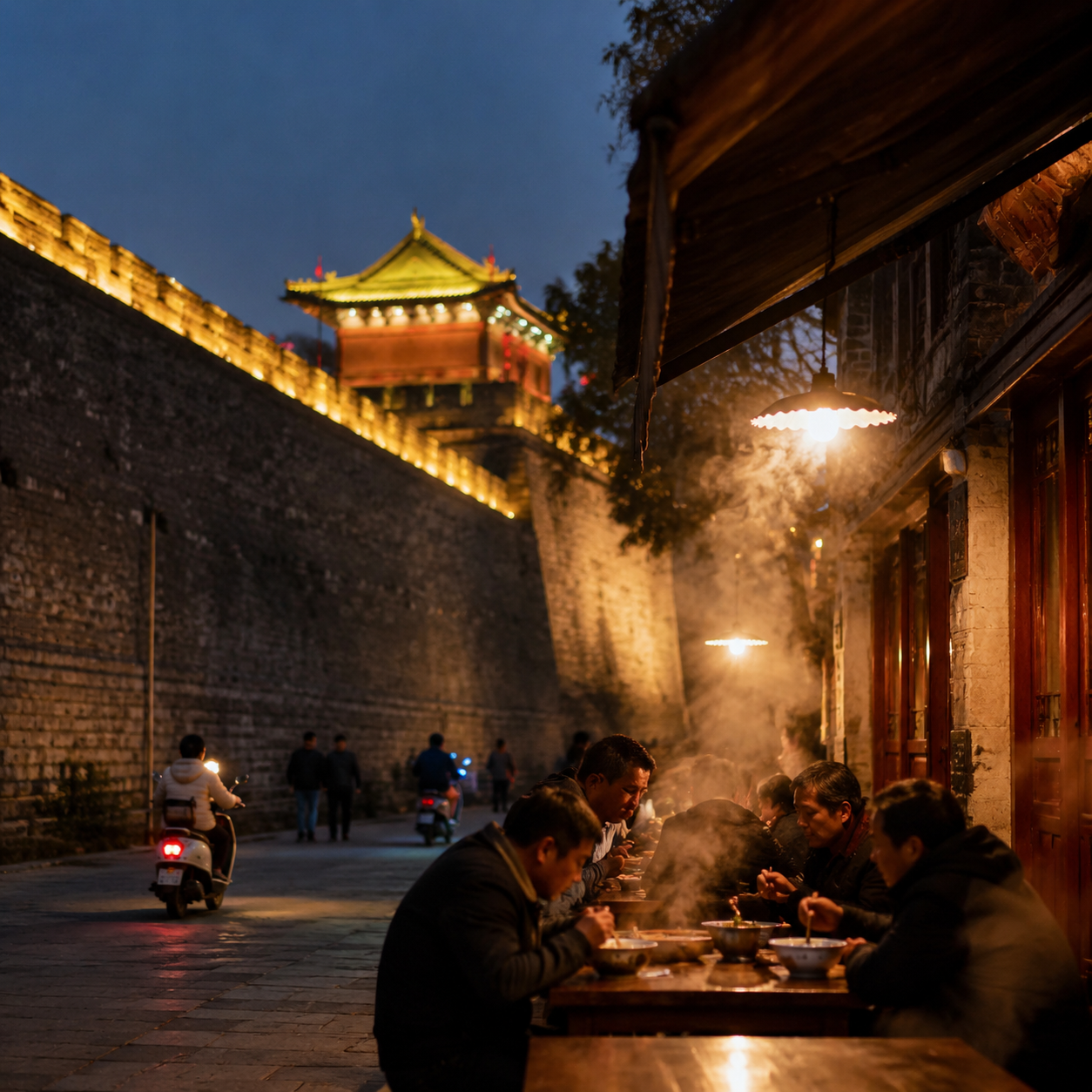
I sat under the lamp for a while and ordered a bowl of soup and a small side dish. The tabletop bore traces of repeated wiping, and a little dampness seemed hidden in the wood grain. At the next table sat an elderly couple. The man tore flatbread into pieces and soaked them in the soup; the woman thought his pieces were too large, took half from his hand, and broke it again. They did not speak much. There was only this small correction of each other, a tacit understanding polished by years of living together. At another table sat several young people, clearly just off work, their ID badges still hanging from their necks. They talked about which road had been jammed, which restaurant had raised prices, whose child was taking extra classes again. Then someone suddenly shifted to the Longmen Grottoes, saying that when friends from other cities came, they still had to be taken there. The old city’s night is like this: history and daily life are not separated. Grottoes, peonies, water banquets, rent, and traffic can all appear in the steam of the same bowl of soup.
05
老街的声音有层次。最外层是游客的脚步和拍照声,他们从丽景门方向走来,抬头看灯笼,低头看导航,讨论哪条巷子更像攻略里的照片。中间一层是店铺的声音,汤锅沸腾,油锅轻响,收款码播报到账,服务员在门口招呼“里面有座”。最里面一层才是居民的声音:钥匙串碰门,电动车支架落地,楼上有人喊“把垃圾带下去”,小孩在巷口追逐,老人坐在门边看人来人往。这些声音交叠,却不完全互相打扰。游客以为自己进入了风景,居民却在风景里继续过日子。那盏灯照见的,正是这两种时间的并行:一边是短暂停留,一边是长久居住。
The sounds of the old street have layers. The outermost layer is made of tourists’ footsteps and camera clicks. They come from the direction of Lijing Gate, looking up at lanterns, down at navigation apps, and discussing which alley resembles the photos in travel guides. The middle layer belongs to shops: soup pots boiling, oil pans crackling softly, payment speakers announcing receipts, servers calling from the doorway that there are seats inside. The innermost layer is the sound of residents: keys striking doors, electric-bike stands dropping to the ground, someone upstairs shouting, “Take the trash down,” children chasing each other at the alley mouth, elders sitting by doorways watching people pass. These sounds overlap without fully disturbing one another. Visitors think they have entered scenery, while residents continue living inside that scenery. What the lamp reveals is precisely the parallel movement of two kinds of time: brief stopping on one side, long dwelling on the other.
06
我沿着街往深处走,灯光变得不那么整齐。靠近主街的地方,招牌明亮,玻璃门反光,店员穿统一围裙;再往里,灯就散了,有的挂在门楣上,有的从厨房窗户透出,有的只是电动车充电处的一小点红光。老城的真实感常常藏在这种不整齐里。墙面补过,砖色不一;门口堆着纸箱、煤气罐、晾衣杆;一只猫蹲在台阶上看人,尾巴扫过掉落的菜叶。某个院门里飘出炒蒜苗的味道,另一个窗口传来电视新闻的声音。这里不是被完整修复成样板的古街,而是仍然会漏风、会做饭、会吵嘴、会在冬天囤白菜的地方。旅游把它照亮,生活把它留住。
I walked deeper into the street, and the lights became less orderly. Near the main street, signboards were bright, glass doors reflected light, and shop assistants wore matching aprons. Farther in, the lights scattered: some hung above door lintels, some came from kitchen windows, and some were only tiny red dots at electric-bike charging spots. The old city’s sense of truth often hides in this disorder. Walls have been patched in different brick colors; cardboard boxes, gas cylinders, and clothes poles stand by doors; a cat crouches on a step watching people, its tail sweeping across fallen vegetable leaves. From one courtyard gate comes the smell of garlic sprouts frying; from another window comes the sound of television news. This is not an ancient street restored completely into a sample display. It is still a place that leaks wind, cooks meals, quarrels, and stores cabbages for winter. Tourism lights it up; life keeps it here.
07
汤馆里的人流到九点以后慢下来。老板把一摞碗从消毒柜里拿出来,碗碰碗发出清脆的响声。灶台旁的年轻师傅开始收拾台面,动作快,水声大,像在给一天收尾。门口灯下,两个外卖骑手短暂停住,一个看手机,一个喝了半碗免费热水。他们没有进店吃饭,只是在灯光边缘借一点暖意。老街的夜色不只属于慢慢逛的人,也属于这些一直移动的人:送餐的、收摊的、打扫的、赶末班车的。他们不一定出现在游记照片里,却决定了夜晚能不能顺利运转。那盏灯照着游客的脸,也照着骑手手套上的灰,照着店员弯腰擦地时露出的疲惫。
After nine, the flow of people in the soup shop slowed. The owner took a stack of bowls from the sterilizing cabinet, and bowl striking bowl made a clear sound. The young cook beside the stove began cleaning the counter, moving quickly, water loud, as if closing the day. Under the lamp at the doorway, two delivery riders stopped briefly, one checking his phone, the other drinking half a bowl of free hot water. They did not come in to eat; they only borrowed a little warmth at the edge of the light. The old street’s night does not belong only to people strolling slowly. It also belongs to those always in motion: delivering food, closing stalls, cleaning floors, catching the last bus. They may not appear in travel photos, but they decide whether the night runs smoothly. The lamp shines on tourists’ faces, but also on the dust on riders’ gloves and the tiredness revealed when a shop worker bends to mop the floor.
08
我喜欢洛阳老街的原因,不是它把古都讲得多么堂皇,而是它愿意把堂皇放在很低的位置。丽景门可以高,城墙可以厚,匾额可以端正,但一转身,最有力量的东西却是汤勺和门灯。所谓古都,如果只剩下碑刻和传说,就会离人很远;而洛阳仍然把它的过去放进当下的碗里。水席不是博物馆里的展品,汤馆不是怀旧布景,居民也不是街区叙事的背景板。他们每天买菜、开火、收钱、回家、骂孩子、等人、关灯。正是这些重复的小动作,让“老城”不是一个供人消费的词,而是一种仍在继续的关系。
What I like about Luoyang’s old street is not that it tells the ancient capital story in a grand way, but that it is willing to place grandeur very low. Lijing Gate can be tall, the city wall thick, the plaques upright, but once you turn around, the most powerful things are a soup ladle and a doorway lamp. An ancient capital, if left only with inscriptions and legends, becomes distant from people. Luoyang still puts its past into present bowls. The water banquet is not an exhibit in a museum; the soup shop is not a nostalgic set; residents are not background figures in a neighborhood narrative. They buy vegetables, light stoves, take payments, return home, scold children, wait for someone, and turn off lights every day. It is precisely these repeated small actions that make “old city” not a word for consumption, but a relationship still continuing.
09
离开时,我回头看那盏灯。它并不明亮到可以照远,只够照清门口几步路,照清一张桌子,照清锅边升起的白气。可它的尺度恰好适合老街。太亮的灯会把夜色赶走,把人的表情照得像展示;太暗的灯又会让街显得疏离。它停在中间,给人一点安全,也给生活留一点阴影。阴影里有未说完的话,有老房子的潮气,有居民不愿被拍到的部分,也有城市真实的皱褶。旅行常常想把地方看清楚,但有些地方不需要被完全看清。洛阳老街的好,在于它让你看见足够多,又知道还有更多属于这里的人自己。
When I left, I looked back at the lamp. It was not bright enough to illuminate far; it only lit a few steps at the doorway, one table, and the white steam rising beside the pot. But its scale suited the old street exactly. A light too bright would drive away the night and make people’s expressions look like displays; a light too dim would make the street feel distant. This lamp remained in between, giving people a little safety while leaving life a little shadow. In the shadow were unfinished words, the dampness of old houses, the parts residents did not want photographed, and the true wrinkles of the city. Travel often wants to see a place clearly, but some places do not need to be seen completely. The virtue of Luoyang’s old street is that it lets you see enough, while reminding you that more still belongs to the people who live here.
10
后来我把那晚记成“一盏灯”,不是因为洛阳缺少更大的意象,而是因为那盏灯把大意象都收住了。它收住了古都的厚重,也收住了水席的热闹;收住了游客的好奇,也收住了居民的疲惫;收住了街巷的烟火气,也收住了夜深以后慢慢安静下来的空气。旅行中有些时刻并不负责提供结论,只负责把你放到一个合适的位置,让你重新理解“看见”。在洛阳老街,我看见的不是被包装出来的古意,而是灯下有人继续生活:汤还热着,桌子擦了又擦,门没有完全关上,楼上的窗还亮着。这样的夜色,比任何宏大的说明都更能证明一座城还活着。
Later I remembered that night as “one lamp,” not because Luoyang lacks larger images, but because the lamp gathered those large images into itself. It held the ancient capital’s weight and the water banquet’s bustle; it held tourists’ curiosity and residents’ fatigue; it held the smoky warmth of alleys and the air slowly quieting after night deepened. Some moments in travel are not responsible for providing conclusions. They simply place you in the right position and let you understand “seeing” again. On Luoyang’s old street, what I saw was not packaged antiquity, but people continuing to live under a lamp: the soup still hot, the tables wiped again and again, the door not fully closed, the upstairs window still lit. Such night, more than any grand explanation, proves that a city is still alive.
- 陪妈妈在无锡看五月太湖烟雨,我终于学会听她慢慢讲年轻时的事 | Walking with My Mother Through Taihu Mist in Wuxi, I Finally Learned to Listen to Her Younger Stories Slowly
- 二月冬末旅游:南方暖意正浓 | Late Winter Travel: Warmth in Southern China
- 中国旅游医疗与保险指南 | Medical & Insurance Guide for China Travel
- 青岛这座城,白天该先进馆,晚上才适合把海慢慢走出来 | In Qingdao, the Day Belongs to Museums First, and the Sea Should Be Walked Out Slowly at Night
- 一只陶马,让孩子在西安开始认真追问历史 | A Clay Horse Opened the Door to History for My Child in Xi’an
- 海口出门前那几分钟,天气、潮气和路线都先挤进了手机里 | In the Minutes Before Going Out in Haikou, Weather, Humidity, and Route All Crowd into the Phone
- 杭州下雨的下午,孩子第一次主动找陌生小朋友一起玩 | On a Rainy Afternoon in Hangzhou, My Child Asked a Stranger to Play Together
- 新疆北疆12日深度游 | 12-Day Northern Xinjiang In-Depth Tour
- 三天玩转上海:完整旅行指南 | Shanghai in 3 Days: Complete Travel Guide
- 杭州西湖边那阵风,提醒我热门景区也要会躲人流 | A Breeze by West Lake Reminded Me How to Dodge Crowds at Famous Attractions
Comments (0)