
在南京城墙脚下,我第一次看清一座古城不是景点,是还在运转的日常 | Beneath Nanjing’s Wall, I First Saw That an Ancient City Is Not a Sight but an Ongoing Daily Life
在南京城墙脚下,我第一次看清一座古城不是景点,是还在运转的日常 | Beneath Nanjing’s Wall, I First Saw That an Ancient City Is Not a Sight but an Ongoing Daily Life
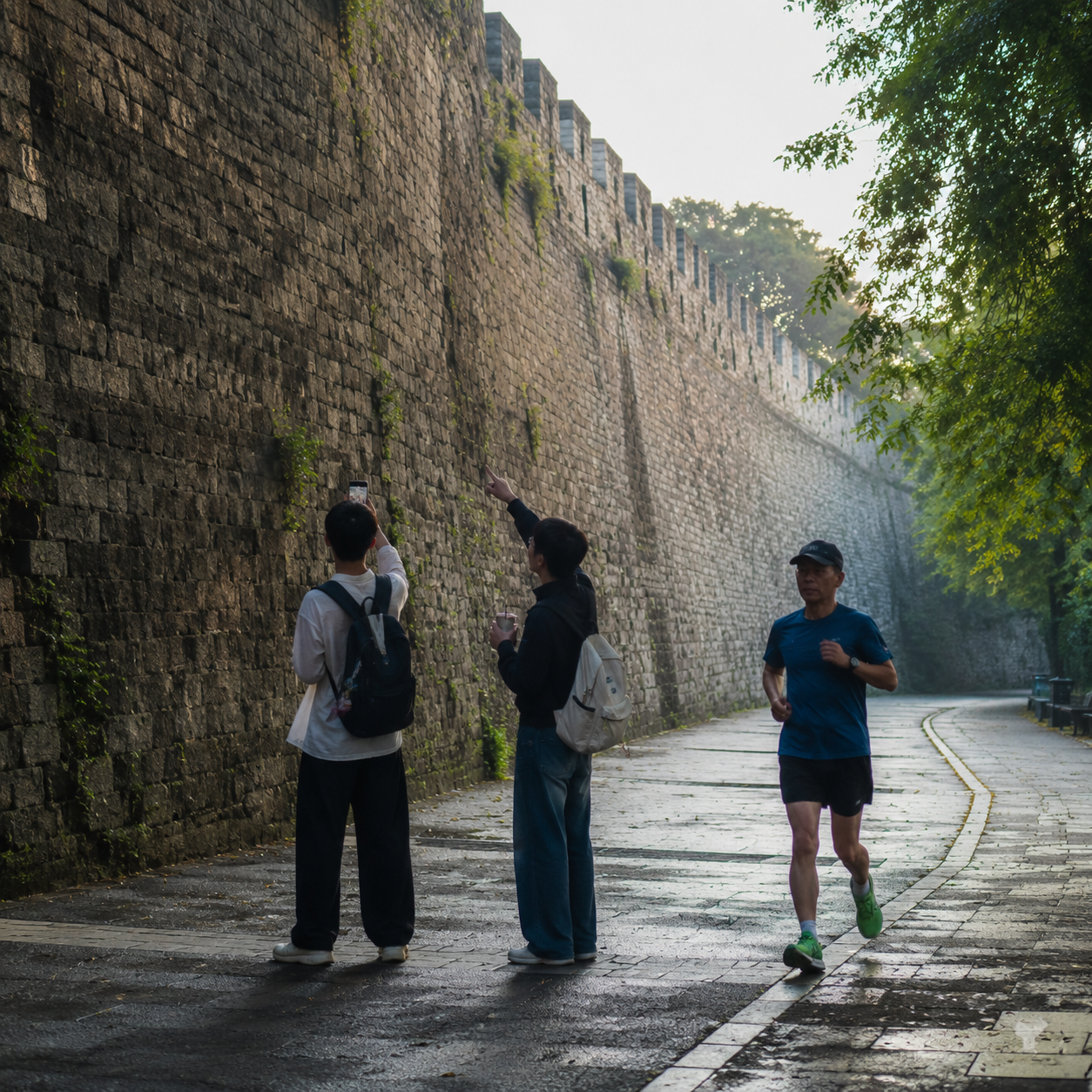
早上八点刚过,解放门一带的光还没有完全硬下来,城砖表面的灰褐色被一层潮气轻轻压住。两个外地年轻人站在坡下抬头看墙,一个人在调手机镜头,另一个人把刚买的豆浆夹在手臂和背包之间,腾出手指路。旁边一位本地晨跑者没有停步,只在经过时提醒了一句:真正值得看的,不是站在上面拍多远,而是先看看下面的人怎么过这道门。
A little after eight in the morning, the light around Jiefang Gate had not yet turned hard. A thin layer of dampness pressed softly over the grey-brown surface of the old bricks. Two young visitors from out of town stood at the slope and looked up at the wall. One adjusted a phone camera; the other pinned a cup of soy milk between arm and backpack to free a hand for pointing. A local runner did not stop, but while passing he offered one sentence: what is worth seeing here is not how far you can photograph from the top, but how people still pass through the gate below.
南京最容易被写成一座“很好理解”的城市:有城墙,有近代史,有梧桐路,有鸭血粉丝汤,有可以被立刻识别出来的中国城市标签。可一旦写快了,它就会被写薄。因为这座城真正有分量的地方,从来不是把几种历史摆在同一张地图上,而是这些层次直到今天还在彼此挤压、彼此让路,甚至彼此借光。
Nanjing is often written as a city that is easy to understand: a city wall, modern history, plane trees, duck blood vermicelli soup, and a set of instantly recognizable Chinese urban labels. But the moment it is written too quickly, it becomes thin. The real weight of the city does not come from placing several historical layers on one map. It comes from the way those layers still press against each other, yield to each other, and even borrow light from each other today.
如果把南京只当成“到此一游”的景点拼盘,城墙会变成背景板,近代建筑会变成拍照坐标,街道只剩下通行功能。可如果把它写成一座仍在运转的城市,很多判断就会跟着变化:什么时候上墙更合适,什么时候反而该留在墙下;为什么一段路适合慢慢走,另一段路却应该早一点离开;为什么有些地方看似安静,却一点都不空。
If Nanjing is treated merely as a sightseeing collage, the wall becomes a backdrop, the Republican-era buildings become photo coordinates, and the streets shrink into passages. But once the city is written as a place still in motion, the judgments change with it: when it makes sense to climb the wall and when it is better to remain below; why one stretch rewards slow walking while another should be left a little earlier; why some places look quiet without feeling empty at all.
第三人称报道体最适合写南京,是因为这座城本身就不急着把答案交出来。它不靠一个巨大场面立刻征服人,而是靠连续的小判断慢慢让人明白:这道门为什么留着,那条斜坡为什么还在被用,城墙边的早餐摊为什么会比纪念品店更先构成城市气质。
A reported third-person mode suits Nanjing precisely because the city does not rush to hand out its answers. It does not overwhelm a visitor with one giant spectacle. Instead, it teaches through a chain of small judgments: why this gate still matters, why that slope is still being used, why the breakfast stall by the wall shapes the city’s character sooner than any souvenir shop.
上午的城墙不该被写成纯粹的“古迹时间”。真正站到上面以后,视线会同时被两种东西拉住:一边是被反复讲述过的厚重历史,另一边却是今天仍然清楚可见的生活结构——车流在外圈绕,居民在里巷穿,学校、菜场、写字楼和景区并没有被彻底切开。南京的好看,很多时候就来自这种没有被处理得太整齐的并置。
The wall in the morning should not be framed as a purely “heritage hour.” Once one actually stands on top, the eyes are pulled by two things at once: on one side, the heavily narrated past; on the other, the structure of present-day life still visible in full—traffic looping around the outer ring, residents cutting through inner lanes, schools, markets, office towers, and scenic zones never fully separated from one another. Much of Nanjing’s beauty comes from this juxtaposition that has not been cleaned into neatness.
一个外地来采访城市更新的作者,通常会先被“保存得很好”这类句子吸引,可在南京,这种说法往往不够。这里不是简单意义上的保存。更准确地说,它是一种没有完全停止使用的保留。城墙不是被远远供起来的,很多入口、坡道、脚下的路感,都还在被今天的人不断重新解释。也正因为如此,南京才不像某些被过度包装的历史城市那样,越完整越失真。
A visiting writer covering urban renewal may first be drawn to phrases like “well preserved,” yet in Nanjing that description is often insufficient. This is not preservation in the simplest sense. It is a retained structure that has never been fully removed from use. The wall has not been placed far away for admiration only; its entrances, slopes, and the feeling of the ground beneath it are still being reinterpreted by people living today. That is precisely why Nanjing avoids the fate of some over-packaged historical cities, where the more complete the presentation becomes, the less true it feels.

从解放门、台城到玄武湖这一线,很多游客会急着把它看成一条标准景观线:上墙、拍湖、看城、再转去下一个点。可真正敏感的人会注意到节奏不该完全一样。台城段适合停得久一点,不只是因为视野开阔,而是因为它能让人把“墙”和“城”同时看见;靠近玄武湖的部分则更容易让人误以为南京只剩下抒情,于是忘了这座城本来就有锋利的一面。
From Jiefang Gate through Taicheng to Xuanwu Lake, many visitors rush to treat the line as a standard scenic route: climb, photograph the lake, look at the wall, and move to the next point. But a more attentive traveler notices that the rhythm should not remain identical. The Taicheng stretch deserves a longer stop, not only because the view opens wide, but because it allows the wall and the city to be seen together. The section near Xuanwu Lake, by contrast, can seduce people into reading Nanjing as pure lyricism, making them forget that the city has edges as well.
南京近代层次最容易被误解成一种“教材式厚重”。其实它更像一种日常里的折叠:今天的人会在曾经的边界旁边买咖啡、上班、散步、等朋友,也会在并不宏大的空间里突然意识到某段历史还压在地形和建筑关系里。那种感觉不总是悲壮,很多时候反而很轻,只是轻得让人之后更难忘。
Nanjing’s modern historical layers are often mistaken for a kind of textbook heaviness. In reality they feel more like folds inside ordinary life. People today buy coffee, go to work, take walks, and wait for friends beside what used to be political or military boundaries. In spaces that are not grand at all, they suddenly sense that some segment of history is still pressing quietly into the relationship between landform and architecture. The sensation is not always tragic or solemn. Often it is surprisingly light—and precisely because it is light, it lingers longer afterward.
下午如果转去颐和路、公馆区或更宽阔的近代街区,报道视角会进一步成立。因为这里最值得写的并不是“哪一栋楼最出片”,而是尺度的变化:从城墙砖面压出的收束感,到宽阔街道、树影、人行道和门牌之间形成的放松感,南京会突然像换了呼吸方式。一个上午还在被历史逼近的人,到下午可能已经开始被城市表面的平静安抚。
If one turns in the afternoon toward Yihe Road, former villa districts, or other broad Republican-era streets, the reported perspective becomes even more convincing. The key is not which building photographs best, but the change in scale: from the compressive feeling produced by the wall’s brick surface to the release offered by broad streets, tree shadows, pavements, and house numbers. Nanjing suddenly seems to breathe differently. A visitor who spent the morning feeling history move closer may find the afternoon soothed by the city’s surface calm.
这时候最有意思的对比出现了。很多城市在“古”和“近代”之间切换时,像在翻页;南京则更像在转身。它不会把前一层完全关掉,再把后一层完整打开。墙的重量会带进街区,街区的松弛也会反过来修正人对城墙的理解。于是一个原本只想“看看古城墙”的人,到最后记住的很可能是梧桐叶影落在坡地上的那种安静移动。

This is where the most interesting contrast appears. In many cities, the shift between “ancient” and “modern” feels like turning a page. In Nanjing it feels more like turning one’s body. The city does not shut one layer and open another in full. The weight of the wall enters the district, and the looseness of the district, in turn, revises one’s understanding of the wall. As a result, a person who came merely to “see the ancient city wall” may end up remembering the quiet movement of plane-tree shadows sliding over a sloped pavement.
吃在南京这一线里也不是题外话。真正有经验的本地人不会把一顿饭安插成机械补给,而会用它来调整情绪和视线。午间去吃一碗汤、一个轻一点的本地小吃,作用往往不是“打卡完成”,而是让人从墙与史之间那种持续绷着的注意力里缓一口气。休息过后,再看街区,感受会完全不同。
Food along this route is not a side note either. People who know the city well do not insert a meal as a mechanical refueling stop. They use it to adjust mood and vision. A bowl of soup or a lighter local dish at midday does not matter because it checks off a culinary item; it matters because it releases the mind from the sustained tension produced by wall and history. After that pause, the district reads differently.
一位第三人称写作者若真想把南京写扎实,最该抵抗的冲动就是替城市做总结。南京并不喜欢被一句话概括。它更像一种逐段累积的认识:先看到砖,再看到门;先看到门,再看到人怎么经过;先看到街区的平静,再意识到这种平静不是没有来历。城市真正站住的时候,读者不会觉得“我懂了”,而会觉得“我还想再回去按另一种顺序走一次”。
If a third-person writer truly wants to write Nanjing solidly, the main temptation to resist is the urge to summarize the city too quickly. Nanjing does not like being concluded in one sentence. It is better understood as an accumulated recognition: first the brick, then the gate; first the gate, then the way people still pass through it; first the calm of the district, then the realization that this calm has origins. When the city finally stands up in the mind, the reader does not think, “I understand it now.” The reader thinks, “I want to come back and walk it again in a different order.”
傍晚再回到城墙脚下时,光已经转斜。卖水的人把小冰箱往里拖了一点,白天在坡上停过的人群散开了,门洞里的阴影比上午更深,但出入的人反而更清楚。那两个早上举着豆浆找角度的年轻人已经不在了,换成一对牵着手慢慢往里走的中年夫妻。城还是那道城,门还是那道门,可一天走下来以后,真正留在报道里的,已经不是“南京有城墙”,而是南京如何让一堵墙继续活在今天的脚步里。
By evening, when one returns to the foot of the wall, the light has already slanted. The water seller has dragged the little cooler slightly inward. The daytime crowd that paused on the slope has thinned out. The shadow inside the gate is deeper than it was in the morning, yet the people entering and leaving are more distinct. The two young visitors who earlier searched for angles with soy milk still in hand are gone; in their place, a middle-aged couple walks slowly inward hand in hand. The wall is the same wall, the gate the same gate. But after a day’s passage, what remains in the report is no longer “Nanjing has a city wall.” It is how Nanjing allows one wall to keep living inside present-day footsteps.
- 北京最怕第一次来的人一上来就把所有重量景点挤在同一天 | Beijing Is Hardest on First-Time Visitors When They Pack All the Heaviest Sights into One Day
- 江南水乡7日慢行:苏州杭州乌镇 | 7-Day Jiangnan Water Towns: Suzhou, Hangzhou & Wuzhen
- 中国旅游最佳季节与气候指南 | Best Seasons & Climate Guide for China Travel
- 我第一次把扫码付款练成一种低压力习惯 | How I Turned QR Payment into a Low-Stress Habit
- 云南古城最怕被一句“适合慢下来”说完,真正值钱的是慢下来以后怎么走 | Yunnan’s Old Towns Deserve More Than “Good for Slowing Down”; What Matters Is How You Move Once You Slow
- 在中国住酒店前先懂这五件事:押金、电梯、外卖和静音时间 | Five Things to Know Before Staying in Hotels in China
- 清明踏青好去处:近郊自然游 | Qingming Outing: Nature Trips Near the City
- 给刚开始学中文的小朋友的一封信:别急着背太多字,先把“会开口”这件事练顺 | A Letter to Kids Starting Chinese: Don’t Rush to Memorize Too Many Characters Before You Learn to Speak Naturally
- 签证与入境要求 | Visa and Entry Requirements
- 我在成都宽窄巷子喝盖碗茶:坐下来才看见成都节奏 | Sitting Down for Gaiwan Tea in Kuanzhai Alley, Chengdu
Comments (0)