
南京梧桐树下的阴影,让我懂得城市记忆不是口号 | Under Nanjing’s Plane Trees, I Learned City Memory Is Not a Slogan
南京梧桐树下的阴影,让我懂得城市记忆不是口号 | Under Nanjing’s Plane Trees, I Learned City Memory Is Not a Slogan
第一眼看南京的梧桐,很多人会先看见浪漫:枝叶在路面上拼出深浅不一的影子,风一吹,整条街像被旧电影的胶片轻轻扫过。可我那天站在中山路边,真正吸引我的不是好看的树冠,而是树荫下的人怎样使用这座城市。有人把电动车停在阴影最厚的地方,老人把菜篮放在树根旁喘口气,外卖员靠着车座回消息,游客抬头拍照,本地人低头赶路。梧桐没有喊出任何口号,却把一天里最普通的动作接住了。
At first glance, Nanjing’s plane trees invite the usual romantic reading: leaves stitching broken shadows across the road, the wind turning an avenue into a strip of old film. Yet what held me on the edge of Zhongshan Road was not the beauty of the canopy. It was the way people used the city beneath it. Scooters gathered where the shade was deepest. An older woman rested her vegetable basket against a root. A delivery rider leaned on his seat and answered messages. Visitors looked up for photographs while locals kept their eyes on the crossing. The trees did not announce memory, but they received ordinary gestures all day long.
我开始把这次散步当成一份小型观察记录。第一层记忆在脚下:树根撑起了砖缝,路面并不完全平整,行人会自然放慢一点,像被城市提醒不要只顾效率。第二层记忆在耳边:公交报站、骑车铃声、街边店铺拉门的声音,混在叶片摩擦声里,形成一种不需要被讲解的背景。第三层记忆在身体上:从阳光里走进树影,皮肤的温度立刻降下来,人会无意识地把肩膀放松。城市记忆不是陈列柜里的纪念品,它先是一种身体知道的差别。
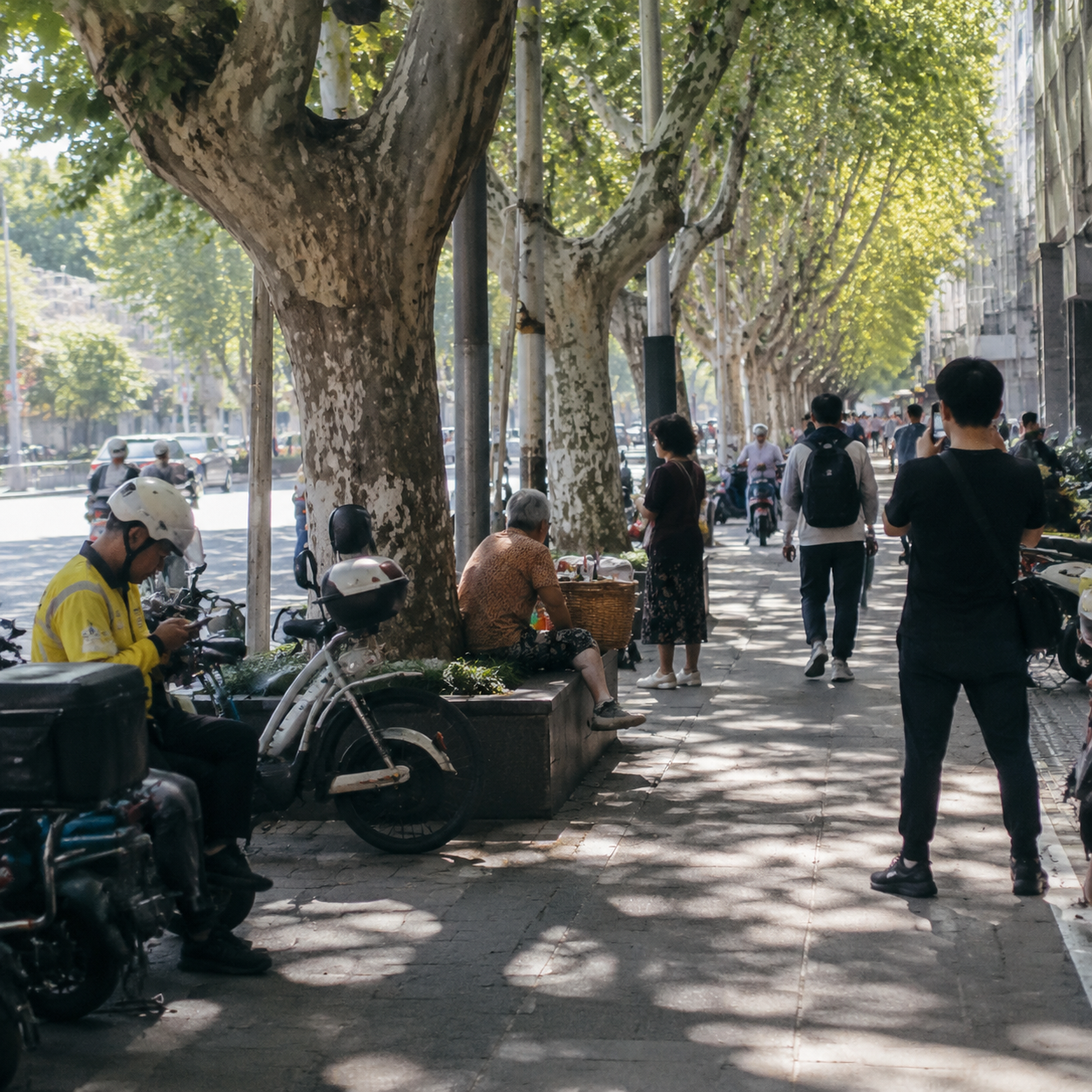
I began to treat the walk as a small field note. The first layer of memory was underfoot: roots had lifted the bricks, the pavement was not perfectly even, and pedestrians slowed almost naturally, as if the city were asking them not to move only at the speed of efficiency. The second layer was in the ear: bus announcements, bicycle bells, the sound of shop shutters, all blended with the rustle of leaves. The third layer was on the skin: step from sunlight into shade and the body cools before the mind names the change. City memory is not a souvenir locked in a display case. It begins as a difference the body recognizes.
在南京,梧桐常常被讲成历史符号,但符号这个词有时太硬,好像一棵树必须先被解释,才有资格被记住。那天我更愿意相信,记忆是在反复使用中沉下来的。树荫替人挡过夏天,替路边摊留过一点舒适,替等车的人争取过几分钟耐心,也替夜里回家的人把街灯滤得柔和。多年以后,一个人说起某条路,未必能准确说出哪一年修过、哪一段有名,却会记得“那里很凉”“那里像回到小时候”“那里走起来不急”。
In Nanjing, the plane trees are often described as historical symbols, but the word symbol can be too rigid, as if a tree must be explained before it deserves to be remembered. That afternoon I preferred a quieter idea: memory settles through repeated use. Shade has protected people from summer heat, kept a roadside stall bearable, lent patience to someone waiting for a bus, and softened streetlights for people walking home at night. Years later, a person may not recall the exact date a road was widened or which section is most famous. They may simply remember that it was cool there, that it felt like childhood, that walking there did not feel rushed.
我沿着树影往前走,看见一位师傅在修自行车。他的摊子没有招牌,工具盒打开在地上,补胎水、扳手、旧抹布都摆得顺手。他说这条路热闹的时候人多,清静的时候也不空,因为总有人要经过。对他来说,梧桐不是风景,而是工作条件的一部分:上午阴影偏东,下午偏西,雨后叶子滴水,秋天落叶要扫开才好放车。这样的叙述没有宏大词汇,却比任何宣传句都更接近城市如何被人长期相处。
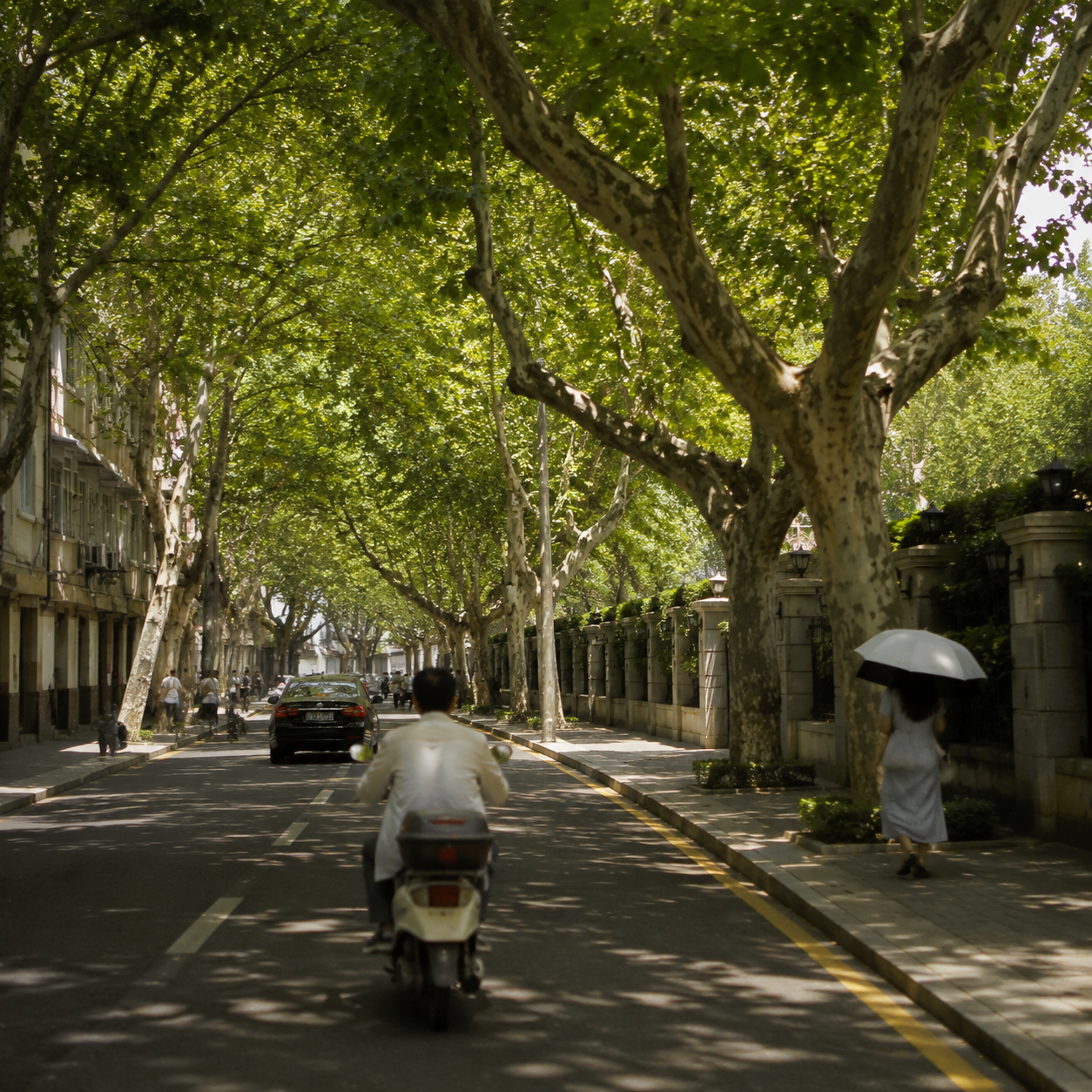
Following the shade, I came upon a man repairing bicycles. His stand had no sign. A tool box lay open on the ground, with patching fluid, wrenches, and an old rag arranged by habit rather than design. He said the road was busy when it was busy and never truly empty when it was quiet, because someone always needed to pass. For him, the plane trees were not scenery but part of his working conditions: the morning shade leaned east, the afternoon shade leaned west, leaves dripped after rain, and in autumn the fallen ones had to be swept aside before bikes could be set down. His account contained no grand vocabulary, yet it came closer to long companionship with a city than any slogan could.
城市记忆最容易被误会成统一答案:一座城应该记住什么,应该怎样表达,应该用什么姿态面对外地人。可树下的南京提醒我,记忆其实有很多入口。有人从民国建筑进入,有人从鸭血粉丝汤进入,有人从秦淮河的夜色进入,也有人只是从一段午后树影进入。入口不同,并不说明记忆浅或深,只说明城市没有被单一叙事完全占有。真正结实的记忆,往往允许普通人把自己的小经验放进去。
City memory is often mistaken for a single answer: what a city should remember, how it should speak, what posture it should take toward outsiders. Nanjing under the trees suggested something else. Memory has many entrances. Some people enter through Republican-era buildings, some through duck-blood vermicelli soup, some through the night colors of the Qinhuai River, and some through a stretch of afternoon shade. Different entrances do not prove that one memory is shallow and another deep. They show that a city has not been completely captured by one narrative. Durable memory leaves room for ordinary people to place their own small experience inside it.
有一段路的树冠合得很密,阳光只剩碎片。我看到两个学生边走边背单词,声音不大,像怕惊动路边的安静。旁边一位老先生把手背在身后,走得很慢,经过一棵树时停下来看树皮。他没有拍照,只是看了一会儿。那一刻我明白,所谓城市记忆不一定总要被分享,不一定要上传,不一定要证明给谁看。它也可以只是一个人站在熟悉的树前,确认时间已经变了,而自己还能认出某些纹理。
On one section the crowns met so closely that sunlight arrived only in fragments. Two students walked by reciting vocabulary in low voices, as if they did not want to disturb the quiet along the curb. An older gentleman, hands clasped behind his back, moved slowly and stopped before a trunk to study the bark. He did not take a picture. He simply looked for a while. In that moment I understood that city memory does not always need to be shared, uploaded, or proven to anyone. It may be one person standing before a familiar tree, recognizing that time has changed while certain textures remain legible.
当然,树也会带来现实问题:根系顶起路面,落叶堵住排水口,枝条需要修剪,台风和暴雨之后更要排查安全。把梧桐说得太诗意,反而会忽略城市管理里辛苦的一面。但如果只把它们看成绿化设施,也会失去另一种尺度。它们既是需要维护的生命,也是街道记忆的容器。城市的成熟,不在于把复杂事物压成一种结论,而在于承认一棵树可以同时麻烦、必要、脆弱、可靠,还与很多人的生活史相连。
The trees also create practical problems: roots lift pavement, fallen leaves block drains, branches require pruning, and after storms safety checks become urgent. If we speak of them only poetically, we miss the labor of urban management. If we reduce them to landscaping equipment, we lose another scale of meaning. They are living things that require care, and they are containers of street memory. A mature city does not flatten complicated things into one conclusion. It admits that a tree can be troublesome, necessary, fragile, reliable, and connected to many private histories at the same time.
傍晚时分,树影开始拉长,路边建筑的墙面变成暖色。白天被高温逼得沉默的街道慢慢恢复谈话声,小店门口有人搬出凳子,骑车的人从叶影里一闪而过。这个时候我最能理解南京的缓慢。它不是没有变化,也不是故意怀旧,而是在快速更新的表面之下,仍保留一些让人辨认方向的东西。梧桐的阴影像一张旧地图,不标注所有地点,却让人知道自己还在某种连续性里面。
Toward evening, the shadows lengthened and the walls of roadside buildings turned warm. The street, silenced by the heat of the day, slowly recovered its voices. Someone carried stools to the front of a small shop. Cyclists flashed through patterns of leaves. At that hour I understood Nanjing’s slowness most clearly. It is not an absence of change, nor a deliberate nostalgia. Beneath the visible surface of renewal, the city keeps certain things by which people can orient themselves. The shade of the plane trees is like an old map: it does not label every place, but it tells you that you are still inside a continuity.
我离开那条路时,没有得到一句可以轻松概括南京的话。相反,我带走的是一些零散但牢靠的画面:修车师傅伸手够扳手,学生在树下念英文,老人看树皮,公交车从绿色阴影里驶出,落叶贴在雨后的路边。这些画面没有把城市装饰得更传奇,却让城市更可信。记忆如果只剩口号,就会离生活越来越远;如果能落在阴影、脚步、气味和等待里,它就会重新变得可触摸。
When I left the road, I did not carry away a sentence that neatly summarized Nanjing. I carried fragments that felt steadier than a summary: the bicycle repairman reaching for a wrench, students reciting English under the leaves, an old man studying bark, a bus emerging from green shadow, fallen leaves pressed to the wet curb. These images did not make the city more legendary. They made it more believable. When memory becomes only a slogan, it drifts away from daily life. When it settles into shade, footsteps, smells, and waiting, it becomes touchable again.
所以,南京梧桐给我的启发并不是“这里有历史”这么简单,而是历史如何通过日常继续发生。它不只在博物馆门口,不只在纪念碑旁,也在一段被反复走过的路上,在一个人选择停下来的阴凉处,在一座城市愿意照看旧树的耐心里。城市记忆不是要求每个人背诵同一段说明,而是让不同的人在同一片树影下,找到各自能理解的时间。那一天,我没有把梧桐当成背景;我把它们当成南京正在低声说话的方式。
What Nanjing’s plane trees gave me, then, was not the simple message that history exists here. They showed me how history continues through the everyday. It is not only at museum entrances or beside monuments. It is on a road walked again and again, in a patch of coolness where someone chooses to pause, and in a city’s patience toward old trees that still need care. City memory does not require everyone to recite the same explanation. It allows different people under the same shade to find their own version of time. That day I stopped treating the plane trees as background. I heard them as one of the ways Nanjing speaks softly.
- 来华必备手机应用 | Mobile Apps You Need in China
- 深圳夜里的便利店,让我看见中国城市的另一种安全感 | A Convenience Store at Night in Shenzhen Showed Me Another Kind of Urban Safety
- 广州早茶桌上,孩子先学会了听,再学会了说 | At a Guangzhou Dim Sum Table, My Child Learned to Listen Before Speaking
- 在青岛,海不会一上来就把你征服,它先让你顺着坡和街区慢慢靠近 | In Qingdao, the Sea Does Not Conquer You at Once; It First Draws You Through Slopes and Streets
- 中国城市地铁出行技巧 | Tips for Using Metro in Chinese Cities
- 中秋赏月最美地点推荐 | Best Places to Enjoy the Mid-Autumn Moon
- 六月毕业旅行目的地推荐 | June Graduation Trip Destinations in China
- 微信支付开通全流程(境外用户) | WeChat Pay Setup for Foreign Visitors
- 云贵川大环线15日自驾 | 15-Day Yunnan-Guizhou-Sichuan Road Trip
- 杭州下雨的下午,孩子第一次主动找陌生小朋友一起玩 | On a Rainy Afternoon in Hangzhou, My Child Asked a Stranger to Play Together
Comments (0)