
拉萨的雨停以后,连水洼边的小停顿都像一种进入方式 | After Rain in Lhasa, Even a Pause Beside a Puddle Felt Like a Way of Entering the City
70# 雨后的拉萨,我把赶路改成了慢走 | After Rain in Lhasa, I Changed Rushing into Slow Walking
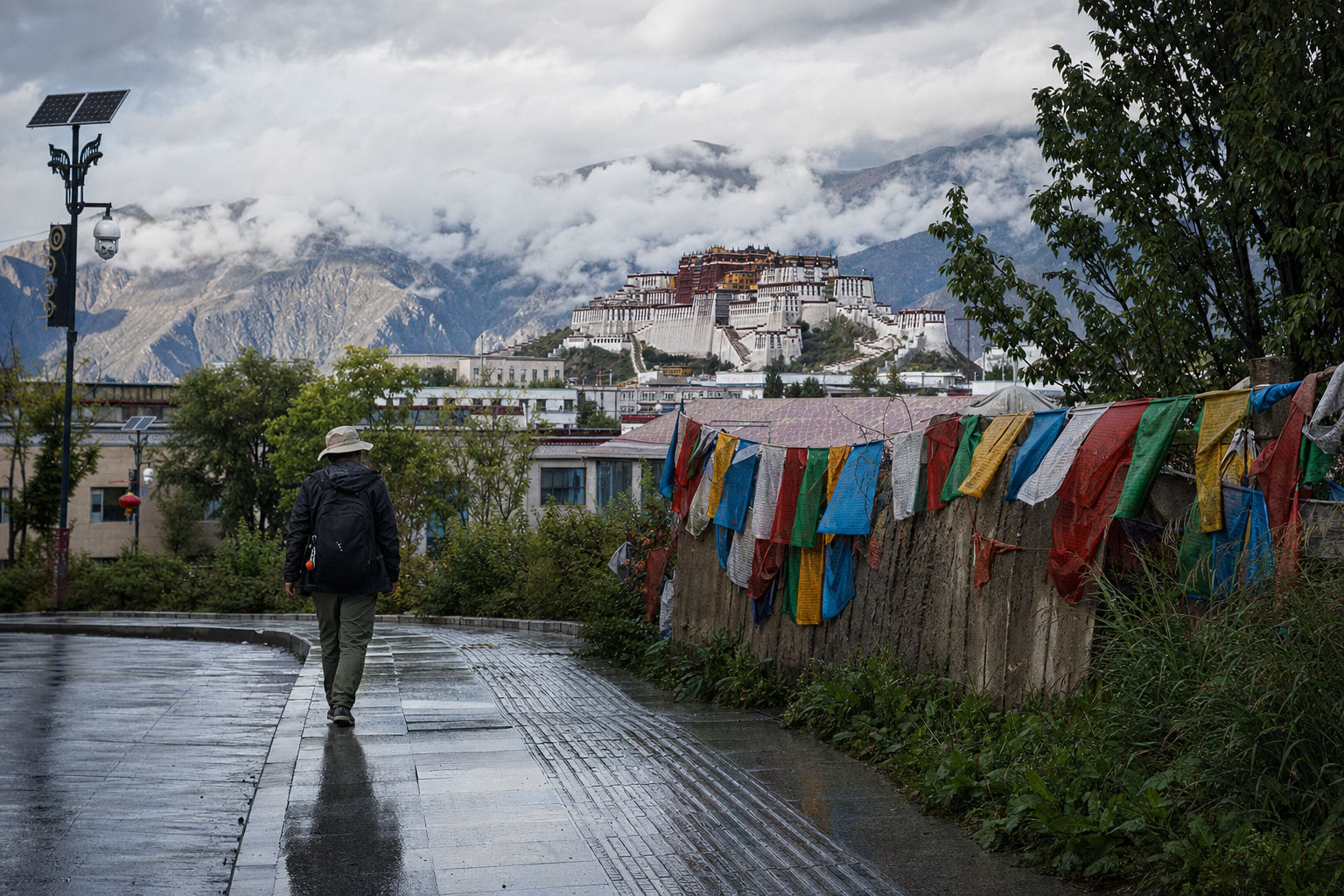
雨刚停的时候,拉萨像从一只清水碗里被轻轻端出来。云还压在山脊上,低得仿佛伸手就能摸到湿润的边缘,布达拉宫的白墙在灰蓝色天光里显得更安静,不是明信片上那种耀眼的白,而是一种被雨水洗过、把尘土和喧哗都暂时收进石缝里的白。我从住处出来,没有急着去任何景点,只沿着还泛着水光的人行道慢慢走。路边的经幡垂着,颜色被雨浸得更深,红黄蓝绿白像刚从梦里醒来的句子。空气里有泥土、柏枝、酥油茶和潮湿石板混在一起的味道,吸进肺里微凉,却不锋利。有人把店门前的水扫到沟里,扫帚划过地面的声音细细的,像给清晨做注脚。我的鞋底踩过浅浅的积水,倒影被脚步轻轻打散,又很快合拢。拉萨的雨后并不催人,它让人把肩膀放低,把眼睛放慢,把心里那些赶路的钟表暂时停下。
When the rain had just stopped, Lhasa seemed to have been lifted gently out of a clear bowl of water. Clouds still rested on the ridges, so low that their damp edges felt almost touchable, and the white walls of the Potala Palace looked quieter under the gray-blue light. It was not the dazzling white of postcards, but a washed white that had tucked dust and noise into the seams of stone for a while. I stepped out from my lodging without hurrying toward any attraction, choosing instead to follow the sidewalks that still shone with rain. Prayer flags hung lower after the shower, their colors deepened by moisture, red, yellow, blue, green, and white like sentences waking from a dream. The air carried soil, juniper, butter tea, and wet flagstone, cool in the lungs but not sharp. Someone swept water from a storefront into the gutter, the broom tracing a thin sound across the ground, like a footnote to morning. My soles broke shallow reflections in puddles, and the images closed again behind me. After rain, Lhasa does not urge anyone forward; it lowers the shoulders, slows the eyes, and pauses the clocks that keep marching inside the heart.
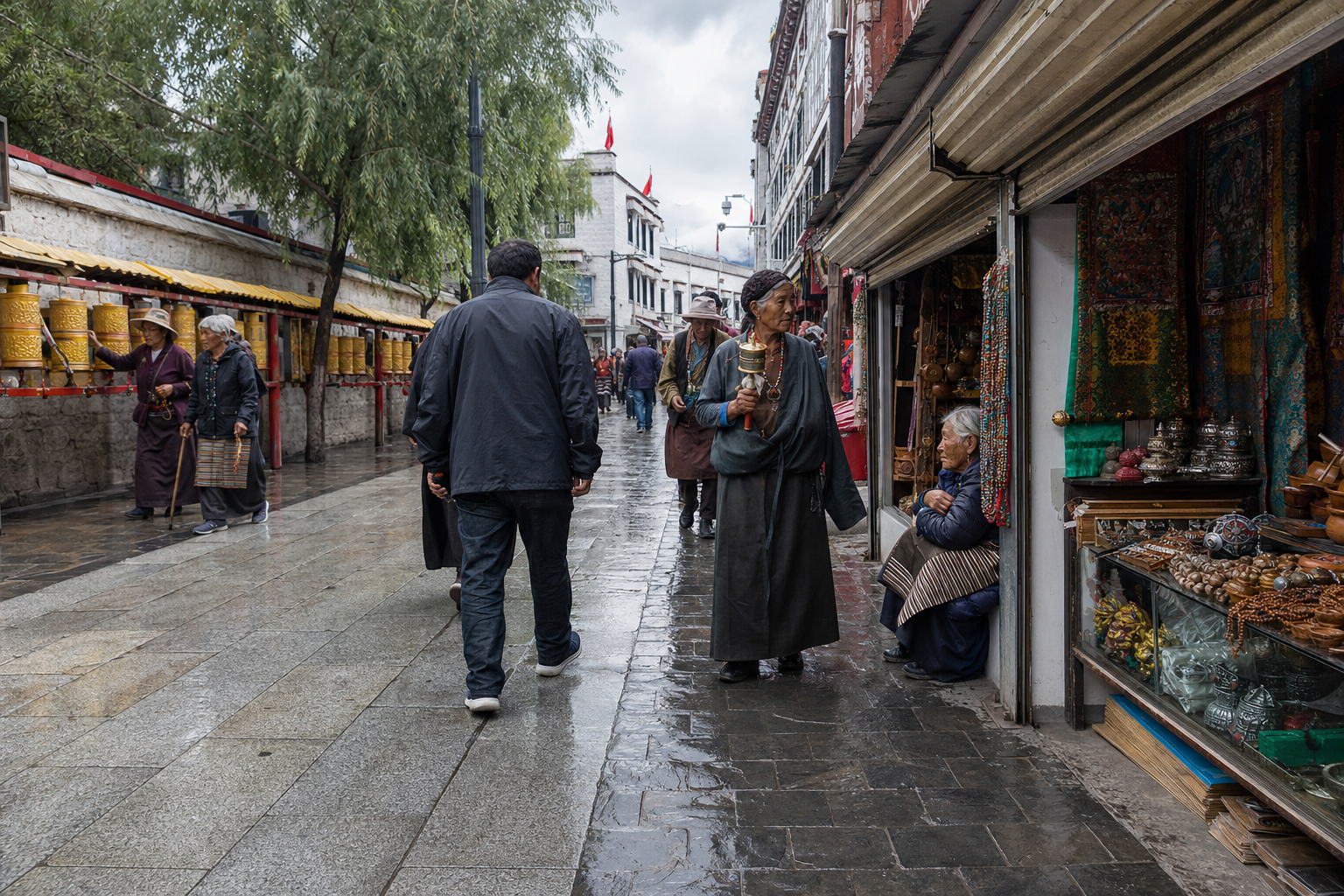
沿着北京东路往八廓街方向走,车声被雨后的湿气压得柔和,连喇叭也像隔着一层布。商铺陆续开门,银饰、唐卡、木碗、藏香都在半开的门缝里露出一点颜色。门口坐着的老人把袖子拢在一起,看着行人经过,眼神像已经看过许多季节,因此不需要急着评价这一刻。转经的人从路口出现,有的手里转着小小的经筒,有的只是低声念诵,脚步绕着同一条古老的方向前行。雨水把石板路磨得发亮,许多脚印叠在上面,又被下一阵风吹来的细尘覆盖。一个年轻母亲牵着孩子,孩子蹲下来盯着水洼里倒映的屋檐,母亲没有催促,只站在旁边等。那种等待很像拉萨给人的感觉:它知道你会继续走,也知道你需要在某个小水洼前停一会儿。我的慢走不是懒散,而是一种顺从,顺从空气里缓慢展开的节奏,也顺从雨后每一处细节都想被看见的心愿。
Walking along Beijing East Road toward Barkhor Street, I noticed how the dampness softened the traffic, even horns sounding as if wrapped in cloth. Shops opened one after another, and silver ornaments, thangkas, wooden bowls, and Tibetan incense revealed bits of color through half-open doors. Elderly people sat at thresholds with sleeves folded together, watching passersby with eyes that had seen enough seasons not to judge the moment too quickly. Pilgrims appeared at the intersection, some turning small prayer wheels, others simply murmuring under their breath, all moving along an old shared direction. The rain had polished the stone road until it shone; many footprints overlapped there, then were covered by fine dust brought by the next breeze. A young mother held a child by the hand, and the child crouched to examine an eave reflected in a puddle. The mother did not rush him, only waited beside him. That waiting resembles what Lhasa gives a traveler: it knows you will continue, and it also knows you may need to pause before a small pool of water. My slow walk was not laziness, but obedience to the rhythm unfolding in the air, and to the desire of every rain-washed detail to be noticed.
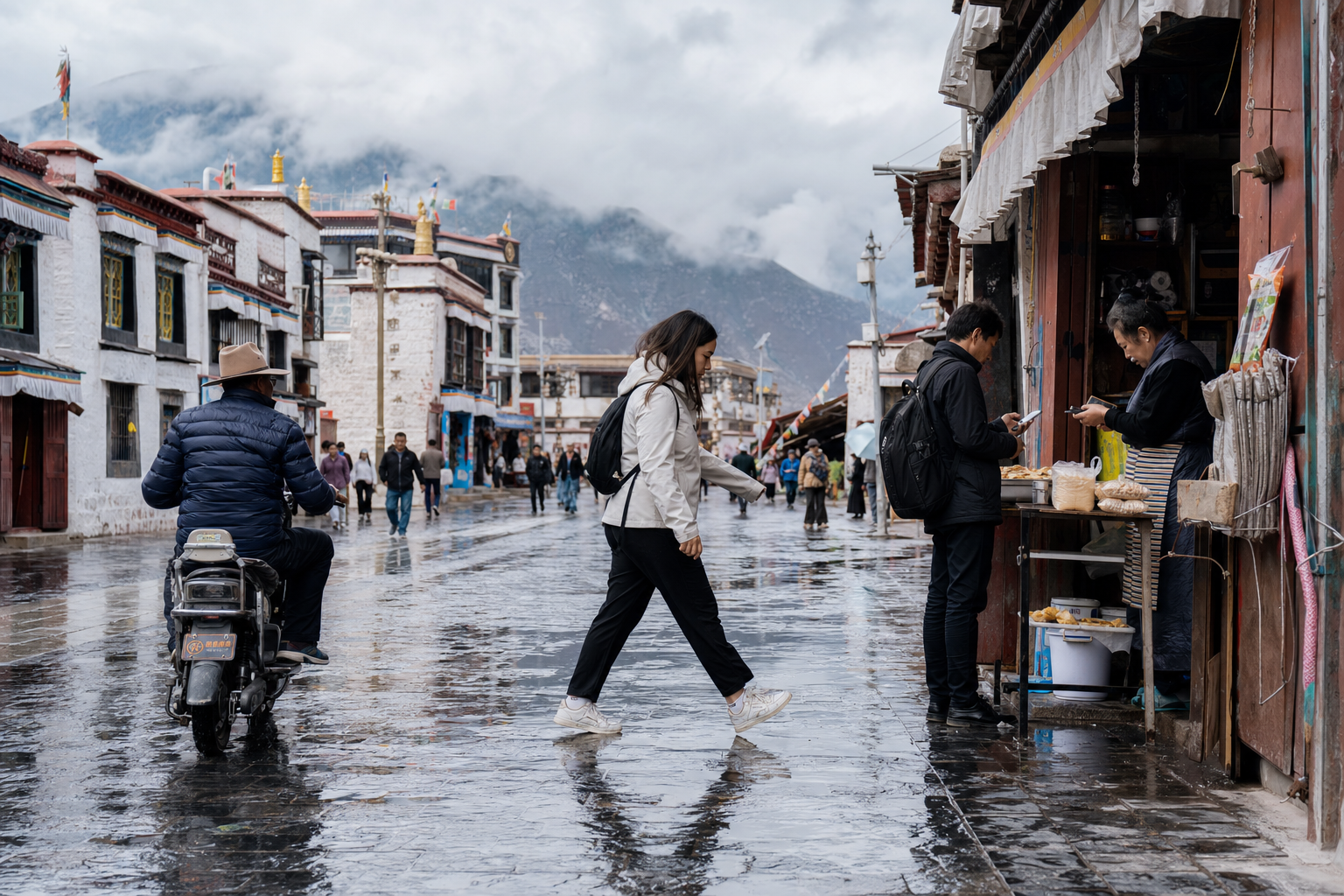
八廓街在雨后尤其像一条会呼吸的环。人群并不稀少,却因为地面湿亮、天空低垂而显得更有秩序。每个人都被路面反射出一点影子,像同时走在地上和水里。屋檐下悬着一串串铜铃,风吹过时发出轻响,声音没有传得很远,却足够提醒人这里还有看不见的时间在流动。小店里飘出甜茶的热气,玻璃窗上凝着雾,里面的人端着杯子说话,嘴唇开合的幅度很小,仿佛怕惊动雨后的静。街边卖糌粑和牦牛肉干的摊主把塑料布掀开一角,检查货物有没有受潮。两个背包客站在路边研究地图,脸上写着想要把城市弄明白的认真,可拉萨偏偏不是一张很快能读完的地图。它更像一圈圈转经的路径,你走得越慢,越明白所谓抵达并不一定是进入某个建筑,而是在一段路上忽然与自己的呼吸相遇。
After rain, Barkhor Street feels especially like a breathing ring. The crowd is not thin, yet the shining pavement and low sky give it a deeper order. Everyone is reflected faintly by the road, as if walking on earth and water at once. Strings of bronze bells hang under eaves; when wind passes, they make a soft sound that does not travel far, but is enough to remind you that invisible time is moving here. Steam from sweet tea drifts out of small shops, fogging the glass, while people inside hold cups and speak with small movements of the lips, as if afraid to disturb the quiet after rain. Vendors selling tsampa and dried yak meat lift corners of plastic covers to check whether their goods have taken on moisture. Two backpackers stand by the road studying a map, wearing the earnest expression of people trying to understand a city, but Lhasa is not a map that can be read quickly. It is more like the circular path of circumambulation: the slower you walk, the more you understand that arrival is not always entering a building, but suddenly meeting your own breath along a road.
我在一处茶馆停下,点了一壶甜茶。木桌被许多手肘磨得发亮,桌面有浅浅的划痕,像岁月留下的细河道。窗外的雨水从屋檐滴落,断断续续,像一首不肯结束的曲子。旁边一桌坐着几个当地人,他们说话时偶尔笑起来,笑声很短,却很暖。茶倒进杯里,奶香和茶香融合得厚实,甜味不是突然袭来的,而是一点点铺开,让身体从指尖开始变得松弛。我把杯子捧在手里,看窗外经过的行人:披着雨衣的骑车人、背着书包的学生、戴着宽檐帽的老人、拎着蔬菜的妇女。他们构成了雨后拉萨真正的风景,比任何宏大的建筑都更细密。旅行者常常带着寻找奇迹的愿望来到高原,可在这间茶馆里,我忽然觉得奇迹也可以很小,小到一杯茶的温度,小到屋檐下一滴水迟迟不落,小到陌生人的笑声在木墙上停留片刻。
I stopped at a teahouse and ordered a pot of sweet tea. The wooden table had been polished by countless elbows, its surface marked with shallow scratches like narrow rivers left by time. Outside the window, rainwater dripped from the eaves in broken intervals, like a song unwilling to end. Several locals sat at the next table; sometimes they laughed while talking, the laughter short but warm. Tea poured into the cup, milk and leaves blending into a dense fragrance. The sweetness did not strike suddenly, but spread slowly, loosening the body from the fingertips inward. Holding the cup, I watched pedestrians pass outside: a cyclist in a raincoat, students with backpacks, an old man in a broad-brimmed hat, a woman carrying vegetables. Together they formed the true scenery of Lhasa after rain, more intricate than any grand building. Travelers often arrive on the plateau hoping to find miracles, yet in that teahouse I felt that miracles can also be small: the warmth of a cup of tea, a drop of water hesitating under an eave, the laughter of strangers lingering for a moment on a wooden wall.
离开茶馆时,天色稍稍亮了一些,远处山线从云后露出,像被慢慢擦干的墨迹。我沿着一条巷子往里走,巷口有孩子追逐,鞋底溅起水花,笑声在墙面之间弹来弹去。墙上刷着新旧不一的颜色,有的地方被雨冲出斑驳,有的地方贴着告示和褪色的海报。巷子里没有壮观的景物,却有生活的密度:一扇门里传出切菜声,一扇窗后有人晾起刚洗过的衣服,一只狗趴在台阶上,懒懒地看我经过。雨后的阳光没有立刻强烈起来,只是从云缝里一点点漏下,给湿墙和水坑镶上浅金色边缘。在这样的光里,时间显得不那么直线,它像绕路的水,愿意在低处停留,也愿意顺着看不见的坡度慢慢流走。我想起自己来拉萨前列过许多清单,可真正让我记住的,也许正是这些不在清单上的巷子、狗、门声和微光。
When I left the teahouse, the sky had brightened a little, and the distant mountain line emerged from behind the clouds like ink slowly wiped dry. I turned into a lane where children chased one another near the entrance, their shoes splashing water and their laughter bouncing between walls. The walls were painted in uneven layers of old and new colors; some places had been mottled by rain, while others carried notices and faded posters. There was nothing spectacular in the lane, but there was the density of life: chopping sounds from behind one door, freshly washed clothes hung behind a window, a dog lying on a step and watching me pass with lazy eyes. The sunlight after rain did not grow strong at once; it leaked gradually through the clouds, edging wet walls and puddles with pale gold. In such light, time seemed less like a straight line and more like water taking detours, willing to linger in low places and flow away along invisible slopes. Before coming to Lhasa I had made many lists, but what I may remember most are these unlisted lanes, dogs, door sounds, and pieces of light.
午后,雨云散得更开,街上开始有了晒东西的人。有人把湿坐垫摊在门口,有人把经书和布包放到阳光里短暂透气。空气仍然清冷,但不再潮重,柏香从一处寺院方向飘来,混着车辆排气和烤饼的味道,形成一种只属于城市本身的复杂气息。我走到一个可以远望布达拉宫的路口,许多人停下来拍照,手机举起又放下。雨后的宫殿看起来并不遥远,它沉稳地坐在那里,像一位不说话的长者,允许人们用不同速度靠近,也允许人们只是远远看一眼。我没有急着拍照,只把双手插进口袋站了一会儿。风从街对面吹来,带着水汽最后的凉意。那一刻我明白,慢走不是为了故意显得深刻,而是因为有些地方本来就拒绝被匆忙消费。它们需要你交出一点时间,才肯把自己的层次慢慢展开。
By afternoon the rain clouds had opened wider, and people began drying things in the streets. Someone spread damp cushions at a doorway; someone placed scriptures and cloth bags briefly in the sun to air them. The air remained cool but no longer heavy with moisture. Juniper scent drifted from the direction of a temple, mingling with vehicle exhaust and baked bread, forming a complex breath that belonged only to the city itself. I reached an intersection from which the Potala Palace could be seen, and many people stopped to take photographs, raising and lowering their phones. After rain, the palace did not seem distant. It sat there steadily, like a silent elder, allowing people to approach at different speeds and allowing others simply to look from afar. I did not hurry to take a picture; I only stood for a while with my hands in my pockets. Wind came from across the street, carrying the last coolness of water. In that moment I understood that walking slowly is not a pose of depth, but a response to places that refuse to be consumed in haste. They require you to offer a little time before they unfold their layers.
傍晚之前,我又回到八廓街外侧。雨水已经从大多数石缝里退去,只在低洼处留下一点暗亮。摊位的灯逐渐亮起,金属饰物反射出细碎的光,像把天空剩下的水色分成许多小片。转经的人仍在走,速度与清晨相差无几,好像一天的变化并没有改变他们脚下的圆。游客多了起来,谈话声、相机声、扫码付款声与远处的诵经声叠在一起,却没有让我觉得混乱。也许因为雨后的城市已经把声音调低过一次,所以再热闹也保留着某种底层的安静。我买了一串简单的手绳,摊主把它放进我掌心,说了句很轻的祝福。我并不确定自己是否完全听懂,但那语气足以让人相信祝福不需要复杂语法。继续走时,手绳在腕间微凉,像一小段被雨水洗过的路,被我带着向夜色里去。
Before evening I returned to the outer side of Barkhor Street. Rainwater had withdrawn from most cracks between stones, leaving only a dim shine in low places. Stall lights gradually came on, and metal ornaments reflected broken sparks, as if dividing the sky’s remaining water-color into many small pieces. Pilgrims were still walking, their pace hardly different from morning, as though the day’s changes had not altered the circle beneath their feet. More tourists appeared, and conversation, camera clicks, mobile payment sounds, and distant chanting layered together, yet the street did not feel chaotic. Perhaps the city after rain had already lowered the volume once, so even liveliness kept a basic quiet underneath. I bought a simple woven bracelet, and the vendor placed it in my palm with a softly spoken blessing. I was not sure I fully understood the words, but the tone was enough to make me believe that blessings do not require complicated grammar. As I walked on, the bracelet felt cool on my wrist, like a short piece of rain-washed road carried with me into night.
夜色降临时,拉萨的雨后慢走终于从白天的清澈转向灯火的温柔。街灯亮在湿过的墙边,光晕比平时更大,像每盏灯都多了一层呼吸。远处的建筑轮廓逐渐沉入蓝黑色,近处的人脸却被店铺灯光照得柔和。晚饭的香味从各处飘来,面片汤、烤肉、甜茶、青稞酒的气息在巷口交汇。我的步子依然不快,因为我知道这一天真正的收获不是走了多少路,而是让自己重新学会怎样走路。现代生活总把效率挂在前面,把抵达看成唯一答案,可拉萨雨后告诉我,路本身也会回答问题。它用水光回答,用沉默回答,用一圈圈脚步和一盏盏灯回答。回到住处前,我回头看了一眼来时的街,水迹已经快干了,但那种缓慢仍留在身体里,像一场雨没有完全停。
When night descended, the slow walk through Lhasa after rain shifted from daytime clarity to the tenderness of lights. Streetlamps glowed beside walls that had been wet, their halos larger than usual, as if each lamp had gained another layer of breath. The outlines of distant buildings sank into blue-black, while nearby faces softened under shop lights. Dinner smells drifted from everywhere: noodle soup, roasted meat, sweet tea, and barley wine meeting at lane entrances. My pace remained unhurried because I knew the day’s real gain was not how far I had walked, but that I had relearned how to walk. Modern life always places efficiency in front and treats arrival as the only answer, but Lhasa after rain told me that the road itself can answer questions. It answers with reflected water, with silence, with circles of footsteps and lamps coming on one by one. Before returning to my lodging, I looked back at the street I had followed. The water marks were almost dry, yet the slowness remained in my body, like a rain that had not completely stopped.
后来我想,如果有人问我雨后的拉萨最值得看什么,我也许不会先说某座宫殿或寺院,而会说请留出一个没有安排的下午。不要急着把城市装进相册,不要害怕错过所谓重点,只要在雨停后走出去,看水怎样从屋檐落下,看云怎样从山边松开,看陌生人的日常怎样在湿润空气里继续。你会发现,高原的庄严并不总是以宏大的方式出现,它也藏在一把扫帚的声音里,藏在茶杯的温度里,藏在孩子蹲看水洼时无人催促的耐心里。慢走让这些微小事物浮上来,让旅行从占有风景变成与风景互相停留。拉萨不会因为你走得慢而减少什么,反而会因为你的慢,给出更多缝隙里的光。雨后的路最终会干,云也会散,但那种被城市温柔放慢的感觉,会在很久以后仍然提醒我:有些地方不是用来赶到的,是用来陪着它一起呼吸的。
Later, I thought that if someone asked what is most worth seeing in Lhasa after rain, I might not begin with a palace or a temple. I would say: leave yourself an afternoon without arrangements. Do not hurry to fit the city into an album, and do not fear missing the so-called highlights. Simply walk out after the rain stops and watch water fall from eaves, clouds loosen from the mountains, and strangers’ daily lives continue in damp air. You will discover that the solemnity of the plateau does not always appear in grand forms. It also hides in the sound of a broom, in the warmth of a teacup, in the patience of a child crouching over a puddle while no one urges him onward. Slow walking lets these small things rise to the surface, turning travel from possession of scenery into a mutual lingering with it. Lhasa loses nothing because you walk slowly; instead, because of your slowness, it offers more light from its seams. The road after rain will eventually dry, and the clouds will scatter, but the feeling of being gently slowed by the city will remind me long afterward: some places are not meant to be rushed toward, but breathed with.
- 乌鲁木齐老街的灯一亮,孜然和人声就把夜晚烤热了 | Once the Old-Street Lights Came On in Urumqi, Cumin and Voices Warmed the Night
- 在景区买票前,我先学会确认日期和入园时段 | Before Buying Scenic Tickets, I Learned to Confirm Date and Entry Time
- 扎染工作坊:我第一次把一块白布慢慢等成风景 | Tie-Dye Workshop: The First Time I Waited for a White Cloth to Become a Landscape
- 冬至温泉之旅:全国最佳泡汤地 | Winter Solstice Hot Spring Tour
- 早上七点,广州人已经喝了两轮茶 | Morning Tea in Guangzhou: A Ritual Before the Rest of China Wakes Up
- 我原以为古装秀会很“复古”,直到看见现代妆发把整场秀台点亮 | I Expected an Ancient-Costume Show to Feel Purely Historical Until Modern Hair and Makeup Lit Up the Entire Runway
- 从汉服到旗袍,我在中国各朝代的衣柜里翻了个遍 | I Raided the Wardrobe of Every Chinese Dynasty and Here's What I Found
- 中国医疗就诊指南:看病买药与保险 | Medical Care in China: Hospitals, Pharmacies & Insurance
- 我在成都学会把夜间抵达拆成一连串小判断 | In Chengdu I Learned to Break a Night Arrival into Small Judgments
- Good Good Study, Day Day Up:那些让老外笑出腹肌的中式英语 | Chinglish That Makes Foreigners Laugh Till They Cry
Comments (0)