
遵义老城坡道上,我把台阶数错了 | I Lost Count of the Steps on Zunyi’s Old-Town Slopes
遵义老城坡道上,我把台阶数错了 | I Lost Count of the Steps on Zunyi’s Old-Town Slopes
雨先落在坡面上 / Rain Came Down on the Slopes First
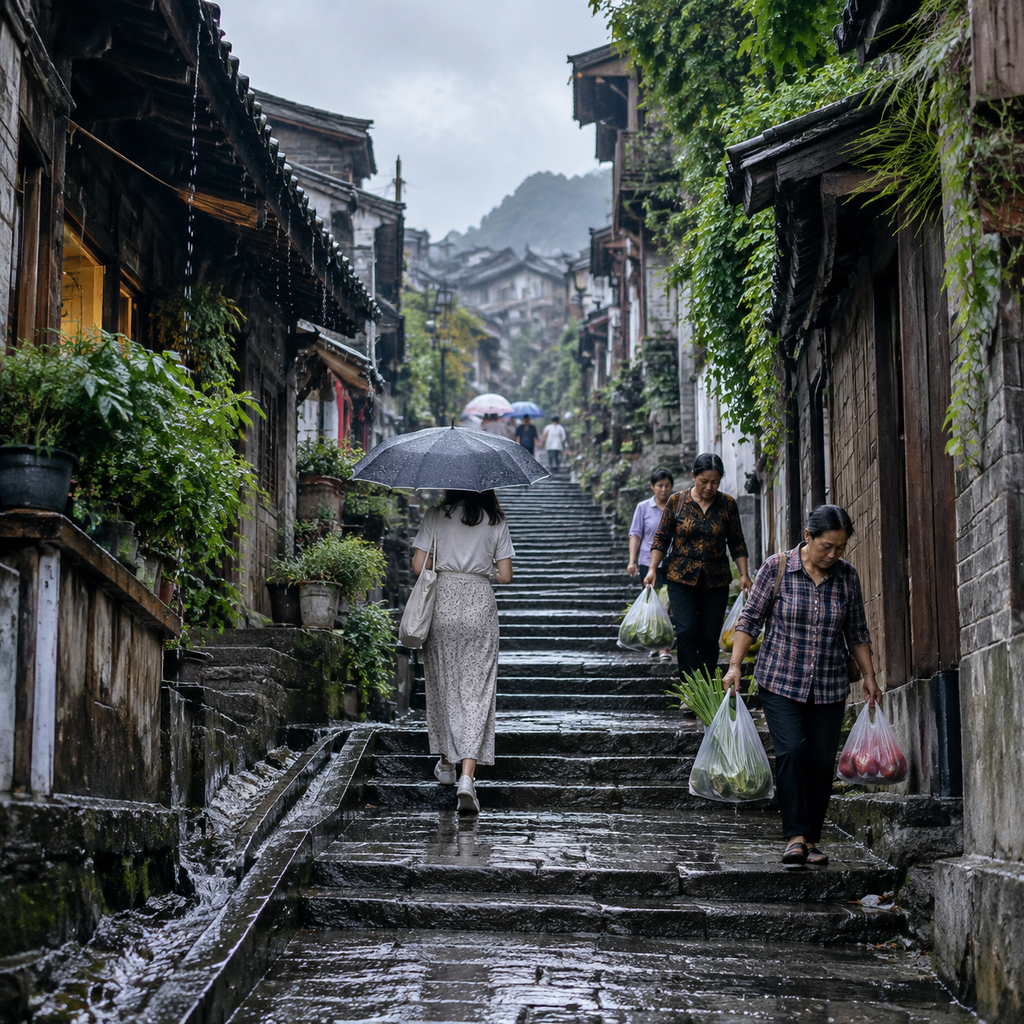
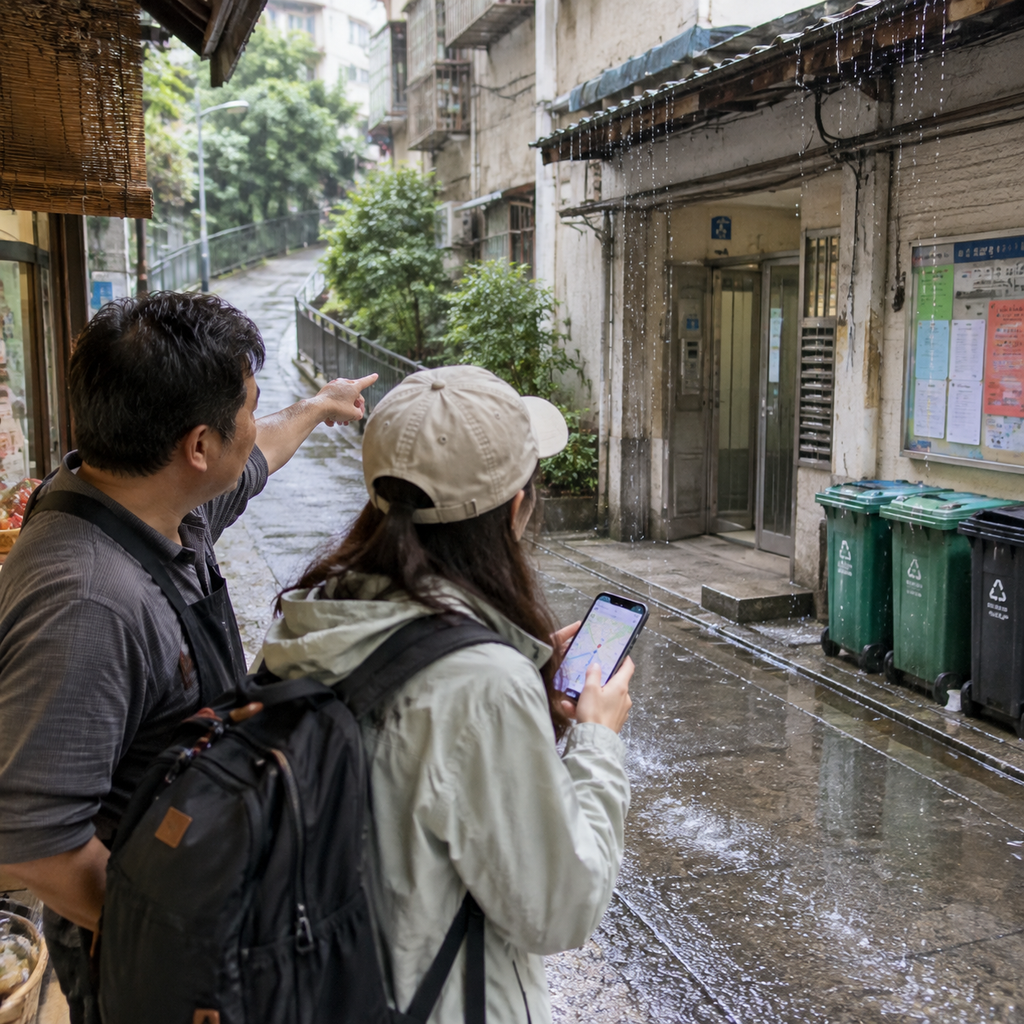
雨后的遵义老城,最先改变的不是颜色,而是脚下的判断。那天上午,云层压得很低,旧街屋檐滴着连续的水线,石板和水泥台阶都泛着薄光。记录者站在一段向上收窄的坡道下,手里没有路线表,只有手机里一张被放大过几次的地图。他原本以为这一段不过一百多级,打算数完台阶再决定要不要继续往高处走。几位买菜的居民从他身边经过,有人把伞柄夹在臂弯里,有人提着装青菜的塑料袋,脚步比他快,也没有抬头看坡顶。坡道在雨里显得比地图上更长,台阶的边缘被水打得发暗,第一眼就提醒人:这里不能只按距离安排体力。
After the rain, the first thing to change in Zunyi’s old town was not its color but the judgment required by the ground. That morning the clouds hung low, water fell in steady lines from the eaves, and the stone paving and concrete steps carried a thin sheen. The observer stood at the foot of a narrowing uphill lane with no printed route plan, only a map enlarged several times on his phone. He had assumed the section would contain little more than a hundred steps and planned to decide at the top whether to continue higher. Residents buying vegetables passed him: one held an umbrella under her arm, another carried a plastic bag of greens. They walked faster without looking toward the crest. In the rain, the slope looked longer than it had on the map, an early reminder that distance alone cannot organize one’s energy here.
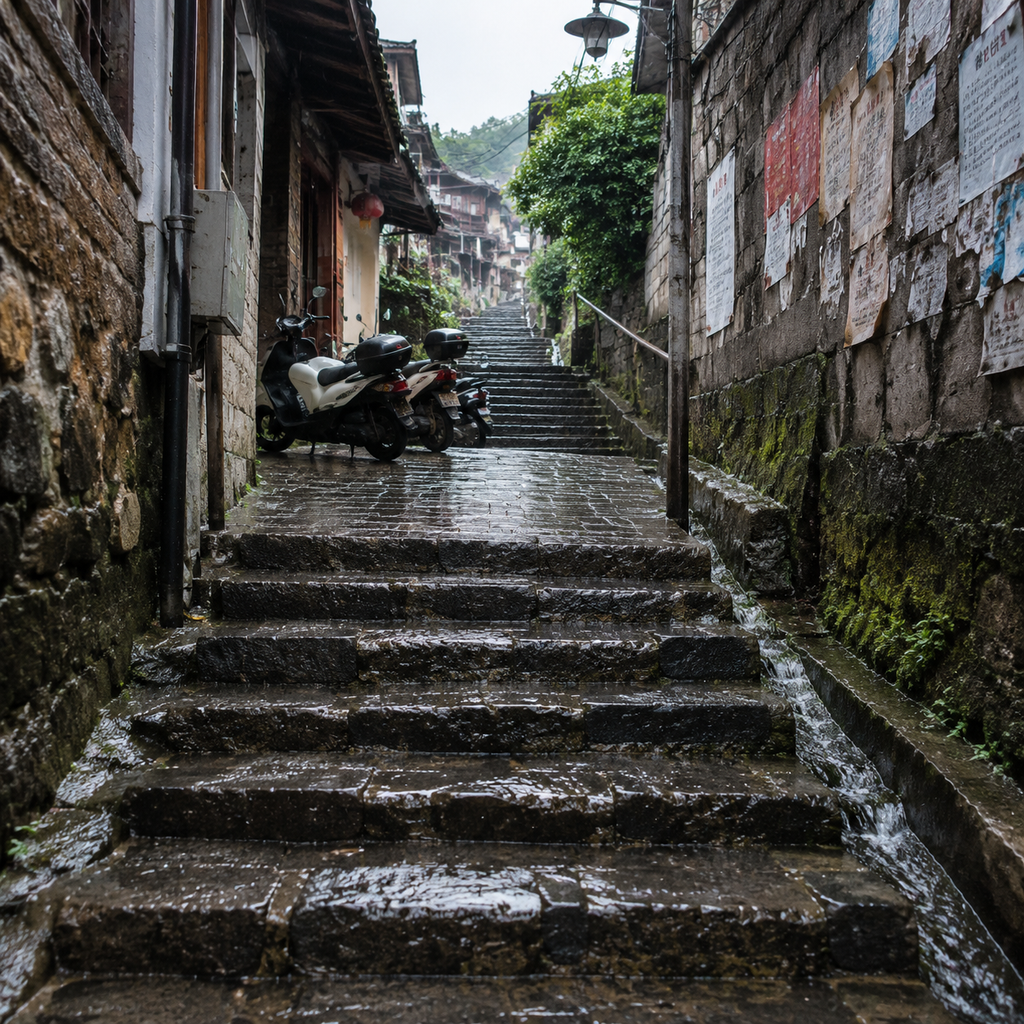
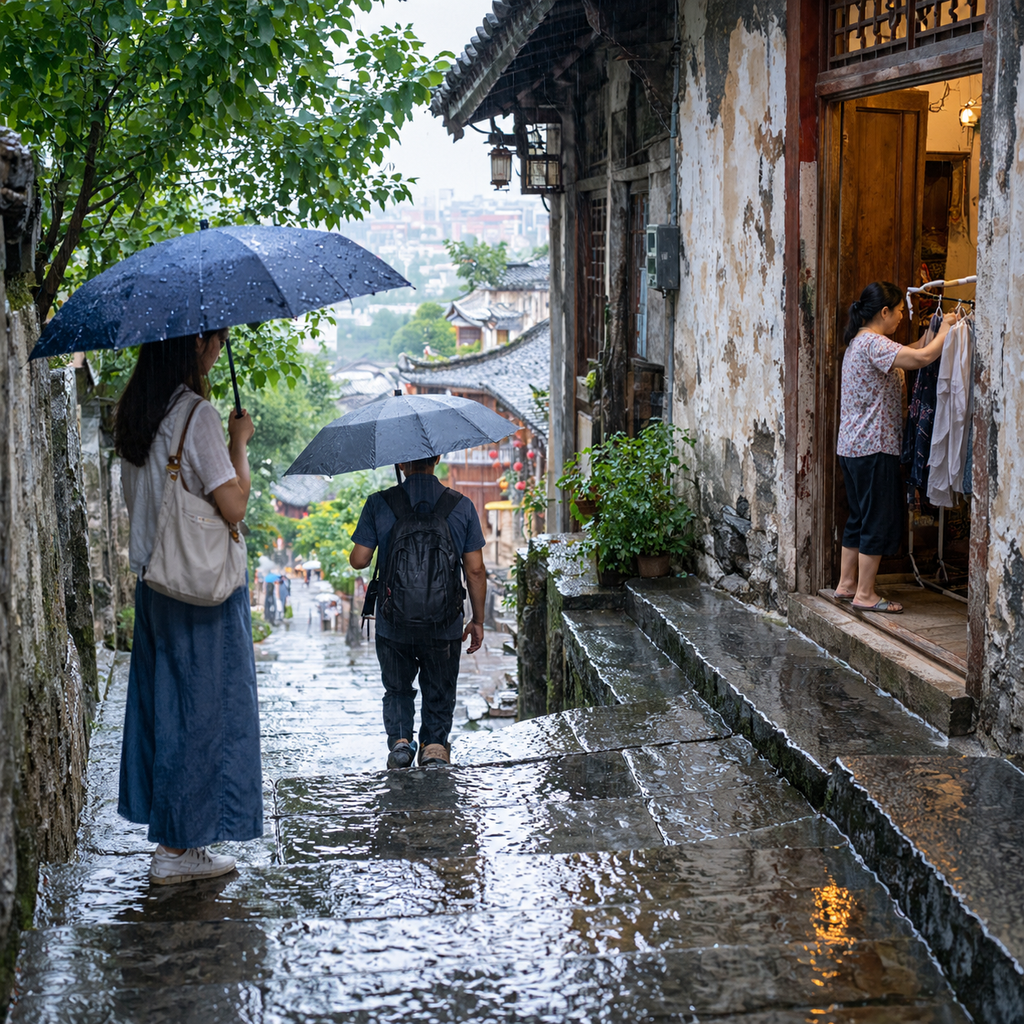
他开始数第一组台阶时,数得很认真。一个、两个、三个,水珠从伞沿落在屏幕上,四舍五入的地图距离与脚下的起伏并不相称。第一段台阶中间有一处平缓的平台,平台边放着几辆电动车,旁边的墙面贴着褪色的生活通知;再往上,台阶短而密,像把一条街折叠起来。到了某个转角,他发现刚才数过的数字已经不可靠:有人从上方下来,他只好侧身让路;一扇门打开,屋里的人把一只晾衣架收进去;雨水顺着边沟流过鞋底。每一次停顿都让计数的节奏断开。台阶没有难度标牌,也没有告诉游客“还剩多少”,它只是把日常生活压缩在一条不断升高的线上。
He began counting the first set of steps with care. One, two, three; droplets fell from the umbrella rim onto his screen, and the rising ground did not match the rounded distance shown on the map. A level landing appeared midway, occupied by several electric scooters, while a faded household notice clung to the wall beside it. Above the landing, the steps grew shorter and tighter, as if the street had been folded upward. At a turn, his count became unreliable. Someone was coming down, so he moved aside; a door opened and a resident pulled a drying rack indoors; rainwater ran through the channel beside his shoes. Each pause broke the rhythm. The steps carried no difficulty sign and did not tell visitors how many remained. They simply compressed ordinary life into a line that kept climbing.
数错的不是数字 / The Mistake Was More Than a Number
他第一次停下来,是因为把一段斜坡当成了台阶。湿滑路面上,连续的浅凹和旧修补缝在视觉上形成了类似阶梯的阴影;他在心里多算了十几级,走近后才发现那只是坡面上不规则的接缝。第二次停下来,是因为把平台两侧的高差算成一组完整台阶,实际需要绕到墙角才接得上。第三次,他干脆不再追求准确总数,把计数改成区间:这一段大约三十级,接下来可能还有两组,坡顶暂时看不见。这个小小的改动让他抬起头来。数目不再是抵达的奖品,而成为判断什么时候该停、哪一侧更稳、是否应该换路的工具。
The first time he stopped, he had mistaken a sloped section for steps. On the wet surface, shallow depressions and old repair seams cast shadows that resembled a staircase; he mentally added more than a dozen steps before realizing they were only irregular joints in the slope. The second pause came when he counted the height difference on both sides of a landing as a complete flight, although the route actually connected only after turning around a wall. On the third attempt, he abandoned the hope of an exact total and switched to ranges: roughly thirty steps here, perhaps two more groups ahead, with the top still hidden. That small adjustment made him look up. The number was no longer a prize awarded at the destination; it became a tool for deciding when to rest, which edge was steadier, and whether to change course.
这种误算也让他的体力感觉变得具体。刚开始,他的呼吸只是略微变深,右手还在伞柄和手机之间来回换位置;走过几组台阶后,小腿前侧开始发紧,脚掌落地时会下意识寻找干燥处。坡道上的居民显然有自己的节奏:一位穿深色雨衣的老人走到平台便停下,把菜袋换到另一只手,再继续下行;一名年轻人骑车到不能骑的地方,迅速下车推行;一位带孩子的母亲没有催孩子跑,只让孩子把手放在靠墙一侧。记录者这才意识到,熟悉坡道的人并不是体力永远充足,而是懂得把动作拆小,把耗力的部分分散到每个转弯和平台。
The miscount also made his changing strength tangible. At first his breathing had only deepened slightly, and his right hand moved between the umbrella handle and phone. After several flights, the fronts of his calves tightened, and each footfall began searching instinctively for a dry patch. Residents had their own rhythm. An older man in a dark raincoat stopped at a landing, shifted his vegetable bag to the other hand, and continued downhill. A young rider dismounted where the slope became too steep and pushed the bicycle. A mother with a child did not urge the child to run; she simply guided the child’s hand toward the wall. The observer realized that people familiar with the slopes were not endlessly strong. They knew how to divide movement into smaller actions and spread effort across every turn and landing.
他把手机收进外套口袋,暂时不用地图。没有屏幕上的蓝线之后,街道的关系反而清楚了一些:哪一段坡面有连续的遮檐,哪一段台阶被屋檐水反复冲刷,哪一个平台能让两个人错身,哪一处墙根堆着杂物不适合久站。靠近坡顶的门面有小卖部、修理电动车的空间和几张被雨收进屋里的塑料凳。它们不是为观光设计的休息站,却承担了同样的功能,只是服务对象首先是住在这里的人。一次路线判断,如果只看地图,往往会错过这些决定安全和体力的细部。
He put the phone into his jacket pocket and stopped consulting the map. Without the blue line on the screen, the street’s relationships became clearer: where the eaves provided continuous cover, which steps were repeatedly washed by runoff, which landing allowed two people to pass, and which wall corner was too cluttered for a safe pause. Near the upper section were a small shop, a space for repairing electric scooters, and several plastic stools pulled indoors from the rain. None had been designed as a tourist rest stop, yet they served a similar purpose for the people who lived there. A route decision based only on a map could easily miss these small features that govern both safety and stamina.
店门口的尺度 / The Scale of a Doorway
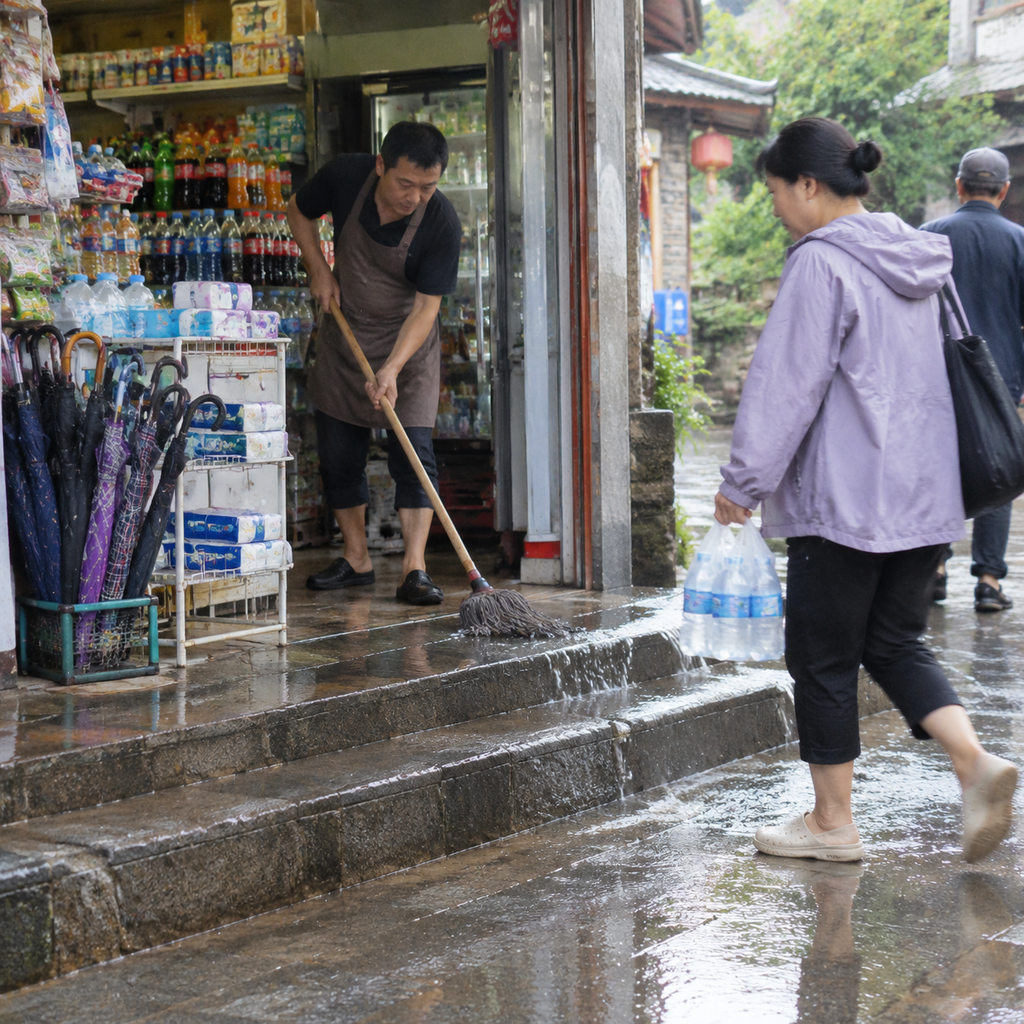
在一间临坡的小店门口,店主正在用拖把把水往门外推。门内的货架挨得很近,雨伞、纸巾、饮料和日用品挤在同一条视线里;门外则是被反复踩亮的几级台阶。记录者没有贸然把店门口当成自己的休息处,只站在不挡进出的边缘,等一位买东西的居民离开后,才向店主示意能否在檐下停一会儿。店主点了点头,又把门旁一只装纸箱的筐往里挪了些。这个动作没有形成可供引用的对白,却清楚说明了坡道上的公共空间如何被临时协调:一块干燥位置既是店铺入口,也是邻里通行时必须保留的窄道。
At the entrance of a small shop beside the slope, the owner was pushing water outward with a mop. Umbrellas, tissues, drinks, and household goods crowded the shelves inside, while the outer steps had been polished by repeated footsteps. The observer did not casually claim the doorway as his resting place. He stood at the edge without blocking anyone, and only after a resident had left did he gesture to ask whether he could pause under the eaves. The shop owner nodded and moved a basket of cardboard boxes farther inside. No quotable dialogue was needed. The gesture made clear how public space is negotiated on a hillside: a dry patch is both a shop entrance and a narrow passage that must remain open for neighbors.
店主看了看他湿掉的鞋面,又看了看上方那段被雨水打亮的台阶,手指朝另一条较缓的巷口指了一下。那条巷子没有连续的阶梯,绕行后会多走一段平路,不能最快到达高处,却能避开一处坡面急转。记录者沿着指示看过去,发现巷口旁有居民楼的单元门、一个收拢的垃圾桶和贴在墙上的社区公告。这里没有“推荐路线”的牌子,路线信息藏在店主对水流和来往行人的熟悉里。对于第一次到访的人,最值得听取的未必是“哪条更近”,而可能是“雨后哪条更容易稳稳走完”。
The owner glanced at his wet shoes, then at the steps shining under the rain, and pointed toward another lane with a gentler grade. That lane had no continuous staircase. It would add a stretch of level walking and would not reach the high ground as quickly, but it avoided a sharp turn on the slick slope. Following the gesture, the observer noticed an apartment entrance, a covered garbage bin, and a community notice on the wall. There was no sign saying “recommended route.” The route information lived in the owner’s familiarity with runoff and passing neighbors. For a first-time visitor, the most useful question may not be which way is shorter, but which way remains steady after rain.
他没有立刻接受这条建议,而是先在脑中比较三件事:原路剩下的坡度,绕行增加的距离,以及自己此刻已经出现的疲劳。快路的优势是方向简单,缺点是台阶边缘湿、视线被弯角切断;缓路要经过几处居民生活空间,可能需要频繁避让,却能把连续发力改成间歇走动。店主继续整理门口,来买水的人从两人之间经过,谈话、塑料袋摩擦声和拖把刮地声混在一起。最后,记录者选择缓路。这个决定没有戏剧性,却比坚持数完台阶更诚实:行程不是向坡顶证明意志,而是根据身体和现场不断调整。
He did not accept the suggestion immediately. He compared three things in his mind: the gradient remaining on the original path, the extra distance of the detour, and the fatigue already present in his body. The direct route had a simple direction but wet step edges and blind corners; the gentler route passed through more residential space and required frequent yielding, yet replaced continuous exertion with intervals of level walking. The owner kept arranging the entrance. A customer passed between them, while conversation, the rasp of a plastic bag, and the mop against the ground blended together. In the end, the observer chose the gentler lane. The decision was not dramatic, but it was more honest than insisting on finishing the count. A route is not a test of willpower against a hill; it is a series of adjustments to body and place.
历史场所并不悬空 / Historic Places Do Not Float Above Daily Life
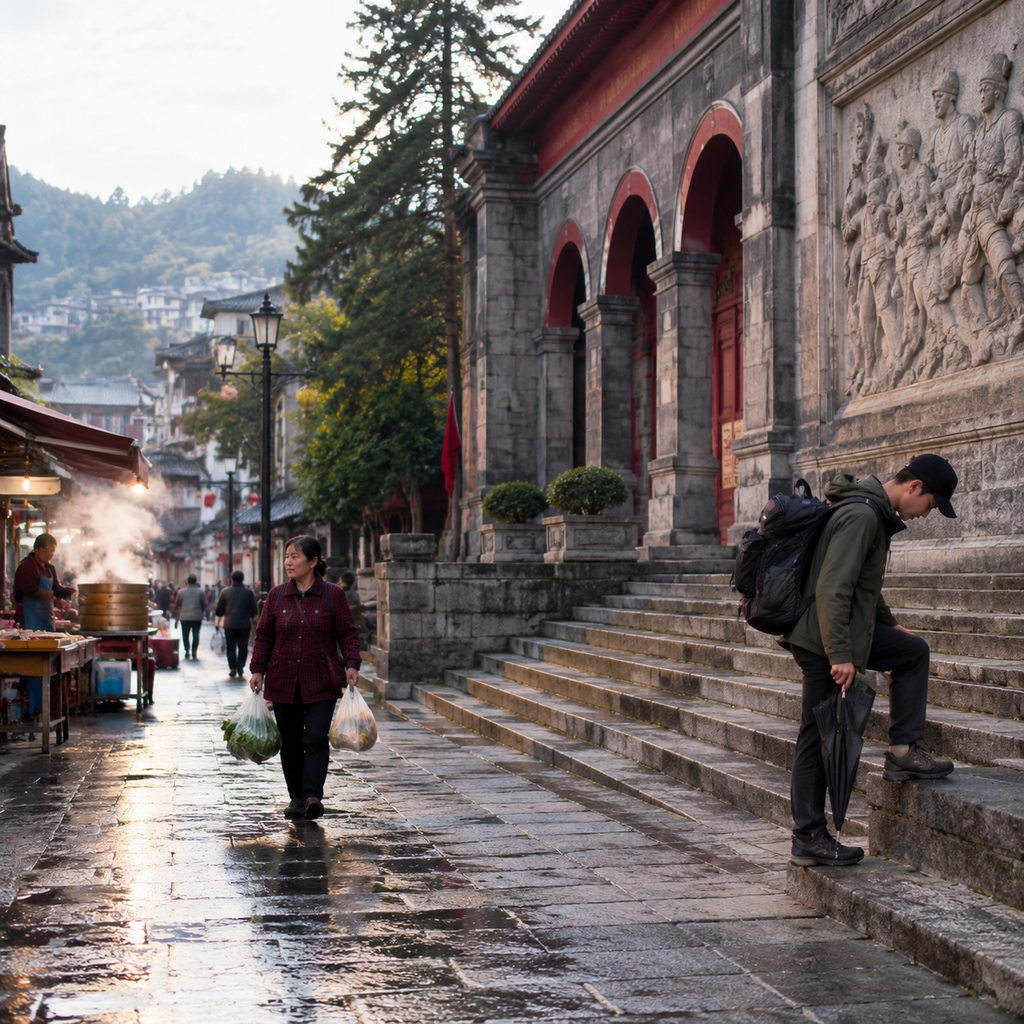
绕行的巷子把他带到一片更开阔的街面,视线里出现了遵义重要的红色历史场所。对许多来访者来说,这些地点承担着明确的纪念、学习和参观功能;但在老城的实际空间里,历史场所并不是从日常街区切割出来的孤岛。它的外侧可能接着居民楼、早餐铺、卖雨具的小摊或等人的门廊,行人经过时有人放慢脚步,有人只是提着菜继续走。记录者站在不妨碍通行的位置观察,发现纪念性空间的肃静与街边生活的声响同时存在:雨棚下的水滴、车辆低速驶过的声音、店铺卷帘门的摩擦声,都没有被一块牌匾完全隔绝。
The detour brought him to a broader street where an important red-history site in Zunyi came into view. For many visitors, such places carry clear purposes of commemoration, study, and visitation. In the old town, however, a historic site does not stand apart as an island detached from daily life. Outside it may be an apartment building, a breakfast shop, a stall selling rain gear, or a doorway where someone waits. Some pedestrians slow down; others continue carrying vegetables. Standing where he would not obstruct anyone, the observer saw solemnity and ordinary street sound occupying the same frame: drops striking an awning, vehicles moving slowly, and the scrape of a shop shutter. A plaque could not fully isolate history from the life around it.
他进入相关开放空间前,先把伞收好,擦了擦鞋底,也没有把湿伞靠在墙面和门边。这样的动作看起来微不足道,却改变了他对“参观历史场所”的理解。这里不是走完坡道后可以随意喧闹的终点,而是一个需要调整声音、速度和身体位置的空间。与此同时,他也没有把周围街巷当成历史背景的陪衬。送货的人要找到门牌,居民要从侧门回家,孩子踩过积水后被家长拉回檐下。纪念性空间的边界因此变得有弹性:人们在其中学习过去,也在边缘处理今天的雨、鞋、菜篮和通行。
Before entering the relevant public area, he folded the umbrella, wiped his soles, and avoided leaning the wet umbrella against a wall or doorway. These actions were small, but they changed his understanding of visiting a historic place. It was not a finish line after climbing the slope where one could become casually loud. It required a change in voice, pace, and bodily position. At the same time, he did not treat the surrounding lanes as mere scenery for history. A delivery worker needed to locate an address, residents used a side entrance, and a child who had stepped into a puddle was pulled back under the eaves. The boundary of the commemorative space was therefore flexible: people studied the past within it while handling today’s rain, shoes, vegetables, and passageways at its edge.
雨势短暂变大时,参观者在檐下聚拢,附近居民却没有因此停止原来的动作。一位老人把折叠车靠向墙边,给推婴儿车的人让出一块干燥位置;有人拿出毛巾擦门把手;一名工作人员反复检查地面是否有明显积水。记录者没有把这些动作解释成宏大的象征,它们首先是对天气和空间的回应。但正是这些回应,让历史场所与城市生活发生了实际联系:参观者需要借用街区的檐、墙和通道,居民也在公共场所的秩序中完成自己的生活。红色历史不是被封存在单独的展柜里,而是与人们如何经过、停留和彼此让路相邻。
When the rain briefly intensified, visitors gathered under the eaves, while nearby residents continued their routines. An older man leaned a folding cart against the wall and made room for someone pushing a stroller. Another person took out a towel to wipe a door handle. A staff member repeatedly checked the ground for visible puddles. The observer did not turn these actions into grand symbols. They were first of all responses to weather and space. Yet those responses created a practical relationship between the historic site and city life: visitors borrowed the neighborhood’s eaves, walls, and passages, while residents carried out their routines within the order of a public place. Red history was not sealed inside a separate display case; it stood beside the ordinary acts of passing, pausing, and making room.
坡下的人声 / Voices at the Lower End
离开历史场所后,他没有马上返回主坡,而是沿着坡下较平的街段走了一会儿。这里的生活密度更高,门面之间的距离很近,电动车停放方向各不相同,雨水被鞋底和车轮带进店内。一个卖日用品的摊位把塑料布往内收,露出几排整齐的拖鞋;隔壁店里有人把蒸汽腾腾的食物端到靠墙的小桌上;再往前,一名居民站在楼门内侧等同伴。没有任何一个场景专门为旅行者准备,却共同解释了老城坡道为什么不能只用“景点之间的连线”来理解。坡道连接的不只是高处和低处,也连接着买菜、回家、做生意和避雨。
After leaving the historic site, he did not return to the main slope at once. He walked along a flatter stretch below it. Life was denser here: storefronts stood close together, electric scooters pointed in different directions, and shoes and wheels carried rainwater indoors. A household-goods vendor pulled a plastic sheet inward, revealing neat rows of slippers. Next door, someone brought steaming food to a small table against the wall. Farther on, a resident waited for a companion inside an apartment entrance. None of these scenes had been prepared for travelers, yet together they explained why the old town’s slopes cannot be understood merely as lines connecting attractions. A slope links more than high and low points; it links shopping, returning home, trading, and finding shelter from rain.
他在一处不影响人流的墙边重新查看地图,发现地图把几条路画得同样细,把高差、排水和门口空间都隐藏了。地图适合回答“下一条街在哪里”,却不一定能回答“下雨时哪一段会让鞋底失去抓地力”。他于是把路线分成三种:连续台阶最少但可能更绕的安全线;能快速抵达高处、需要更谨慎落脚的直线上坡;以及把历史场所和居民街段交替安排、便于分次停留的混合线。这样的分类不是官方线路,也不应被当成固定攻略,只是一个人在现场把抽象地图翻译成身体可以执行的选择。
He checked the map again at a wall where he would not interrupt the flow of people. The map drew several roads with equal thin lines, hiding differences in elevation, drainage, and doorway space. It could answer where the next street was, but not necessarily which section would make his soles lose traction in rain. He began to think in three route types: a safer line with fewer continuous steps but more detour; a direct uphill line that reached higher ground quickly but demanded careful footing; and a mixed line that alternated historic sites with residential streets, making shorter pauses possible. These were not official routes and should not be treated as fixed instructions. They were simply a way of translating an abstract map into choices the body could carry out.
一位在楼下整理雨具的居民看到他把地图转来转去,指了指前方一条有遮檐的横巷,又指指通往坡顶的台阶。对方没有替他决定,只把两个方向的差别用手势分开:一个方向平一些,另一个方向更直接。记录者点头道谢,先走横巷。他注意到这种沟通不需要长篇说明,地点、天气和身体状态已经构成了共同语境。对陌生人来说,向居民问路时,最好把问题缩小到能被现场回答的程度,例如确认“这边是否能避开最陡的一段”,而不是笼统地问“怎么游览老城”。问题越具体,得到的建议越接近当下真正需要。
A resident arranging rain gear downstairs noticed him turning the map repeatedly. The resident pointed toward a covered cross-lane and then toward the steps leading uphill. No decision was made on his behalf; gestures separated the two choices: one was flatter, the other more direct. The observer thanked the resident and took the cross-lane first. He noticed that this exchange required no long explanation. Place, weather, and physical condition had already created a shared context. For a stranger, it is more useful to narrow a question to something the scene can answer, such as whether a lane avoids the steepest section, rather than asking vaguely how to tour the old town. The more specific the question, the closer the advice is likely to be to the immediate need.
第二次上坡 / The Second Climb
午后雨势减弱,他决定再试一次上坡,但这次不再为总台阶数设目标。他给自己安排了几个可观察的节点:先到有遮檐的转角,再到能看见坡下屋顶的平台,然后判断是否继续靠近高处。第一段走得比上午顺,原因并不只是雨小了;他把手机放在易取的位置,却没有边走边盯屏幕,脚步也从“赶紧完成这一组”改成了每次落脚前看清台阶边缘。一个背着书包的学生从后面赶上来,在较宽处超过他;他主动贴墙让出通道,等对方过去后才恢复速度。体力并没有突然增加,变化发生在动作不再互相争抢。
In the afternoon, when the rain weakened, he decided to try the climb again, this time without setting a target for the total number of steps. He chose observable checkpoints: a covered turn, then a landing from which the rooftops below could be seen, followed by a decision about whether to continue higher. The first section felt easier than in the morning, not simply because the rain had eased. He kept the phone accessible without staring at it while walking, and changed his rhythm from finishing a flight quickly to checking each step edge before placing his foot. A student with a backpack caught up from behind and passed him at a wider spot. He moved close to the wall, waited, and resumed only after the student had gone by. His strength had not suddenly increased; the improvement came from stopping his actions from competing with one another.
到达第一个节点时,他看到屋檐下坐着一位修理小电器的师傅,旁边摆着拆开的外壳和几件工具。师傅没有抬头招呼,也没有把这里变成可供游客拍照的布景。记录者只在边缘看了几秒,便继续向上。这个普通的工作门面给坡道增加了另一种尺度:高差会影响搬运、进出和摆放,修理空间必须在狭窄街面里留下可用的宽度;来访者若只顾拍摄,就可能站到工具、车辆或顾客的路径上。观察老城,不能只找“有故事的老建筑”,也要看人们怎样在不宽裕的空间中完成工作。
At the first checkpoint he saw an appliance repairer sitting under the eaves, with opened casings and tools beside him. The repairer did not look up to greet him, and the spot was not a staged backdrop for visitors. The observer watched from the edge for a few seconds and continued upward. This ordinary workfront gave the slope another scale. Elevation affected carrying, entering, leaving, and arranging goods, while the repair space had to preserve usable width on a narrow street. A visitor focused only on taking photographs could stand in the path of tools, vehicles, or customers. To observe the old town, one must look not only for historic buildings with a story but also at how people work within limited space.
第二组台阶比上午记忆中的更短,却更累。记忆把一段路压扁了,身体却把坡度一寸寸还回来。他在平台上喝水,视线落到下方:雨水已经少了,屋顶边缘仍然滴着水;一辆电动车在坡下缓慢调头,骑车人下车后推过一段狭窄处;街边小店的灯亮起来,照在湿墙上形成一块偏黄的反光。高处并没有出现想象中的“完成感”,反而让他看见更多需要考虑的事:下行时膝盖承受的力量、迎面来人时如何侧身、傍晚光线减弱后哪些台阶会变得难辨。
The second set of steps was shorter than he remembered from the morning, yet more tiring. Memory had compressed the distance, while the body returned the gradient inch by inch. He drank water on the landing and looked down. The rain had diminished, but water still dripped from roof edges. An electric scooter turned slowly below; its rider dismounted and pushed through a narrow section. A small shop switched on its light, casting a yellowish reflection on the wet wall. The higher view did not produce the imagined sense of completion. Instead, it revealed more decisions: the force on the knees during descent, how to yield to oncoming people, and which steps might become difficult to see as evening light faded.
取舍不是放弃 / Choosing Is Not Giving Up
他在这里做了第二次路线取舍:不再追求一次走完整条坡线,而是把高处能够看到的部分留作下一次。这个决定并非因为路线“不值得”,恰恰是因为坡道上的信息需要时间消化。若继续向上,他可能获得更多俯视街区的视野,却会减少在坡下店铺和历史场所边缘停留的时间;若现在回转,他可以沿着较平的街道观察居民如何收摊、接孩子、搬运物品,也能在天色和路面更适合时重新安排上行。旅行中的取舍常被写成少看一个点,其实也可能是把一个地方从单次征服改成多次理解。
Here he made a second route decision: he would stop trying to complete the entire slope in one outing and leave the higher section for another time. It was not because the route lacked value; the slope contained more information than he could absorb at once. Continuing might offer a broader view over the neighborhood, but it would reduce the time available for observing lower-street shops and the edges of historic sites. Turning back would allow him to watch residents close stalls, collect children, and carry goods along flatter streets, and to attempt the upper route later when light and ground conditions were more favorable. Travel choices are often described as missing one stop, but they can also turn a place from a one-time conquest into repeated understanding.
下行时,他刻意放慢。上坡时容易把台阶当成目标,下坡时每一级台阶都要求重新确认身体的位置。湿面上的深色区域未必更滑,也不能因此随便踩踏;真正可靠的判断是看表面是否有水膜、边缘是否破损、脚底是否能完整接触。遇到迎面上来的居民,他提前停在平台或较宽的位置,不在狭窄台阶中间突然转身。遇到骑车人推行,他让出靠外一侧后等待。路上没有人专门教他这些动作,但道路宽度、雨水方向和他人的步伐都在不断提示。
On the descent he deliberately slowed down. Going uphill makes it easy to treat steps as targets; going downhill requires the body’s position to be reassessed at every step. A dark patch on wet ground is not automatically more slippery, and it should not be stepped on casually. A more dependable judgment considers whether a film of water covers the surface, whether the edge is damaged, and whether the sole can make full contact. When residents approached, he stopped early on a landing or wider section instead of turning suddenly in a narrow flight. When someone pushed a bicycle, he moved aside and waited. No one formally taught him these actions. The width of the road, the direction of runoff, and other people’s pace supplied constant instruction.
他再次经过那家临坡小店时,门口已经换了另一批进出的人。店主把拖把靠在墙边,地面仍有水痕,但入口留出了一条清楚的通道。记录者没有停留太久,只向店主抬手表示自己改走了缓路。店主看了一眼他的鞋,笑意很轻,随后转身去接一位顾客递来的物品。没有虚构的热情对白,也没有需要被放大的戏剧冲突;一个小小的回看动作就够了。路线建议的价值,不在于让陌生人完全照做,而在于让他能够带着新的观察回来,验证哪一种选择适合自己的身体和当天的天气。
When he passed the small shop beside the slope again, a different group of people was entering and leaving. The owner had leaned the mop against the wall. Water marks remained, but a clear passage had been left at the entrance. The observer did not stay long. He raised a hand to show that he had taken the gentler route. The owner glanced at his shoes with a faint smile and turned to receive an item from a customer. There was no invented warm quotation and no dramatic confrontation to amplify. A small return gesture was enough. The value of route advice is not that a stranger follows it perfectly; it is that he can return with better observations and test which choice fits his body and that day’s weather.
雨天安全写在细节里 / Rain Safety Lives in Details
到傍晚,雨又细细落下来,坡道上的灯光在水面上被拉成短线。记录者决定不再往高处试,先沿着较平的路回到人流更稳定的街段。他把伞撑稳,手机只在停下时查看;经过台阶时不跨越积水,也不把手伸向陌生的电线、栏杆或店门内侧借力。遇到地面反光过强、看不清台阶落差的地方,他宁愿退回平台等待,也没有用快走来换取安全感。安全不是一条抽象提醒,而是一连串看似拖慢行程的动作:确认、停下、让路、绕行,再继续。
By evening, fine rain fell again, and the slope’s lights stretched into short lines across the wet surface. The observer decided not to test the higher section again and returned along the flatter route toward a busier, more stable street. He kept the umbrella steady and checked the phone only when stopped. On the steps he did not leap across puddles, nor did he grab an unfamiliar wire, railing, or the inside of a shop doorway for support. Where reflections made the height of the steps hard to read, he preferred to wait on a landing rather than walk faster in search of reassurance. Safety was not an abstract warning. It was a series of actions that seemed to slow the outing: check, stop, yield, detour, and continue.
他还重新考虑了“路线完成”的含义。上午那次失败的计数,本来让他觉得自己被一串数字牵着走;到了晚上,他甚至不再想知道准确总数。台阶数量当然可以帮助估计难度,却无法替代现场观察。不同身高、鞋底、负重和天气,会让同一段坡产生不同体感;同一个人在上坡和下坡时,也会面对不同的风险。真正有用的记录可以是:哪一组台阶在雨后容易积水,哪个平台适合短暂停留,哪条绕路虽然更长却减少连续爬升,哪个时段光线变化会影响辨认。数字被放回它该在的位置,服务于判断,而不是统治判断。
He also reconsidered what it meant to “complete” a route. In the morning, the failed count had made him feel led by a sequence of numbers. By evening, he no longer cared about the exact total. The number of steps could help estimate difficulty, but it could not replace observation. Height, footwear, carried weight, and weather gave the same flight different physical meanings; the same person also faced different risks going up and going down. More useful notes would be which steps collected water after rain, which landing allowed a short pause, which longer detour reduced continuous climbing, and how changing light affected visibility. The numbers returned to their proper place: serving judgment instead of controlling it.
老城的高低处 / The Town’s High and Low Places
回到坡下时,街边店铺的日常声响比上午更清晰。有人收起遮雨布,有人把门前的小凳叠到一边,有人站在檐下等待雨势变小;居民楼里传出关门声和短促的脚步声,外卖或杂物被放在门边后很快取走。记录者没有把这些细节写成“当地人从容生活”的概括,因为从容并不总是事实,有的人赶时间,有的人在搬重物,有的人只是熟悉这条路,知道哪里能避开最湿的地方。老城的生活并非一幅静止画,而是一套在坡度、门槛、雨水和邻里距离之间不断调整的动作系统。
Back at the lower street, the sounds of shop routines were clearer than in the morning. Someone folded a rain cover, someone stacked the small stools by a doorway, and someone waited under an awning for the rain to ease. From apartment buildings came closing doors and brief footsteps; deliveries or household items were placed by entrances and quickly collected. The observer did not reduce these details to a claim that local life was always relaxed. Some people were in a hurry, some were carrying heavy things, and some simply knew the street well enough to avoid its wettest sections. Life in the old town was not a still picture. It was a system of movements continually adjusted to slope, thresholds, runoff, and the distance between neighbors.
他把上午错算的三段台阶和下午主动放弃的高处写在同一页上,没有给它们分别贴上“失败”和“成功”的标签。前者暴露了他把地图距离当成身体距离的习惯,后者则让他看见路线还有第二层价值:它决定一个人会在什么地方遇见谁、听见什么、是否有机会观察店铺和居民如何使用街道。倘若只追求最高点,他会把坡下的生活压缩成出发区;倘若只在平路上走,他又无法理解老城空间为何形成这样的层次。高处提供方向感,低处提供生活密度,两者需要被放在同一条路线里衡量。
He wrote the three miscounted sections from the morning and the higher ground deliberately left for later on the same page, without labeling one as failure and the other as success. The first exposed his habit of treating map distance as bodily distance. The second revealed another value of a route: it determines whom a person meets, what sounds he hears, and whether he has time to observe how shops and residents use the street. If he pursued only the highest point, the life below would shrink into a starting area. If he stayed only on level ground, he would not understand why the old town had developed such layered spaces. The upper section offered orientation; the lower section offered density of life. Both belonged in the same calculation.
把体力拆开用 / Spending Strength in Portions
缓路并不等于轻松。它只是把陡直的压力拆散到更长的街面上:先是一段几乎平的巷道,接着是两三组不连续的短台阶,然后又要绕过停放的车辆和临时伸出的雨棚。记录者发现,疲劳在这种路线上不那么显眼,却更容易被忽略。上坡时肌肉紧张会给出明确警报,平路绕行时,人反而可能因为觉得“已经避开难处”而加快脚步。他因此给自己留出很普通的规则:每走到能够看清下一次转弯的位置,就停几秒钟,不急着在行进中翻照片或回复消息;喝水时站到不挡门的位置;鞋带松了就找平台处理,不在湿台阶上低头弯腰。这些都不是旅行仪式,而是让体力不在无关动作里漏掉的办法。
The gentler route was not effortless. It merely dispersed the force of a steep climb across a longer street: first an almost level lane, then two or three discontinuous short flights, followed by parked vehicles and awnings projecting into the way. The observer found that fatigue was less obvious on this route and therefore easier to ignore. Uphill, tense muscles give a clear warning. On a flatter detour, a person may speed up because the difficult part seems to have been avoided. He adopted plain rules: whenever he reached a place from which the next turn was visible, he paused for a few seconds instead of checking photos or messages while moving; when drinking water, he stood where he did not block a doorway; if a shoelace loosened, he handled it on a landing rather than bending over on wet steps. These were not travel rituals. They were ways to stop strength from leaking away through irrelevant movements.
他的呼吸也在提醒他调整。上午刚起步时,呼吸快一点还可以用意志压过去;下午再走时,他开始区分“喘”与“乱”。前者是坡度带来的正常变化,停在平台、放慢两三个步幅后会缓下来;后者则出现在他一边避人一边看路一边试图记数的时候,肩膀会抬起,步伐变短,注意力也被切碎。于是他不再把每次停下都当作落后于计划。住在坡边的人本来就会在门口、转角、台阶尽头短暂停顿,停下并不显得突兀。对来访者而言,学会用街道原有的节奏恢复,比硬把自己的城市步速套上去更合适。
His breathing also told him when to adjust. On the first climb, slightly faster breathing seemed like something willpower could simply suppress. On the later climb, he began to distinguish between being winded and becoming disorganized. The first was a normal response to gradient and eased after a landing and two or three slower strides. The second appeared when he tried to yield, watch the ground, and keep counting at the same time: his shoulders rose, his steps shortened, and his attention fractured. He stopped treating every pause as falling behind schedule. People living beside the slope already paused briefly at doorways, turns, and the ends of flights; stopping did not look out of place. For a visitor, recovering in the rhythm the street already uses is more suitable than forcing an urban walking pace onto it.
在纪念性与居住性之间 / Between Commemoration and Residence
经过红色历史场所附近时,他特别留意到不同人使用同一片空间的方式并不相同。参观者倾向于寻找入口、说明信息和便于停留的视点;居民更关心门是否能打开、车辆能否通过、雨伞有没有碰到旁人。两套需求并不必然冲突,但冲突很容易发生在狭窄处。有人为了拍建筑抬高手机,身后便可能排起等待通行的人;有人在入口外停下来整理物品,旁边的住户就要侧身绕过。记录者把相机始终放低,先让出人行线,再决定是否停留。他并不因此少看了什么,反而看清了这类场所真正的空间关系:它既承载集体记忆,也嵌入必须照常运行的街区。
Near the red-history site, he paid particular attention to how different people used the same space. Visitors tended to look for entrances, explanatory information, and viewpoints where they could pause. Residents were more concerned with whether a door could open, whether a vehicle could pass, and whether an umbrella might strike someone. These needs did not inherently conflict, but conflict could arise easily in narrow places. Someone lifting a phone to photograph a building might create a line of people waiting to pass behind them. Someone stopping outside an entrance to organize belongings might force a resident to squeeze around. The observer kept his camera low, yielded the walking line first, and only then decided whether to stop. He did not see less as a result. He saw the real spatial relationship more clearly: the place held collective memory while remaining embedded in a neighborhood that had to function normally.
这种理解也影响他参观时的停留长度。他没有把每一处说明都读成必须完成的任务,而是给自己留出回看余地:先走一遍确认空间和人流,再在不拥挤的时刻停下来读需要读的内容。下雨天尤其如此,湿伞、雨衣和鞋底会让人的占地范围变大,原本能容纳几个人的檐下很快变窄。工作人员检查地面、居民从侧边进出、游客寻找遮雨处,都是同一个空间里发生的合理动作。记录者从中得到的并非一种抽象的“文明参观”口号,而是具体的判断顺序:不占入口,不堵通道,不为了照片跨过安全线,也不把居民的日常便利当成可被默认借用的资源。
That understanding also changed the length of his visits. He did not turn every explanatory panel into a task that had to be completed. Instead, he left room to return: first walking through to understand the space and flow of people, then stopping to read what mattered when the area was less crowded. This was especially relevant in rain, when wet umbrellas, raincoats, and shoe soles enlarged the space each person occupied, quickly narrowing an eave that usually held several people. Staff checking the ground, residents entering from the side, and visitors seeking cover were all reasonable actions in the same place. What the observer gained was not an abstract slogan about polite visiting but a concrete order of judgment: do not occupy an entrance, block a passage, cross a safety boundary for a photograph, or assume that residents’ daily convenience is a resource available for visitors to use.
下坡比上坡更需要计划 / Descent Requires More Planning Than Ascent
当他准备离开老城更高的街段时,才发现下坡比上坡更容易诱发错误。上坡时,身体会自然向前倾,眼睛也常盯着前方;下坡时,人容易因为看见目的地方向而急着加速,脚跟先落地,膝盖和脚踝承担的冲击随之变大。雨水让这种冲动更不合适。他把伞稍微向外偏,避免伞沿遮住台阶下方;每逢台阶连续超过几级,就把视线放在下一两级,而不是一直看最底部。遇到台阶边缘有落叶或泥沙,他宁可走近墙侧的完整踏面,也不从中间最亮的水迹上试探。安全感来自可重复的动作,不来自“应该没事”的猜测。
When preparing to leave the higher streets of the old town, he discovered that descent invited more mistakes than ascent. Going up, the body naturally leans forward and the eyes often look ahead. Going down, a person may rush after seeing the direction of the destination, land on the heel first, and increase the impact borne by knees and ankles. Rain makes that impulse even less suitable. He angled his umbrella slightly outward so the rim would not hide the steps below. Whenever a flight extended for more than a few steps, he looked one or two steps ahead rather than all the way to the bottom. Where leaves or silt covered the edge, he chose the intact tread near the wall instead of testing the brightest water mark in the middle. Reassurance came from repeatable actions, not from guessing that things would probably be fine.
有两次,他为了给迎面上来的人腾位置,选择停住而不是跨到下一阶。第一次是在一段只能容一人半宽的石阶上,一位提着袋子的居民从下方上来,他靠墙站稳,等对方经过;第二次是在转弯处,一辆被推行的电动车占据了较大的宽度,他退回前一个平台,让车和人都通过。这样做会让下行时间变长,也会打断“我快到坡下了”的心理预期,但它让每次让路都有稳定落脚点。老城的坡道不是为单独通行的人设计的私人跑道,尤其在雨天,互相等待本身就是路线的一部分。
Twice, he chose to stop rather than step aside onto the next riser in order to make room for people coming upward. The first time was on a stone flight only wide enough for one and a half people; a resident carrying bags approached from below, so he stood firmly by the wall and waited. The second was at a turn where a pushed electric scooter occupied more width; he stepped back to the previous landing and let both vehicle and person pass. This lengthened the descent and interrupted the expectation of being almost back at the bottom, but it gave each act of yielding a stable place for the feet. The old town’s slopes are not private running lanes for solitary travelers. In rain especially, waiting for one another is part of the route.
把路线写成可变的线 / Treating a Route as Adjustable
当天的最后一段路,他没有再打开“最快到达”的导航选项,而是选择先穿过有店铺灯光和较多行人的街面,再回到交通更方便的位置。这并非意味着所有人都应照抄他的路线。有人体力充足、天气晴朗,可能愿意走更直接的台阶;有人带着老人、孩子或较多行李,则需要把连续爬升降到更低。真正值得提前准备的,是几种替代方案:若雨变大,优先回到有遮蔽和人流的路段;若脚部不适,减少下坡次数而非硬撑;若想兼顾历史参观和老城观察,把一处纪念性场所与一段居民街巷配对,而不是把所有参观点串成不间断冲刺。路线一旦允许变化,旅行者就不必把临时调整误认为计划失败。
On the final stretch that day, he did not reopen the navigation option for the fastest arrival. He chose instead to pass through a street with shop lights and more pedestrians before returning to a place with easier transport connections. This did not mean that everyone should copy his route. Someone with ample strength in clear weather may prefer more direct steps. Someone traveling with older relatives, children, or heavier bags may need to reduce continuous climbing further. What is worth preparing in advance is a set of alternatives: if rain grows heavier, return first to streets with cover and foot traffic; if the feet begin to hurt, reduce descents instead of pushing through; if one wants both historical visiting and old-town observation, pair one commemorative site with one residential lane rather than stringing every stop into an uninterrupted sprint. Once a route is allowed to change, an adjustment no longer has to feel like a failed plan.
他也没有把居民和店主的帮助浪漫化。有人愿意用手势指路,有人只是忙着自己的事;有人会在狭窄处让一让,有人也需要优先搬货、送孩子或关店。最好的相处方式不是期待每个陌生人承担导游角色,而是先看清自己是否挡路、是否占用檐下、是否把问题问得过大。短暂、明确、方便对方拒绝的请求,通常比长时间拦住一个忙碌的人更合适。对方若提供了方向,记录者会把它当作现场信息,再结合路面和身体状态判断;对方若没有回应,他便自行退到安全位置重新看图。这样的边界感使街边交流更自然,也让旅行不依赖虚构的偶遇故事。
He did not romanticize assistance from residents and shopkeepers. Some people were willing to point the way with a gesture; others were simply occupied with their own work. Some yielded in a narrow place, while others needed to move goods, collect children, or close a shop first. The best way to coexist is not to expect every stranger to act as a guide, but to see first whether one is blocking the way, occupying the eaves, or asking a question that is too broad. A brief, specific request that is easy to decline is usually more appropriate than stopping a busy person for a long exchange. If someone offers a direction, the observer treats it as local information and then assesses it against the ground and his body. If there is no response, he steps back to a safe place and checks the map himself. This sense of boundary makes street-side contact more natural and keeps travel from depending on invented encounters.
留给下一次的空白 / Leaving Room for Another Visit
他在坡下最后一次核对方向时,把未走的那一截高处在地图上轻轻缩小,没有删除,也没有硬加进当天的行程。这样的留白很实际:它让第二天的鞋底、天气和体力都可以重新参与决定,也避免为了完成截图上的路线而在光线变暗时继续冒险。老城的坡并不会因为一次未走完而消失,反倒会因这份未完成留下可再次验证的疑问:晴天时台阶边缘是否更清楚,清晨的人流是否不同,居民开门和店铺营业前后的通行空间又会怎样变化。
When he checked his direction one last time at the foot of the slope, he gently reduced the unwalked upper section on the map instead of deleting it or forcing it into the day’s itinerary. That blank space was practical. It allowed footwear, weather, and strength to participate in the decision again the next day, and it avoided continued risk in fading light just to complete the route on a screen. The old town’s slope would not disappear because one section remained unwalked. The unfinished portion instead preserved questions to test another time: would step edges be clearer in dry weather, would morning foot traffic be different, and how would passage space change before and after residents opened doors and shops began their routines?
下一次不先数 / Next Time, He Will Not Count First
临走前,他站在一段已经被雨洗暗的台阶旁,回头看那条自己两次走过的坡。第一次,他试图用数字控制未知;第二次,他用节点、体感和他人的通行方式重新认识它。坡道并没有因为被走过两遍就变得简单,台阶也没有给出一个可以写进标题的准确答案。它只让一个外来观察者逐渐明白,遵义老城的路线取舍从来不是“景点多走几个”这么单一:要把红色历史场所的纪念性、居民区的连续生活、店门口的窄小尺度和雨天的安全边界一起放进判断里。
Before leaving, he stood beside a flight darkened by rain and looked back at the slope he had walked twice. The first time, he tried to control the unknown with numbers. The second time, he used checkpoints, bodily signals, and the movement of other people to understand it again. The slope had not become simple merely because he had walked it twice, and the steps had not offered an exact answer suitable for a neat headline. They had gradually shown an outsider that route choices in Zunyi’s old town are not simply about fitting in more attractions. The commemorative character of red-history sites, the continuity of residential life, the narrow scale of shop entrances, and the safety limits imposed by rain all belong in the same judgment.
他最后记下的不是台阶总数,而是一个更能复用的顺序:先看雨水怎么走,再看人怎么走;先找能够停下的地方,再决定是否继续上坡;先确认历史场所和生活街道之间的边界,再选择拍照、参观或绕行的方式。若体力下降,放弃一段高处并不等于放弃整座老城;若路线绕远,也不代表效率低下。对这座有坡度的旧城而言,走得慢一点、少数几级、留出回转余地,往往能让人看见更多真实的连接。那天他把台阶数错了,最后却把路线本身看得更准确。
What he recorded in the end was not the total number of steps but a sequence that could be used again: first watch how rainwater moves, then watch how people move; first locate places where stopping is possible, then decide whether to climb farther; first understand the boundary between historic sites and lived streets, then choose whether to photograph, visit, or detour. When strength falls, leaving a higher section does not mean abandoning the old town. When a route takes longer, it is not necessarily inefficient. In this sloped old city, walking more slowly, counting fewer steps, and preserving room to turn around can reveal more of its real connections. He had miscounted the steps that day, yet ended by seeing the route more accurately.
Public Source Notes
地方文旅公开资料类型;历史场所公开介绍类型;地图与街道空间信息类型;公共安全与雨天步行提示类型。
- 四月江南烟雨游 | April in Jiangnan: Misty Rain and Ancient Water Towns
- 在中国打车这件事,没你想的那么难 | Ride-Hailing in China: Easier Than You Think
- 学打中国结之后,我终于理解“吉祥”为什么可以握在手里 | After Learning Chinese Knotting, I Finally Understood How Auspicious Meaning Can Be Held in the Hand
- 青岛海边的雾气,让我把拍照计划改成了散步计划 | Sea Fog in Qingdao Turned My Photo Plan into a Walking Plan
- 盐业历史博物馆的楼梯声,把自贡的地下记忆带到了地面 | The Sound of Wooden Stairs Brought Zigong’s Underground Memory to the Surface
- 泉州西街入夜以后,一盏圆灯就能把面线糊和人情都照热 | Once Night Falls on West Street in Quanzhou, One Round Lamp Can Warm Both Noodles and Human Feeling
- 西安兵马俑:完整参观指南 | Xi an Terracotta Warriors: A Complete Guide
- 中国住宿选择指南:酒店民宿客栈 | China Accommodation Guide: Hotels, B&Bs & Inns
- 杭州西湖边那阵风,提醒我热门景区也要会躲人流 | A Breeze by West Lake Reminded Me How to Dodge Crowds at Famous Attractions
- 中国茶具:完美伴手礼 | Chinese Tea Set: A Perfect Gift
Comments (0)