
合浦老街那块没来得及拍照的月饼 | The Mooncake on Hepu Old Street That I Never Managed to Photograph
合浦老街那块没来得及拍照的月饼 | The Mooncake on Hepu Old Street That I Never Managed to Photograph
傍晚的合浦老街还有一点白天留下来的热气。我从骑楼下面走过去,鞋底时不时碰到被磨得发亮的石板,身边有人拎着菜袋往巷子里拐,也有人把小圆凳摆到门口,坐在那里剥一只刚买回来的水果。那时我还没有决定要不要买月饼,只是被一阵烘烤后的甜香牵着走。香味并不猛烈,夹在海风、油锅和旧墙返潮的气息中,像一条很细的线,走两步就淡下去,停下来又重新找得到。我顺着它绕过一个转角,看到一张案板、一只托盘和几双忙着收拾的手。
In the evening, Hepu Old Street still held a little of the day's heat. I walked beneath the arcades, my soles occasionally meeting stone slabs polished smooth by years of feet. Someone carrying a bag of vegetables turned into a lane; someone else had placed a low stool by a doorway and was peeling fruit just bought from the market. I had not yet decided whether to buy a mooncake. I was simply following a thin thread of baked sweetness. It was not a loud smell. Mixed with sea air, frying oil, and dampness rising from old walls, it faded after a few steps and returned whenever I stopped. I followed it around a corner and found a worktable, a tray, and several pairs of busy hands.
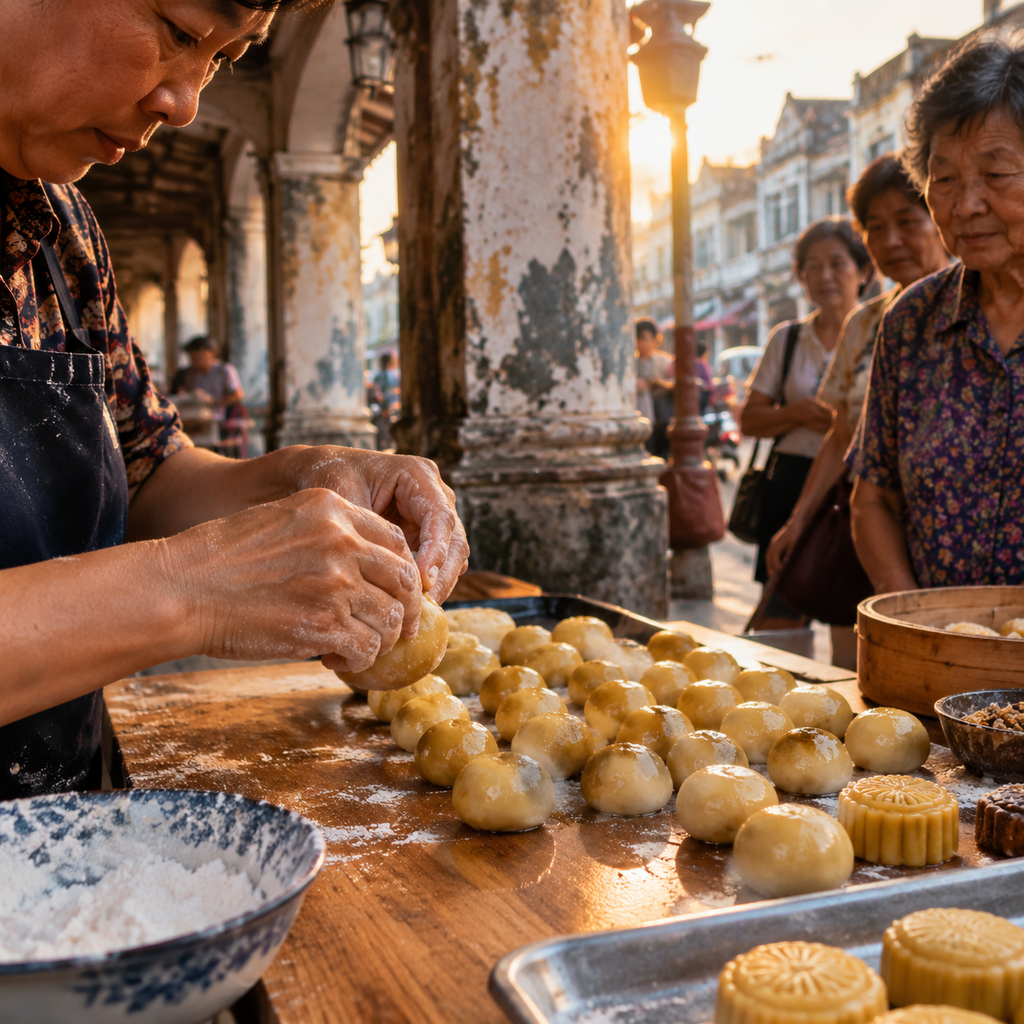
我先站在旁边看,没有马上开口。案板上的面团已经分成大小相近的小团,表面沾着一层很薄的油光。做月饼的人把一团面皮按扁,放进馅料,再用拇指和食指慢慢往上收口。这个动作看起来轻,实际很有耐心:收得急,边缘会裂;收得太慢,馅就容易从一侧露出来。旁边的街坊和她说着我听得不全明白的口音,语气像是在商量家里要带几块,又像在讨论哪一批更适合放到第二天吃。我没有拍照,也没有拿出手机,因为眼前每个人都在做事,不像一个等着被摆拍的场面。
I stood to one side and watched before saying anything. The dough on the table had been divided into pieces of nearly equal size, each carrying a faint sheen of oil. The maker flattened one piece, placed the filling inside, and slowly gathered the edges upward with thumb and forefinger. It looked gentle but required patience. If she hurried, the skin would split; if she worked too slowly, the filling might show through one side. A neighbor beside her spoke in an accent I could not fully follow. They seemed to be deciding how many pieces to take home, perhaps also discussing which batch would be better to eat the next day. I did not take out my phone. Everyone was working, and this was not a scene waiting to be arranged for a photograph.
我问能不能买一块现做的。对方先看了看托盘,又指向已经包好的几只,告诉我刚出炉的还要等一会儿。我听懂了大半,剩下的靠她的手势补齐:手指指向炉子,掌心向外停了一下,意思很清楚。她没有报出一个特别复杂的流程,也没有把月饼说成什么必须立刻拥有的东西,只让我自己决定是现在等,还是拿已经做好的。我站在骑楼柱子边,柱身上有细小的斑驳,手背能感觉到潮气。我说那就等一会儿,顺便看看它怎么从面团变成月饼。
I asked whether I could buy one freshly made. She looked at the tray and pointed to several already shaped pieces, then told me the next batch would need a little more time. I understood most of it; her gestures supplied the rest. She pointed toward the oven and held one palm outward for a moment. The meaning was plain. She did not present the mooncake as something I had to possess immediately. She left me to choose between waiting and taking one already finished. I stood beside an arcade column mottled with age, dampness cool against the back of my hand. I said I would wait and watch how dough became a mooncake.
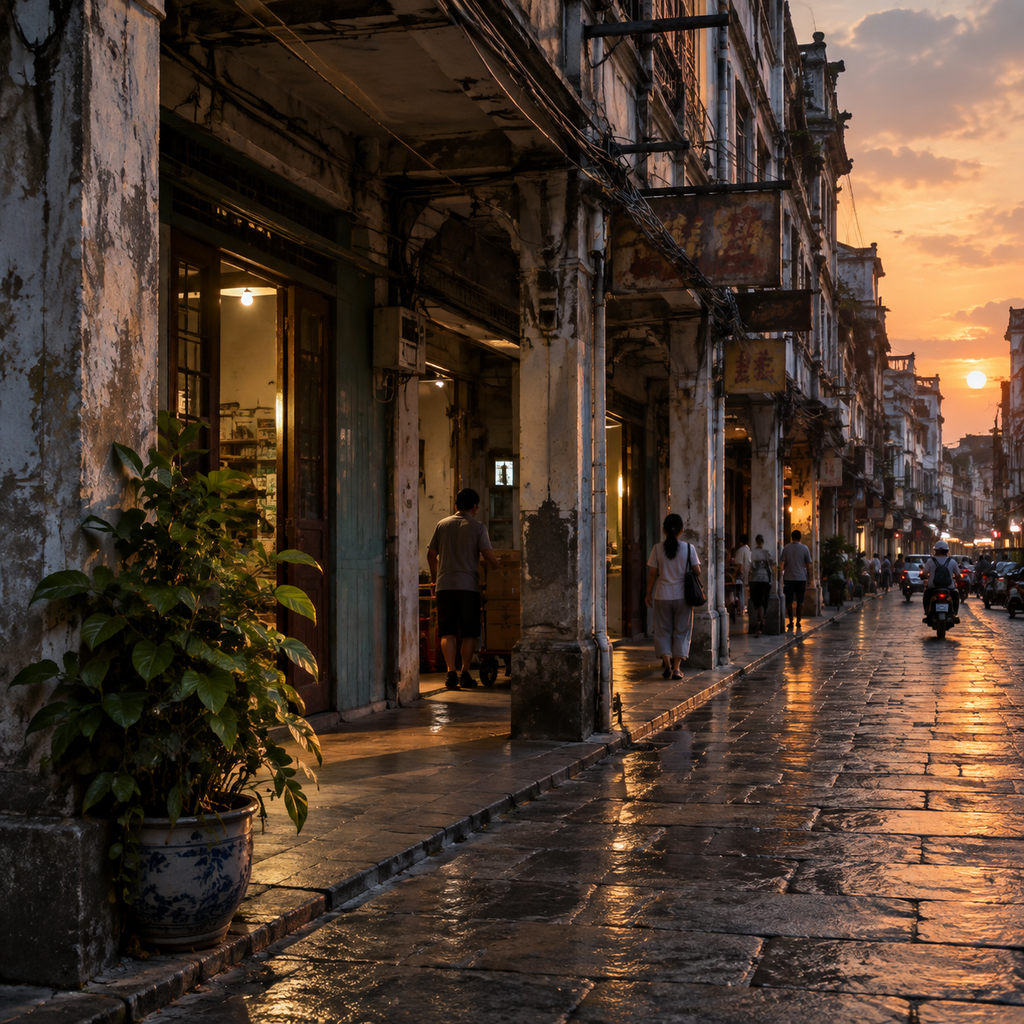
等待的时候,我才真正注意到这条老街的空间。骑楼把屋檐向街面推出来,下面形成一条不宽不窄的连续阴影。有人在阴影里穿行,有人把货物往里面挪,有的门半开着,屋内的灯光落到脚边,和外面的灰蓝天色接在一起。街巷并没有被一条笔直的观光路线切成几个景点,它更像生活自己留下的折痕:向左一拐,便是堆着纸箱的后门;再向前几步,墙根有一盆长得很旺的植物;抬头看,旧招牌和电线在骑楼檐口上方交叠。我很喜欢这种不急着解释自己的街道,食物也在这样的空间里显得更有来处。
While waiting, I began to notice the street itself. The arcades pushed their roofs toward the road, making a continuous band of shade, neither wide nor narrow. People moved through it, shifted goods inward, and left some doors half open. Interior lights spilled onto the ground and met the gray-blue evening outside. The lane had not been divided into attractions by a straight sightseeing route. It felt more like a crease left by ordinary life: turn left and there was a back door stacked with cartons; walk a few steps farther and a plant grew vigorously beside the wall; look up and old signs crossed with wires above the arcade roofs. I liked a street that did not rush to explain itself. Food seemed to have a clearer place of origin in that kind of space.
案板边还有一位买月饼的阿姨。她没有催我,也没有把我当成特意来寻找地方特色的游客。她把自己挑中的几块放在纸袋旁边,顺手问我是不是第一次来合浦。我说是第一次走进这片老街,她便从街上的店铺、骑楼和家里过节吃东西说起,说得很自然,不像在背诵介绍。她提到月饼时没有只讲口味,而是说家里人拿到月饼以后,往往不会立刻一口吃完,会切开分着尝,喝茶的人再多坐一会儿。她说的不是一条规定,只是一种她熟悉的生活节奏。我听着,忽然明白自己刚才所谓的“买一块”,其实还没有想清楚要怎样吃它。
Another woman was buying mooncakes beside the table. She did not hurry me or treat me as a visitor searching for a local specialty. She placed her chosen pieces beside a paper bag and casually asked whether I was visiting Hepu for the first time. I said it was my first time walking into this part of the old street. She began talking about the shops, the arcades, and the way people at home eat during a festival, with the ease of someone recalling daily life rather than reciting an introduction. When she spoke of mooncakes, she did not focus only on flavor. She said people at home often cut them open and share them instead of finishing one at once, then sit a little longer if there is tea. It was not a rule, just a rhythm she knew. Listening to her, I realized that I had not yet thought through what I meant by buying one mooncake.
我在北部湾沿海吃过一些很容易让人记住的东西。海边的味道常常不是单一的鲜,里面还带着晒过的咸、晒网的腥、米粉汤的热气、蒜蓉和辣椒被油一浇之后的香。家里做饭时,海产品不一定要被复杂地加工,重要的是新鲜和下锅的时机;小吃也未必需要夸张的摆盘,一碗热汤、一撮葱花、一点酸辣,就足以让人记住某个地方。合浦老街的月饼和这些食物不完全一样,它不是海味,却同样带着沿海生活的背景:空气潮,天气热,食物要考虑保存,也要考虑一家人如何分着吃、带回去吃、留到下一次见面时再拿出来。
I have eaten foods along the Beibu Gulf that stay in the memory for reasons beyond simple freshness. Coastal flavor is rarely just “seafood.” It may carry salt from drying, the scent of nets, the heat of rice-noodle broth, or the fragrance of garlic and chili hit by hot oil. At home, seafood does not always need elaborate treatment; freshness and the moment it enters the pan matter more. A snack need not be arranged dramatically either. Hot broth, a little scallion, and a touch of sourness and spice can be enough to attach a place to the mind. Hepu mooncakes are not seafood, but they share that coastal setting. The air is humid, the weather can be hot, and food has to be thought about in terms of keeping, carrying home, sharing with family, or bringing out again when people meet.
我问那位做月饼的人,皮和馅要怎么配。她没有给我一个精确比例,也没有假装每一块都能被一句话定义。她只说,皮不能太厚,馅也不能压得太满,否则烤出来口感会不平衡。说完她拿起一只刚包好的给我看,按了一下边缘,让我看收口有没有藏好。她的手指沾着面粉,指甲缝里也留着一点浅色粉末。那一刻我特别想拍下来:不是成品摆在托盘里的漂亮,而是手指如何确认一只月饼能不能经得住炉火。但我依然没有拍。有人在我身后侧身通过,我往旁边让了一步,手机还在口袋里。
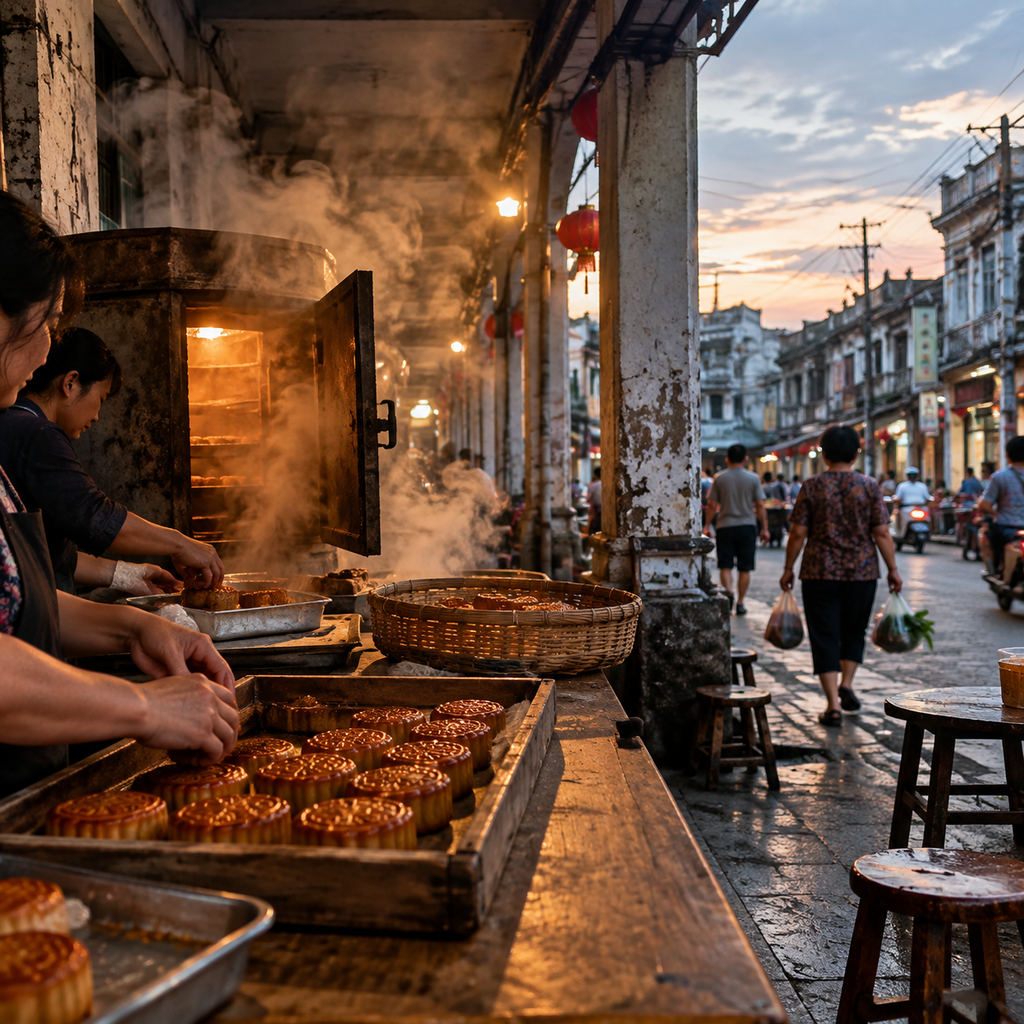
I asked the maker how she balanced the skin and filling. She did not offer an exact ratio or pretend that every piece could be defined by one formula. She said the skin should not be too thick and the filling should not be packed too tightly, or the texture would lose its balance after baking. Then she picked up a newly wrapped piece and pressed its edge so I could see whether the seam was hidden. Flour marked her fingers, with a pale trace caught beneath the nails. I wanted to photograph that moment: not the pretty finished mooncakes on a tray, but the way her fingers checked whether one piece could withstand the heat. Still, I did not. Someone behind me needed to pass, so I stepped aside and kept the phone in my pocket.
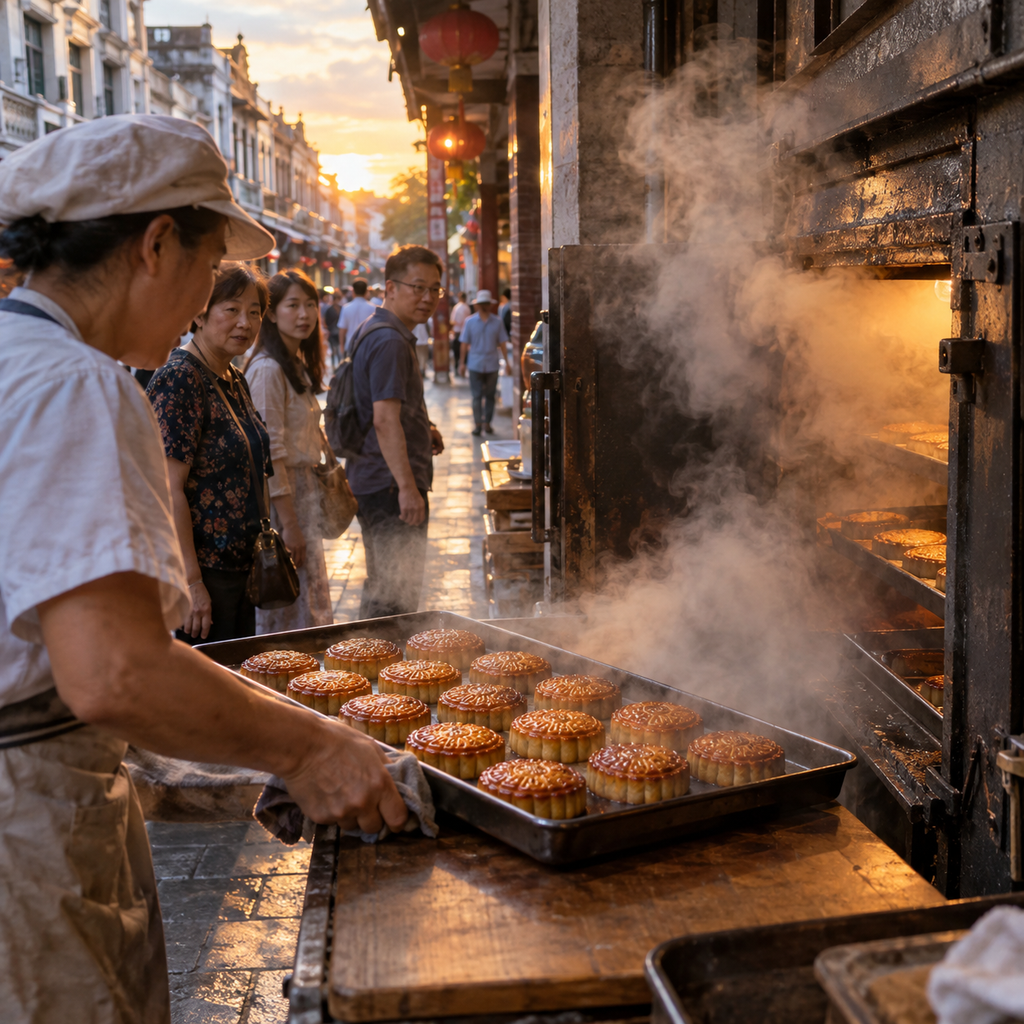
炉门打开时,热气先扑到骑楼下,再慢慢散进街巷。那股香味比刚才厚了许多,甜味、油香和烤过的面皮味缠在一起,连旁边经过的人也会放慢脚步。炉子并没有制造出一个与街道隔绝的厨房场景,反而把制作过程直接推到人流中间:路过的人可以看见,问一句,买一点,也可以只是闻到味道再继续走。月饼从炉里出来以后,表面颜色还在变化,边缘略深,中间亮一些,托盘被放到案板上时发出轻轻的碰响。那声音很小,却让我有种事情终于落地的感觉。
When the oven door opened, heat moved first beneath the arcade and then slowly into the lane. The fragrance became fuller: sweetness, oil, and baked pastry folded together. Even passersby slowed down. The oven did not create a kitchen cut off from the street. It brought the making directly into the path of pedestrians. Someone could look, ask a question, buy a little, or simply catch the smell and keep walking. When the mooncakes emerged, their color was still deepening. The edges were darker, the centers brighter, and the tray made a soft sound against the table. It was a small noise, but it gave me the feeling that something had finally arrived at its proper ending.
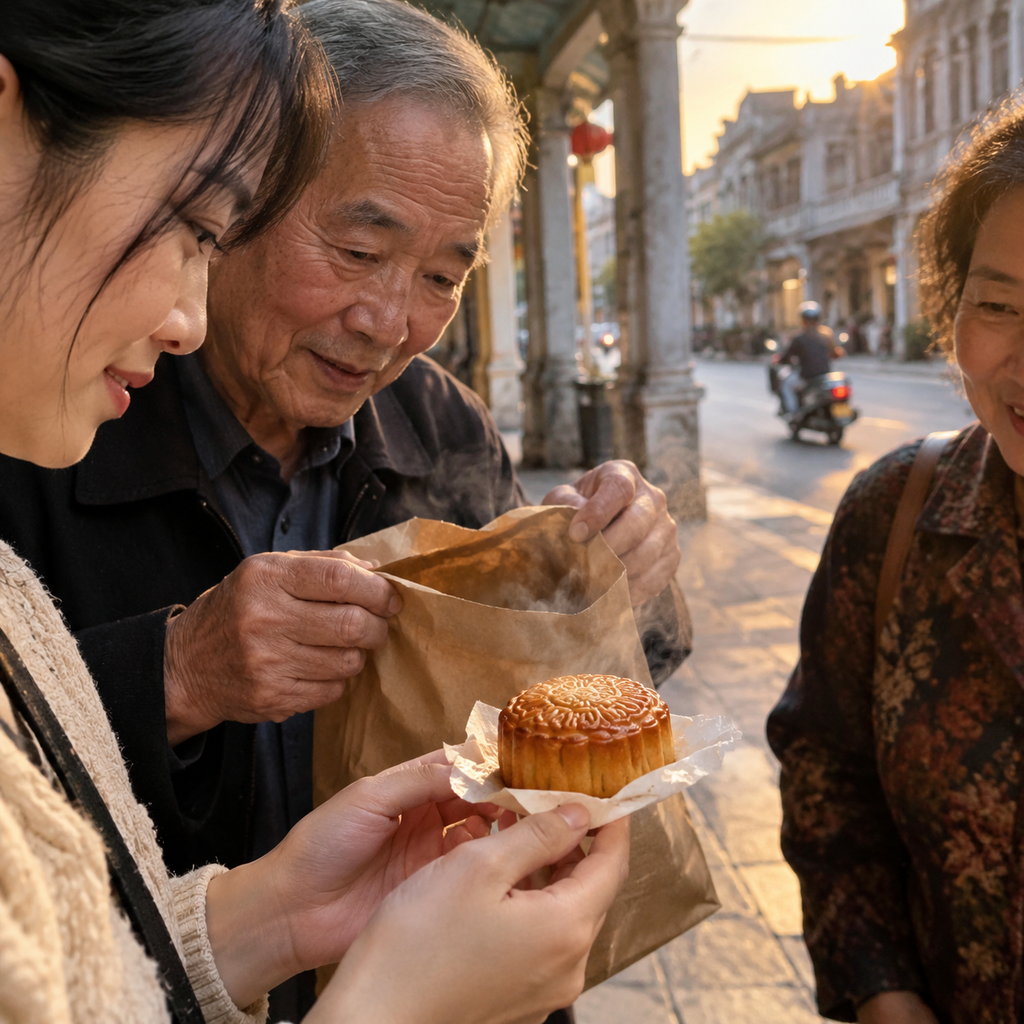
我原本以为自己会先拍月饼的纹路,再拍断面。真正拿到它时,事情完全不是这样。那只月饼被放在一小片纸上,纸边因为热气稍微卷起,我用两根手指托住它,马上感觉到外壳仍有温度。它并不烫得拿不住,却热到不适合立刻塞进袋子。做月饼的人提醒我先别急着封口,等它缓一缓。旁边的阿姨也把自己买的那袋子打开一点,让热气透出来。我们几个人站在骑楼下,像在共同照看一件刚出炉的小东西。我那时已经把手机掏出来了,却只是看了一眼屏幕。
I had imagined photographing the mooncake's pattern first and then its cut surface. Once it was actually in my hand, the moment went differently. It rested on a small piece of paper whose edge curled slightly from the heat. I held it between two fingers and felt warmth still inside the crust. It was not too hot to hold, but too warm to put straight into a closed bag. The maker reminded me not to seal it yet. The woman beside me opened her own bag a little so the heat could escape. Under the arcade, several of us stood as though jointly looking after a small thing just born from the oven. I had taken out my phone by then, but I only glanced at the screen.
就在那个具体的瞬间,街巷里一辆电动车从我们身边慢慢过去。车上的人提醒了一声,大家同时往墙边收了收肩膀。我手里的月饼向外倾了一下,纸片差点滑掉。我赶紧用掌心挡住,把它重新放稳。那一两秒里,我只顾着保护它,连手机的相机都没有打开。等电动车走远,炉边又有人递来下一只,阿姨问我要不要把这一块切开看看。我低头时,月饼的表面已经被自己的手指碰出一道很浅的印子,旁边有一点碎皮掉在纸上。它不再是一个适合端正拍摄的完整物件了。我没有觉得可惜,反而松了口气,好像它终于从“要记录的食物”变回了“可以吃的食物”。
In that precise moment, an electric scooter moved slowly past us in the lane. Its rider called out, and everyone drew their shoulders closer to the wall. The mooncake tilted in my hand; the paper nearly slipped away. I covered it with my palm and steadied it. For those few seconds I was occupied with protecting the pastry, and I never opened the camera. Once the scooter had gone, another mooncake was passed over from the oven, and the woman asked whether I wanted to cut mine open. When I looked down, my fingers had left a faint mark on the surface, and a few crumbs had fallen onto the paper. It was no longer a perfectly untouched object ready for a photograph. I did not mind. I felt relieved, as if it had changed back from “food to document” into “food to eat.”
切开以后,月饼的内部没有按照我预想的方式整齐分层。馅料有细密的部分,也有稍微松开的地方;外皮靠近边缘更干一些,中心则带着烘烤后的柔软。那位阿姨把一半递给我,让我先尝外皮。我咬下去时,第一感觉不是很甜,而是表面微微发韧,随后才有馅的香气出来。她看着我点头,像是确认我没有被一口的温度和甜度吓到。我们没有讨论什么“正宗不正宗”,因为在现场,食物已经通过手、炉子、纸袋和人的等待把自己说清楚了。
After we cut it open, the inside did not form the perfectly neat layers I had imagined. Some of the filling was dense, some slightly loosened; the crust near the edge was drier, while the center remained soft from baking. The woman gave me half and suggested I taste the crust first. My first impression was not overwhelming sweetness. The surface had a little resistance, then the aroma of the filling arrived. She watched me nod, as if checking that the heat and sweetness had not startled me. We did not debate whether it was “authentic.” In that setting, the food had already explained itself through hands, oven, paper bag, and waiting.
我后来才发现,买月饼这件事并不像在柜台前完成一次简单交换。我要先判断它是不是刚出炉,等多久,是否适合马上装袋;要听懂做月饼的人是在回答我的问题,还是在提醒我一个吃法;还要留意站的位置,不挡住做事的人,也不挡住骑楼下经过的街坊。老街上的交流常常没有完整的问答格式,更多时候是一句话、一个指向炉子的动作、一次让路,或者把纸袋口轻轻折开。对外地人来说,最容易错过的不是某个知识点,而是这些不写在菜单上的配合。
I later realized that buying a mooncake was not simply an exchange at a counter. I had to judge whether it had just come out of the oven, how long it should cool, and whether it could be bagged immediately. I had to listen for whether the maker was answering my question or reminding me how to eat it. I also had to choose where to stand so I would not obstruct the workers or the neighbors passing under the arcade. Conversation on an old street does not always take the form of complete questions and answers. It may be a sentence, a gesture toward the oven, a shared step aside, or a paper bag folded open to let heat escape. For an outsider, what is easiest to miss is not a fact from a guidebook, but this unspoken cooperation.
合浦老街给我的感觉,也来自它的尺度。骑楼的柱子把街面分成一段一段,却没有把人完全分开;商铺的门面有自己的边界,门口又向公共空间伸出一点;巷子能容下买菜的人、送货的人、骑车的人和停下来聊天的人,只是大家要不断调整彼此的位置。月饼制作摆在这样的街面上,天然带着一种公开性。你能看见面团怎么被按、馅料怎么被包、炉门怎么开,也能看见买家拿到食物后如何等待。它不是表演,却因为没有刻意遮挡而让人看到了劳动的节奏。
Part of Hepu Old Street's character comes from its scale. The arcade columns divide the frontage into sections without completely separating people. Each shop has its own boundary, yet its doorway extends slightly into shared space. The lanes can hold shoppers, delivery workers, cyclists, and people who stop for a conversation, but everyone must keep adjusting their position. Mooncake making placed on such a street naturally becomes visible. You can see dough pressed, filling wrapped, and the oven opened; you can also see buyers wait after receiving their food. It is not a performance. Precisely because it is not hidden, it allows a passerby to notice the rhythm of labor.
我也把这块月饼和我记得的沿海餐桌放在一起比较。小时候吃鱼,长辈常常先看鱼眼和鱼身的紧实,再决定清蒸还是煎;吃虾时,手上会留下壳的锋利和一点海水似的咸;喝汤时,碗沿的热气会把人逼得慢下来。北部湾一带的饮食记忆有一种很实际的敏感:食材从哪里来,什么时候吃,能不能放,几个人分,剩下的怎么处理。月饼也进入同一套生活判断,只是它把“当下的新鲜”与“之后的分享”放在一起。刚出炉时可以先尝,凉下来又适合带走,切开之后一块食物变成几个人的谈资。
I placed the mooncake beside my memories of coastal meals. When I was young, elders would inspect a fish's eye and firmness before deciding whether to steam or fry it. Eating shrimp left the sharpness of shells and a saltiness like seawater on my hands. Soup arrived with enough steam around the rim to make everyone slow down. Coastal food memories around the Beibu Gulf carry a practical attentiveness: where an ingredient came from, when to eat it, how long it would keep, how many people would share it, and what to do with what remained. Mooncakes enter the same system of judgment, although they join immediate freshness to later sharing. Fresh from the oven, one can be tasted; once cooled, it can be carried away; after cutting, it becomes a reason for several people to keep talking.
那位阿姨后来准备离开,临走前把纸袋往上提了一下,确认里面没有被热气闷住。她又问我是不是也要带几块回去。我说只买这一块,因为我想在街上慢慢吃。她没有劝我多买,只说那就先吃,吃不完再包好。这个建议非常普通,却让我觉得舒服。旅行中常有人急着告诉你应该带什么、错过什么、怎样才算来过;而她只是把一个选择交还给我。她拎着袋子走进巷口,袋底随着脚步轻轻晃动,经过一盏刚亮起来的门灯时,影子在墙上短暂地变长。
The woman eventually prepared to leave. Before walking away, she lifted the paper bag to make sure heat was not trapped inside. She asked whether I wanted to take a few pieces home as well. I said I would keep just this one and eat it slowly on the street. She did not persuade me to buy more. She simply said I could eat it first and wrap it again if I could not finish. It was ordinary advice, and that was why it felt good. Travel often comes with people eager to tell you what to carry, what not to miss, and what counts as having truly visited. She gave the choice back to me. Her bag swung lightly as she entered the lane, and beneath a newly lit doorway lamp her shadow briefly stretched across the wall.
我在骑楼下继续吃那半块月饼。街面上的光线正在换颜色,白天的灰慢慢被店铺灯光切开。一个小孩从门里跑出来,手里拿着塑料勺,后面的人喊他不要撞到别人;一位老人把折叠椅往里收,给推车让开;远处传来锅铲碰到铁锅的声音。月饼的碎屑落在纸上,我用手指捻起来吃掉,手指上留下细细的油感。这个动作不够优雅,却很符合老街的现场。没有人专门停下来注视我,我也不必把自己调整成一个正在拍摄的游客。
I continued eating the half mooncake under the arcade. The light was changing, daylight giving way to shop lamps that cut through the gray. A child ran out of a doorway with a plastic spoon while someone behind him called out, warning him not to bump anyone. An older man pulled a folding chair inward to make room for a cart. Somewhere farther away, a spatula struck an iron wok. Crumbs fell onto the paper, and I pinched them up with my fingers, leaving a fine film of oil on my skin. It was not an elegant gesture, but it belonged to the street. No one had stopped to watch me, and I did not need to arrange myself as a tourist in the middle of taking a photograph.
我曾经以为旅行记忆必须有一个清晰的证据:照片里要有招牌、食物、自己的手,最好还能让别人一眼认出地点。那天在合浦老街,我第一次觉得证据也可以是身体记住的东西。比如鞋底在石板上发出的轻响,骑楼阴影下比街口略低的温度,纸袋没有封死时透出的热,月饼表面被手指碰出的一道浅痕,还有街坊说话时偶尔被环境声音盖住的半句。它们不能全部放进相册,却会在后来某个平常的晚上突然回来,提醒我那时不是站在旁边参观,而是正在等待、让路、接住一块差点滑掉的月饼。
I used to think a travel memory needed clear evidence: a signboard, the food, my own hand, and perhaps enough of the setting for anyone to identify the place. In Hepu Old Street, I began to understand that evidence can also be something the body remembers. The faint sound of soles on stone, the cooler air beneath the arcade, the heat escaping from an unsealed paper bag, the shallow mark my finger left on the crust, and half a neighbor's sentence covered by street noise all stayed with me. They cannot all fit into a photo album, yet they return on an ordinary evening and remind me that I was not standing outside as a spectator. I was waiting, making room, and catching a mooncake that almost slipped away.
如果再走一遍那条街,我大概还是会先绕到月饼香味传来的地方,还是会问一句能不能买刚出炉的,还是会站得离案板稍远一点。变化只在于,我不会急着把手机准备好。我会先看做月饼的人是否有空回答,先让经过的街坊走过去,先等纸袋里的热气松开。因为真正让我记住的并不是月饼最后长什么样,而是它从一双沾着面粉的手交到我手里时,周围的人如何一起给它腾出一点位置。那一块没有来得及拍照的月饼,最后被我吃完了。没有照片替我保存它,可合浦老街的风、炉火和人声已经把它留在了另一种更慢的记忆里。
If I walked that street again, I would probably follow the mooncake smell to the same kind of worktable, ask whether a fresh piece was available, and stand a little farther from the dough. The difference is that I would not prepare my phone first. I would see whether the maker had a spare moment to answer, let passing neighbors go through, and wait for the heat to loosen inside the bag. What stayed with me was not the final appearance of the mooncake. It was the way everyone around me made a little room when a flour-dusted pair of hands passed it to me. I finished the piece I never managed to photograph. No picture preserves it, but the wind, oven heat, and voices of Hepu Old Street have kept it in a slower kind of memory.
等一炉月饼的半个下午
第二天我又回到合浦老街,不过这次没有把行程排得太满。午后的太阳从骑楼屋檐边斜斜照进来,亮处像一块被水洗过的白布,阴影里却仍有昨夜潮气留下的凉。我沿着前一天走过的路慢慢辨认方向,先听见扫帚刷过地面的沙沙声,再闻到一股混着麦香和油脂的气味。案板已经摆好,面粉筛落时扬起极轻的白雾,落在深色围裙上,像一层不规则的薄霜。做月饼的人把盆沿擦干净,称面、分馅、搓圆,每一步都不急,却没有一秒显得多余。她把拇指压在面团中央,转动手腕让凹口均匀,再把馅料推入里面;馅料稍微偏向一边,她便用指腹拨回来,像把一粒不听话的米重新拨进碗心。我站在不妨碍取物的位置,看着她反复调整,才明白所谓手艺并不总是醒目的绝招,更多时候是对细小偏差的耐心修正。
The next day I returned to Hepu Old Street without filling the afternoon with a fixed itinerary. Sunlight slid in from the arcade roofs, bright as cloth rinsed clean, while yesterday's damp coolness remained in the shade. I recognized the route by sound before sight: a broom brushing grit, then the smell of wheat and fat. The worktable was ready. Flour fell through a sieve in a pale, fleeting mist and settled on a dark apron like uneven frost. The maker weighed dough, divided fillings, and rolled each portion without hurry, yet nothing seemed wasted. She pressed a hollow into the center with her thumb, turned her wrist to even the walls, and guided the filling inside. When it drifted to one side, she nudged it back with a fingertip. Watching her make those small corrections, I understood that craft is not always a dramatic trick. Often it is the patient repair of tiny imbalances.
我这次特意留意了时间怎样进入食物。面团刚拌好时,手指按下去会慢慢回弹;包好的月饼放在托盘上,边缘还显得柔软,不能彼此挤得太近;进炉之前,表面要保持干净,否则烤过以后细小的面粉结会变成不均匀的斑点。炉火的热度把等待分成几段,先是看不见的升温,再是香气从门缝里出来,最后才轮到颜色改变。有人问什么时候能取,我听见回答里有几个熟悉的词,更多内容被锅盖碰撞和街上车辆声打断。没有人拿秒表催促,大家凭经验看状态:边缘开始收紧,表面从湿润变得有光,香味不再像生面粉,而有了烘烤后的厚度。对游客来说,最好的做法不是追问一个绝对准确的分钟数,而是观察这一炉的实际进度,给食物留出完成自己的时间。
This time I paid attention to how time entered the food. Freshly mixed dough slowly pushed back against a finger. Shaped mooncakes still had soft edges and needed space on the tray. Before baking, their surfaces had to remain clean, because tiny flour clumps would become uneven spots after heating. The oven divided waiting into stages: warmth first gathering invisibly, fragrance escaping through the door, and color changing last. Someone asked when the batch would be ready, but parts of the answer disappeared beneath lids, pans, and passing traffic. No one used a stopwatch. People judged the signs: edges tightening, surfaces turning glossy, and the smell moving beyond raw flour into the deeper scent of baking. A traveler does not need to demand an exact number of minutes. It is better to watch the actual batch and let the food take the time it needs.
骑楼里的走法
合浦老街适合用一种略慢、略靠边的走法。不要一直低头看导航,也不要为了赶到下一个地方把脚步踩得太重。骑楼下的地面有高低变化,石板缝里偶尔积着一点水,门槛前又可能放着正在晾干的竹篮。经过店门时,我会先观察门口是否有人搬东西,再决定从左侧还是右侧通过;遇到推车,就把肩膀往里收,等车尾过去后再继续。这样的让路并不隆重,常常只需要一个眼神和半步距离,却能让陌生人之间保持舒服的秩序。转进小巷以后,声音会突然变近,碗筷声、抽屉拉动声、屋里电视的对白从不同方向传出来。巷子尽头若有风,先吹动晾着的布,再把海边带来的湿咸味送到鼻尖。旅行者可以把这些变化当作路线的一部分,而不只是把街道当成通往某个坐标的空白。
Hepu Old Street is best walked at a slightly slower pace and close enough to the side for others to pass. I tried not to stare at navigation or press toward the next destination. The arcade floor changed height in places; a little water gathered in stone joints, and bamboo baskets sometimes rested outside doorways to dry. Before passing a shop, I watched for people carrying goods and chose a side. When a cart came through, I drew my shoulder inward and resumed only after its rear had cleared. This kind of courtesy needed no ceremony, only a glance and half a step. Turning into a lane brought sounds closer: bowls, drawers, and television voices arriving from separate rooms. If wind entered at the far end, it moved cloth first and then carried a damp saltiness inland. Those shifts are part of the route, not empty space between coordinates.
我曾在一段骑楼下停了很久,只因为墙边一块旧木板挡住了一个不起眼的缺口。木板上有反复摩擦留下的亮痕,旁边放着一只用来接水的塑料盆。路过的人都熟悉它的存在,脚步会自然地绕开;我却第一次看见时差点撞上去。一个街坊从后面提醒,我连忙往旁边退,才发现自己站的位置正好压住了门口一小片阴影。对方没有责怪,只是把盆往里挪了挪,给我和后面的人都腾出空间。这样的瞬间没有景点说明,也不会出现在旅行攻略的重点清单里,可它让老街从“可观看的建筑”变成“有人共同使用的生活场所”。如果要拍照,最好先确认不会挡住门口、摊位或邻里往来;如果不拍,便把这次调整位置的动作记住,也是一种参与。
I once stopped beneath an arcade because an old plank partly covered a small gap beside the wall. Repeated rubbing had polished one edge, and a plastic basin caught water nearby. Residents knew to step around it; I nearly walked into it. A neighbor warned me from behind, and I moved back, realizing I had occupied a patch of shade at the entrance. Without scolding, the neighbor shifted the basin inward and made room for both me and the people behind. Such a moment has no plaque and rarely appears in a guide's highlights, yet it turned the old street from architecture to a place jointly used by residents. Anyone taking photographs should first check that a doorway, stall, or passage remains clear. Anyone who does not take one can remember the small act of moving aside; that is participation too.
买月饼时不只看外表
如果想在老街买月饼,我会建议先买少量,尤其是第一次尝试时。可以观察表皮是否完整,轻轻托起时有没有明显塌陷,再问清楚哪些是已经冷却、哪些还保留着炉火后的温度。不要只凭颜色深浅判断口感,因为不同批次在烘烤后的变化并不完全一样;有的外皮看起来朴素,入口却有清楚的麦香和油润感;有的刚出炉时边缘略硬,放凉后反而更容易切开。若准备带回住处或继续转车,纸袋不要立刻压紧,先让热气散掉,避免表皮被水汽闷软。路上也不要把它和气味很重、会渗油的食物紧紧放在一起。月饼不是必须当天拍完、当天评出结论的纪念品,它更像一段可以分成几次完成的体验:现场闻、温热时尝、冷却后再比较,最后把剩下的半块留给同行的人。
When buying mooncakes on the old street, I would start with a small amount, especially on a first visit. Look for an intact crust, lift it gently to see whether it has collapsed, and ask which pieces have cooled and which still hold oven warmth. Color alone does not predict texture. A plain-looking crust may carry a clear wheat aroma and a comfortable richness; one that seems a little firm at the edge when hot may cut more easily after cooling. If the mooncake must travel to lodging or another transport connection, leave the paper bag partly open until the steam escapes. Do not pack it tightly beside strongly scented or oily foods. A mooncake need not be photographed and judged in one sitting. It can be experienced in stages: smell it at the worktable, taste it warm, compare it after cooling, and share the remaining piece with a companion.
我把月饼放凉以后又尝了一次,口感果然变得安静。刚出炉时,外皮的香气最先冲出来,手指触到的是柔软和热;过了一段时间,甜味没有消失,却变得更集中,馅料的颗粒感也更容易被舌头分辨。咬到边缘时,会有细小的碎屑落下,咀嚼几下以后,油香才慢慢铺开。那种变化让我想到沿海人家保存食物的习惯:一顿饭的滋味并不只在锅里完成,也会随着温度、时间和下一次加热继续变化。旅行中若有条件,不妨留一小块到晚上再吃,配温水或清茶,不必刻意寻找复杂的搭配。坐在住处窗边,听外面车辆渐少,月饼从街边买来的热食变成桌上的分享物,旅程也会因此多出一个缓慢的收尾。
After the mooncake cooled, I tasted it again and found the flavor quieter. When warm, the crust sent out its aroma first, while the fingers felt softness and heat. Later the sweetness did not disappear; it became more focused, and the filling's grain was easier to notice. Tiny flakes fell from the edge, and only after a few chews did the richness spread across the mouth. It reminded me that coastal food traditions often account for time: a dish is not finished only in the pan, but changes with temperature, resting, and reheating. If circumstances allow, keep a small piece for the evening. Warm water or plain tea is enough. By a window, with traffic thinning outside, the mooncake changes from hot street food into something shared at a table, giving the journey a slower ending.
北部湾的味道怎样留在街上
How Beibu Gulf Flavor Remains in the Street
走出月饼摊后,我在老街附近吃了一碗热汤。汤面浮着一点油花,葱末被热气推到碗边,入口先是温度,随后才是鲜和淡淡的咸。旁边有人把辣椒和蒜末拨进小碟里,先蘸一口,再决定要不要把更多调料放进汤中。这样的动作让我想起北部湾沿岸的餐桌,很多味道不是一次性加到最大,而是让每个人按自己的习惯调整。海鲜的鲜可以被姜蒜托住,也可以被酸味拉亮;米粉吸住汤汁后变得柔软,夹起时却仍有一点弹性;炸物刚入口有脆响,放在汤边久了便吸进湿气,口感也跟着改变。合浦老街的饮食记忆并不只属于某一道菜,它藏在端碗、添料、吹凉、分食这些连续动作里,也藏在吃完后用纸巾擦手、把碗推回原处的细节中。
After leaving the mooncake table, I ate a bowl of hot soup nearby. A little oil floated on the surface, and chopped scallions gathered at the rim as steam rose. Heat arrived first, followed by a clean savory note and a light saltiness. Someone next to me mixed chili and garlic in a small dish, dipped one bite, and only then decided whether to add more. That reminded me of Beibu Gulf tables, where flavor is often adjusted rather than pushed immediately to its strongest level. Seafood may be steadied by ginger and garlic or brightened by sourness. Rice noodles absorb broth and soften while retaining a little spring. Fried food begins with a crisp sound but takes on moisture if left beside soup. Hepu's food memory belongs not to one dish alone, but to the sequence of lifting a bowl, adding seasoning, cooling a bite, sharing, wiping one's hands, and returning the bowl.
我没有把这碗汤拍下来。不是因为它不值得记录,而是因为那时我的手正扶着碗,另一只手要把筷子上滑下来的米粉接回去。汤的热气让镜片似乎都要起雾,旁边的桌子有人起身,我得把椅子往里收。等我终于腾出手,碗里的汤已经少了一半,葱花散开,表面的油光也不再整齐。它不适合被重新摆成刚端上来的样子,我也不想为了照片把真实的吃法暂停。没拍照的瞬间往往不是空白,反而因为手在忙、嘴在尝、身体要给别人让位置,留下了更完整的感受。回想起来,我记得汤入口时舌尖被热度占住的短暂迟疑,记得蒜末带来的锐利,也记得吃完月饼后再喝一口清汤,甜味被轻轻收住的感觉。
I did not photograph the soup. Not because it lacked value, but because one hand held the bowl while the other caught noodles sliding from the chopsticks. Steam threatened to fog my glasses, and someone at the next table stood up, so I pulled my chair inward. By the time my hands were free, half the broth was gone, the scallions had spread, and the oil no longer lay in a neat pattern. Recreating its arrival would have meant pausing the way I was eating. Moments without photographs are not necessarily empty. Because the hands are occupied, the mouth is tasting, and the body is making room, the memory can become more complete. I remember the brief hesitation when heat reached my tongue, the sharp lift of garlic, and the way a sip of clear soup gently settled the sweetness left by the mooncake.
和街坊聊几句再离开
在合浦老街,和街坊交流不需要设计成一次正式访谈。买东西时可以问一句怎么保存,坐下吃东西时可以请教哪种吃法更适合慢慢尝,经过门口时则先打个招呼,再听对方愿不愿意多说。若对方正在忙,就把问题缩短,不要把手机和录音设备直接伸到别人面前。很多信息会在自然的动作里出现:有人把刚出炉的月饼放到通风处,说明他在意口感;有人把海产品先沥干再下锅,说明他熟悉水分对味道的影响;有人把切开的食物分给旁边的人,说明“好吃”在这里常常要通过共享来完成。旅行者不必把每句闲谈变成可发布的素材,听见以后点点头、道声谢谢,已经足够。尊重不是把别人排除在体验之外,而是允许他们保留不想被记录的部分。
Conversation with residents on Hepu Old Street does not need to become a formal interview. While buying something, ask how it is kept. While eating, ask which way suits a slow tasting. At a doorway, greet people first and see whether they want to continue. If someone is busy, shorten the question and do not place a phone or recorder directly in front of them. Information often appears through ordinary actions. A fresh mooncake set in a ventilated place suggests attention to texture. Seafood drained before entering the wok shows an understanding of how water changes flavor. A cut piece passed to someone nearby shows that “good” is often completed through sharing. Travelers do not need to turn every exchange into publishable material. A nod and thanks can be enough. Respect means allowing people to keep parts of their lives unrecorded.
我离开前又绕了一小段路,经过几户人家门前。有人在清洗贝壳,水流冲过表面时带着细碎的沙声;有人把晒过的食材收进篮子,手掌在篮底轻轻拍了两下,像是在确认没有遗漏;一位老人坐在门边择菜,偶尔抬头看一眼经过的人。没有谁特意向我介绍这里的生活,可我在这些动作中看见了沿海日常的连续性:潮气来了要通风,食材买回来要处理,晚饭前要把门口收拾出路,邻里碰面总有几句家常。骑楼保存下来的不只是墙面和柱子,也保存了人如何在有限空间里安排工作、休息和相遇。走得越慢,越能看见这些安排并非杂乱,而是经过多年磨合后形成的默契。
Before leaving, I took a short detour past several doorways. Someone rinsed shells, water carrying a fine sandy sound across them. Someone gathered dried ingredients into a basket and tapped the bottom twice, checking that nothing had been left behind. An older resident sat sorting vegetables and occasionally looked up at passersby. No one gave me a tour, yet these actions showed the continuity of coastal daily life: ventilating when damp air arrived, preparing ingredients after shopping, clearing the entrance before dinner, and exchanging a few domestic words with neighbors. The arcades preserve more than walls and columns. They preserve the ways people arrange work, rest, and encounters within limited space. The slower I walked, the clearer it became that this was not disorder but a practical understanding shaped over years.
给后来者的一条慢路线
如果把合浦老街安排进一天的行程,我会把早一点的时间留给观察街巷,把午后或傍晚留给食物。先从骑楼下走一圈,不急着买东西,看看哪些门口正在准备食材,哪些地方适合短暂停留;遇到阳光强的时候,利用连续的阴影走,鞋子也更容易避开积水和搬运路线。想买月饼时,不妨先询问当天是否有刚出炉的一批,再根据自己的行程决定买多少。若后面还要乘车,不要把需要冷却的食物压在行李最底层;若打算边走边吃,带一张干净纸巾,给自己也给摊位留出整洁。吃完后不要立刻离开,可以沿着巷子再走几分钟,听听声音从街面转进住家之间的变化。真正适合带走的纪念物不一定是数量最多的礼盒,也可能只是少买一些,让每一块都能被认真吃完。
If Hepu Old Street is part of a day trip, I would reserve the earlier hours for reading the lanes and the later afternoon or evening for food. Walk beneath the arcades once before buying anything. Notice which doorways are preparing ingredients and where a brief stop will not obstruct anyone. When the sun is strong, use the continuous shade and watch for puddles and delivery paths. If mooncakes are your goal, ask whether a fresh batch is available and match the amount to the rest of your route. If you must travel onward, do not bury warm food at the bottom of luggage. If you eat while walking, carry a clean tissue and leave the work area tidy. After eating, stay for a few more minutes and notice how street sounds recede into residential lanes. The best souvenir may not be the largest box. Buying less can mean giving each piece enough attention to be finished.
还可以给自己留一个“无照片段”。这段时间里不打开相机,只用眼睛和耳朵确认几件事:面团被按下时的回弹,炉门打开后的热浪,月饼掰开时细碎的断裂声,海风经过骑楼转角时带来的咸味,街坊为了让车通过而同时侧身的动作。若担心忘记,晚上回到住处后再写几句,不必追求完整游记,只记下当时手上有什么、脚站在哪里、嘴里最后留下什么味道。这样的记录不会替代照片,却能补上照片无法保存的温度和次序。旅行不是把所有东西都变成证据,而是让某些东西在离开以后仍能以气味、口感和动作重新出现。
You can also reserve a “no-photo interval.” Keep the camera closed and notice a few things: the spring of dough under pressure, the wave of heat from an opened oven, the fine crackle of a mooncake breaking, salt carried by wind around an arcade corner, and neighbors stepping aside together for a vehicle. If you fear forgetting, write a few lines that night. You do not need a complete travel essay; note what your hands held, where your feet stood, and what flavor remained at the end. Such notes do not replace photographs. They restore temperature and sequence, which photographs cannot fully keep. Travel is not an effort to turn everything into evidence. It is also a way of letting certain things return later as scent, texture, and movement.
我最后买走的仍然只有一块月饼。它在纸袋里随着步伐轻轻碰到袋壁,发出几乎听不见的闷响。我经过骑楼柱子时没有停下来找最佳角度,也没有把它举到招牌前证明自己来过。走到街口,风里混进了油锅的香和远处海水似的湿气,我撕开纸袋一角,让里面保持通风。第一口是在路边吃的,第二口留到回去以后,剩下的一点被我掰给同行的人。没有照片记录这三次不同温度的口感,却正因为分成了三次,合浦老街的下午也被分成了几个可以重新想起的片段。那块月饼最终消失在胃里,没拍照的瞬间却没有消失;它和骑楼的阴影、街坊的让路、北部湾沿岸饭桌上的咸鲜一起,变成我对这座老街最踏实的记忆。
I still took away only one mooncake. It tapped softly against the paper bag as I walked. I did not stop beside an arcade column to find a perfect angle or hold it under a sign as proof of having visited. At the street entrance, wind carried frying oil and a dampness like seawater, so I opened one corner of the bag for ventilation. I ate the first bite by the road, saved the second for later, and shared the last little piece with my companion. No photograph captured those three textures at different temperatures. Because the eating happened in stages, the afternoon also separated into moments I could revisit. The mooncake disappeared, but the unphotographed instant did not. It remained with arcade shade, neighbors making room, and the salty freshness of Beibu Gulf meals as my most grounded memory of the old street.
离开之前再闻一次炉边的香
Smelling the Oven Once More Before Leaving
临近离开时,我没有马上走向街口,而是把脚步放慢,回到那张案板附近。新一炉月饼正在等待入炉,面皮被手掌压过后留下细小的纹理,馅料的气味还没有完全透出来,只有靠近时才能闻到一点豆沙或坚果似的温厚香气。做月饼的人用刷子扫去托盘边的碎粉,又把几只距离太近的月饼往两旁分开。她的动作几乎没有声音,刷毛掠过金属时只发出轻轻的擦响。旁边的街坊提着菜篮经过,停下来问了几句,又从口袋里拿出纸巾擦去篮柄上的水。这样的往返让下午显得有层次:有人为晚饭准备食材,有人为节日准备点心,有人只是顺路看一眼熟悉的炉火。旅行者若愿意多等几分钟,便能看见同一处地方怎样在不同人的手里承担不同用途。
Before leaving, I did not go straight to the street entrance. I slowed down and returned near the worktable. Another batch was waiting to enter the oven. Palm pressure had left fine marks on the pastry skin, while the filling's aroma had not fully opened; only close by could I catch its warm, nutty or bean-like depth. The maker brushed loose flour from the tray and separated pieces that sat too close together. The brush made almost no sound, only a soft scrape against metal. A neighbor carrying a vegetable basket stopped to ask a few questions, then used a tissue to wipe water from the handle. The afternoon gained layers through these crossings: one person preparing dinner, another preparing festival food, someone else simply checking a familiar oven. A traveler who waits a few extra minutes may see one place serve many purposes in different hands.
我把最后一口月饼咽下去以后,嘴里还留着一点烘烤后的甜香。随后喝了几口水,甜味被冲淡,舌面却仍能感觉到油润留下的细微厚度。风从街巷一头穿过来,吹得纸袋口轻轻开合,我伸手按住,却没有把它重新封死。袋里只剩下几片碎皮,我舍不得立刻丢掉,就用纸巾把它们拢到一起。这个动作让我想到旅行中常被忽略的收拾:把吃过的纸张折好,把椅子推回原处,把挡路的袋子提到身边。它们看上去与“游览”无关,却决定了一个人如何进入别人的生活空间,又如何不带来额外的麻烦。若后来再来,我仍会给自己安排一段没有拍摄目标的时间,专心完成这些小动作,再把记忆交给脚步带回去。
After swallowing the final bite, I could still taste a baked sweetness. A few sips of water softened it, but the tongue retained the faint richness left by the oil. Wind passed through the lane and lifted the paper bag's opening. I held it down without sealing it again. Only a few crumbs remained, and I gathered them onto a tissue before discarding it. The gesture reminded me of the quiet tidying that travel often overlooks: folding used paper, returning a chair, and keeping a bag close so it does not block a passage. These acts may seem unrelated to sightseeing, yet they determine how someone enters another person's living space without adding trouble. If I return, I will again reserve time without a photographic goal, complete these small acts, and let my steps carry the memory away.
来源说明:本文为基于个人现场叙事的原创改写,不虚构具体店名、价格、营业时间、人物原话或未经核实的地方史实。文中关于骑楼街巷、沿海饮食记忆和月饼制作的描写,限于可观察的日常经验与一般性食物常识;涉及合浦及北部湾地域背景的核对,可参阅中国政府网地方公开信息、广西文化和旅游厅公开资料,以及合浦县人民政府网站的公开介绍。本文未逐字引用上述资料,也未将公开资料改写成百科式历史叙述。
- 我带父母第一次来中国,不是先去最红景点,而是先把一天过顺 | When I Brought My Parents to China for the First Time, I Focused on a Smooth Day Before Famous Sights
- 中山装与唐装:男士传统服饰怎么穿 | Zhongshan Suit & Tang Suit: Men's Traditional Wear
- 苏州一到雨天,最容易失灵的不是路线图,而是那种“这里本来很好走”的自信 | When Rain Comes to Suzhou, What Fails First Is Not the Map but the Confidence That the City Is Easy to Walk
- 我在杭州小馆里第一次听懂“清淡一点” | In a Hangzhou Eatery, I Finally Understood “A Little Lighter”
- 我第一次看懂明代衣服,不是在博物馆,而是在裁缝铺里看人怎么站 | I First Understood Ming Clothing Not in a Museum, but in a Tailor's Shop Watching How People Stood
- 我在苏州学会先找一条不费力的厕所路线 | In Suzhou I Learned to Find a Low-Effort Restroom Route First
- 在重庆住满一个月以后,镜头终于开始拍到景点以外的日常骨架 | After a Full Month in Chongqing, the Camera Finally Catches the Everyday Framework Beyond the Sights
- 广州真正上镜的,不只是早茶和烧味,而是吃这件事怎样带着整座城往前走 | What Truly Films Well in Guangzhou Is Not Only Dim Sum and Roast Meats but the Way Eating Pulls the Whole City Forward
- 从兰州牛肉面开始理解一座河谷城市 | Understanding a River-Valley City Through Lanzhou Beef Noodles
- 在上海弄堂里学会慢下来 | Learning to Slow Down in Shanghai's Lanes
Comments (0)