
山城重庆那条上坡路,教我别低估城市地形 | My First Chongqing Hill Road Taught Me Not to Underestimate City Terrain
山城重庆那条上坡路,教我别低估城市地形 | My First Chongqing Hill Road Taught Me Not to Underestimate City Terrain
我第一次在重庆真正被城市地形教育,是在一个看起来很普通的下午。手机地图显示,从较场口附近到我订的小旅馆只有一公里多,步行时间二十分钟。我看着屏幕上那条弯曲但不算长的蓝线,觉得这段路正好可以当作饭后散步。重庆用一种很安静的方式等着我误判:它没有在地图上写“接下来会让你喘气”,只把海拔变化藏进了一条细线里。
The first time Chongqing’s terrain truly taught me a lesson was on an ordinary-looking afternoon. My phone map said the distance from near Jiaochangkou to the small hotel I had booked was a little over one kilometer, about twenty minutes on foot. I looked at the curved but not very long blue line and thought it would be a good post-meal walk. Chongqing waited for my mistake quietly. It did not write “you are about to lose your breath” on the map. It simply hid elevation inside a thin line.
那天我刚吃完一碗小面,嘴里还有花椒的麻,背包里装着相机、充电宝和一瓶水。街边的店铺往外冒着热气,楼上晾衣杆伸出来,公交车从路口拐过去时带起一阵风。我跟着导航往前走,最初几百米一切正常:人行道不宽,电动车从身边滑过,路口红绿灯换得很快。直到我看见前方那条路突然抬起头。
That day I had just finished a bowl of Chongqing noodles, with the numbness of Sichuan pepper still in my mouth. My backpack held a camera, a power bank, and a bottle of water. Steam drifted from small restaurants, laundry poles reached out from upper floors, and a bus turned through the intersection with a gust of air behind it. I followed the navigation, and the first few hundred meters felt normal: the sidewalk was narrow, electric scooters slid past me, and the traffic lights changed quickly. Then I saw the road ahead suddenly lift its head.
它不是景区里那种被修饰过的坡,也不是照片里好看的石阶。那是一条日常上坡路,旁边有水果店、药房、修锁摊和停得很紧的车。正因为它太日常,我一开始没有把它当成挑战。我只是把手机放进口袋,想用十分钟走完。走了不到两分钟,我的步伐就从旅行者的轻快变成了本地通勤者才懂的节省模式。
It was not a polished slope inside a scenic area, nor a photogenic stone staircase. It was an everyday uphill road, lined with a fruit shop, a pharmacy, a key-repair stand, and tightly parked cars. Because it looked so ordinary, I did not first treat it as a challenge. I simply put my phone in my pocket and expected to finish it in ten minutes. In less than two minutes, my pace changed from a traveler’s lightness to an energy-saving mode that local commuters understand well.
重庆的上坡不是单纯的角度问题,而是连续性问题。你以为走到前面那个路灯就会平一点,结果路灯之后还有一个弯;你以为拐过弯就能休息,结果弯后是一段更窄的坡;你以为导航上的距离在减少,身体却告诉你高度还在增加。地图用平面计算距离,腿用重力重新解释距离。
Chongqing’s uphill roads are not only about angle; they are about continuity. You think the road will flatten after the next streetlamp, but there is another bend beyond it. You think you can rest after the bend, but a narrower slope follows. You think the distance on the map is shrinking, while your body tells you the height is still increasing. The map calculates distance on a plane. Your legs reinterpret distance through gravity.
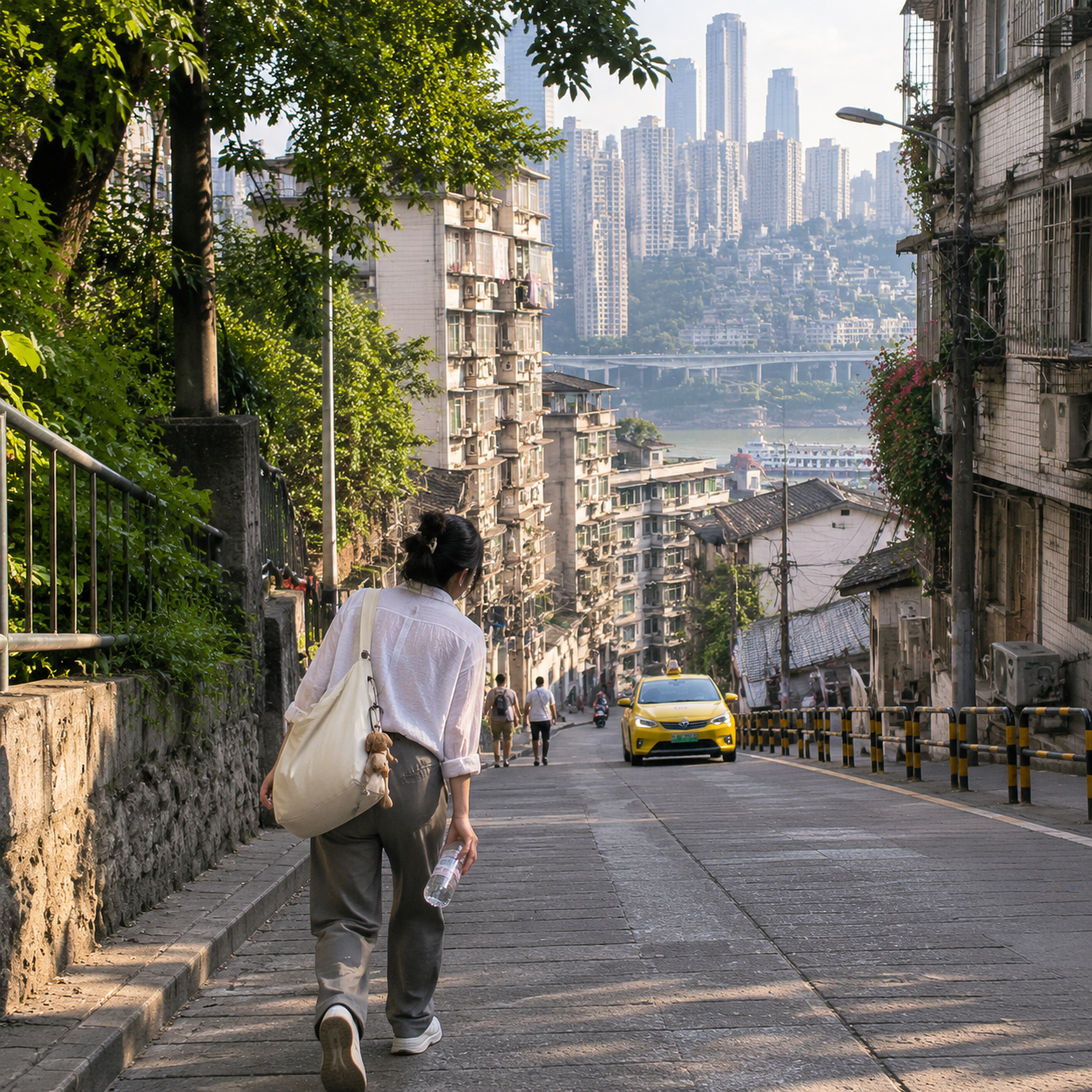
走到坡路中间时,我停在一家便利店门口假装看饮料。其实我不是特别渴,只是需要一个不尴尬的理由站住。店门口有两级台阶,台阶上坐着一位阿姨,手里剥着橘子。她看了看我的背包,又看了看我额头上的汗,笑着说:“上去还早哦。”这句话没有嘲笑的意思,更像重庆人对地形的温柔提示。
Halfway up the slope, I stopped in front of a convenience store and pretended to look at drinks. I was not especially thirsty; I simply needed a reason to stand still without looking defeated. There were two steps at the entrance, and an auntie sat there peeling an orange. She looked at my backpack, then at the sweat on my forehead, and smiled: “Still a while to go upward.” It was not mockery. It felt more like a Chongqing resident’s gentle warning about terrain.
我买了一瓶冰水,站在店门口重新看地图。导航仍然自信,蓝线仍然短,剩余时间甚至只剩十五分钟。可我第一次注意到旁边的小灰线、楼梯标识和道路名字的走向。重庆的地图不能只看长度,还要看线条怎样贴着山体绕行。一个“近”的目的地,可能在垂直方向上离你很远。
I bought a cold bottle of water and checked the map again at the store entrance. The navigation remained confident, the blue line remained short, and the remaining time was now only fifteen minutes. But for the first time I noticed the small gray lines, staircase symbols, and the directions of road names nearby. In Chongqing, you cannot read a map only by length. You have to see how lines wrap around the mountain. A destination that is “near” may be far from you vertically.
继续往上走时,我开始学着观察本地人的身体语言。穿皮鞋的上班族不是直直冲上去,而是用稳定的小步保持节奏;送外卖的骑手在坡口提前减速,判断对面车流后再拧油门;推婴儿车的年轻父亲选择了路边更粗糙但更缓的那一侧;拎菜的老人走几步就在树荫下停一停,停得自然,不像是在认输。
As I continued upward, I began to study local body language. Office workers in leather shoes did not charge straight up; they kept a steady rhythm with small steps. Delivery riders slowed before the slope, judged the oncoming traffic, and only then turned the throttle. A young father pushing a stroller chose the rougher but gentler side near the curb. An elderly person carrying vegetables stopped every few steps under tree shade, resting naturally, not as if surrendering.
我忽然意识到,重庆人走路时对地形有一种提前量。他们不会等到累了才调整,而是在坡刚开始时就已经改变步幅、路线和呼吸。外地游客常犯的错,是把平原城市的走法带到山城:看见距离不远就加速,看见小巷就钻进去,看见台阶就以为是捷径。结果每一步都在向身体借债。
I suddenly realized that Chongqing residents walk with a kind of advance allowance for terrain. They do not wait until they are tired to adjust; they change stride, route, and breathing as soon as the slope begins. A common mistake for visitors is bringing flat-city walking habits into a mountain city: speeding up because the distance looks short, entering an alley because it seems direct, and treating stairs as automatic shortcuts. Each step then borrows energy from the body.
第二个转弯处,我犯了这类错误。导航显示前方有一条小巷可以切过去,距离少了两百米。我看到巷口有一串台阶,旁边墙上贴着旧广告,觉得这很像旅行文章里会推荐的“本地小路”。我没有多想就拐进去。前十级台阶让我觉得选择正确,第二十级开始变窄,第三十级之后,台阶突然变得更陡,尽头还看不见出口。
At the second turn, I made exactly that kind of mistake. The navigation showed a small alley ahead that would cut about two hundred meters from the route. At the entrance, I saw a set of stairs with old advertisements pasted on the wall, and it looked like the kind of “local path” a travel article might recommend. I turned in without thinking. The first ten steps made me feel clever. After twenty, the stairs narrowed. After thirty, they became sharply steeper, and I still could not see the exit.
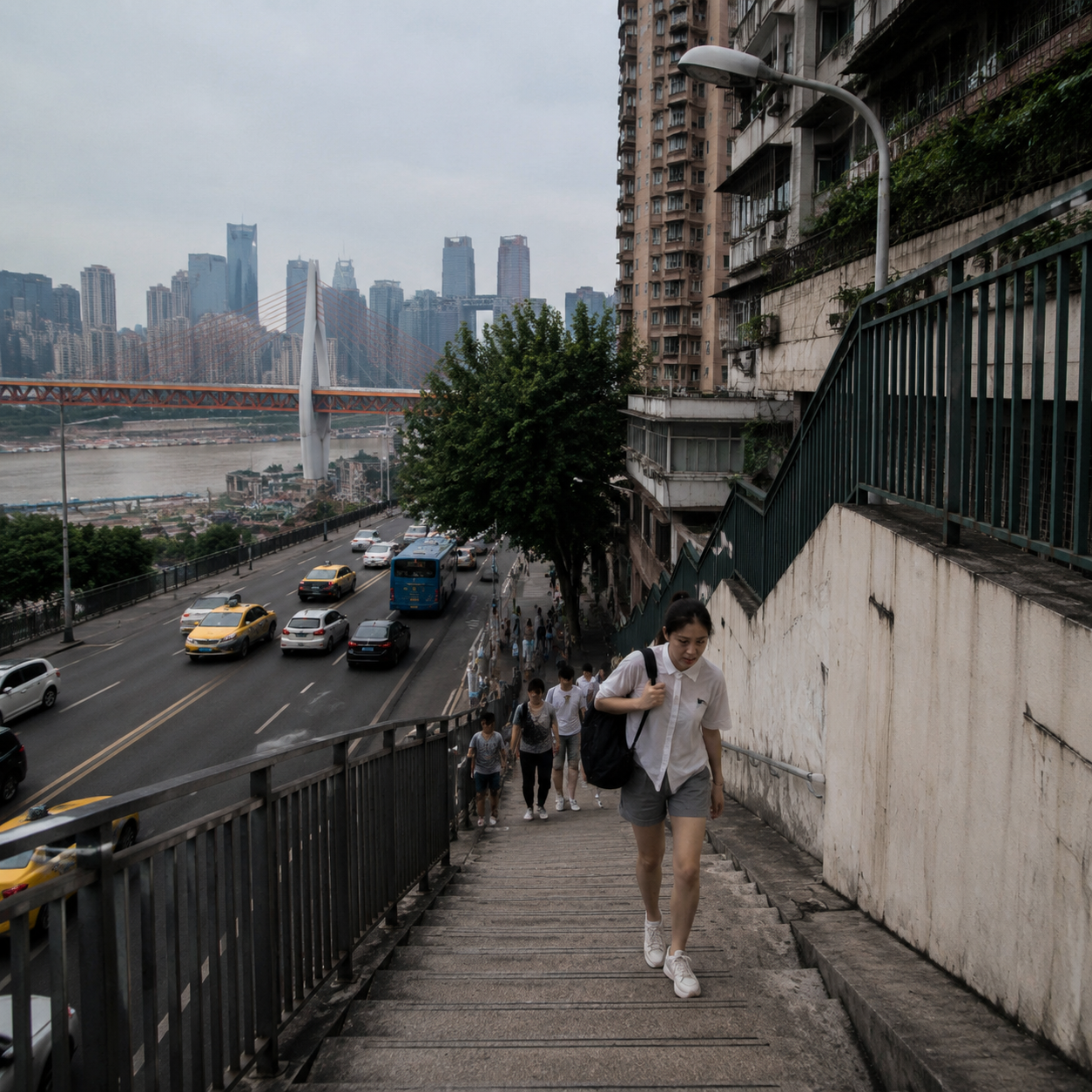
巷子里很安静,只有楼上厨房传来的锅铲声和一只猫从台阶边溜过去。墙面潮湿,扶手有些旧,我不得不一手扶着栏杆,一手把背包肩带往上提。走到一半时,我听见身后有人轻松地上来,是一位提着菜的叔叔。他没有急着超过我,只在我停下喘气时说:“慢慢走,这边近是近,累也累。”
The alley was quiet, with only the sound of a spatula from an upstairs kitchen and a cat slipping along the edge of the steps. The wall was damp, the handrail was worn, and I had to hold it with one hand while pulling my backpack strap higher with the other. Halfway up, I heard someone coming easily behind me: an uncle carrying vegetables. He did not rush to pass. When I stopped for breath, he said, “Take it slowly. This way is close, yes, but it is tiring too.”
这句话比导航更准确。导航把“近”当成优势,却不替我计算坡度、台阶高度、背包重量和下午的湿热。叔叔说完后从我旁边过去,步子不大,脚跟落得很稳。他像在走一段熟悉的旋律,每个停顿都知道放在哪里。我跟在后面,第一次把“路线”理解成体力管理,而不是几何题。
That sentence was more accurate than the navigation. The app treated “close” as an advantage, but did not calculate slope, stair height, backpack weight, or the damp heat of the afternoon. After speaking, the uncle passed me with small steps and steady heels. He moved as if walking through a familiar melody, knowing exactly where each pause belonged. Following him, I understood “route” as energy management for the first time, not as a geometry problem.
台阶尽头并不是我想象中的开阔路口,而是一条更窄的横街。左边往上,右边也往上,只是角度不同。我站在那里有点想笑,因为这座城市像在认真纠正我的平面思维。导航说向右,我却先看了看右侧路边有没有阴影、有没有可以停脚的店门、有没有车流逼得人贴墙走。几分钟前我只看方向,现在我开始看条件。
The stairs did not end at the open intersection I had imagined, but at a narrower cross street. The left side went up, and the right side also went up, only at a different angle. I stood there and almost laughed, because the city seemed to be carefully correcting my flat-map thinking. The navigation said to go right, but I first checked whether there was shade, whether storefronts offered places to pause, and whether traffic would force pedestrians against the wall. A few minutes earlier I had only looked at direction. Now I was looking at conditions.
这一段路让我对重庆的“层”有了具体感觉。不是宣传片里漂亮的立体交通,而是脚下真实的层:一楼可能对着马路,三楼也可能对着另一条马路;你从一个门进去,以为自己在地面,走出另一个门时却发现脚下又多了一段坡;天桥、台阶、扶梯、隧道和小巷不是装饰,它们都是城市为了和山体相处而长出来的器官。
That part of the walk gave me a concrete feeling for Chongqing’s layers. Not the beautiful three-dimensional traffic often shown in promotional videos, but the real layers under your feet: a first floor may face one road, and a third floor may face another road; you enter through one door thinking you are at ground level, then leave through another and find another slope beneath you. Footbridges, stairs, escalators, tunnels, and alleys are not decoration. They are organs the city has grown in order to live with the mountain.
后来我经过一段没有树荫的坡,阳光被楼面反射回来,热度像从两边夹住我。前方有一家面馆,门口挂着红色塑料帘。我钻进去点了一杯酸梅汤,老板问我是不是找不到路。我说路找得到,就是没想到这么上。老板笑了,说:“重庆很多地方不是远,是高。”这句话我记了下来,因为它几乎可以当作山城旅行的第一条注释。
Later I passed a slope with no shade, where sunlight bounced back from building walls and pressed heat from both sides. Ahead was a noodle shop with a red plastic curtain at the entrance. I went in and ordered a cup of sour plum drink. The owner asked whether I was lost. I said I could find the road; I just had not expected so much upward walking. He laughed and said, “Many places in Chongqing are not far. They are high.” I remembered that sentence because it could almost serve as the first note for traveling in a mountain city.
在面馆里休息的十分钟,我重新规划了剩下的路。我没有再选择最短路线,而是选择坡度看起来更缓、沿途有店铺和公交站的路线。它多绕了三百米,却让我安心很多。我把背包里的相机拿出来挂在胸前,减轻肩膀压力,又把水放到外侧口袋,保证不用停很久也能喝到。重庆让我在半小时内从“游客散步”切换成“地形应对”。
During ten minutes of rest in the noodle shop, I replanned the remaining route. I no longer chose the shortest path. I chose the one that looked gentler and had shops and bus stops along the way. It added three hundred meters, but made me feel much safer. I took the camera out of my backpack and hung it across my chest to reduce shoulder strain, then moved the water bottle to the outer pocket so I could drink without a long stop. In half an hour, Chongqing changed me from “visitor taking a walk” to “person responding to terrain.”
我开始享受这种阅读城市的方式。看一条路时,不再只问它通向哪里,还问它怎样通向那里:是连续上升,还是先下后上;是车多但坡缓,还是安静但台阶密;有没有栏杆、阴影、便利店、可以避让电动车的宽度。对初到重庆的人来说,这些问题比“还有几百米”更实用。
I began to enjoy this way of reading the city. When looking at a road, I no longer asked only where it led, but how it led there: continuous climbing or down then up; more traffic but gentler slope, or quiet but dense stairs; handrails, shade, convenience stores, and enough width to avoid electric scooters. For someone newly arrived in Chongqing, these questions are more useful than “how many hundred meters remain.”
快到旅馆时,我走过一座小天桥。站在桥上回头看,刚才那些坡、巷子和楼面叠在一起,像一张被揉过又展开的纸。远处轻轨从楼群之间穿过去,声音不大,却让空间突然有了方向。我终于明白,重庆的迷人不只在于它立体,而在于这种立体不是为了让游客惊叹才存在。它首先是居民每天要通过、要适应、要熟练掌握的生活条件。
Near the hotel, I crossed a small footbridge. From the bridge I looked back, and the slopes, alleys, and building faces I had passed folded together like a sheet of paper crumpled and opened again. In the distance, a monorail moved between buildings. Its sound was not loud, but it suddenly gave the space a direction. I finally understood that Chongqing’s charm is not simply that it is three-dimensional. More importantly, that three-dimensionality does not exist just to impress visitors. It is first a living condition that residents pass through, adapt to, and master every day.
旅馆前台在一栋楼的五层,但入口却在另一条路边,看起来像一楼。我拖着有点发酸的腿走进去,前台小姐姐问我是不是走上来的。我点头。她没有惊讶,只递给我房卡,又指了指旁边的电梯,说如果晚上去洪崖洞,可以先下到二层后门,再走另一条路,会轻松一点。她说得很自然,好像在提醒天气,而不是揭示一套城市密码。
The hotel reception was on the fifth floor of a building, but its entrance opened onto another roadside and looked like a first floor. I walked in with slightly aching legs, and the receptionist asked whether I had come up on foot. I nodded. She was not surprised. She handed me the room card, then pointed to the elevator and said that if I went to Hongyadong at night, I could first go down to the second-floor back door and take another road, which would be easier. She said it naturally, as if mentioning the weather rather than revealing a city code.
进房间后,我把背包放下,站在窗边看外面的坡路。刚才让我喘气的那段路,此刻看起来并不夸张,甚至有点温和。几辆车慢慢爬上来,一个外卖员把车停在路边,低头确认地址,然后拎着餐盒钻进旁边的楼道。我突然对那些在重庆生活的人生出敬意。他们不是每天征服地形,而是每天和地形谈判。
After entering my room, I set down my backpack and stood by the window looking at the slope outside. The road that had made me breathless now did not look dramatic; it even seemed somewhat gentle. A few cars climbed slowly. A delivery rider parked by the roadside, checked the address, and carried a meal box into the building entrance. I suddenly felt respect for people who live in Chongqing. They do not conquer terrain every day. They negotiate with it every day.
这次上坡路也改变了我后面几天的旅行方式。我不再把一天排得太满,不把两个“看起来很近”的地点强行连在一起。出门前我会多看一眼等高感,或者至少观察路线里有没有大量台阶;如果天气闷热,我会把打车或坐轨道交通当成正常选择,而不是懒惰;如果要步行,我会把休息点提前放进计划里。
That uphill walk changed the way I traveled during the following days. I stopped packing the schedule too tightly and stopped forcing two places together just because they looked close. Before going out, I checked elevation when possible, or at least looked for many stairs along the route. If the weather was humid, I treated taxis or rail transit as normal choices, not laziness. If I chose to walk, I put rest points into the plan in advance.
我还学会了在重庆问路时多问一句。不是只问“这里怎么走”,而是问“走上去累不累”“有没有电梯或扶梯”“从哪边过去比较平”。这些问题听起来不够浪漫,却能让旅行质量提高很多。本地人通常会给出很具体的答案:从商场里面穿、坐电梯到某层、别走那条梯坎、从公交站后面绕。这样的答案,是地图不一定给你的。
I also learned to ask one extra question when asking directions in Chongqing. Not only “How do I get there?” but “Is it tiring to walk up?” “Is there an elevator or escalator?” and “Which side is flatter?” These questions may not sound romantic, but they improve travel quality a lot. Local people often give very specific answers: cut through the mall, take the elevator to a certain floor, avoid that stair lane, go around behind the bus stop. These are answers a map may not give.
回想起来,那条上坡路并没有带我去一个著名景点,却比很多景点更像重庆。它有热气、坡度、店铺、台阶、绕路、误判和善意提醒。它让我用膝盖和呼吸记住了一座城市的形状。旅行中有些理解不是通过拍照完成的,而是在你放慢、出汗、停下、再重新选择路线时完成的。
Looking back, that uphill road did not take me to a famous attraction, yet it felt more like Chongqing than many attractions. It had heat, slope, shops, stairs, detours, misjudgment, and kind warnings. It made me remember the shape of a city through my knees and breathing. Some understanding in travel is not completed through taking photos. It happens when you slow down, sweat, stop, and choose your route again.
如果你第一次去重庆,我会建议你把城市地形当成行程的一部分,而不是背景。不要只看两个点之间的直线距离,也不要迷信最短路线。带一双真正适合走路的鞋,少背一点东西,夏天给自己留出更多时间。看到台阶时先抬头看尽头,看到坡路时先判断阴影和车流。重庆很好走,但前提是你承认它不是平的。
If you visit Chongqing for the first time, I suggest treating the city’s terrain as part of the itinerary, not as background. Do not look only at the straight-line distance between two points, and do not trust the shortest route automatically. Wear shoes that are genuinely good for walking, carry less, and give yourself more time in summer. When you see stairs, look up for the end first. When you see a slope, check shade and traffic before committing. Chongqing is very walkable, but only if you admit it is not flat.
那天晚上我去吃火锅,最后还是选择坐轨道交通加一小段步行。走到店门口时,我没有因为少走路而觉得遗憾。相反,我更有力气看街边的灯、更认真地闻锅底的香气,也更能听见身边人的笑声。山城教我的不是别走路,而是别轻视路。尊重地形之后,城市反而把更多细节交给了我。
That night I went out for hotpot and chose rail transit plus a short walk. When I reached the restaurant, I did not feel sorry for walking less. Instead, I had more energy to look at the streetlights, smell the soup base more clearly, and hear the laughter around me. What the mountain city taught me was not to avoid walking, but to stop underestimating the road. Once I respected the terrain, the city gave me more details in return.
- 中国住宿选择指南:酒店民宿客栈 | China Accommodation Guide: Hotels, B&Bs & Inns
- 南京梧桐树下的阴影,让我懂得城市记忆不是口号 | Under Nanjing’s Plane Trees, I Learned City Memory Is Not a Slogan
- 中国旅游安全须知 | Safety Tips for Traveling in China
- 五一去哪儿?8个你可能没听过的宝藏目的地 | Where to Go for May Day? 8 Hidden Gems You Probably Haven't Heard Of
- 把重庆说成超大城市很容易,难的是教人第一晚从哪层开始不慌 | Calling Chongqing Massive Is Easy; Showing a Visitor Where to Begin on the First Night Without Panic Is Harder
- 苏州夜里最珍贵的经验,常常不是多走一座桥,而是在最好看的地方及时收住 | The Most Valuable Lesson in Suzhou at Night Is Often Not One More Bridge but Knowing When to Stop at the Beautiful Moment
- 那本被果汁弄湿的拼音本,让本人第一次学会声调不是唱歌,而是方向 | A Pinyin Notebook Spilled with Juice Taught Me That Tones Are Not Singing but Direction
- 我在广州真正走顺的那天,是从一顿饭开始给路线排节奏的 | The Day Guangzhou Finally Became Easy for Me Was the Day I Let a Meal Set the Rhythm of the Route
- 中国旅游网络与上网指南 | Internet & Connectivity Guide for China Travel
- 西安兵马俑:完整参观指南 | Xi an Terracotta Warriors: A Complete Guide
Comments (0)