
窑火没有替我把碗烧好:景德镇一只歪口杯的诞生 | The Kiln Could Not Fix My Crooked Cup in Jingdezhen
窑火没有替我把碗烧好:景德镇一只歪口杯的诞生 | The Kiln Could Not Fix My Crooked Cup in Jingdezhen
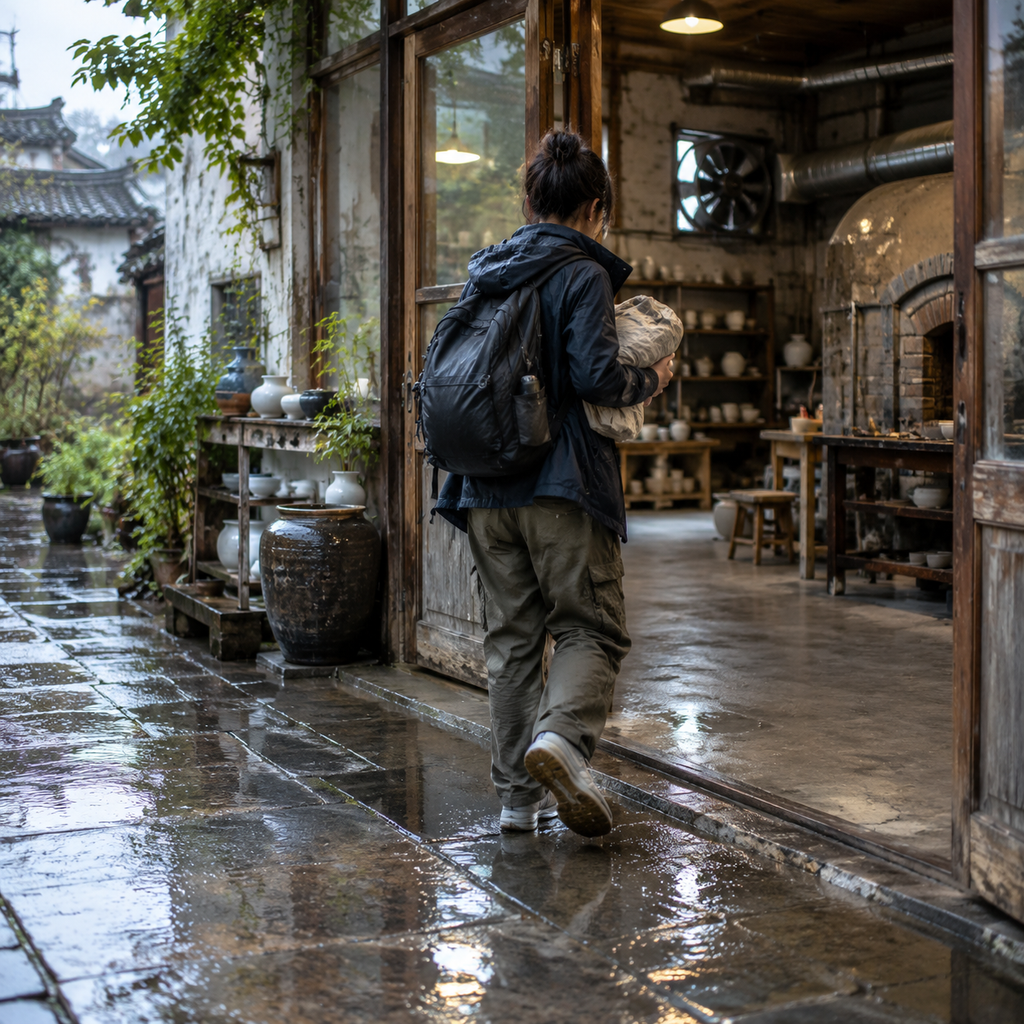
我到景德镇那天,雨刚停不久。上午的路面还留着一层发暗的水光,我抱着一块用布包住的陶泥走进工作室,鞋底在门口的粗糙地砖上轻轻打滑。窑房那边没有游客想象中的轰鸣,只有排风扇持续转动的低声,混着湿泥、木架和一点像粉笔灰一样的干燥气味。师傅把转盘擦出一圈干净的圆面,我坐下,把袖口卷到手肘,心里想着今天至少要带走一只端正的杯子。那时我还不知道,泥土很快会把这句自信拆成许多小片。
I arrived in Jingdezhen not long after the rain had stopped. The road still held a dull sheen of water, and I carried a cloth-wrapped lump of clay into the studio, my soles slipping slightly on the rough tiles by the door. There was no dramatic roar from the kiln room, only the steady hum of an exhaust fan mixed with the smell of wet clay, wooden shelves, and something dry and chalky. The master wiped a clean circle on the wheel. I sat down, rolled my sleeves to the elbows, and privately decided that I would at least take home a properly upright cup. I did not yet know how quickly the clay would break that confidence into small pieces.
我来这里之前,对拉坯的想象很像一段被剪短的视频:泥团在转盘中央旋转,手掌一合,杯身就从低矮的圆丘变成薄薄的器壁。真正坐到转盘前,我才发现每一个动作都拖着后果。泥太干,手指会被表面细小的颗粒顶开;水放多了,外层变得滑,里面的形状却开始塌;力气往左多了一点,口沿就会在下一圈里记住这点偏差。我原本把陶艺看成手对泥的控制,今天更像是手不断学习怎样听泥的反应。
Before coming, I imagined wheel throwing as if it were a shortened video: a lump spins in the center, the palms close around it, and a low mound becomes a thin-walled cup. Sitting at the wheel showed me that every motion carries a consequence. When the clay is too dry, tiny grains push against the fingers. When there is too much water, the surface becomes slippery while the form underneath starts to collapse. A little extra force on the left is remembered by the rim on the next rotation. I had thought pottery was a matter of the hand controlling the clay. That morning it felt more like the hand learning to listen to the clay's reply.
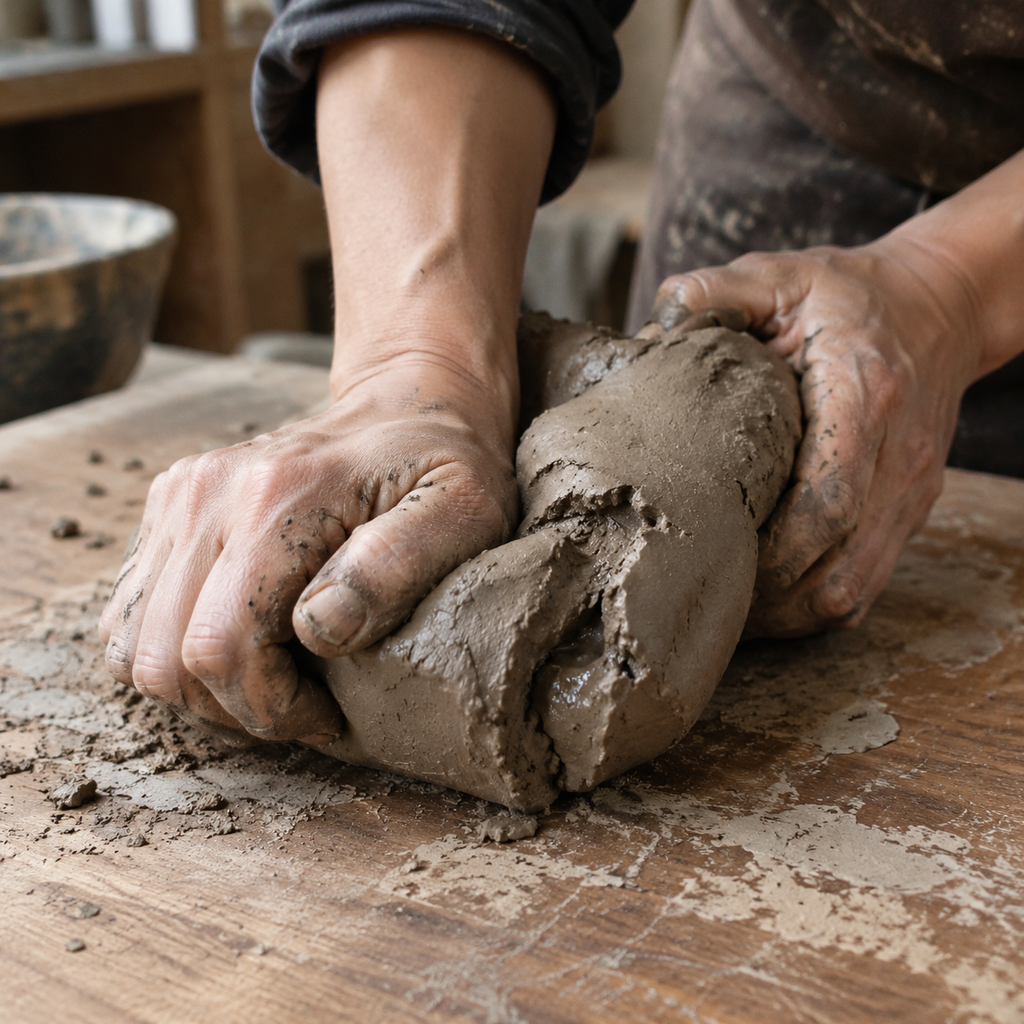
师傅先让我不要急着塑形,只做一件看起来很笨的事:把泥反复摔在案板上,再用掌根向前推、向下压、向自己收回来。泥块落下时发出沉闷的啪声,湿气从裂开的边缘露出来,又在下一次挤压中合拢。我做了几遍,手腕很快发酸,脑子里却还惦记着杯子的高度。师傅没有替我数次数,也没有给出一个漂亮的标准动作,只是在泥块歪到一边时把它转回来,示意我先让内部的空气和硬点尽量散开。这个准备阶段没有成品可看,却决定了后面每一圈会不会突然失控。
The master first asked me not to shape anything. Instead, I had to do something that looked almost foolish: slap the clay repeatedly onto the worktable, then push it forward with the heel of my palm, press it down, and draw it back toward myself. Each drop made a dull slap. Moisture showed along a split edge and disappeared again under the next compression. After a few rounds my wrist ached, while my mind was already worrying about the cup's height. The master did not count the repetitions or demonstrate a polished routine. When the lump leaned to one side, he simply turned it back and indicated that I should first disperse the trapped air and hard spots as much as possible. There was no finished object to admire in this stage, yet it decided whether the next rotation would suddenly run away from me.
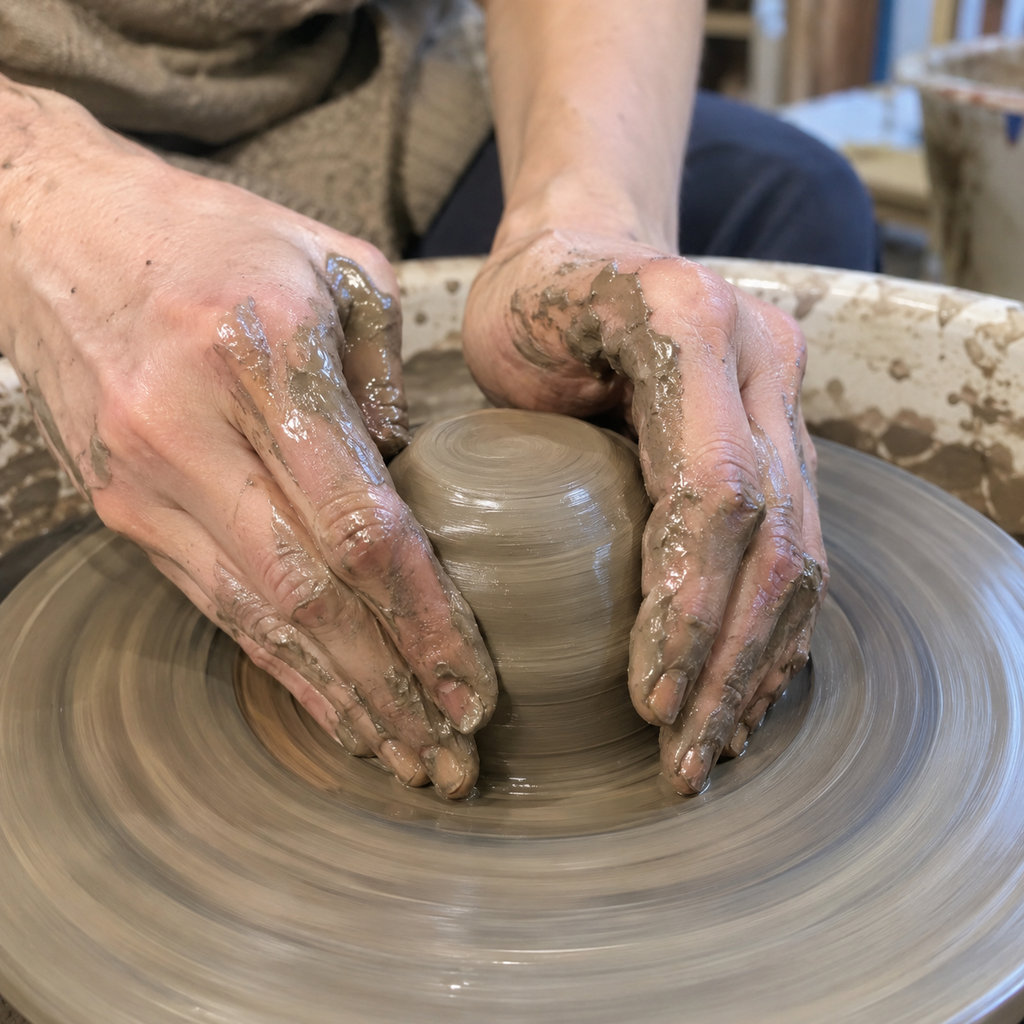
我把泥分成一个适合手掌握住的团,放到转盘中心,按下开关。起初它像一座被雨水打湿的小山,随着速度升起来又压低。我的左手负责托住,右手试着把表面收紧,没多久,泥心就偏了。偏心不是立刻倒塌的戏剧性错误,它更像桌面上的一粒米,在你以为没有关系的时候不断硌着指腹。每转一圈,我都觉得自己已经对齐了,可当我放松一点,杯壁便朝着同一个方向晃。转盘仍然平稳地转,只有我的手在追赶一个并不存在的中心。
I divided the prepared clay into a lump that fit comfortably in my palm and placed it at the wheel's center before pressing the switch. At first it looked like a small hill soaked by rain, rising and lowering as the speed changed. My left hand supported it while my right tried to tighten the surface. Before long, the core drifted off center. An off-center lump does not always collapse dramatically. It is more like a grain of rice on a tabletop, a small hard interruption that keeps pressing into the fingertip while you insist nothing is wrong. With each turn I felt I had corrected it, but as soon as I relaxed, the wall wobbled in the same direction. The wheel was turning smoothly. My hand was chasing a center that was no longer there.
师傅看了一会儿,伸手把我的脚踏位置往后推了推,又把转盘速度调得慢些。他没有接过泥,也没有替我完成那一步,只让我把两只手靠近,像用一个窄窄的门框夹住泥团。随后他用食指轻点自己的手腕,再指向泥心,提醒我先稳住节奏,不要用手臂去和转盘较劲。我这才意识到,自己一直在用肩膀发力,手掌忽松忽紧,仿佛只要按得够用力,泥就会屈服。转速慢下来以后,偏心反而更清楚了。我必须承认它在那里,而不是把错误藏进更快的旋转里。
The master watched for a while, moved the position of my foot pedal, and slowed the wheel. He did not take over the clay or complete the correction for me. Instead, he had me bring both hands closer, using them like a narrow doorway around the lump. He tapped his wrist, then pointed toward the center, reminding me through the gesture to steady the rhythm instead of fighting the wheel with my arms. I realized that I had been using my shoulders, tightening and loosening my palms without consistency, as if enough force would make the clay obey. Once the wheel slowed, the off-center shape became easier to see. I had to admit the error was there rather than hide it inside faster rotation.
我重新把泥往中心推。这个动作比我想象中慢,甚至有些枯燥。手掌贴住泥面时,我能感觉到它从粗糙变得均匀,湿润的表层在指缝边留下凉意。转盘的金属边缘偶尔溅上几滴水,发出短促的嗒声。我不再盯着想象中的杯子,而是盯着泥团最高处有没有左右摆动。几圈之后,泥心终于安静下来。它并没有因为我的努力变得听话,只是我和它之间的冲突少了一点。那是今天第一个让我放心的瞬间,也是一种很有限的放心。
I pushed the clay back toward the center. The motion was slower and more tedious than I had expected. With my palm against the surface, I felt it change from rough to even, while the damp skin left a cool trace between my fingers. A few drops of water landed on the metal rim of the wheel with short, sharp taps. I stopped staring at the imaginary cup and watched for any side-to-side movement at the highest point of the lump. After several turns, the center finally grew quiet. The clay had not become obedient because of my effort. There was simply less conflict between us. It was the first moment that day when I felt reassured, and the reassurance was very limited.
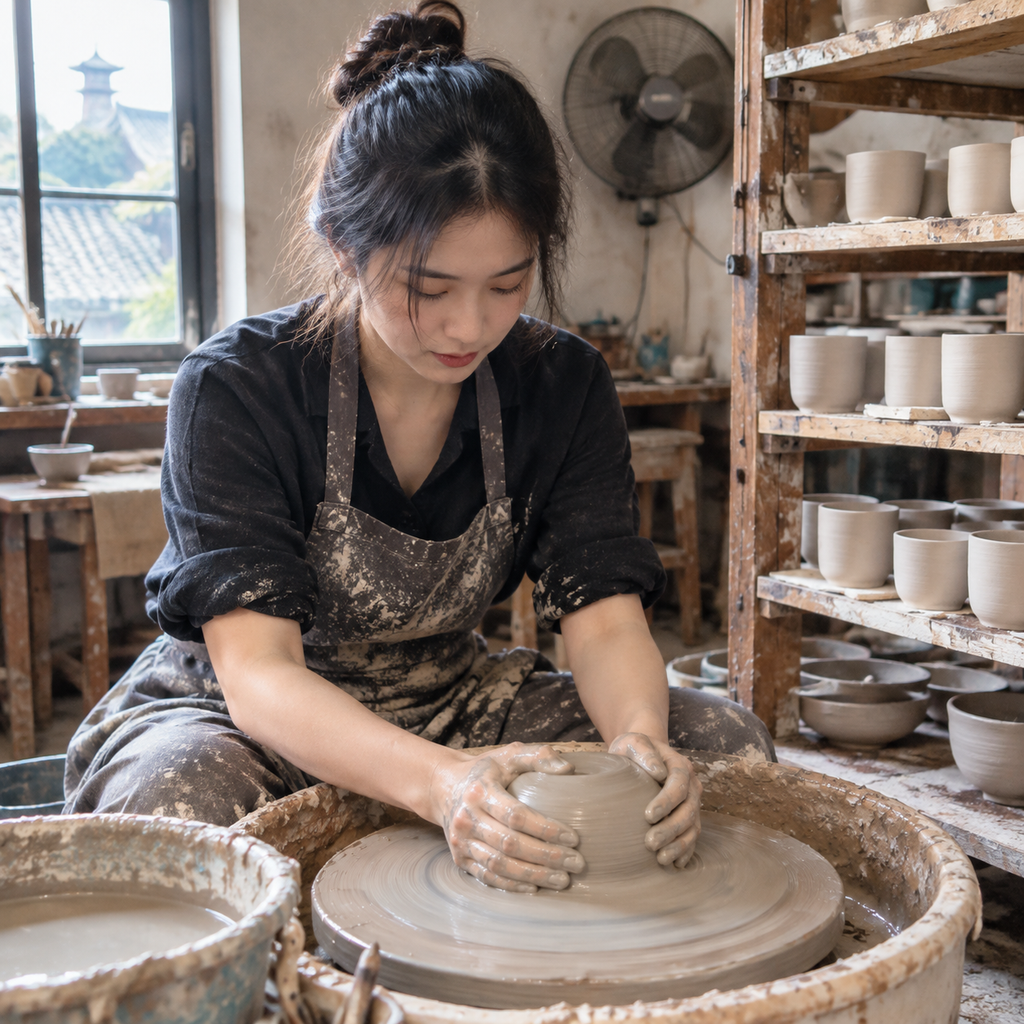
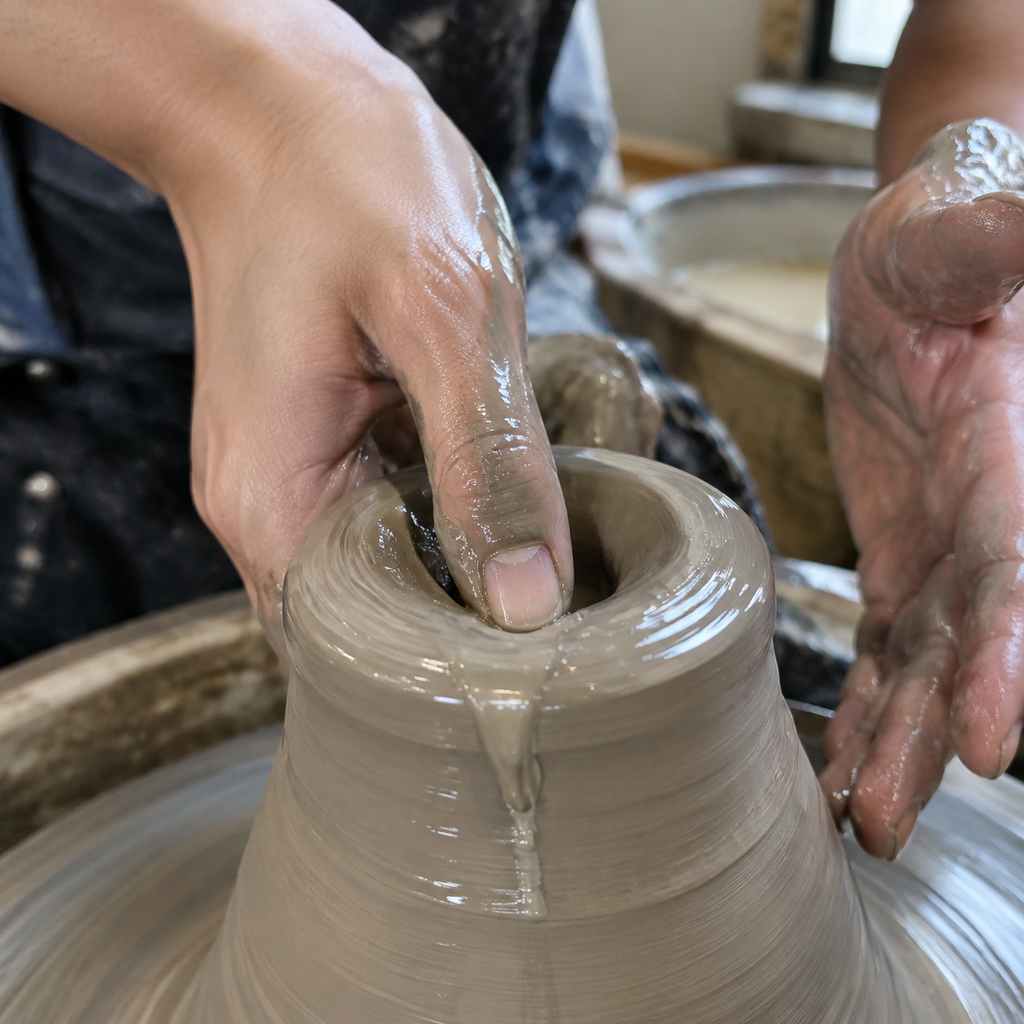
开孔时,我先用拇指在泥顶压出一个小凹点,再慢慢向下探。师傅的手停在我视线边缘,随时准备阻止我压穿底部。我想把杯子做得深一点,手指却越过了自己能感知的位置,底部一下子变薄。泥浆沿着指甲边往下流,像一小股灰色的水。我赶紧收手,留下一个不够规整的内底。师傅让我把手指停在原处感受厚度,然后再把空间向外扩,而不是一开始就追着容量走。我第一次明白,器物的内部不是挖出来的空洞,它要靠边界慢慢建立。
To open the form, I pressed a small hollow into the top with my thumb and moved downward slowly. The master's hand stayed at the edge of my vision, ready to stop me if I pierced the base. I wanted a deeper cup, but my finger passed beyond what I could sense, and the bottom suddenly became too thin. Slip ran along the side of my fingernail like a narrow gray stream. I pulled back too quickly and left an uneven interior floor. The master had me hold my finger in place and feel the thickness before expanding the space outward. He was teaching me that the inside of a vessel is not merely an empty hole dug into clay. Its boundary has to be built gradually.
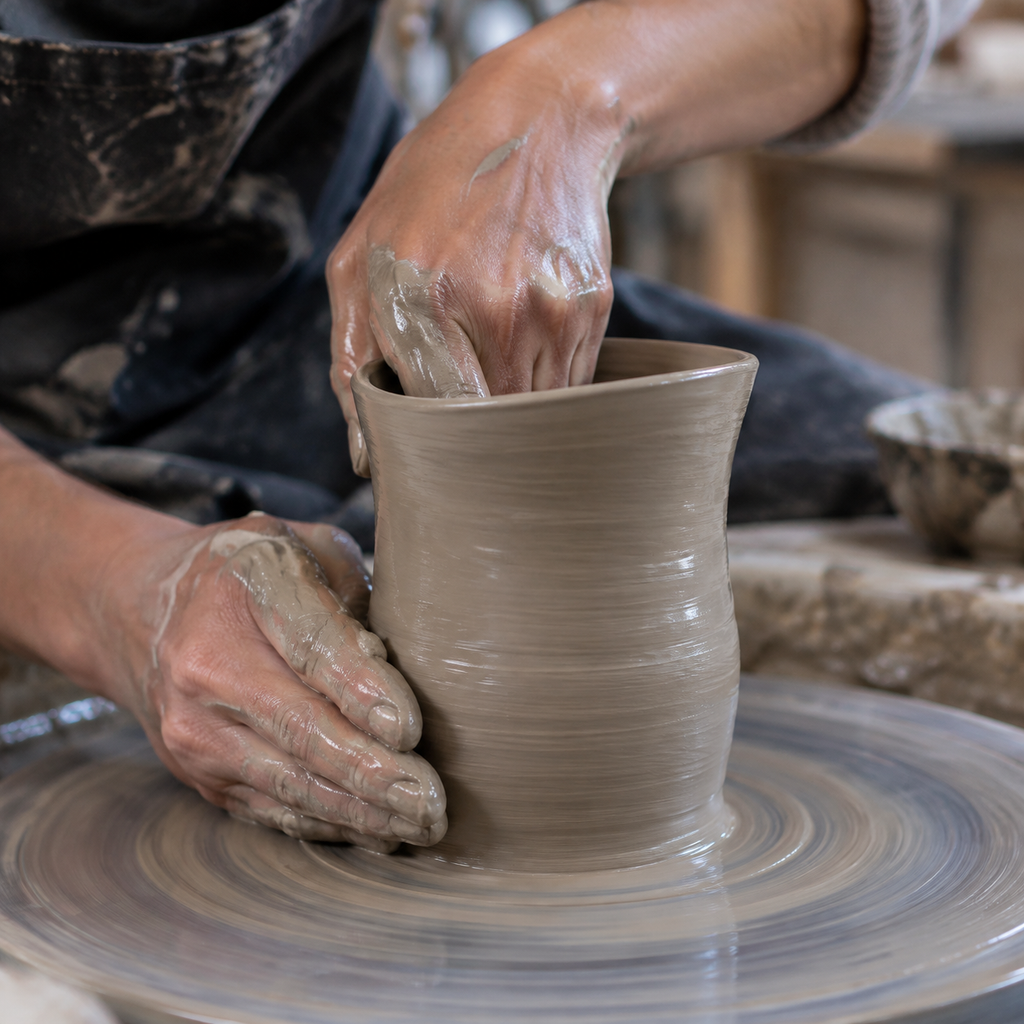
我开始拉第一圈杯壁。左手在外面托,右手在里面向上走,两边的压力必须相互认识。泥壁刚被拉高时很软,像一张会呼吸的湿纸。我把手提得太快,杯壁上方薄得发亮,底部却还沉在转盘上。为了补救,我加了一点泥浆,结果手指在同一处停留过久,那里被磨出一道浅浅的凹痕。师傅没有皱眉,只把海绵递给我,让我先吸掉多余水分。我这才知道,许多看似温柔的陶艺动作其实不能无限重复,泥也会疲劳,也会被你所谓的修正磨掉。
I began pulling the first wall of the cup. My left hand supported the outside while my right hand rose inside, and the pressure from both sides had to stay in conversation. The wall was soft as soon as it lifted, like wet paper that could breathe. I raised my hand too quickly. The upper wall became thin and glossy while the base remained heavy on the wheel. To repair it, I added a little slip, but then held my fingers in one place too long and rubbed a shallow hollow into the surface. The master did not frown. He passed me a sponge so I could remove the excess water. I learned that many gentle-looking pottery motions cannot be repeated forever. Clay gets tired too, and what I call a correction can simply wear away the form.
第二圈比第一圈好一些,因为我终于不再只看高度。我看杯壁有没有平均地跟着转盘走,看手指是否在某个位置停住,看水是不是已经聚在杯底。杯口仍然偏薄,我想把它拉直,手指从一侧多带了一点泥,另一侧就被拉得更窄。那一刻杯身像在转盘上轻轻点头。我把脚踏踩慢,停下手,重新蘸水。动作一停,歪斜就没有那么吓人了;真正让它变得糟糕的,是我慌忙追着它纠正。
The second pull went better because I finally stopped watching height alone. I watched whether the wall moved evenly with the wheel, whether my fingers paused at one point, and whether water was collecting at the base. The rim was still too thin. I tried to straighten it, carried a little more clay from one side, and made the opposite side narrower. The body seemed to nod gently as it turned. I slowed the pedal, stopped my hands, and dipped them in water again. Once the motion stopped, the crookedness no longer looked frightening. What made it worse was my panic as I chased it around the wheel.
我第三次向上拉时,杯身已经有了一个大致的轮廓。我原来想做一只口沿规整、肩部略收的杯子,手上却留下了更软的曲线。杯口一边高,一边低,最高处不是我设计出来的弧线,而是几次不均匀用力叠出来的结果。我用木片轻轻修过外壁,仍然无法让两边完全一致。师傅走到我身边,先看底部,再看口沿,最后用手背隔着一点距离比了比高度。他提醒我别把所有注意力都放在那一圈歪口上,先保证底够稳、壁没有裂,剩下的形状要等它干到合适的时候再判断。
By the third upward pull, the cup had a rough outline. I had planned a regular rim with a slightly tucked-in shoulder, but my hands left behind a softer curve. One side of the mouth was higher than the other. The high point was not a designed arc; it was the accumulated result of uneven pressure. I smoothed the outside with a wooden rib, but the two sides would not become identical. The master came over, examined the base, then the rim, and finally compared the height with the back of his hand held just above it. He reminded me not to let the crooked rim consume all my attention. First the base had to be stable and the wall free of cracks. The rest of the shape could be judged later, after the clay had dried to the right stage.
我听见了这句话,却没有真正接受。手工课里最容易发生的误会,是把师傅的提醒当成一种安慰,以为对方是在告诉你问题没有那么严重。其实他是在重新排列问题的顺序。我仍旧把口沿看成一张成绩单,歪了一点就像整只杯子都失败了。转盘上的泥已经不能无限修改,我却还想用最后几分钟把它变成脑中那只完美的杯子。我的手指在杯口附近停得太久,边缘开始发软,水痕也把原本清楚的转折抹掉了。
I heard the reminder but did not truly accept it. A common misunderstanding in a handwork class is to mistake a teacher's caution for comfort, as if the other person is saying the problem is not serious. In fact, he was rearranging the order of the problems. I still treated the rim like a grade on a test. If it leaned even slightly, the whole cup felt like a failure. The clay on the wheel could not be revised forever, but I kept trying to turn it into the perfect cup in my head during the last few minutes. My fingers stayed near the rim too long. The edge softened, and the water smudged a transition that had once been clear.
师傅终于用指尖指了指杯底,又指了指我放在旁边的海绵,示意我该停了。我把转盘关掉,车间里立刻少了一层连续的嗡声。静下来之后,我能看见那只杯子真实的样子:外壁有几圈不完全平行的拉痕,口沿像被风吹过的小岸线,底部倒还扎实。它没有按照我的预想长出来,却也没有塌成一团。师傅用薄木片在杯底周围划出一个记号,提醒我等它变硬后再修脚。我把杯子连同圆垫一起移到架子上,第一次没有再伸手摸口沿。
The master finally pointed to the base, then to the sponge beside me, indicating that I should stop. I switched off the wheel, and the studio immediately lost one layer of constant humming. In the quiet I could see the cup as it really was: several throwing lines on the outside were not quite parallel, the rim resembled a small shoreline pushed by wind, and the base was still solid. It had not grown according to my plan, but it had not collapsed either. The master marked a circle around the foot with a thin wooden tool and reminded me to trim it once the clay became firmer. I moved the cup, still on its round bat, to the shelf and did not touch the rim again.
等待泥变硬的时间,比我想象中更难熬。杯子放在架子中层,旁边有别人的浅盘、粗口罐和几件还没有完成的器物。室内空气没有明显变化,可我每隔一会儿就想过去确认它有没有继续歪。师傅让我们不要用手频繁试探,只能在表面不再粘手、器壁能够承受轻微触碰时再开始下一步。我站在架子前,把手伸到一半又收回。这个小动作看起来可笑,却让我第一次感到,制作不是一直动手,也包含知道什么时候不碰。
Waiting for the clay to firm up was harder than I expected. The cup sat on the middle shelf beside other people's shallow dishes, wide-mouthed jars, and unfinished forms. The air in the room did not seem to change, yet every few minutes I wanted to check whether my cup had continued leaning. The master told us not to test the surface constantly. We should continue only when it no longer stuck to the fingers and the wall could take a light touch. I stood before the shelf, extended my hand halfway, and pulled it back. The gesture looked ridiculous, but it taught me that making also includes knowing when to leave something alone.
我在这段空档里看工作室里的其他动作。有人用刮片清理转盘上的泥浆,有人把自己的作品从木板上轻轻托起,检查底缘有没有粘住,还有人坐在窗边,把失败的泥重新揉成团。没有人专门宣布哪一件做得好,大家只是低头处理手上的小问题。窗外排水沟里的水还在慢慢流,车轮压过湿路时发出短促的摩擦声。景德镇在我这里不再只是瓷器的名字,而是这些泥、粉尘、刮片和等待共同组成的工作日常。
During that pause I watched the other movements in the studio. Someone scraped slip from the wheel. Someone lifted a piece carefully from its board to check whether the lower edge had stuck. Another person by the window kneaded a failed form back into a lump. No one announced which piece was good. Everyone simply lowered their head and dealt with a small problem in front of them. Water still moved slowly through the drain outside, and tires made a brief rubbing sound on the wet road. Jingdezhen stopped being only a name associated with porcelain. It became a workday made from clay, dust, trimming tools, and waiting.
轮到修脚时,我把杯子倒扣在转盘上,第一次真正看见底部。原来我在拉坯时把注意力全放在口沿和外壁,杯底留下了稍厚的一圈泥。师傅让我用手掌确认它是否平稳,再用木刀一点点削去多余部分。我下刀太深,底部立刻出现一道刺眼的白痕,心里一紧,手腕也僵住了。他没有替我把那道痕藏掉,只示意我沿着同一方向继续,让脚圈逐渐显出来。削泥的声音很轻,像铅笔在粗纸上来回擦过。每一下都不可逆,我不敢再凭冲动用力。
When it was time to trim the foot, I placed the cup upside down on the wheel and saw the base properly for the first time. While throwing, I had focused on the rim and outer wall, leaving a band of clay that was too thick underneath. The master had me check the stability with my palm and then remove the excess a little at a time with a wooden knife. I cut too deeply, leaving a bright, alarming mark. My wrist stiffened. He did not hide the mark for me. He indicated that I should continue in the same direction so the foot ring could gradually appear. The trimming sound was quiet, like a pencil rubbing across coarse paper. Every cut was irreversible, and I no longer trusted impulse as a source of force.
修完以后,杯底比之前轻,放回转盘时也不再晃得那么明显。我把它翻回来,歪口仍在。这个结果让我有些失望,因为我偷偷期待过修脚能带来一次整体纠正,仿佛底部一旦漂亮,杯身就会自动端正。师傅让我从上方看一眼,再从桌面高度看一眼。两个角度给出的杯子并不相同:俯视时歪口很明显,平视时杯壁的曲线反而让它显得有一点动作。我意识到所谓缺陷并不是一个固定的数字,它会随着观看的位置、光线和手里是否拿着它而改变。
After trimming, the foot was lighter, and the cup wobbled less when I placed it back on the wheel. I turned it upright. The crooked rim was still there. I felt disappointed because I had secretly hoped that a clean foot would somehow correct the entire form, as if a beautiful base could make the body stand straight by itself. The master asked me to view it once from above and once from table height. The two angles showed different cups. From above, the uneven rim was obvious. At eye level, the curve of the wall made the cup look as if it had a small gesture. I began to understand that a flaw is not a fixed number. It changes with the position of the viewer, the light, and whether the object is being held.
接下来的干燥让我比修脚时更没有办法。杯子需要慢慢失去水分,不能因为我着急就提前进入下一步。我把它放在不太靠近风口的位置,和其他器物保持一点间隔。每天看它,颜色都会变得更浅,表面从湿润的暗灰转成柔和的灰白。口沿那处歪斜没有消失,有时因为阴影落在一边,看起来甚至更明显。我曾经想用湿布把边缘重新压平,手指刚碰到杯口就停住了。那会儿我已经知道,继续改不一定叫认真,可能只是拒绝接受已经发生的形状。
The next stage of drying gave me even less control than trimming. The cup had to lose moisture slowly, and my impatience could not move it forward. I placed it away from the strongest draft, leaving some space between it and the other pieces. Each day its color grew lighter, from a damp dark gray to a soft gray-white. The crooked section did not disappear. Under certain shadows it looked even more pronounced. I once considered using a damp cloth to press the edge flat, but stopped as soon as my fingers reached the rim. By then I understood that continued editing is not always care. Sometimes it is simply a refusal to accept the shape that has already happened.
在等待的几天里,我开始重新想象杯子的用途。最初我只想让它适合拍照:轮廓要干净,口沿要均匀,杯壁要像工业模具里出来的一样没有犹豫。可当它逐渐干透,我发现自己更常去看手指留下的转圈痕迹。那些痕迹没有被釉料完全遮住,像一段不太流利却能读懂的笔迹。工厂生产的杯子当然也有人的设计和判断,只是人的手不必在每一个瞬间承受泥土的反应。我过去把平整当作质量,把整齐当作价值,手上的这只杯子逼我承认两者并不完全相同。
Over the days of waiting, I began to imagine the cup's use differently. At first I wanted it to be photogenic: a clean outline, an even rim, a wall that looked as though it had come from an industrial mold without hesitation. As it dried, however, I found myself looking more often at the circular marks left by my fingers. The glaze would not necessarily erase them all; they looked like handwriting that was not fluent but could still be read. Factory-made cups also involve human design and judgment, of course. The difference is that a factory hand does not have to absorb the clay's response at every second. I had treated smoothness as quality and regularity as value. This cup forced me to admit that the two are not exactly the same.
真正进入窑炉之前,杯子还要经过一次检查。师傅用手指沿着底缘走了一圈,确认没有明显的毛刺,又从侧面看口沿和杯身的连接。他把杯子转了几次,最后把它放到一块窑板上,位置没有特别居中,而是按照架上其他器物之间的距离留出空隙。这个动作看起来不像我想象中的仪式,更像装车前的整理。我问他歪口会不会在高温里变直,他摇了摇头,手掌在空中做出一个轻轻收缩的动作,意思是烧制会让泥体收缩、釉面发生变化,却不会替我重做一个杯口。
Before the cup entered the kiln, it went through another inspection. The master ran a finger around the foot to check for obvious roughness, then viewed the connection between the rim and the body from the side. He rotated the cup several times before placing it on a kiln shelf, leaving space between it and the other pieces rather than forcing everything into a perfectly tight arrangement. It looked less like the ritual I had imagined and more like organizing a load before transport. I asked whether the crooked rim might become straight at high heat. He shook his head and made a small closing motion with his hand in the air. Firing would shrink the clay and change the glaze, but it would not remake my rim for me.
我原先把窑火想得过于神秘,好像只要经过足够高的温度,泥土里所有不成熟的地方都会被烧掉,剩下一个更接近标准答案的物件。师傅的动作把这层幻想拆开了。窑炉可以改变硬度、颜色和收缩后的比例,却不能补回我拉坯时没有建立好的中心,也不能替我承担那几次过快的上提。入窑前,杯子已经带着我的选择进去:底部留了多少厚度,壁面哪里薄,口沿在哪一侧多受了一点压力。火不是橡皮擦,它只是把这些选择固定到一个新的阶段。
I had imagined the kiln as something too mysterious, as if enough heat would burn away every immature decision in the clay and leave behind an object closer to the correct answer. The master's gesture broke that fantasy apart. A kiln can change hardness, color, and the proportions after shrinkage. It cannot restore a center that I failed to establish on the wheel, nor can it carry the consequences of lifting too quickly. Before the cup entered, it already carried my decisions: how much thickness I left in the base, where the wall was thin, and which side of the rim received extra pressure. Fire is not an eraser. It only fixes those decisions at a new stage.
窑门合上以后,工作室的气氛并没有变成电影里的紧张。有人继续清理案板,有人给下一批泥块套上塑料布,也有人坐在门边等师傅安排后续的工作。我却总觉得自己的杯子正在里面经历一场判决。窑炉外壳摸上去并不烫,真正的温度被厚重的材料隔在内部。师傅提醒我们不要频繁开关窑门,也不要在冷却还没有结束时急着看结果。等待从手上的劳动转移到身体里,我开始意识到,制作过程有一半是做,另一半是接受自己暂时什么也不能做。
After the kiln door closed, the studio did not become tense like a film scene. Someone kept cleaning a worktable. Someone covered the next batch of clay with plastic. Another person sat near the door waiting for the master's next instruction. I still felt that my cup was inside facing a verdict. The outer shell of the kiln was not hot to the touch; the real heat was held behind thick material. The master reminded us not to open the door repeatedly and not to rush toward the result before cooling was complete. Waiting moved from my hands into my body. I began to understand that half of making is doing, while the other half is accepting that there is temporarily nothing more you can do.
我离开工作室去街上走了一圈。雨后的景德镇比上午亮,路边的水洼把招牌和电线切成一块一块的倒影。经过卖早点的小店时,我闻到蒸汽里混着米浆和油的气味,衣服袖口仍然有淡淡的泥味。我没有心情把城市当成一张景点清单去赶,只想让手腕休息一下。路旁有几辆电动车从积水边绕过去,车轮把水线推向路沿。我突然想到,器物也有自己的绕行:杯口绕不开我留下的偏差,只能在那个偏差旁边继续长出身体。
I left the studio and walked along the street for a while. Jingdezhen looked brighter after the rain. Puddles broke signs and overhead wires into separate pieces of reflection. Near a small breakfast shop, I smelled rice batter and oil rising with the steam, while my sleeve still carried a faint trace of clay. I did not feel like treating the city as a checklist of sights. I only wanted to let my wrist rest. Electric scooters curved around puddles, their tires pushing thin lines of water toward the curb. I thought about how objects also have to go around things. The rim could not avoid the deviation I had left behind, so the body continued growing beside it.
第二天回到工作室时,窑炉还没有打开。我先看见架子上空出了一小块位置,那是杯子被送进去后留下的空白。空白比成品更容易让我紧张,因为它允许我把结果想得过分好,也允许我把它想得过分坏。师傅在窑房附近检查记录,我没有追问温度和具体时长,只问什么时候可以看。他让我等冷却到合适程度。我点点头,手却无意识地在桌面上画起圆圈,像是在转一个看不见的转盘。
When I returned the next day, the kiln had not been opened. I first noticed the small empty space on the shelf where my cup had been. An empty space makes me more nervous than a finished object because it lets me imagine the result as either far too good or far too bad. The master was checking notes near the kiln. I did not ask for an exact temperature or firing time; I only asked when we could look. He told me to wait until the kiln had cooled sufficiently. I nodded, while my hand unconsciously drew circles on the tabletop as if turning an invisible wheel.
后来窑门终于打开,先出来的是一阵并不夸张却很清楚的热气。师傅戴上手套,把窑板一块块取出,器物之间发出轻微的碰响。我站在旁边,努力不把自己的杯子认成任何一只形状相近的杯子。它被放到桌上时,颜色比生坯深了一些,表面有一层安静的光。釉色在杯身上并不完全均匀,歪口那边的亮度随角度变化,某一处看起来像薄薄的水痕,换个位置又变成更深的阴影。烧制没有把它改造成标准器形,只让原来的手迹变得更硬、更清楚。
When the kiln was finally opened, a clear wave of heat came out, without any theatrical drama. The master put on gloves and removed the shelves one by one. The pieces made faint tapping sounds against one another. I tried not to mistake my cup for another form with a similar outline. When it reached the table, its color was darker than the unfired clay, and the surface held a quiet sheen. The glaze was not entirely even. On the crooked side, its brightness changed with the angle: in one position it looked like a thin water mark, and in another it became a deeper shadow. The firing had not turned it into a standard form. It had only made the marks of my hands harder and clearer.
我的第一反应仍然是失望。我把杯子举到眼前,先看最高的那一侧,再看被压低的那一侧,脑子里立刻浮现出修正方案:如果当时少加一点水,如果第三圈不要停在那里,如果一开始把脚踏踩慢一点。我甚至觉得这只杯子在提醒我一个很简单的事实,而我不想听。手作失败不像考试只在交卷时发生,它会一路跟着你,从泥块的第一次偏心,跟到窑门打开以后。成品只是把失败从过程里带出来,让你无法再用下一圈旋转把它遮过去。
My first reaction was still disappointment. I lifted the cup and looked at the higher side of the rim, then at the lower side, while my mind immediately generated repairs: less water, no pause during the third pull, a slower pedal from the beginning. I even felt that the cup was reminding me of something simple that I did not want to hear. A failure in handwork does not happen only at the moment of submission. It follows you from the first off-center lump all the way to the opening of the kiln. The finished object carries the failure out of the process, where you can no longer hide it inside the next rotation.
师傅把杯子放回桌面,轻轻转了一下,让歪口朝向我。他没有替我把它说成有趣,也没有急着说这样才有个性,只让我看它放下后是否稳定。我把手掌贴在桌面旁边,确认杯底没有明显晃动。接着我从侧面观察杯壁,发现它虽然不对称,却有一条连贯的弧线;那条弧线并不是设计图上的线,而是我在力气不够均匀时留下的运动轨迹。师傅的提醒到这时才真正落下来:先看它是否站得住,再谈它长得像不像我原来想的样子。
The master placed the cup back on the table and turned it slightly so the crooked rim faced me. He did not call it charming or rush to say that the irregularity gave it character. He asked me to check whether it sat steadily. I placed my palm beside the base and confirmed that it did not noticeably rock. Then I studied the wall from the side. It was not symmetrical, yet its curve was continuous. That curve was not a line from a design drawing. It was the record of motion left behind when my pressure was uneven. Only then did the master's reminder settle properly: first see whether the object can stand, and only afterward ask whether it resembles what you originally imagined.
我没有马上把水倒进杯子里。釉面是否适合具体饮用,我并不了解,也不想把一次工作室体验夸张成完整的器物检测。于是我先用清水做很朴素的观察:杯子放在桌面上,水面是不是随着歪口显得倾斜,拿起时重量是否落在手掌中央,指尖会不会碰到不平的边缘。它没有给我一种标准化产品的无条件安心,却让我清楚地感到手的位置。杯身一歪,我的拇指自然会靠向较高的一侧,掌心则在另一侧托住它。这个不对称把握持变成了一种小小的协商。
I did not immediately pour a drink into the cup. I did not know whether the glaze was suitable for a particular kind of use, and I did not want to turn a workshop experience into a claim about complete product testing. Instead, I used clean water for a modest observation. I placed the cup on the table and watched whether the water appeared slanted because of the rim, then lifted it to see whether its weight rested in the center of my palm and whether my fingers met any sharp uneven edge. It did not give me the unconditional ease of a standardized product, but it made the position of my hand clear. Because the body leaned, my thumb naturally moved toward the higher side while my palm supported the other. The asymmetry turned holding it into a small negotiation.
我想起自己以前买杯子时的习惯。手会先摸一圈口沿,确认没有磕碰,再把杯底放在柜台上看它是否稳,最后才看颜色和图案。那些动作并没有错,只是我从未想过,所谓稳、平、顺眼,背后都需要许多看不见的控制。工业器物把控制隐藏在模具、设备和重复流程里,使用者因此可以放心地把注意力放在饮品上。手作把控制露了出来,甚至把我这个做得不够好的人也留在了杯身上。它让我看到,以前被我当成理所当然的平整,其实是一种技术成果。
I remembered how I used to choose a cup. I would run a finger around the rim to check for chips, set the base on a counter to see whether it was stable, and only then look at the color or pattern. Those actions were sensible, but I had never considered how much invisible control was behind something being steady, even, and pleasing to look at. Industrial objects hide that control inside molds, equipment, and repeated processes, so the user can focus on the drink. Handwork exposes the control, and it leaves the person who did not do everything well on the body of the cup. It showed me that the smooth regularity I had taken for granted was itself a technical achievement.
景德镇给我的触动并不来自一个宏大的故事,而来自工作室里这种对细节的耐心。泥浆要在该停的时候停,杯壁要在还能承受时修,作品进窑前要留出合适的距离,窑门打开后又必须等冷却结束。每一步都不像旅游宣传里那样迅速地产生结果。师傅的工作也不是替学徒消灭错误,而是让错误停在不会继续扩大的地方,再把判断权还给做这件事的人。我之前希望学到一种保证成功的手法,最后学到的却是怎样在失控边缘少做一个错误动作。
What moved me in Jingdezhen was not a grand story but the studio's patience with small details. Slip has to stop at the right moment. A wall can be adjusted only while it can still bear the pressure. A piece needs enough space before entering the kiln, and the kiln must be allowed to cool before its door is opened. None of these steps produces an immediate result like a line in a travel advertisement. The master's work was not to erase every mistake made by a beginner. It was to keep a mistake from expanding, then return the judgment to the person who made the piece. I had hoped to learn a technique that guaranteed success. I ended up learning how to avoid one more wrong motion at the edge of losing control.
我也开始理解为什么师傅不急着把歪口修成直口。口沿当然可以被修整,很多器物也确实需要平整、密合和统一的边界,不能把所有不合格都浪漫化。可在这只杯子的制作阶段,继续强压只会破坏已经建立起来的壁厚和底部。它不是因为歪了就天然更好,也不是因为失败就必须被丢掉。判断要回到具体对象:裂缝是否会继续发展,底部是否稳定,边缘是否安全,形状是否仍然有使用或观看的可能。师傅让我面对的不是一句手作至上的口号,而是一个需要逐项确认的实际问题。
I also began to understand why the master did not rush to straighten the rim. A rim can certainly be trimmed, and many vessels genuinely need level, fitting, and consistent edges. Not every defect should be romanticized. But at that stage, pressing the crooked side harder would have damaged the wall thickness and the base that were already holding. The cup was not automatically better because it leaned, nor did failure mean it had to be thrown away. The judgment had to return to this particular object: whether cracks might develop, whether the base was stable, whether the edge was safe, and whether the form still had a possible use or visual life. The master was not giving me a slogan about handmade things. He was asking me to check a practical set of conditions.
下午我把杯子放在窗边的木桌上,观察光线怎样掠过它。雨云散开后,亮处从窗框移动到杯身,釉面的细小起伏也随之显出来。若把杯口对着自己,歪斜像一个没有说完的问题;若把较低的一侧转向外面,杯子又显得安静许多。我试着给它拍照,拍了几张就停了,因为镜头会把某个角度夸大成全部真相。真正拿在手里时,我会转动它,会看到手指留下的痕迹,也会感觉到重量如何改变。相机只截取一瞬,手却把成品当成一个可以反复认识的东西。
In the afternoon I placed the cup on a wooden table by the window and watched the light move across it. When the rain clouds cleared, the bright patch shifted from the frame to the body, revealing small rises and falls in the glaze. With the rim facing me, the lean looked like an unfinished question. Turn the lower side outward, and the cup became much quieter. I tried to photograph it, but stopped after a few shots because a lens can exaggerate one angle into the whole truth. In my hand I could rotate the cup, see the traces left by my fingers, and feel how the weight shifted. A camera captures a moment. A hand keeps meeting the finished thing and learning it again.
我没有把这只杯子命名成“失败的杯子”,但也没有急着给它一个浪漫名字来掩盖不满意。它首先是一件经过我手的成品,带着可见的偏差和已经无法回到泥团状态的决定。成品这个词在那天变得具体起来:不是所有步骤都正确以后才配拥有它,而是当材料已经完成一次转化,你必须对它的状态负责。它可能还不够好,也可能不适合某种用途,但它不再只是练习过程中的半成品。窑火把它从可重来的泥,变成了需要被认真判断的对象。
I did not name it "the failed cup," but I also did not rush to give it a romantic name that would hide my disappointment. It was first of all a finished object that had passed through my hands, carrying visible deviations and decisions that could no longer return to a lump of clay. The word finished became concrete that day. It did not mean every step had been correct. It meant the material had completed one transformation, and I now had to take responsibility for its condition. It might not be good enough, and it might not suit every use, but it was no longer merely an unfinished exercise. The kiln had changed reusable clay into an object that needed an honest judgment.
晚上回到住处,我仍然能在指甲边找到一小点洗不干净的泥色。我把手浸在温水里,灰痕慢慢淡下去,腕部却还记得白天反复推泥的酸。桌上没有杯子可看,我反而更清楚地回想起那只歪口:不是它第一次偏心时最难看,也不是出窑时最让我失望,而是我明明已经知道应该停手,却还想再替它做一点决定的那一刻。手作失败的刺痛常常不在结果本身,而在你回看过程时发现,某个局面本来可以被更早地接受。
That evening I could still find a small trace of clay beside my fingernails. I soaked my hands in warm water until the gray mark faded, while my wrists remembered the ache of pushing the clay again and again. There was no cup on the table to look at, yet I remembered the crooked rim more clearly. It had not looked its worst when the lump first went off center, nor had the kiln opening caused the deepest disappointment. The sharpest moment was when I knew I should stop but still wanted to make one more decision for the object. The sting of a handmade failure often lies less in the result than in reviewing the process and realizing that one situation could have been accepted earlier.
第二天我又去看那只杯子。它没有因为我睡了一觉就变得更端正,窗边的灰尘也没有替它增加任何故事。可我对它的看法松了一点。我开始把注意力放在几件可以确认的事上:底部站得稳,杯壁没有肉眼可见的裂痕,口沿的高低差形成了一个明确的方向,手握住时需要调整但并不慌乱。剩下那些无法用一句话归类的地方,我先留着。过去我总想立即判定一件东西到底好不好,现在愿意给它留一点观察时间,这种改变比杯子的外形更像我真正带走的东西。
I visited the cup again the next day. It had not become straighter after a night's sleep, and the dust by the window had not supplied it with a new story. My view of it had simply loosened. I began with things I could actually confirm: the base stood steadily, there were no cracks visible to the eye, the difference in rim height gave the form a clear direction, and holding it required an adjustment without causing panic. I left the qualities that could not be sorted into one sentence alone. I used to want an immediate verdict on whether an object was good. Now I was willing to give it time to be observed. That change felt more like what I carried away than the shape of the cup itself.
我以前把控制理解成不让错误发生,今天把它改成了另一种更难的能力:知道错误已经发生以后,哪些地方还可以修,哪些地方一碰就会扩大损失。拉坯时的中心、开孔时的底厚、提拉时的速度、修脚时的深浅、干燥时的距离、入窑前的摆放,每个选择都不是孤立的。前一步给后一步留下条件,后一步又会把前一步放大。手工没有一个可以跳过的总开关,只有许多细小的判断接连发生。我的杯子歪在口沿,但真正的偏差早已在更前面开始。
I used to define control as preventing mistakes. That day I changed the definition to something harder: after a mistake has happened, knowing which parts can still be adjusted and which touch would only enlarge the damage. The center on the wheel, the thickness of the base, the speed of each pull, the depth of trimming, the distance during drying, and the placement before firing were connected choices. Each step left conditions for the next, and the next could magnify the one before it. Handwork has no master switch that lets you skip the decisions. It has a chain of small judgments. My cup leaned at the rim, but the deviation had begun much earlier.
师傅后来让我把杯子和其他作品放在一起看。我发现一只看起来很规整的杯子也有细微的手工痕迹,只是它们没有抢先站到视线中央;另一只杯子底缘略厚,却因为整体比例安静而不显得突兀。我们没有给作品排名,师傅只是把它们转动,让光线轮流落到不同表面。我不再只寻找自己的错误,也开始看别人的手怎样处理转折、怎样让厚薄之间有连贯关系。比较不是为了找一个可以模仿的标准答案,而是让我知道,手作的差异并不等于随便,差异背后仍然有判断和训练。
Later, the master had me look at my cup beside the other pieces. A cup that appeared very regular also held small handmade traces, but they did not step into the center of the eye first. Another had a slightly thick foot, yet the quiet proportion of the whole kept it from feeling awkward. We did not rank the pieces. The master simply rotated them so light moved across different surfaces. I stopped searching only for my own mistakes and began noticing how other hands handled transitions and kept changes in thickness coherent. Comparison was not a hunt for one standard answer to copy. It showed me that difference does not mean carelessness. There can be judgment and training behind an irregular result.
我还重新看了那块被我削出白痕的杯底。刚出窑时我觉得它刺眼,过了一会儿却发现那道痕迹和脚圈的旋转方向一致,像是在底部留下一个小小的停顿。它当然不是什么值得炫耀的技术,甚至可能只是我下刀过深的证据,但它让我记住了修脚时手腕突然僵住的感觉。成品不会替过程解释自己,解释它的人是我。若我只说它有一种独特质感,便会把具体的失误藏掉;若我只说它做坏了,又会抹去我后来学会停手的部分。两种说法都不完整。
I looked again at the pale mark I had cut into the foot. Right after firing it had seemed glaring. Later I noticed that it followed the direction of the foot ring's rotation, like a small pause recorded underneath. It was not a technique worth boasting about. It might simply be evidence that I cut too deeply. Still, it brought back the feeling of my wrist stiffening during trimming. A finished object does not explain its process by itself. I am the one who explains it. If I call the mark a unique texture, I hide the actual mistake. If I call the cup ruined, I erase the part where I learned to stop. Neither description is complete.
我在工作室最后一次拿起杯子时,已经不再试图把最高的一边压回去。我用拇指放在外壁较厚的位置,其他手指托住底部,慢慢把它转了一圈。杯口朝向不同方向时,杯身的影子会在桌面上变形,有时像一片没有封口的叶子,有时只是普通的弧线。它没有戏剧化地向我证明什么,也没有把我的失败变成一件漂亮的寓言。它只是存在于手里,要求我用实际触感去认识它。那种认识比一句“手作就是不完美”更费力,也更可靠。
The last time I lifted the cup in the studio, I no longer tried to press the higher side down. I placed my thumb against the thicker part of the outer wall, supported the base with my other fingers, and turned it slowly through one full circle. As the rim faced different directions, its shadow changed shape on the table. Sometimes it looked like an unclosed leaf. Sometimes it was simply a curve. The cup did not dramatically prove anything to me, and it did not turn my failure into a beautiful fable. It simply existed in my hands and asked to be known through actual touch. That kind of understanding took more work, and felt more dependable, than saying that handmade things are imperfect.
我把它包好时,特意没有把歪口完全藏在布里,而是让那一侧留出一点空间,避免运输中被挤到。这个动作很普通,却像是我和它关系的最后一课。制作时我总想着让它服从我的设想,离开工作室以后,我要做的是根据它已经有的形状安排保护。照顾成品不等于替它编一个好听的解释,而是承认它哪里脆弱,哪里需要支撑,哪里可以保留。杯子最终没有变成我计划中的标准圆口,却让我学会了给一个不标准的东西安排合适的位置。
When I wrapped it, I deliberately left a little room around the crooked side so it would not be pressed during transport. It was an ordinary action, yet it felt like the final lesson in my relationship with the cup. During making, I kept asking it to obey my plan. Once it left the studio, my job was to protect the shape it already had. Caring for a finished object does not mean inventing a flattering explanation for it. It means admitting where it is fragile, where it needs support, and what can remain visible. The cup did not become the standard round-rimmed form I had planned. It taught me how to give an unstandardized thing a suitable place.
离开景德镇前,我又经过窑房门口。门已经关上,里面的温度和刚才那一轮烧制的结果都留在厚重的墙后。我的杯子不在窑里了,可我仍然对那扇门有一点敬畏,不是因为火会替人完成奇迹,而是因为火把人做过的选择保存下来。它会让某些地方更牢,也会让某些偏差更明显。等候窑火的意义,从来不是把责任交给火,而是让自己有时间接受,最后留下来的东西不会完全听从愿望。
Before leaving Jingdezhen, I passed the kiln room once more. The door was closed, and the heat and result of that firing were behind the heavy wall. My cup was no longer inside, but I still felt a little respect for the door. It was not because fire performs miracles for people. It was because fire preserves the choices a person has already made. It can make some places stronger and make some deviations more visible. Waiting for the kiln is not a way to hand responsibility over to the fire. It gives you time to accept that what remains will not obey your wishes completely.
我现在回想那只歪口杯,最先浮现的不是它的釉色,也不是我失望时皱起来的眉头,而是师傅把转盘速度调慢的那一下。速度慢下来,错误没有消失,反而更清楚;可正因为清楚,我才知道该在哪里停、该把注意力放回哪里。后来每次遇到一件不够顺利的事,我都会想起那块在转盘上晃动的泥。并不是把所有失败都留下来才叫尊重手作,也不是把所有东西修得笔直才算成功。真正需要练习的是,在材料还能回应时认真调整,在继续调整只会伤害它时承认边界。
When I think about the crooked cup now, the first image is not its glaze or the frown I wore in disappointment. It is the moment the master slowed the wheel. The slower speed did not remove the error. It made the error easier to see. Because I could see it, I knew where to stop and where to return my attention. Since then, whenever something has gone poorly, I have remembered that lump wobbling on the wheel. Respecting handwork does not mean keeping every failure, and success does not mean making everything perfectly straight. The practice lies in adjusting carefully while the material can still answer, then admitting the boundary when further adjustment would only hurt it.
那只杯子最后放在我的书桌一角,歪口朝向窗外。我没有把它摆在最显眼的位置,也没有把它收进柜子里。早晨光线从边缘进来时,杯壁上的细小转痕会先亮一下,随后阴影把口沿的高低差重新画出来。我偶尔伸手去转它,让较低的一侧朝向自己,再用掌心确认底部是否依旧稳。这个动作已经不再是检查成绩,而像是在和那天的泥重新打一个招呼。窑火没有替我把杯子烧好,它只把一只并不完美的杯子交还给我,让我终于看懂,成品不是愿望的奖状,而是双手做过什么的证词。
The cup now sits in one corner of my desk, its crooked rim facing the window. I have not placed it in the most conspicuous spot, but neither have I hidden it in a cabinet. When morning light enters from the edge, the small throwing marks brighten first, and then the shadow redraws the difference in height around the rim. Sometimes I reach over and turn it so the lower side faces me, then check with my palm that the base is still steady. The gesture is no longer a test score. It is more like greeting the clay from that day. The kiln did not fix my cup for me. It returned an imperfect cup that finally taught me to see a finished object not as a certificate of desire, but as evidence of what my hands actually did.
- 风筝制作与放飞:我第一次看懂中国人为什么把春天送上天空 | Kite Making and Flying: My First Real Understanding of How China Sends Spring into the Sky
- 厦门老街小店的午饭,让我明白“本地味道”不是网红菜单 | Lunch in a Small Xiamen Old-Street Shop Taught Me Local Flavor Is Not a Viral Menu
- 一锅潮汕牛肉的时间表:从早市吃到深夜粿条 | The Timetable of Chaoshan Beef: From Morning Market to Late-Night Noodles
- 中国旅游语言障碍解决方案 | Overcoming Language Barriers in China
- 中国气候分区与最佳旅行季节 | China Climate Zones & Best Travel Seasons
- 五月黄山脚下的一场雨,让本人第一次明白赶景点不如先安顿情绪 | A Rainy May Day at the Foot of Huangshan Taught Me to Settle My Mood Before Chasing Views
- 少数民族服饰巡礼:苗族藏族彝族 | Ethnic Minority Costumes: Miao, Tibetan & Yi
- 深圳夜里的便利店,让我看见中国城市的另一种安全感 | A Convenience Store at Night in Shenzhen Showed Me Another Kind of Urban Safety
- 在泉州看见海上丝路:寺庙、古港和街巷里的混合文化 | Quanzhou and the Maritime Silk Road: Temples, Port Traces, and Living Culture
- 南京最动人的地方,常常不是讲出来的历史,而是人今天还在怎么顺手用它 | What Moves Me Most in Nanjing Is Not History as Told but the Way People Still Use It Today
Comments (0)